Chapter 09 – Activity-Based Costing
9-17
Matching
A.
Activity-based costing
D.
Death spiral
B.
Cost driver
E.
Department allocation method
C.
Cost hierarchy
F.
Plantwide allocation method
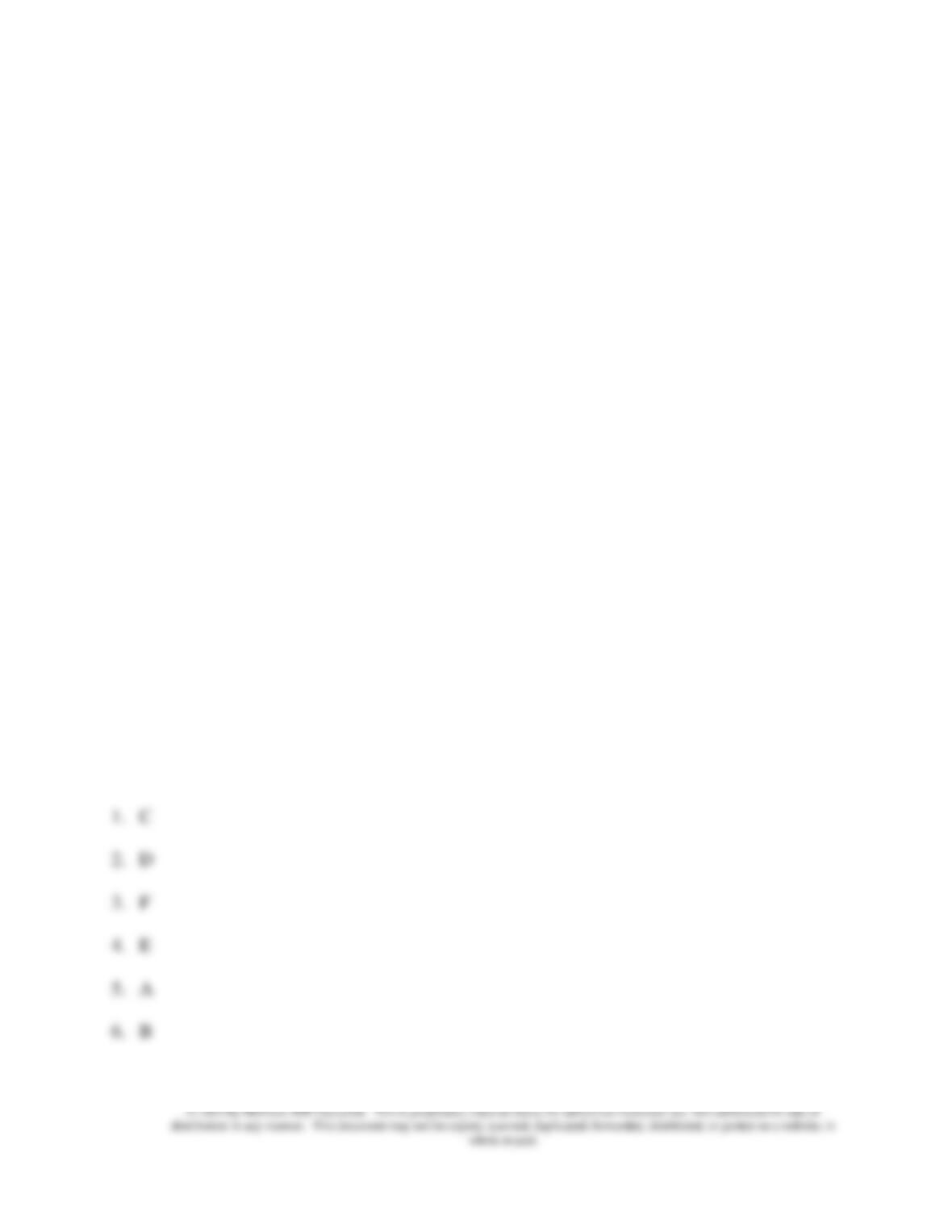
_____ 1. Represents a classification of cost drivers into general levels of activity, volume,
batch, product, etc.
_____ 2. A phenomenon that begins by attempting to increase price to meet higher reported
product costs, losing demand, reporting still higher costs, and so on until the firm is pricing itself
out of business.
_____ 3. An allocation method that uses one cost pool (of indirect costs) for the entire plant.
_____ 4. Uses a separate cost pool for each department.
_____ 5. A two-stage product costing method that first assigns costs to activities and then
allocates them to products based on the each product’s consumption of activities.
_____ 6. Any factor that causes, or “drives,” an activity’s costs.
Answers

Chapter 09 – Activity-Based Costing
9-18
Multiple Choice
1. Death spiral
a. Happens when managers try to set higher prices to recover increasing reported costs.
b. Occurs when capacity is reduced.
c. May happen when the market share is gaining.
d. Has to do with costs other than overhead.
2. In a two-stage cost allocation system,
a. The first stage involves assigning overhead costs to cost pools.
b. The cost pools may be departments.
c. Each cost pool requires an allocation rate.
d. All of the above.
3. One of the cost pools at Toylands Store is the Personnel department that provides recruiting
and training for Sales and Administrative departments and has an estimated overhead of
$45,000. Sales department has 12 employees and Administrative department has 3. How
much of the overhead cost of the Personnel department should be allocated to the Sales
department?
a. $9,000.
b. $22,000.
c. $36,000.
d. $38,000.
The following information is for questions 4 – 7.
The accountant of Toylands Manufacturing collected the following information:
Activity
Overhead costs
Cost driver
Product X1
Product X2
Machining Dept.
Setup
$200,000
Number of setups
200
50
Machining
700,000
Machine hours
20,000
15,000
Packaging Dept.
Assembly
300,000
Direct labor hours
40,000
60,000
Inspection
180,000
Number of inspections
120
60
4. If Toylands Manufacturing uses a plantwide rate based on direct labor hours to allocate
overhead costs, how much is product X1’s share of overhead?
a. $324,000.
b. $416,000.
c. $638,000.
d. $552,000.

Chapter 09 – Activity-Based Costing
9-19
5. If the department allocation method is used, what is the overhead rate for the Machining
department with machine hours as the allocation base?
a. $39.43 per machine hour.
b. $13.71 per machine hour.
c. $20 per machine hour.
d. $25.71 per machine hour.
6. When activity-based costing is used, what is product X2’s share of the Packaging department
overhead costs?
a. $270,000.
b. $240,000.
c. $580,000.
d. $380,000.
7. When activity-based costing is used, how much of the overhead cost is allocated to product
X1?
a. $580,000.
b. $800,000.
c. $950,000.
d. $670,000.
8. Which of the following is true of activity-based costing relative to traditional costing?
a. It requires less detailed cost measures.
b. Accounting department alone can handle all the work.
c. It needs more cost pools.
d. It is less costly to implement.
9. Activity-based costing can be beneficial to
a. Banks.
b. Nonprofit organizations.
c. Law firms
d. All of the above.
10. Low-volume products, relative to high-volume ones,
a. Entail less complexity during production.
b. Often require more machine setups.
c. Will not disrupt the production flow of high-volume items.
d. Are usually overcosted.
11. What are the steps required for activity-based costing in administration?
a. Identify activities that consume resources.
b. Identify cost drivers associated with activities.
c. Compute activity rate per cost driver.
d. All of the above.
Chapter 09 – Activity-Based Costing
9-20
12. Which of the following statements is incorrect?
a. Nowadays, labor is still a major product cost in many companies, especially service
organizations.
b. When the labor component drops, it is prudent to allocate overhead based on direct labor.
c. When the labor component drops, the overhead rate based on direct labor tends to
increase substantially.
d. When all resources are used proportionally, allocation of overhead based on machine
hours is acceptable.
Answers
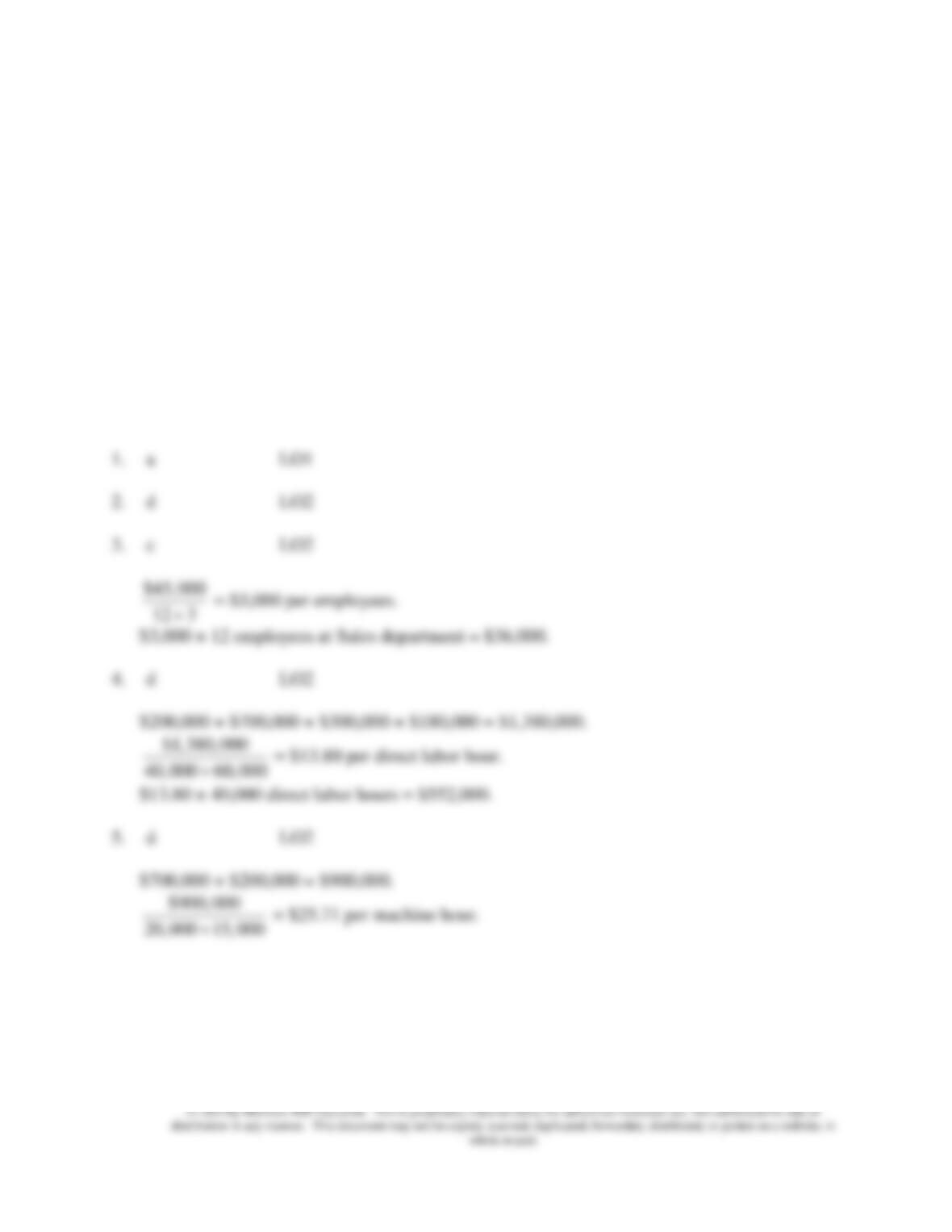
20,000 15,000
Chapter 09 – Activity-Based Costing
9-21
© 2014 by McGraw-Hill Education. This is proprietary material solely for authorized instructor use. Not authorized for sale or
distribution in any manner. This document may not be copied, scanned, duplicated, forwarded, distributed, or posted on a website, in
whole or part.
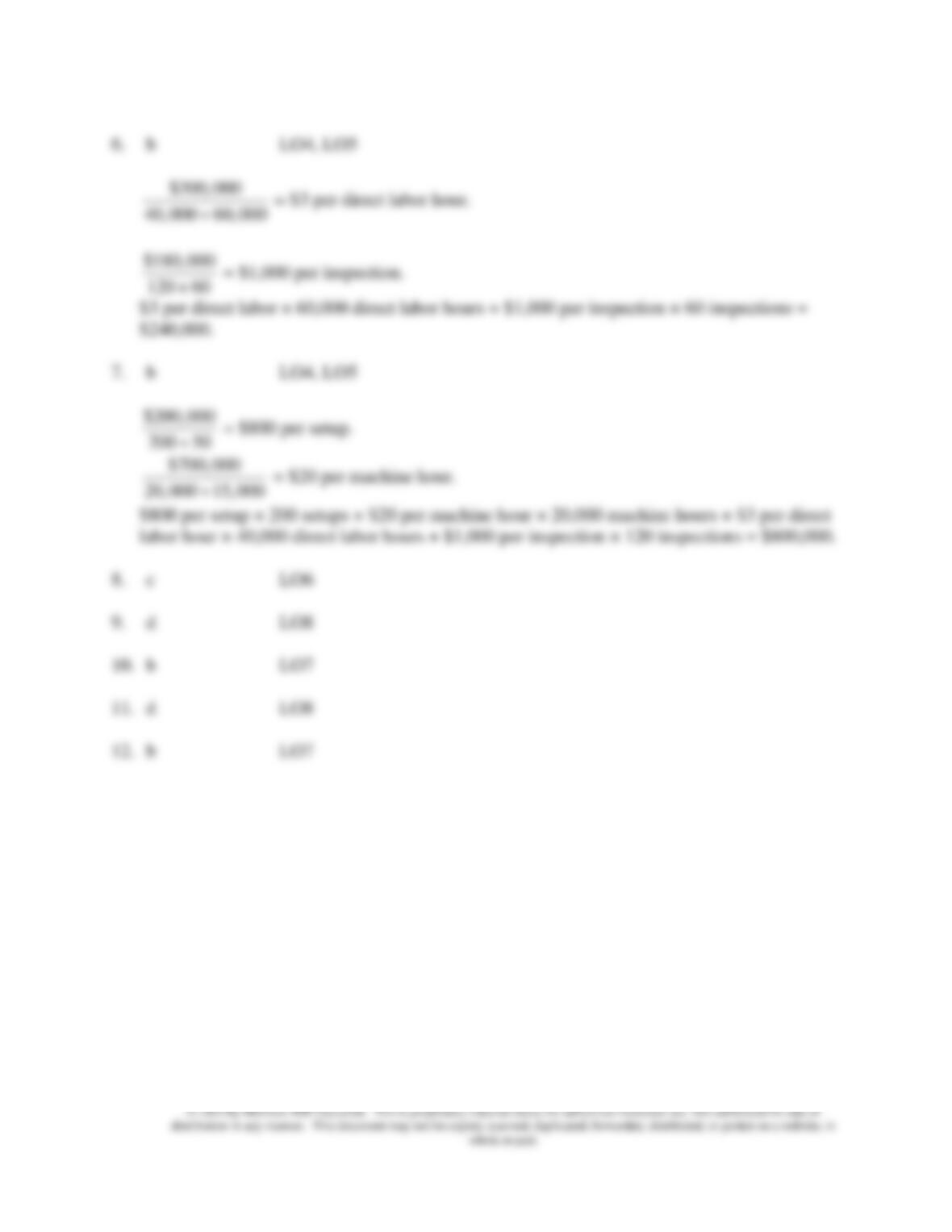
6. b LO4, LO5
$300,000
40,000 60,000
= $3 per direct labor hour.
$180,000
120 60
= $1,000 per inspection.
$3 per direct labor × 60,000 direct labor hours + $1,000 per inspection × 60 inspections =
$240,000.
7. b LO4, LO5
$200,000
200 50
= $800 per setup.
$700,000
20,000 15,000
= $20 per machine hour.
$800 per setup × 200 setups + $20 per machine hour × 20,000 machine hours + $3 per direct
labor hour × 40,000 direct labor hours + $1,000 per inspection × 120 inspections = $800,000.
8. c LO6
9. d LO8
10. b LO7
11. d LO8
12. b LO7