
Chapter 08 – Process Costing
8-18
Mixing
$220,000
$100,000
$120,000
Packaging
75,900
37,500
38,400
Total materials cost
$295,900
$137,500
$158,400
Conversion:
Mixing
$219,000
$75,000
$144,000
Packaging
131,400
45,000
86,400
Total conversion cost
$350,400
$120,000
$230,400
Total product cost
$646,300
$257,500
$388,800
Number of units
2,500
4,800
Cost per unit
$103
$81
The conversion cost is assigned to the two products based on total units. For Mixing
Department, each unit is allocated $30 (=
$219,000
2,500 units + 4,800 units
). Then the conversion
cost for Compound H in the Mixing Department becomes $75,000 (= $30 × 2,500 units) and
the conversion cost for Compound L in the Mixing Department becomes $144,000 (= $30 ×
4,800 units).
For Packaging Department, each unit is allocated $18 (=
$131,400
2,500 units + 4,800 units
) of the
conversion cost. Then the conversion cost for Compound H in the Packaging Department
becomes $45,000 (= $18 × 2,500 units) and the conversion cost for Compound L in the
Packaging Department becomes $86,400 (= $18 × 4,800 units).
======================
♦ In practice, elements of all three production methods (job, process, and operation) and their
corresponding costing methods can easily be found.
• Every company has its own unique costing methods that do not precisely fit any of
these three categories.
• The system that provides managers the best information for the decisions they make
routinely should be chosen.
Matching
A.
Equivalent unit
E.
Prior department costs
B.
FIFO process costing
F.
Production cost report
C.
Operation
G.
Weighted-average process costing
D.
Operation costing

Chapter 08 – Process Costing
8-19
_____ 1. An inventory costing method that combines costs and equivalent units of a period
with the costs and the equivalent units in beginning inventory from the last period.
_____ 2. Summarizes production and cost results for a period.
_____ 3. The manufacturing costs of units transferred out of one department and into a
subsequent department in the manufacturing process.
_____ 4. A hybrid of job and process costing that is used in manufacturing goods that have
some common characteristics and some individual characteristics.
_____ 5. A standardized method of making a product that is repeatedly performed.
_____ 6. An inventory costing method whereby the first goods received are the first ones
charged out when sold or transferred.
_____ 7. The number of complete physical units to which units in inventories are equal in
terms of work done to date.
Answers

Chapter 08 – Process Costing
8-20
Multiple Choice
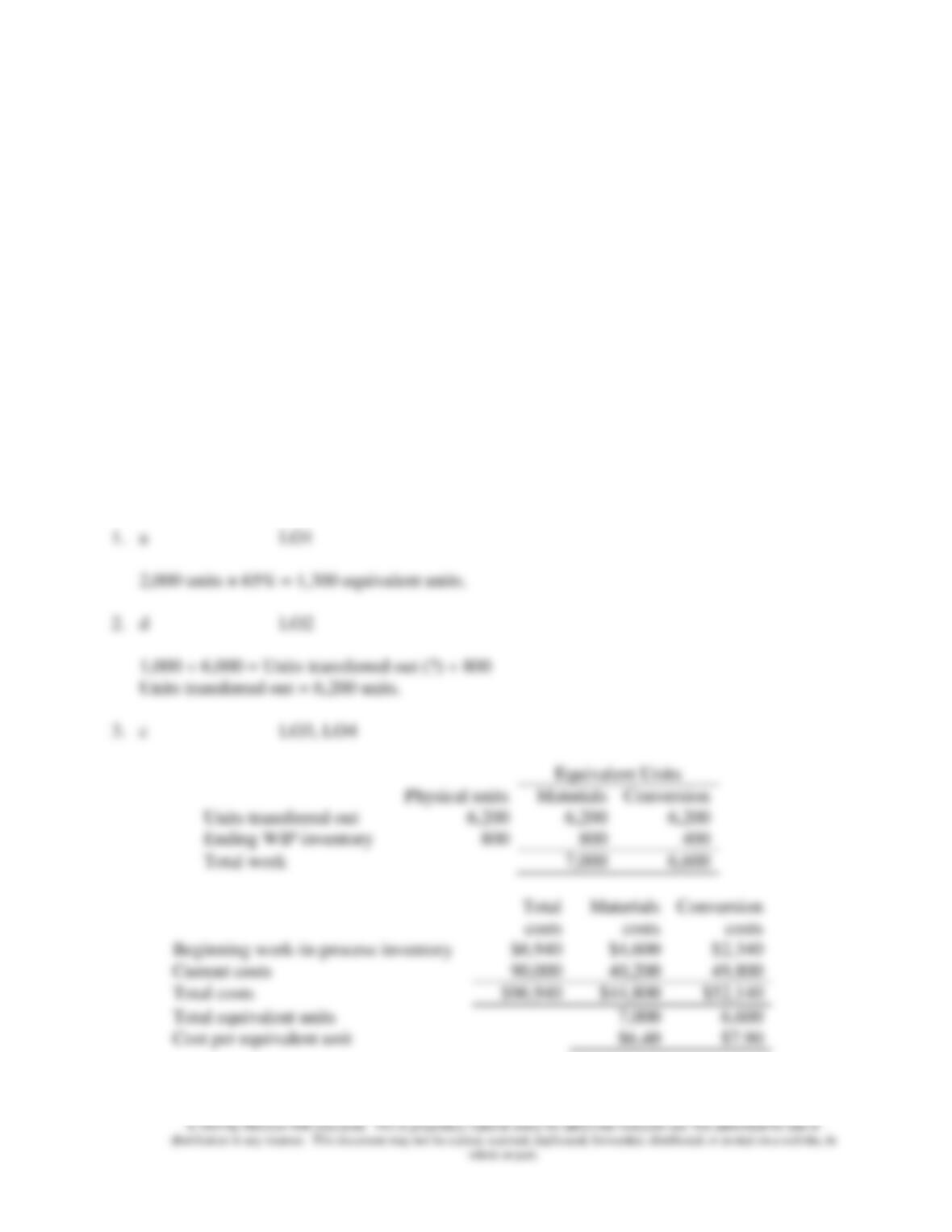
1. There are 2,000 units in the ending work-in-process inventory which are 65 percent complete
with respect to conversion costs. What are the equivalent units of production for the ending
inventory with respect to conversion?
a. 1,300 equivalent units.
b. 1,500 equivalent units.
c. 1,700 equivalent units.
d. 2,100 equivalent units.
The following information is for questions 2 – 7.
At Mixing Department, all materials are added at the beginning of the process. Labor and
overhead (conversion resources) are added evenly throughout the process. The following
information pertains to the Mixing Department for the month of August.
Physical units
Materials
Conversion
Beginning work-in–
process inventory
1,000 units
(60% complete)
$4,600
$2,340
Units started in August
6,000 units
Ending work-in–
process inventory
800 units
(50% complete)
Costs added in August
40,200
49,800
2. How many units were completed and transferred out?
a. 4,100 units.
b. 5,300 units.
c. 5,900 units.
d. 6,200 units.
3. Using the weighted-average method, what is the conversion cost per equivalent unit?
a. $8.50.
b. $8.10.
c. $7.90.
d. $7.50.
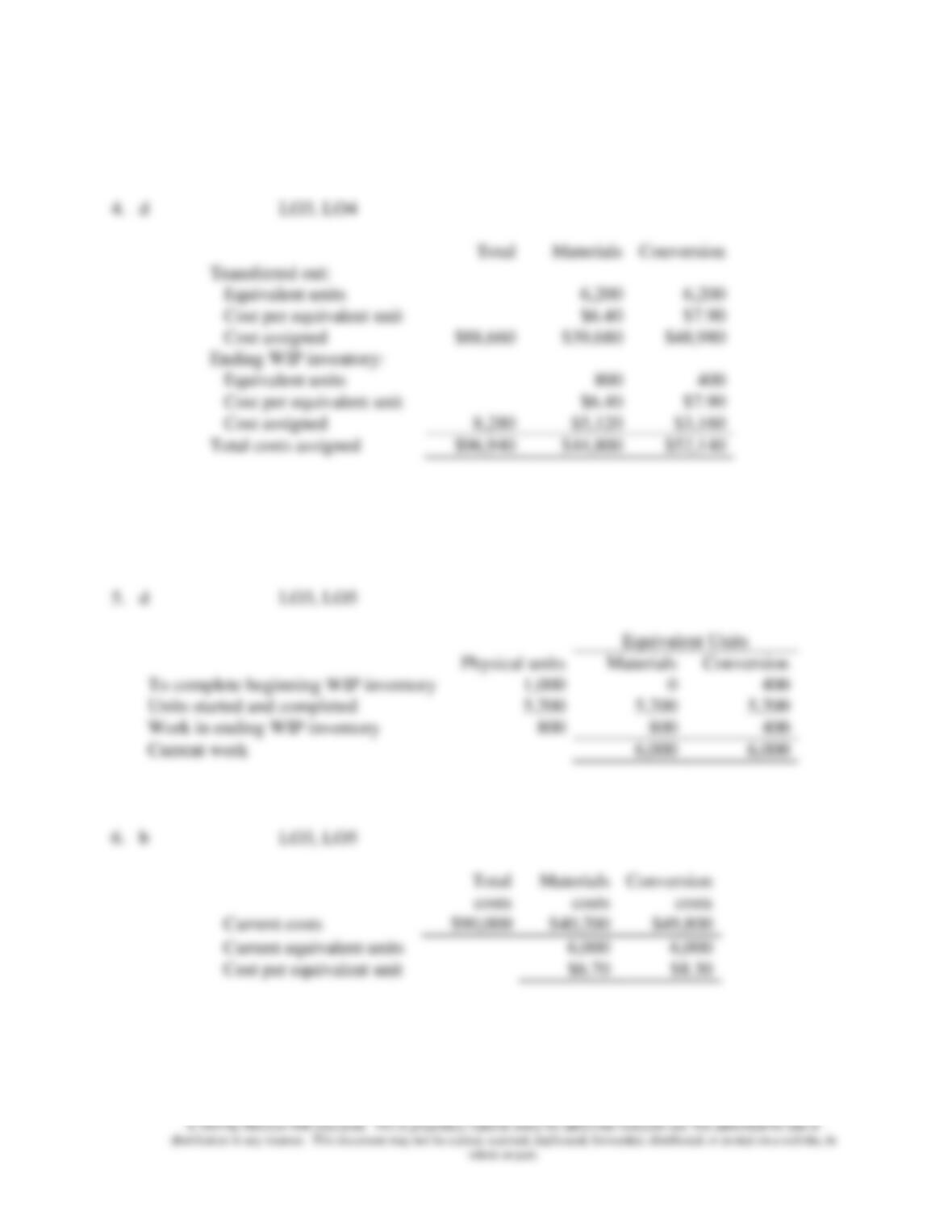
4. Using the weighted-average method, what is the cost assigned to the ending work-in-process
inventory?
a. $5,780.
b. $6,960.
c. $7,640.
d. $8,280.

Chapter 08 – Process Costing
8-21
5. Using the FIFO method, what is the number of equivalent units for conversion?
a. 4,800.
b. 5,400.
c. 5,600.
d. 6,000.
6. Using the FIFO method, what is the conversion cost per equivalent unit?
a. $7.90.
b. $8.30.
c. $8.60.
d. $9.10.
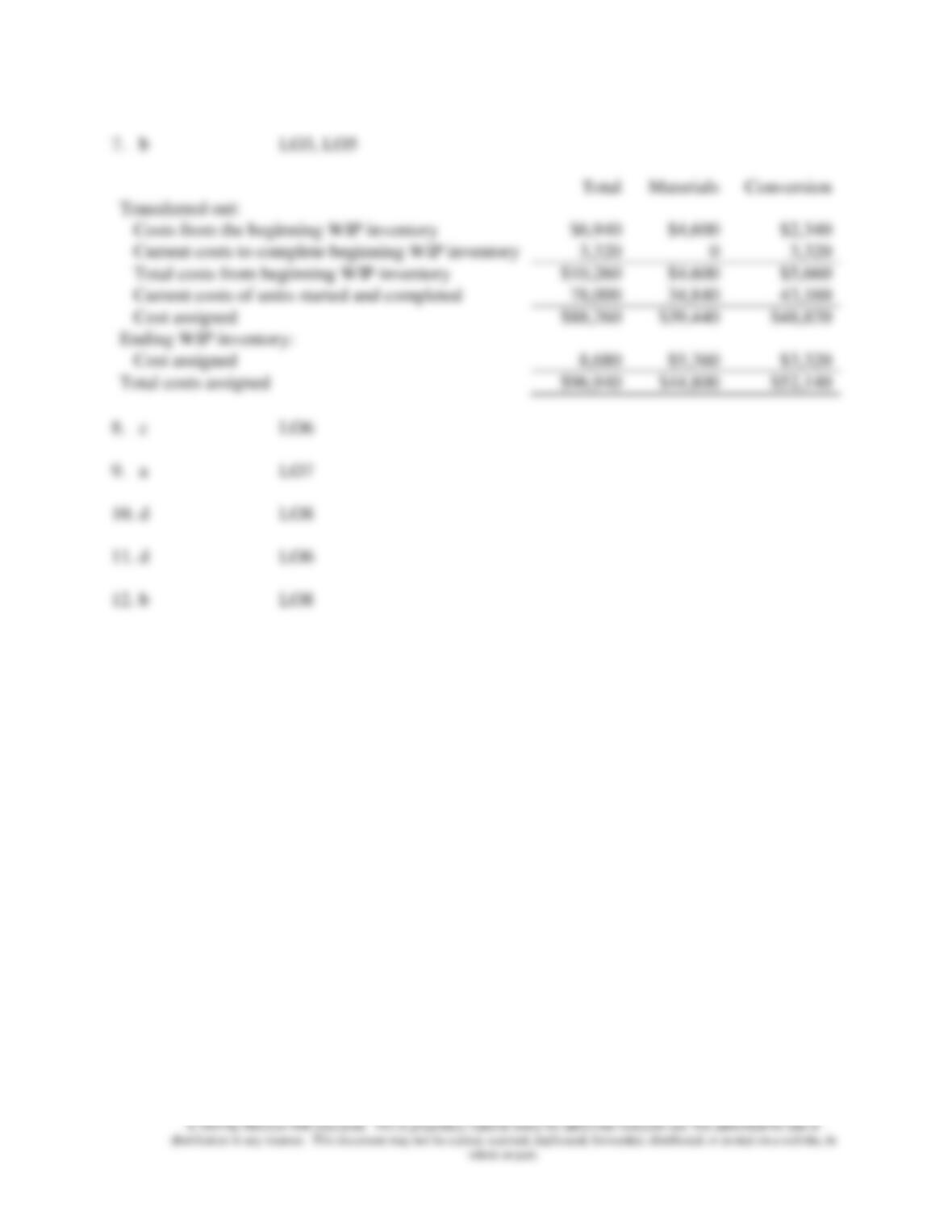
7. Using the FIFO method, what is the cost assigned to the ending work-in-process inventory?
a. $8,280.
b. $8,680.
c. $9,140.
d. $10,260.
8. Which of the following statements is incorrect?
a. Weighted-average costing does not separate beginning inventory from current period
activity.
b. As the product passes from one department to another, its costs must follow.
c. Equivalent whole units in terms of prior department costs cannot be determined.
d. The FIFO method results in unit costs that better reflect current costs.
9. Which of the following statements is correct?
a. Process costing assumes that each unit produced is relatively uniform.
b. Process costing maintains a detailed record of the cost of each unit produced.
c. Process costing provides as much information as job costing.
d. The difference between job costing and process costing is in the basic concepts.
10. Operation costing system
a. Is a hybrid system.
b. Treats materials costs using job order costing method.
c. Treats conversion costs using process costing approach
d. All of the above.
11. Prior department costs
a. Are also called transferred-in costs.
b. Are the manufacturing costs of units transferred from one department to another.
c. Are treated as direct materials added at the beginning of the process.
d. All of the above.
Chapter 08 – Process Costing
12. Which of the following statements is correct?
a. In practice, only one of the production methods can be found.
b. An operation is a standardized method of making a product repeatedly performed.
c. Every company follows a standard costing method mandated by regulators.
d. The system that costs the most should be adopted because it provides the most accurate
information.
Answers
Chapter 08 – Process Costing
8-23
Chapter 08 – Process Costing
8-24