
Chapter 07 – Job Costing
7-11
For underapplied overhead,
Applied manufacturing overhead xx
Work–in-process inventory xx
Finished goods inventory xx
Cost of goods sold xx
Manufacturing overhead control xx
The overhead accounts have no remaining balances after allocation.
(3) Prorating over- or underapplied overhead among individual jobs based on the
cumulative job costs before allocation.
For overapplied overhead,
Applied manufacturing overhead xx
Individual jobs xx
Manufacturing overhead control xx
For underapplied overhead,
Applied manufacturing overhead xx
Individual jobs xx
Manufacturing overhead control xx
♦ Some companies combine the two manufacturing overhead accounts into one account.
Manufacturing overhead costs incurred are debited and manufacturing overhead costs applied are
credited.
• The net debit balance of the single overhead account indicates underapplied overhead,
while the net credit balance indicates overapplied overhead.
• The over– or underapplied overhead will be dealt with using any of the approaches
mentioned earlier.
Manufacturing overhead
Overhead costs incurred
Overhead costs applied
Debit balance
(Underapplied)
Credit balance
(Overapplied)
♦ Three costing methods are available. Depending mainly on how overhead costs are treated,

Chapter 07 – Job Costing
7-12
(1) normal cost is the cost of a job determined by actual direct material and labor costs plus
overhead applied using a predetermined overhead rate and an actual allocation base,
(2) actual cost is the cost of a job determined by actual direct material and labor costs plus
overhead applied using an actual overhead rate and an actual allocation base, and
(3) standard cost is the cost of a job determined by standard (budgeted) direct material and
labor costs plus overhead applied using a predetermined overhead rate and a standard
(budgeted) allocation base.
• When over– and underapplied overhead is allocated using the overhead (or the
allocation base) in the individual accounts, the result approximates actual costing.
• Standard costing will be discussed in more detail in Chapter 16.
• The tradeoffs between actual and normal costing involve the speed, convenience, and
accuracy of the cost information. Actual costing requires management to wait until actual
costs are known but provides more current information. Normal costing is a reasonable
compromise that uses estimates only for indirect costs.
♦ The two-stage cost allocation process introduced in Chapter 6 can easily be applied to the job
costing problems in this chapter in which two or more allocation bases may be used to calculate
the associated predetermined overhead rates, one for each allocation base.
♦ In summary, a job cost is determined in six steps:
1. Select an allocation base for computing the predetermined overhead rate(s).
2. Estimate overhead for each overhead cost pool.
3. Calculate the predetermined overhead rate(s) by dividing the estimated overhead by the
estimated allocation base.
4. Record direct costs for each job as they are incurred.
5. Apply overhead using the predetermined rates as jobs are completed or when the
financial statements are prepared.
6. If there is over- or underapplied overhead, either write it off directly to Cost of goods
sold or allocate it to Cost of goods sold and ending inventory accounts.
======================
Demonstration Problem
Jacob Welding, Inc. specializes in custom steel frames and uses job costing to account for its
operations. The following information is available as of May 1 for the work–in-process inventory
account.

Chapter 07 – Job Costing
7-13
Job#
Direct
materials
Direct
labor
Manufacturing
overhead
Total costs
304
$3,000
$1,800
$2,520
$7,320
306
4,000
2,100
2,940
9,040
Total costs
$7,000
$3,900
$5,460
$16,360
Jacob Welding pays an hourly rate of $15 for direct labor. The manufacturing overhead costs are
applied to jobs based on the direct labor hours used. During the month of May, Jacob Welding
spends $5,800 to purchase materials and $4,650 for manufacturing overhead. The operations in
May are summarized below.
Job#
Material requisition
summary
Time card summary
(Hours)
304
$1,100
40
306
900
30
307
2,800
110
308
750
25
Total
$5,550
205
Jobs 304, 306, and 307 are completed in May but only Jobs 304 and 307 are delivered to
customers.
Required: Determine
1. Calculate the predetermined overhead rate used.
2. Prepare the necessary journal entries for May (assuming any over- or underapplied
manufacturing overhead is written off to Cost of goods sold account monthly).
Solution:
1. Job#304 was charged $1,800 for direct labor cost as of May 1. That translated into 120
direct labor hours worked (i.e., $1,800 ÷ $15 per hour). Since $2,520 of manufacturing
overhead was assigned to Job #304, the predetermined overhead rate used must be $21
per direct labor hour (= $2,520 ÷ 120 direct labor hours). The answer can be confirmed
with information from Job #306 as well.
2. Materials inventory 5,800
Accounts payable 5,800
(Materials purchased)
Work-in-process inventory 5,550
Materials inventory 5,550
(Materials put into production)

Chapter 07 – Job Costing
7-14
Work-in-process inventory 3,075
Wages payable 3,075
(Direct labor incurred)
Manufacturing overhead control 4,650
Accounts payable, etc. 4,650
(Manufacturing overhead incurred)
Work-in-process inventory 4,305
Applied manufacturing overhead 4,305
(Manufacturing overhead applied)
A summary of the job cost sheets for Jacob Welding at the end of May shows the following:
Costs added during May
Job#
BB
Direct
materials
Direct
labor
Manufacturing
overhead
EB
304
$7,320
$1,100
$600
$840
$9,860
306
9,040
900
450
630
11,020
307
–
2,800
1,650
2,310
6,760
308
–
750
375
525
1,650
Total
$16,360
$5,550
$3,075
$4,305
$29,290
Finished goods inventory 27,640
Work-in-process inventory 27,640
(Jobs 304, 306, and 307 completed)
Cost of goods sold 16,620
Finished goods inventory 16,620
(Jobs 304 and 307 delivered to customers)
Applied manufacturing overhead 4,305
Cost of goods sold 345
Manufacturing overhead control 4,650
(Underapplied manufacturing overhead written off to Cost of goods sold)
======================
LO 7-4 Apply job costing methods in service organizations.
♦ Job costing procedure is similar for both manufacturing and service organizations.

Chapter 07 – Job Costing
7-15
• Job costing provides management the information necessary to assess job profitability
and to use historical cost data to estimate costs for bidding purposes.
• Job costing allows a service firm to assess customer profitability because the cost object
(each job) is often the customer.
• Exhibit 7.8 shows cost flows through T-accounts for a service organization.
• The three major differences between manufacturing and service organizations are:
(1) Service organizations generally use less direct materials than manufacturing.
(2) Service companies’ overhead accounts have slightly different names (Service
overhead control, Applied service overhead, etc.).
(3) Service companies’ finished goods (or services) are charged to Cost of services billed
account rather than to Cost of goods sold.
LO 7-5 Understand the ethical issues in job costing.
♦ Improprieties in job costing generally are caused by one or more of the following actions:
misstating the stage of completion, charging costs to the wrong jobs or categories, or simply
misrepresenting the costs of jobs.
• Job supervisors who report the stage of completion of their jobs may have a tendency to
overstate it.
• When costs are charged to wrong jobs, managers who rely on accurate cost information
for pricing, control, and other decisions will be misled. It also cheats people who are
paying for a job on a cost-plus basis. The In-Action box provides information about cost
allocation and government contract practices.
• Costs can be misrepresented by choosing the method to allocate overhead costs to
obtain a favorable result rather than how overhead resources are really used.
• The practice is unethical and could be illegal.
LO 7-6 Describe the difference between jobs and projects.
♦ A project is a complex job that often takes months or years to complete and requires the work
of many different departments, divisions, or subcontractors.
• Relative to jobs, projects are more difficult to evaluate.

Chapter 07 – Job Costing
7-16
• To evaluate a project, the contractor must establish a budget of costs to be incurred
throughout the project at various stages of completion (in percentages).
• As the project progresses, the contractor evaluates two critical areas:
(1) budgeted versus actual cost of work performed to date, and
(2) budgeted versus actual percentage of completion.
• The two graphs in Exhibit 7.10 are simple examples of how the evaluation of costs and
schedule can be performed.
• The complex nature of projects requires that budgeted costs and budgeted stages of
completion be revised at certain intervals throughout the project to reflect potential
changes. This allows managers to be evaluated by comparing actual results against the
revised budget.
Matching
A.
Actual cost
F.
Normal cost
B.
Control account
G.
Overapplied overhead
C.
Job
H.
Project
D.
Job cost sheet
I.
Standard cost
E.
Job shop
J.
Subsidiary ledger account
K.
Underapplied overhead
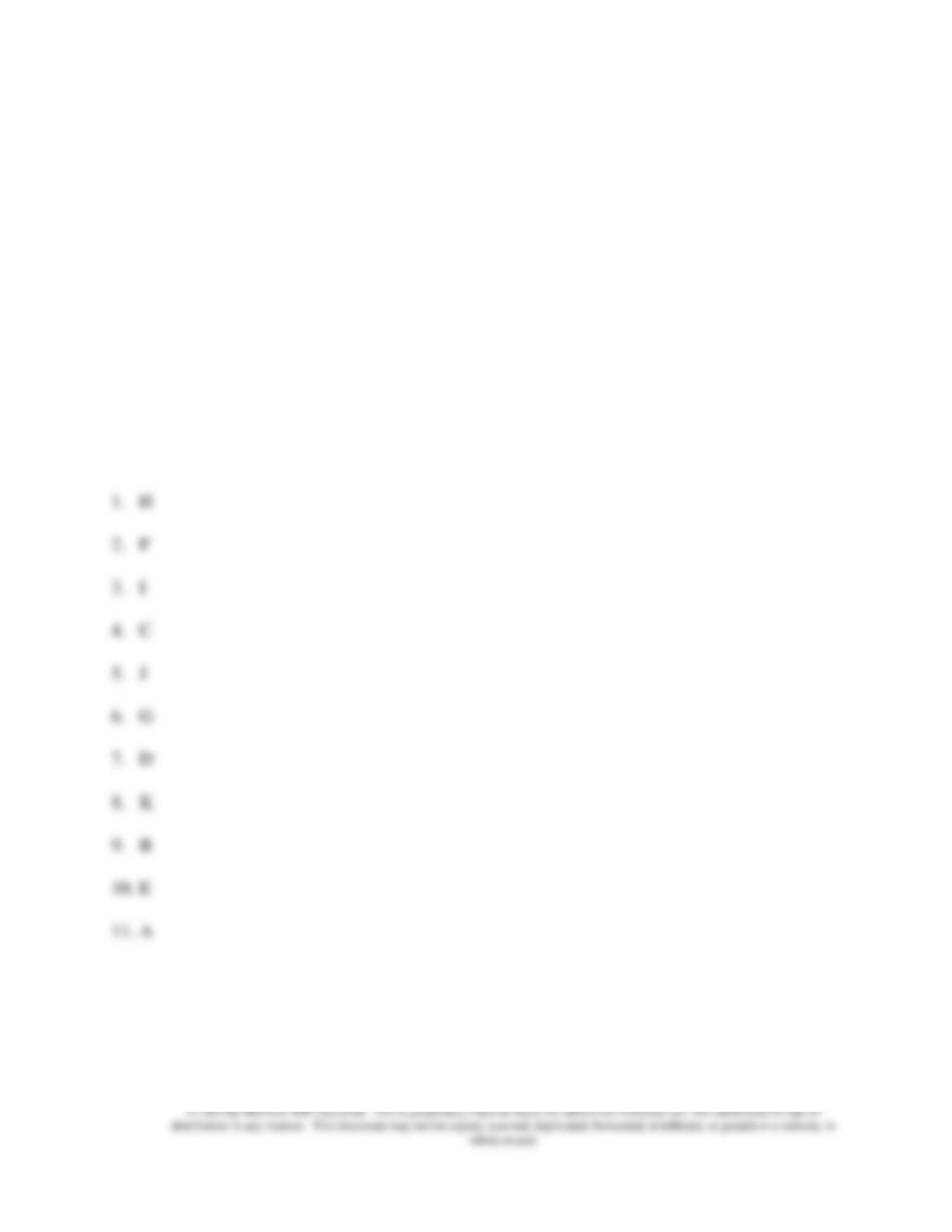
_____ 1. A complex job that often takes months or years to complete and requires the work of
many different departments, divisions, or subcontractors.
_____ 2. The cost of a job determined by actual direct material and labor costs plus overhead
applied using a predetermined overhead rate and an actual allocation base.
_____ 3. The cost of a job determined by standard (budgeted) direct material and labor costs
plus overhead applied using a predetermined overhead rate and a standard (budgeted)
allocation base.
_____ 4. A cost object (product, service, customer, etc.) that can be distinguished easily from
others and for which a cost is desired.
_____ 5. Records financial transactions for a specific customer, vendor, or job.
_____ 6. The actual overhead costs incurred are less than the applied overhead costs.
Chapter 07 – Job Costing
7-17
_____ 7. Records the costs for the individual jobs along with some additional information.
_____ 8. The actual overhead costs incurred are in excess of the applied overhead costs.
_____ 9. An account in the general ledger that summarizes a set of subsidiary ledger accounts.
_____ 10. A firm that produces jobs.
_____ 11. The cost of a job determined by actual direct material and labor costs plus overhead
applied using an actual overhead rate and an actual allocation base.
Answers

Chapter 07 – Job Costing
7-18
Multiple Choice
1. Which of the following is NOT a job?
a. An audit engagement.
b. A home renovation.
c. A fast food order.
d. A lawsuit.
2. Which of the following statements is correct?
a. Each job is recorded in a job cost sheet.
b. Job shop is a firm that produces jobs.
c. Work-in-process inventory is a control account.
d. All of the above.
The following information is for questions 3 – 4.
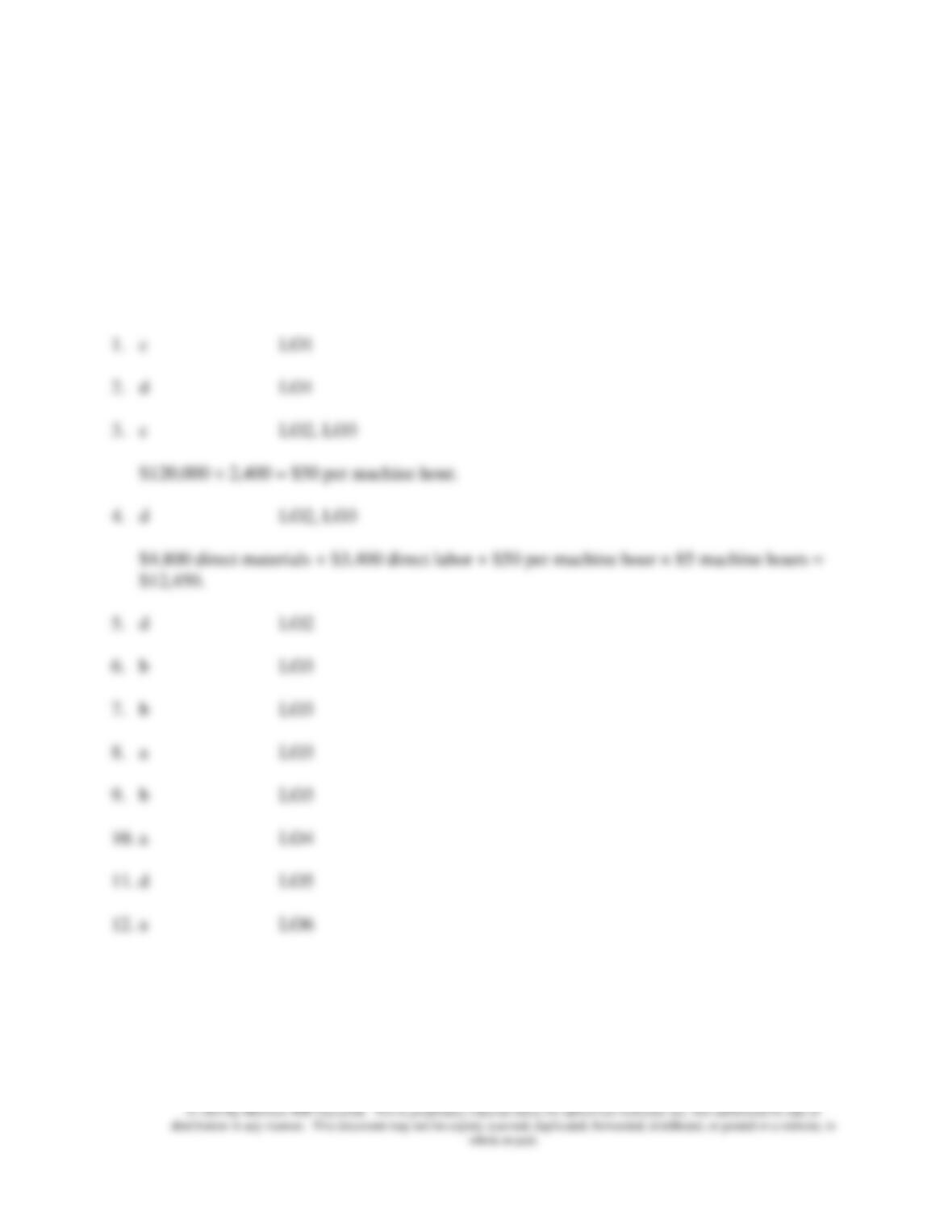
KC Manufacturing uses job costing. Its annual estimated manufacturing overhead and machine
hours (the allocation base) were $120,000 and 2,400 hours, respectively. Job #06-07 was
completed in July and incurred direct materials $4,800, direct labor $3,400, and 85 machine
hours.
3. What is the predetermined overhead rate for KC Manufacturing?
a. $35 per direct labor hour.
b. $45 per direct labor dollar.
c. $50 per machine hour.
d. Can not be determined.
4. What’s the total cost for Job #06-07?
a. $9,350
b. $24,750
c. $22,050
d. $12,450
5. When a completed job is delivered to the customer, the journal entry that should be made is
a. Finished goods inventory
Direct materials
Direct labor
Manufacturing overhead
b. Work-in-process inventory
Direct materials
Direct labor

Chapter 07 – Job Costing
7-19
Manufacturing overhead
c. Finished goods inventory
Work-in-process inventory
d. Cost of goods sold
Finished goods inventory
6. The predetermined overhead rate is
a. Not calculated until actual overhead costs are available.
b. Calculated at the beginning of the year.
c. Calculated at the end of the year.
d. Used to determine the amount of manufacturing overhead incurred.
7. Applied overhead is recorded with a
a. Debit to Manufacturing overhead.
b. Credit to Manufacturing overhead.
c. Credit to Work-in-process inventory.
d. Debit to Finished goods inventory.
8. The underapplied overhead
a. Is evidenced by a debit balance in the Manufacturing overhead account.
b. Can be written off to Finished goods inventory.
c. Can be prorated between Cost of goods sold and Work-in-process inventory
d. Shows that overhead incurred is less than overhead applied.
9. Which of the following statements is correct?
a. Actual cost is composed of actual direct costs plus overhead applied using a
predetermined overhead rate.
b. Normal cost is composed of actual direct costs plus overhead applied based on the actual
allocation base.
c. Standard cost is composed of standard direct costs plus overhead applied based on the
actual allocation base.
d. There is no tradeoff between different costing methods.
10. For a service organization that uses a job costing system,
a. Generally less direct materials are used than manufacturing companies.
b. Overhead accounts carry the same names as those of manufacturing companies.
c. Cost of goods sold account is commonly used.
d. The job costing procedure differs a lot from that used in manufacturing companies.
11. Which of the following represents improprieties in job costing?
a. Misstate the stage of completion.
b. Charge costs to the wrong jobs or categories.
c. Misrepresent the costs of jobs.
d. All of the above.
Chapter 07 – Job Costing
7-20
12. Projects are
a. Complex jobs.
b. Easier to evaluate, relative to jobs.
c. Devoid of budgeting requirements.
d. Less time consuming, relative to jobs.
Answers