Chapter 04 – Fundamentals of Cost Analysis for Decision Making
that opportunity costs should be ignored. Exhibit 4.6 extends the case to consider the
opportunity cost of alternative facility use.
======================
Demonstration Problem 2
Cube Manufacturing usually produces its own parts for assembly. The following monthly data
are available for one of the parts, Part A31:
Manufacturing costs
Variable per unit
$6
Fixed costs
15,000
Nonmanufacturing costs
Variable per unit
$1
Fixed costs
9,000
Cube needs 2,000 units of Part A31 every month. An outside supplier offers to deliver that part
for $11.5 each. By accepting the offer, Cube can save half of the fixed manufacturing costs and
all variable costs, but the fixed nonmanufacturing costs are not affected.
Required:
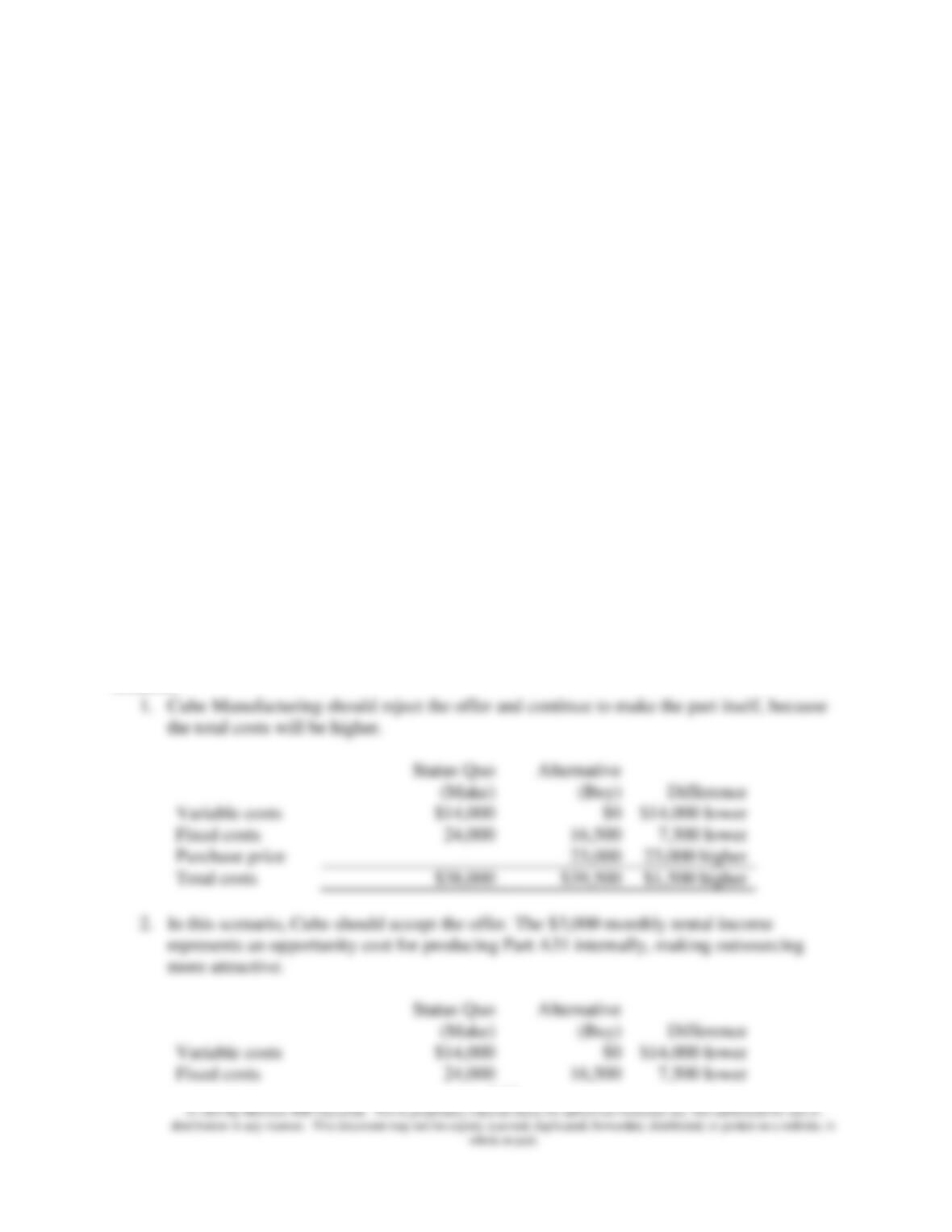
1. Should Cube Manufacturing accept the offer and outsource Part A31?
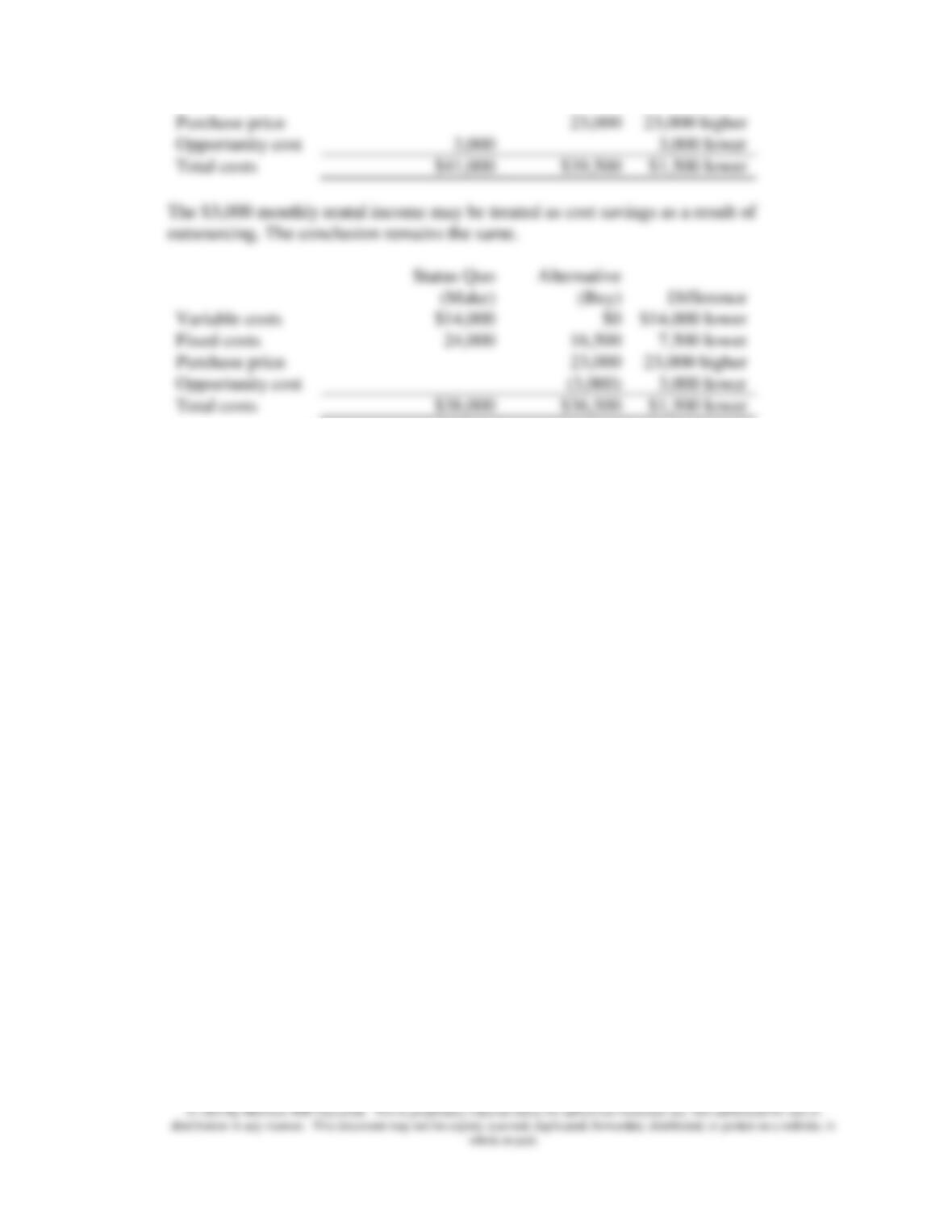
2. If the facility used to produce Part A31 can be leased out to generate a monthly rental
income of $3,000, what should Cube Manufacturing do?
Solution:
Variable costs
$14,000 lower
Fixed costs
Purchase price
Total costs
Variable costs
Chapter 04 – Fundamentals of Cost Analysis for Decision Making
4-12
Purchase price
23,000
23,000 higher
Opportunity cost
3,000
3,000 lower
Total costs
$41,000
$39,500
$1,500 lower
The $3,000 monthly rental income may be treated as cost savings as a result of
outsourcing. The conclusion remains the same.
Status Quo
(Make)
Alternative
(Buy)
Difference
Variable costs
$14,000
$0
$14,000 lower
Fixed costs
24,000
16,500
7,500 lower
Purchase price
23,000
23,000 higher
Opportunity cost
(3,000)
3,000 lower
Total costs
$38,000
$36,500
$1,500 lower
======================
♦ Unprofitable product lines and noncompetitive business units may be subjected to increased
scrutiny. Managers have to decide whether to keep or drop them.
• Financial statements prepared in accordance with generally accepted accounting
principles do not routinely provide differential cost information. Differential cost
estimates depend on unique information that usually requires separate analysis.
• In deciding whether to eliminate a product line or a business unit, the differential
analysis should look at the CVP income statement with the emphases on the contribution
margin made by the division under consideration and on the disposition of that division’s
fixed costs.
• The divisional profits reported in income statement (see Exhibit 4.7) can be misleading
because all costs, not just differential ones, are present. Differential cost estimates depend
on unique information that usually requires separate analysis (see Exhibit 4.8).
• Other considerations include the potential opportunity costs of keeping the product lines
(such as the alternative use of the shelf space), the impacts on related products or units
which will stay, and nonfinancial factors such as the potential impacts on employees and
communities.
======================
Demonstration Problem 3
Cube Manufacturing produces three different products: Platinum, Gold, and Silver. The financial
statement from last quarter is shown below.
Chapter 04 – Fundamentals of Cost Analysis for Decision Making
Platinum
Gold
Silver
Total
Sales
$500,000
$400,000
$200,000
$1,100,000
Variable costs
(350,000)
(300,000)
(160,000)
(810,000)
Contribution margin
$150,000
$100,000
$40,000
$290,000
Fixed costs
(80,000)
(60,000)
(50,000)
(190,000)
Operating profit (loss)
$70,000
$40,000
$(10,000)
$100,000
The general manager is thinking of eliminating the Silver product line to improve the financial
results. The cost accountant cautions that the fixed costs allocated to Silver have to be absorbed
by the remaining two products if the decision is finalized.
Required:
What should the general manager of Cube Manufacturing do? Please explain.
Solution:
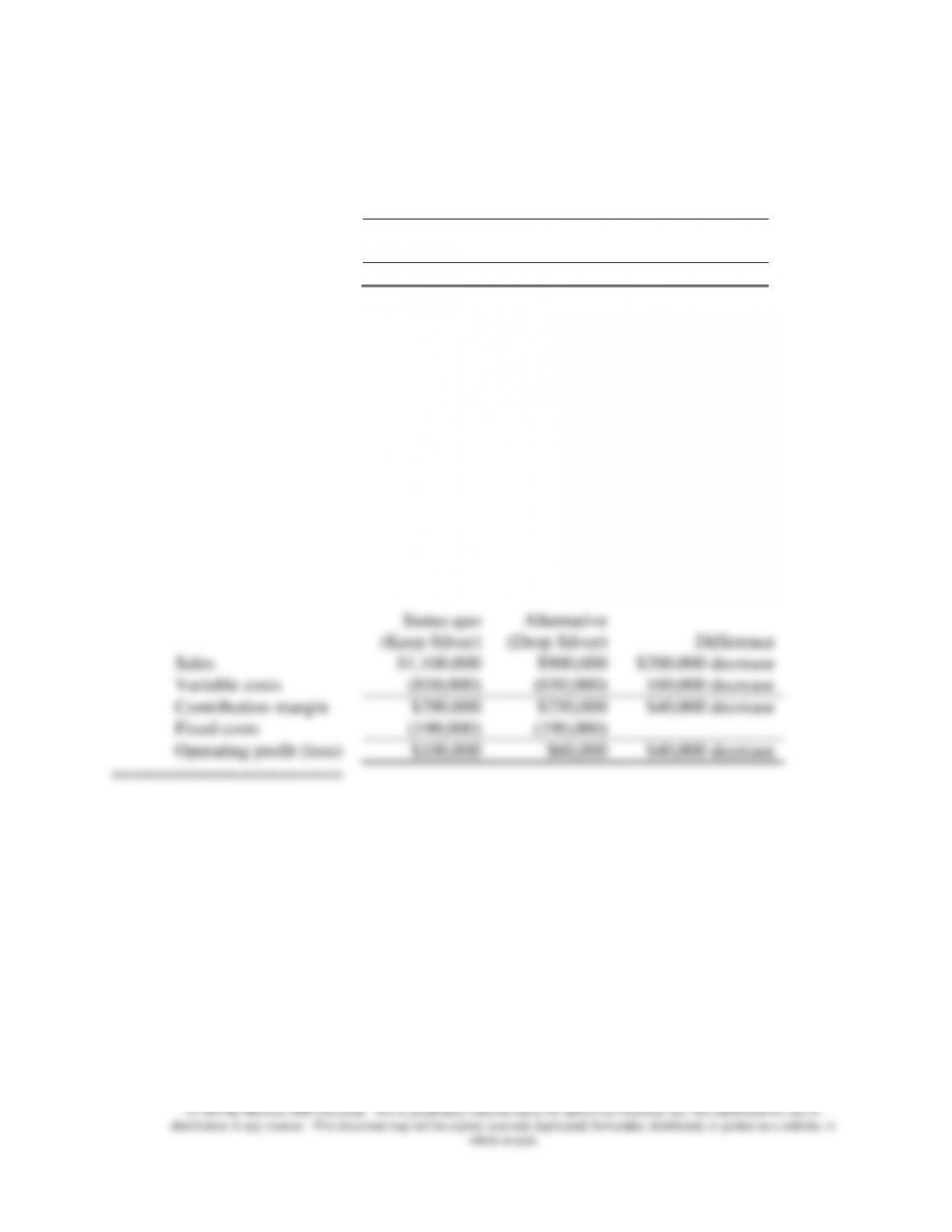
The general manager should keep the Silver product line. If Silver is dropped, the total fixed
costs of $190,000 remain the same while the contribution margin from Silver will be lost,
resulting a net loss of $40,000 for the company as a whole.
Sales
Variable costs
(810,000)
(650,000)
160,000 decrease
Contribution margin
$40,000 decrease
Fixed costs
(190,000)
(190,000)
Operating profit (loss)
$40,000 decrease

Chapter 04 – Fundamentals of Cost Analysis for Decision Making
4-14
• Microsoft Excel’s Solver function can be used to find the optimal product mix when
there are constraining resources.
LO 4-5 Understand the theory of constraints.
♦ Theory of constraints (TOC) focuses on revenue and cost management when faced with
bottlenecks, defined as operations where the work required limits production.
• Dependencies among multiple parts and processes to produce goods give rise to
bottlenecks as the constraining resources.
• Maximizing the output of the constrained resources is the best route to increased
marginal revenues.
• The three components in the theory of constraints are
(1) throughput contribution: sales dollars minus direct materials costs and other
variable costs such as energy and piecework labor,
(2) investments: inventories, equipment, buildings, and other assets used to generate
throughput contribution, and
(3) other operating costs: all operating costs other than direct materials and other variable
costs incurred to earn throughput contribution, including most salaries and wages,
rent, utilities, and depreciation.
• The theory of constraints assumes a short-run time horizon and considers only materials,
purchased parts, piecework labor, and energy to run machines to be variable; everything
else is assumed fixed and will be expensed in the period in which they are incurred.
• The objective of the theory of constraints is to maximize throughput contribution while
minimizing investments and other operating costs, therefore maximizing the contribution
margin per unit of the constraining resource.
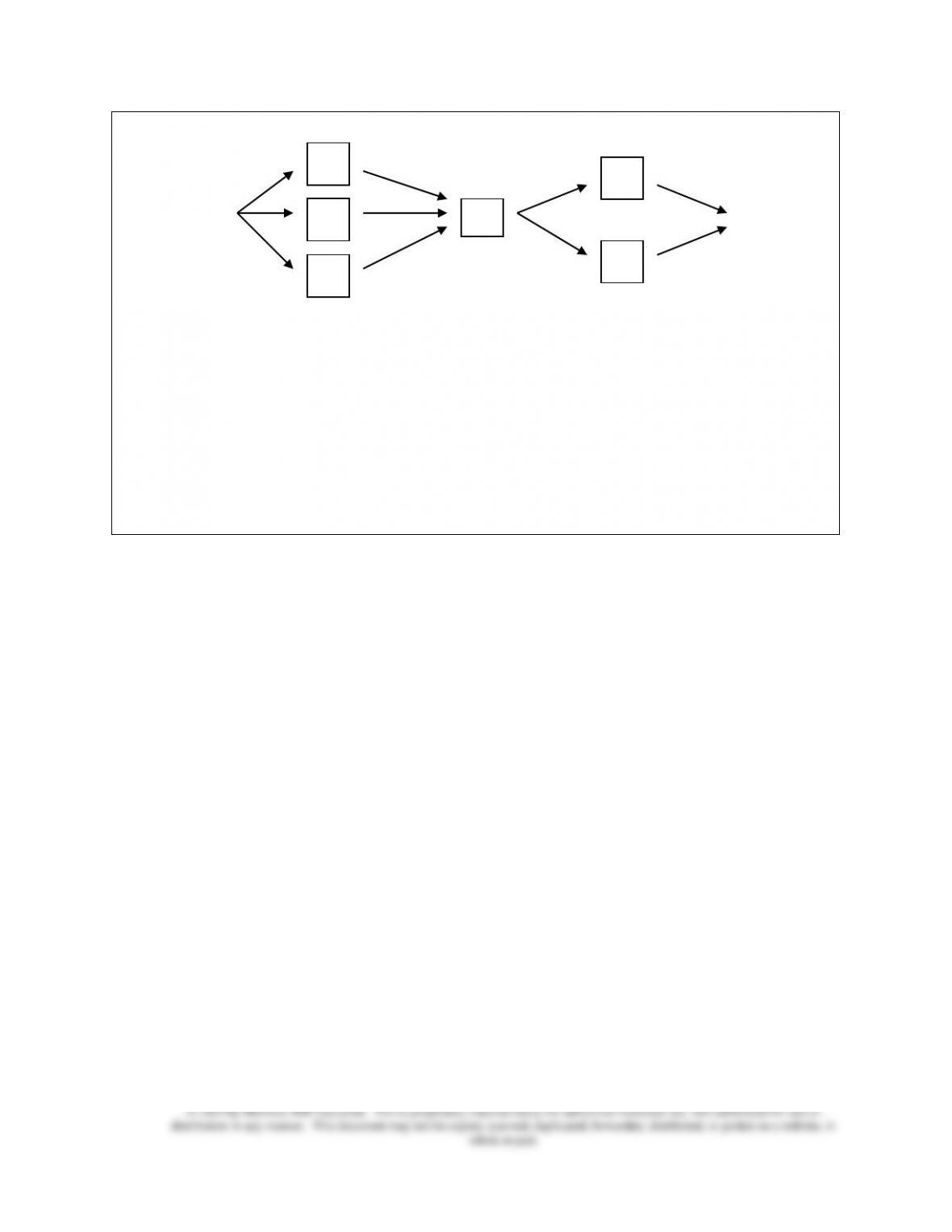
Example 3: The following illustrates the manufacturing process in a factory. Every unit
of the finished product has to go through three departments as identified by the
machines used, A, B, and C. There are three “A” machines (capacity: 1,200 units each
per hour), one “B” machine (capacity: 3,000 units per hour), and two “C” machines
(capacity: 1,600 units each per hour).
Chapter 04 – Fundamentals of Cost Analysis for Decision Making
4-15
Raw Finished
Materials Goods
When “A” machines are utilized at full capacity, their output results in inventory
buildup in front of “B” machine because its capacity can not keep pace. “B” machine is
identified as the bottleneck of the whole operation.
The full-capacity output from “B” machine can be handled with ease by the
downstream “C” machines. Theory of constraints dictates maximizing the output from
“B” machine while subordinating the other two departments to the pace of “B”
machine in order to optimize the operations.
Matching
A.
Bottleneck
G.
Price discrimination
B.
Differential analysis
H.
Product life cycle
C.
Full cost
I.
Special order
D.
Dumping
J.
Sunk cost
E.
Make-or-buy decision
K.
Target price
F.
Peak-load pricing
L.
Throughput contribution
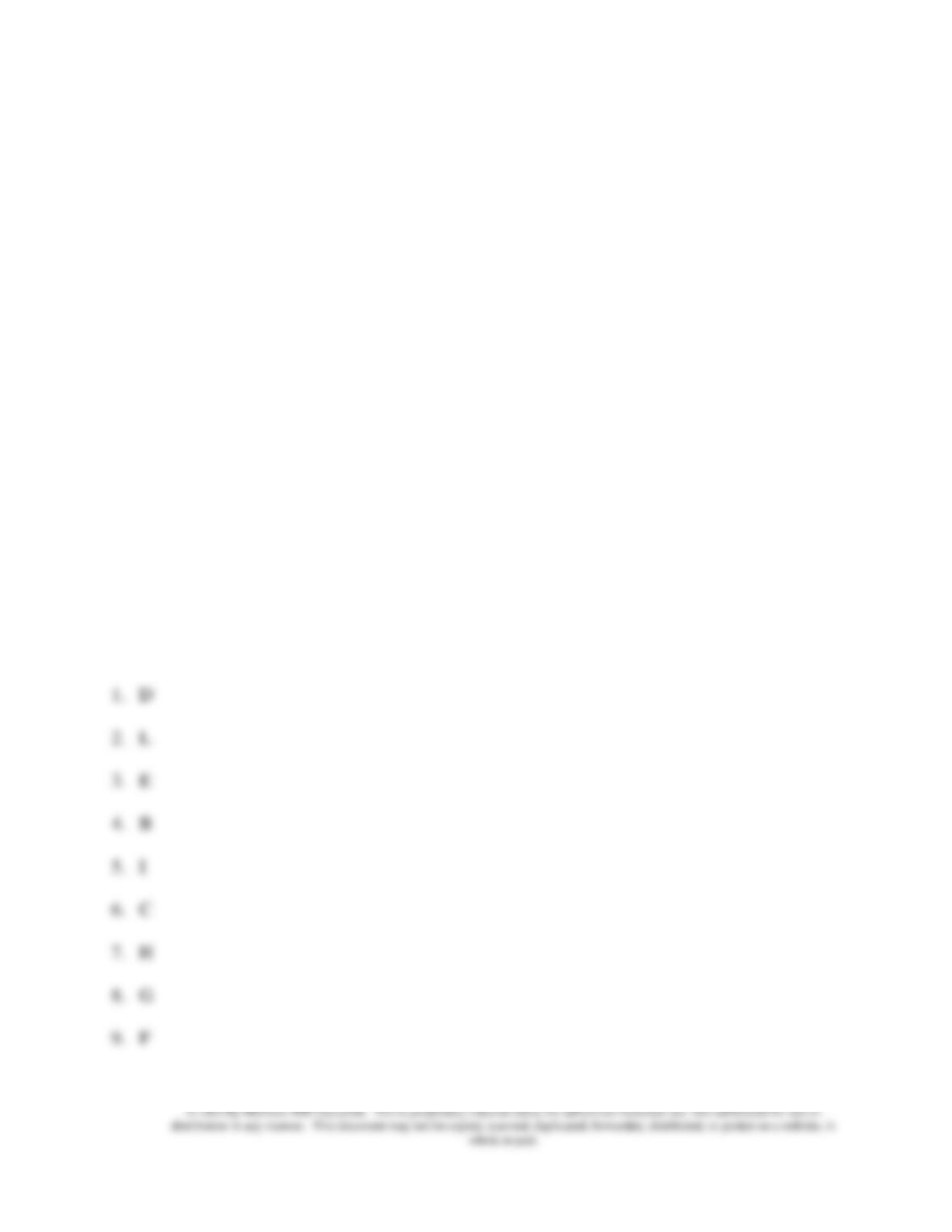
_____ 1. Occurs when a company exports its product to consumers in another country at an
export price below its domestic price.
_____ 2. Sales dollars minus direct materials costs and other variable costs such as energy and
piecework labor.
_____ 3. Involves any decision concerning whether to make the needed goods internally or
purchase them from outside sources.
_____ 4. Refers to the process of estimating revenues and costs of alternative actions available
to decision makers and of comparing these estimates to the status quo.
A
A
A
B
C
C
1,200 units each
3,000 units
1,600 units each
Chapter 04 – Fundamentals of Cost Analysis for Decision Making
4-16
_____ 5. Represents an order that will not affect other sales and is usually a short-run
occurrence.
_____ 6. The sum of the fixed and variable costs of manufacturing and selling a unit.
_____ 7. Covers the time from initial research and development to the time at which support to
the customer ends.
_____ 8. The practice of selling identical goods or services to different customers at different
prices.
_____ 9. The practice of setting prices highest when the quantity demanded for the product
approaches the physical capacity to produce it (and lower at other times).
_____ 10. Operations where the work required limits production.
_____ 11. The price based on customers’ perceived value for the product and the price that
competitors charge.
_____ 12. Costs incurred in the past that cannot be changed by present or future decisions.
Answers

Chapter 04 – Fundamentals of Cost Analysis for Decision Making
4-17
© 2014 by McGraw-Hill Education. This is proprietary material solely for authorized instructor use. Not authorized for sale or
distribution in any manner. This document may not be copied, scanned, duplicated, forwarded, distributed, or posted on a website, in
whole or part.
10. A
11. K
12. J
Multiple Choice
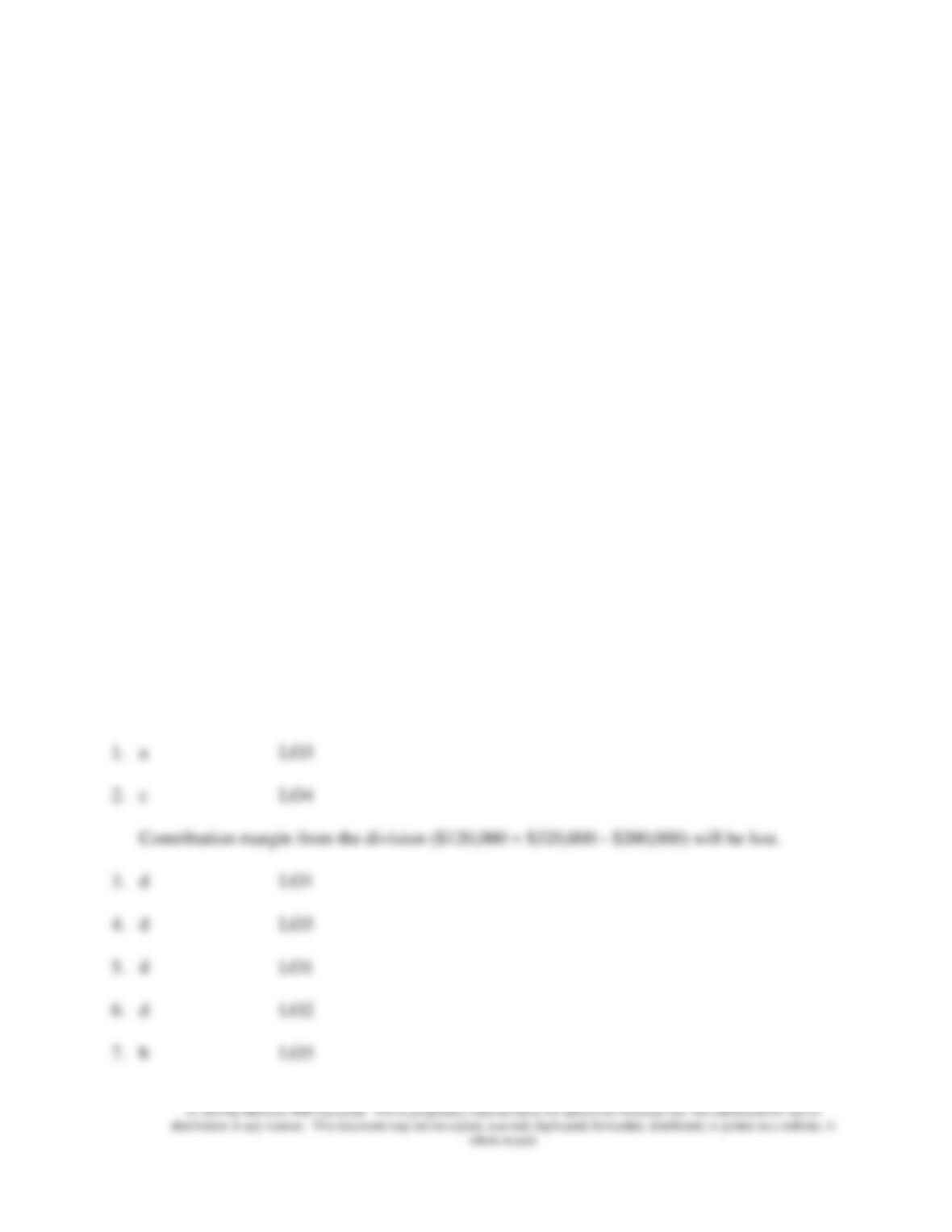
1. Which of the following statements is correct?
a. Life-cycle costing tracking costs from start to finish.
b. Product life cycle ends when the product is delivered to customers.
c. Product price must be set to cover the costs of manufacturing activities only.
d. “Take–back” requirement for product recycle and disposal is customers’ responsibility.
2. A division has the following data: Sales $320,000, Variable costs $200,000, and Fixed costs
$140,000. If the division were eliminated, the fixed costs would be allocated to other
divisions. What will be the net impact on the company’s overall profit?
a. $20,000 increase.
b. $60,000 decrease.
c. $120,000 decrease.
d. Can not be determined from the data provided
3. Two alternative projects are under consideration:
Project A
Project B
Revenues
$360,000
280,000
Variable costs
210,000
180,000
Fixed costs
90,000
90,000
Which of the following are relevant in choosing between the projects?
a. Revenues.
b. Variable costs.
c. Fixed costs.
d. Both a and b.
4. Which of the following statements is correct?
a. Predatory pricing is illegal.
b. Dumping hurts consumers in the long run.
c. Price discrimination requires market segmentation.
d. All of the above.

Chapter 04 – Fundamentals of Cost Analysis for Decision Making
4-18
5. For differential analysis,
a. Differential costs are relevant costs.
b. No fixed costs are differential.
c. Most variable costs are differential.
d. Both a and c.
6. Full cost is
a. The sum of variable and fixed cost per unit.
b. Always relevant for short-run decisions.
c. Useful for long-run pricing decisions.
d. Both a and c.
7. In a competitive market where firms are price takers,
a. Each firm can set its own prices.
b. Target pricing is appropriate.
c. Target cost must be achieved in the short run.
d. Cost-based pricing should be adopted.
The following information is for questions 8 – 9.
Company B is considering whether to outsource Part#375 needed to produce finished products.
If manufactured internally, it will cost direct materials $2 per unit, direct labor $1.20 per unit,
variable overhead $1.50 per unit, and fixed overhead $18,000. An outside supplier is available to
provide between 5,000 and 50,000 units of Part#375 at $6.20 per unit.
8. At what volume will Company B become indifferent to the make-or-buy choice?
a. 8,000 units.
b. 12,000 units.
c. 20,000 units.
d. 31,000 units.
9. If Company B needs 8,000 units of Part#375, and outsourcing saves only 25% of the fixed
overhead, then Company B’s make-or-buy decision and cost advantage are
a. Make, $7,500.
b. Make, $6,000.
c. Buy, $2,000.
d. Buy, $4,000.
10. Theory of constraints (TOC)
a. Applies to long-run cost management.
b. Is concerned with improving bottleneck operations.
c. Tries to minimize throughput contribution.
d. Considers most salaries and wages, rent, utilities and depreciation to be variable costs.
Chapter 04 – Fundamentals of Cost Analysis for Decision Making
4-19
11. A company currently manufactures a subassembly for its main product. The unit costs for the
subassembly are:
Prime costs $25, Variable overhead $10, and Fixed overhead $8.
The fixed overhead is an allocated amount shared by other operations. What is the relevant
cost of the subassembly?
a. $25.
b. $35.
c. $43.
d. $33.
12. Differential analysis is suitable for the following situations except
a. Make-or-buy decisions.
b. Whether to close a business unit.
c. Cost behavior analysis.
d. Product mix decisions.
Answers
Chapter 04 – Fundamentals of Cost Analysis for Decision Making
4-20
© 2014 by McGraw-Hill Education. This is proprietary material solely for authorized instructor use. Not authorized for sale or
distribution in any manner. This document may not be copied, scanned, duplicated, forwarded, distributed, or posted on a website, in
whole or part.
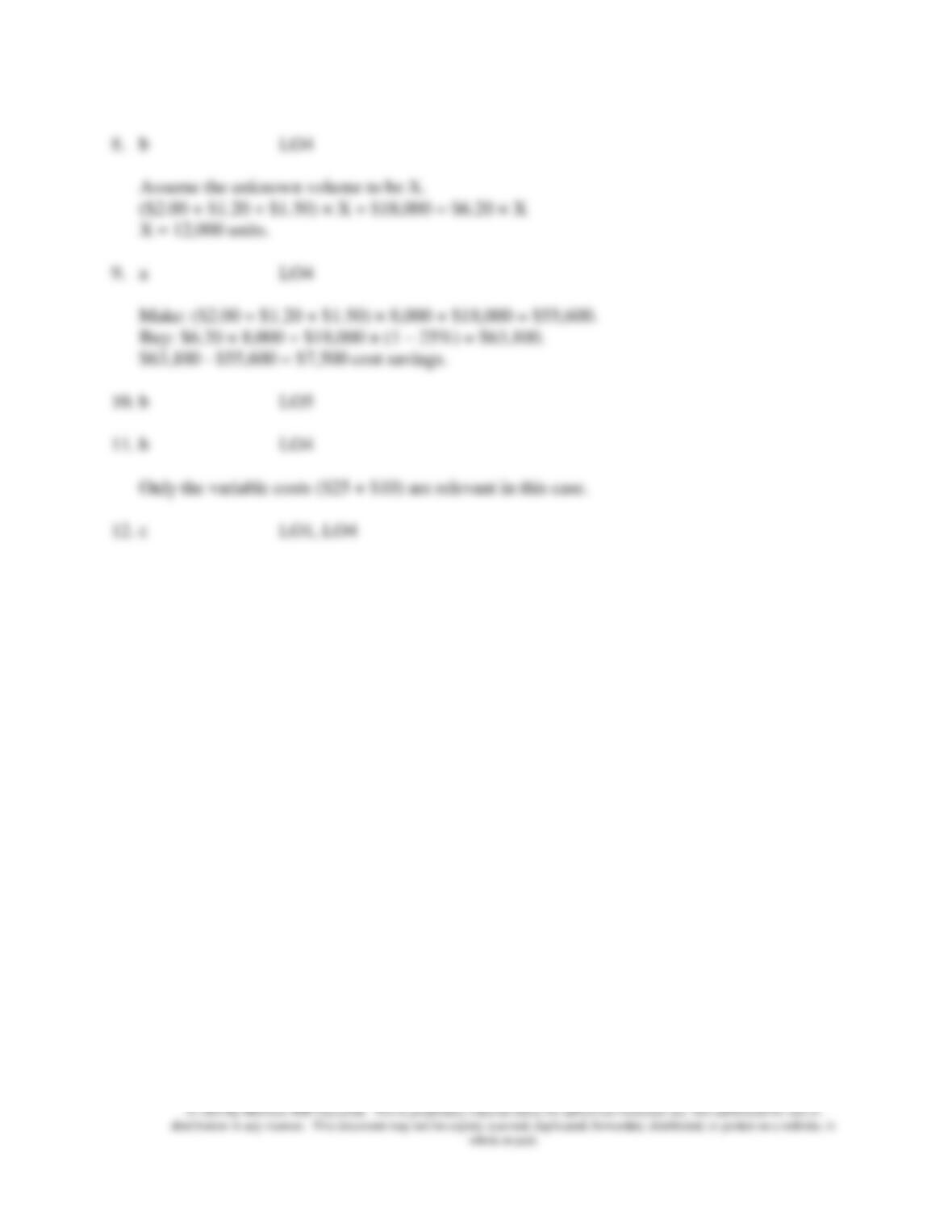
8. b LO4
Assume the unknown volume to be X.
($2.00 + $1.20 + $1.50) × X + $18,000 = $6.20 × X
X = 12,000 units.
9. a LO4
Make: ($2.00 + $1.20 + $1.50) × 8,000 + $18,000 = $55,600.
Buy: $6.20 × 8,000 + $18,000 × (1 – 25%) = $63,100.
$63,100 – $55,600 = $7,500 cost savings.
10. b LO5
11. b LO4
Only the variable costs ($25 + $10) are relevant in this case.
12. c LO1, LO4