Chapter 02 – Cost Concepts and Behavior
2-19
Demonstration Problem 4
The following information is available for each unit of the finished product produced and sold:
Sales price
$60
Variable manufacturing cost
20
Fixed manufacturing cost
12*
Variable marketing and administrative cost
6
Fixed marketing and administrative cost
4*
* The unit fixed manufacturing cost and fixed marketing and administrative cost are based on an
estimated volume of 6,000 units produced and sold.
Required:
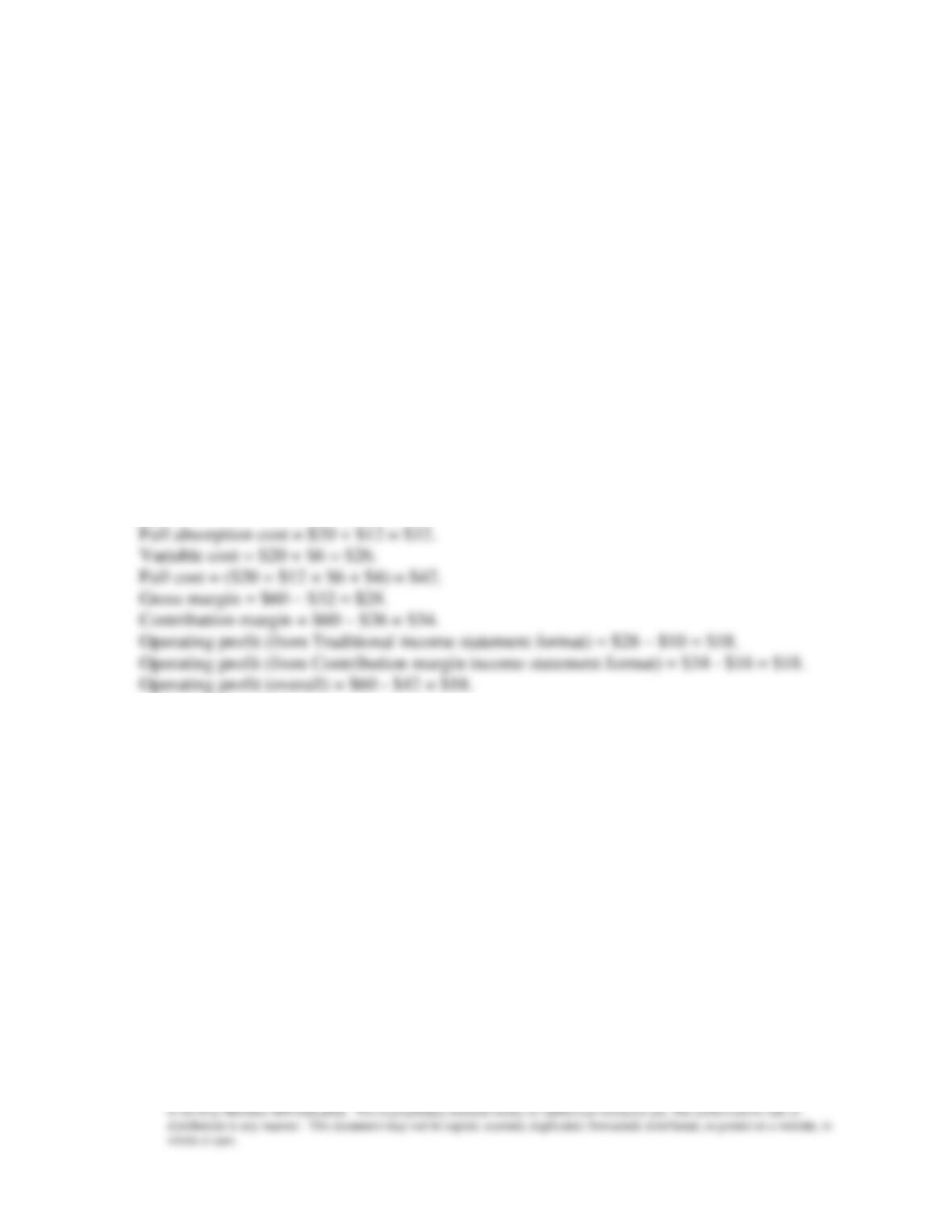
Determine full absorption cost, variable cost, full cost, gross margin, contribution margin,
and operating profit per unit.
Solution:
======================
LO7 Understand the distinction between financial and contribution margin
income statements.
♦ Period costs can be determined once product costs are properly defined. Three approaches to
determining product costs are available.
• Full absorption costing (traditional income statement): As required by GAAP, all fixed
and variable manufacturing costs are product costs. All other costs are period costs.
• Variable costing (contribution margin income statement): Only variable manufacturing
costs are product costs. All other costs are period costs.
• Managerial costing: Management determines which costs are associated with the
product. Any new costs resulting from adding a product are considered product costs.
Chapter 02 – Cost Concepts and Behavior
2-20
♦ Assume that all units produced are sold. A comparison of the first two income statement
formats is shown below.
Traditional
Income Statement
Contribution margin
Income Statement
Sales revenue
Sales revenue
Less: Cost of goods sold
(including variable and fixed
manufacturing costs)
Less: Variable costs
(including variable manufacturing,
marketing and administrative costs)
Gross margin
Contribution margin
Less: Marketing and administrative costs
(including variable and fixed marketing
and administrative costs)
Less: Fixed costs
(including fixed manufacturing,
marketing and administrative costs)
Operating profit
Operating profit
• Exhibit 2.14 illustrates the differences between gross margin and contribution margin
income statements.
• The product costs assigned to inventory are carried in the accounts as assets. When the
goods are sold, the costs flow from inventory to the cost of goods sold account of the
income statement.
======================
Demonstration Problem 5
(Continued from Demonstration Problem 4)
Required:
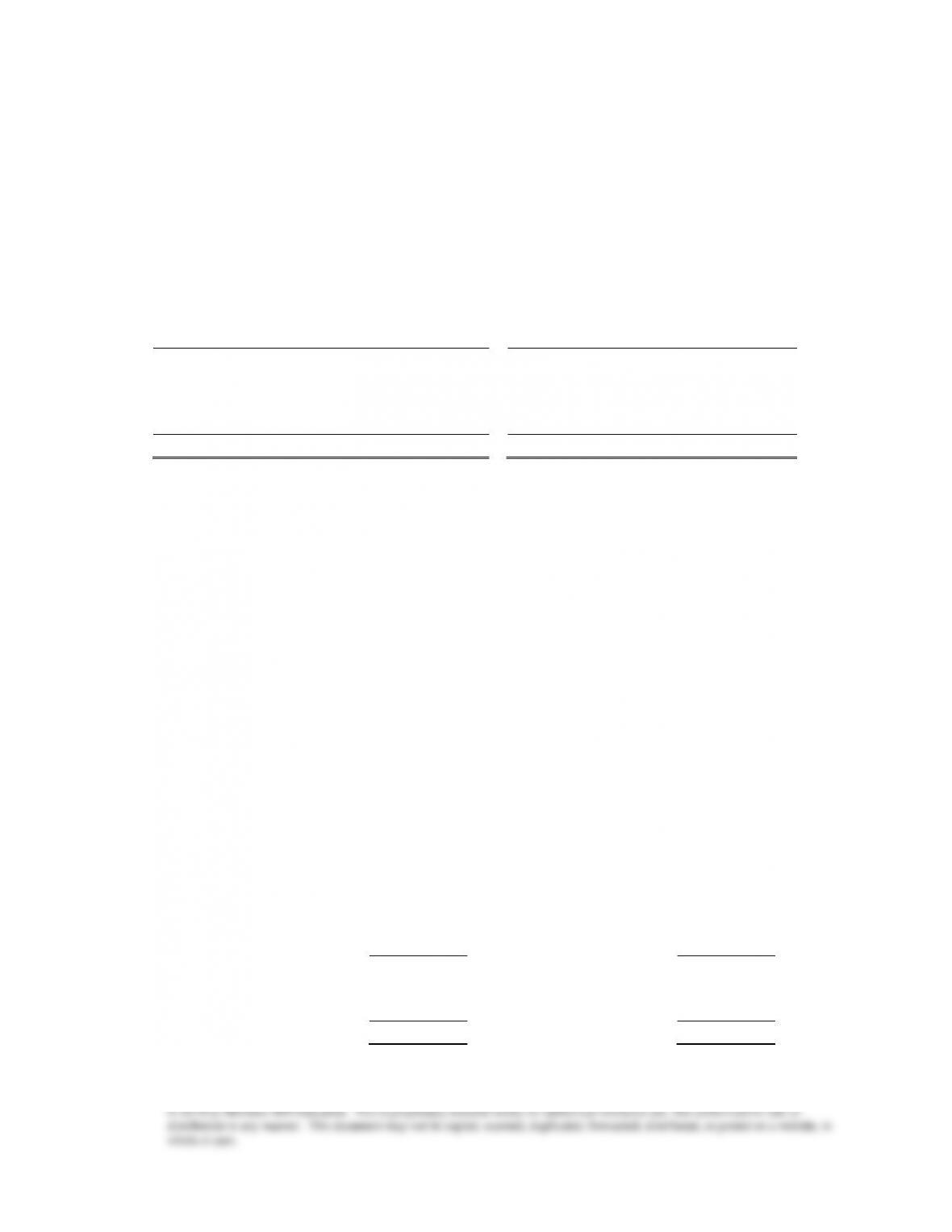
Prepare a traditional income statement and contribution margin income statement when 6,000
units are produced and sold.
Solution:
Traditional
income statement
Contribution margin
income statement
Revenues
$360,000
Revenues
$360,000
Less: Cost of goods sold
(192,000)
Less: Variable cost
(156,000)
Gross margin
$168,000
Contribution margin
$204,000
Less: Marketing and
administrative costs
(60,000)
Less: Fixed costs
(96,000)
Operating profit
$108,000
Operating profit
$108,000
======================

Chapter 02 – Cost Concepts and Behavior
2-21
♦ The cost accounting system is designed to provide managers with relevant information for
decision making. To that end, financial statements may be developed to serve special purposes.
• Case in point is the development of a value income statement that classifies costs into
value-added and nonvalue-added categories. The goal is to make the most out of value-
added activities while minimizing or even eliminating nonvalue-added activities to
reduce costs.
• Exhibit 2.15 provides an example of the value income statement.
• Depending on the business and strategic environment of the firm, it is possible to
construct financial statements around activities related to quality, environmental
compliance, or new product development.
♦ A summary of cost terms and definitions is available in Exhibit 2.16.
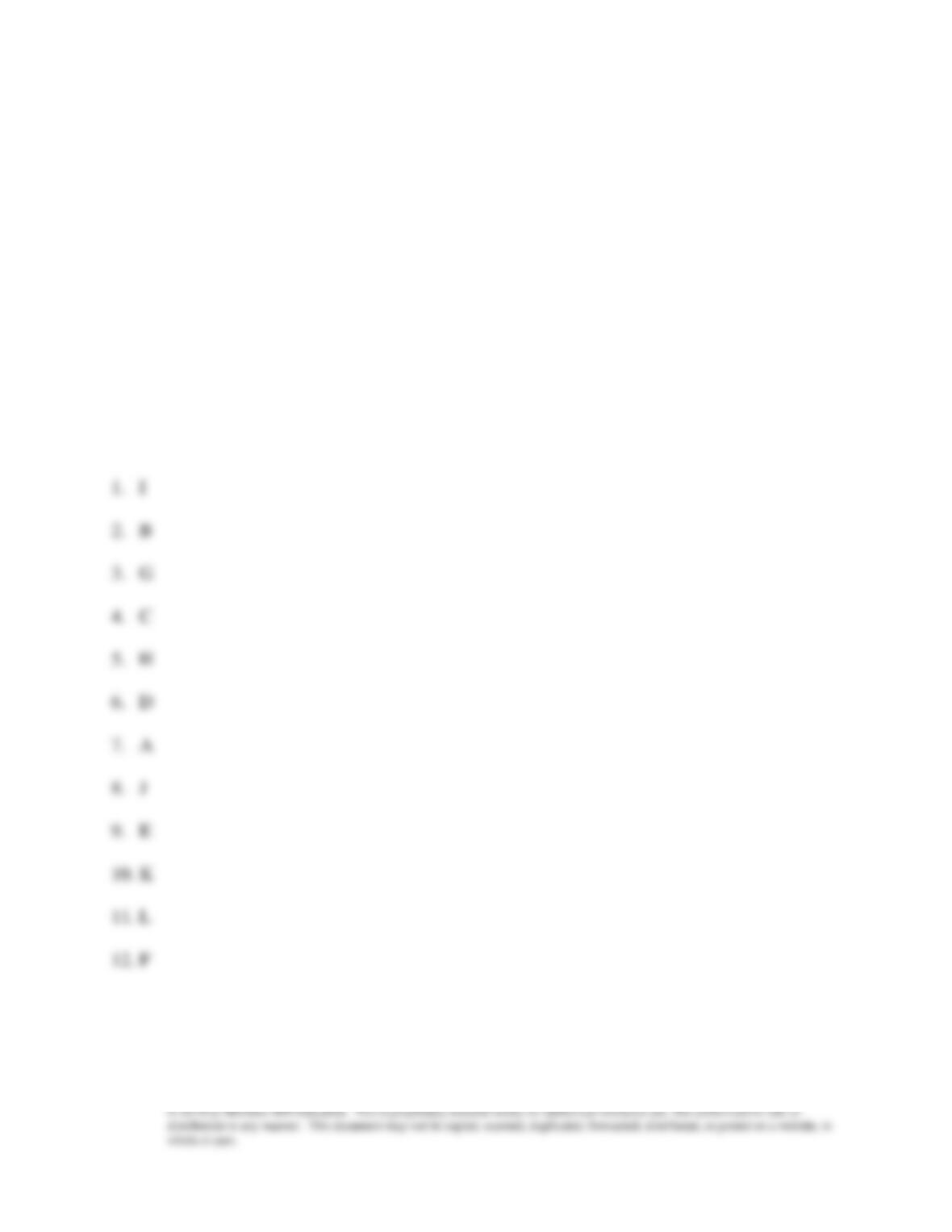
Matching
A.
Administrative costs
G.
Full absorption cost
B.
Conversion costs
H.
Indirect cost
C.
Cost allocation
I.
Opportunity cost
D.
Cost object
J.
Prime costs
E.
Cost pool
K.
Semivariable cost
F.
Direct cost
L.
Work in process
_____ 1. The foregone benefit from the best (forgone) alternative course of action.
_____ 2. The costs that convert direct materials into the final product.
_____ 3. The sum of all variable and fixed manufacturing costs.
_____ 4. The process of assigning indirect costs to product, services, people, business units, etc.
_____ 5. Any cost that cannot be directly related to a cost object.
_____ 6. Any end to which a cost is assigned.
_____ 7. The costs required to manage the organization and provide staff support.
_____ 8. Direct materials + Direct labor.
Chapter 02 – Cost Concepts and Behavior
2-22
_____ 9. The collection of costs to be assigned to the cost objects.
_____ 10. A cost that has both fixed and variable components.
_____ 11. A product in the production process but not yet complete.
_____ 12. Any cost that can be directly (unambiguously) related to a cost object at reasonable
cost.
Answers

Chapter 02 – Cost Concepts and Behavior
2-23
Multiple Choice
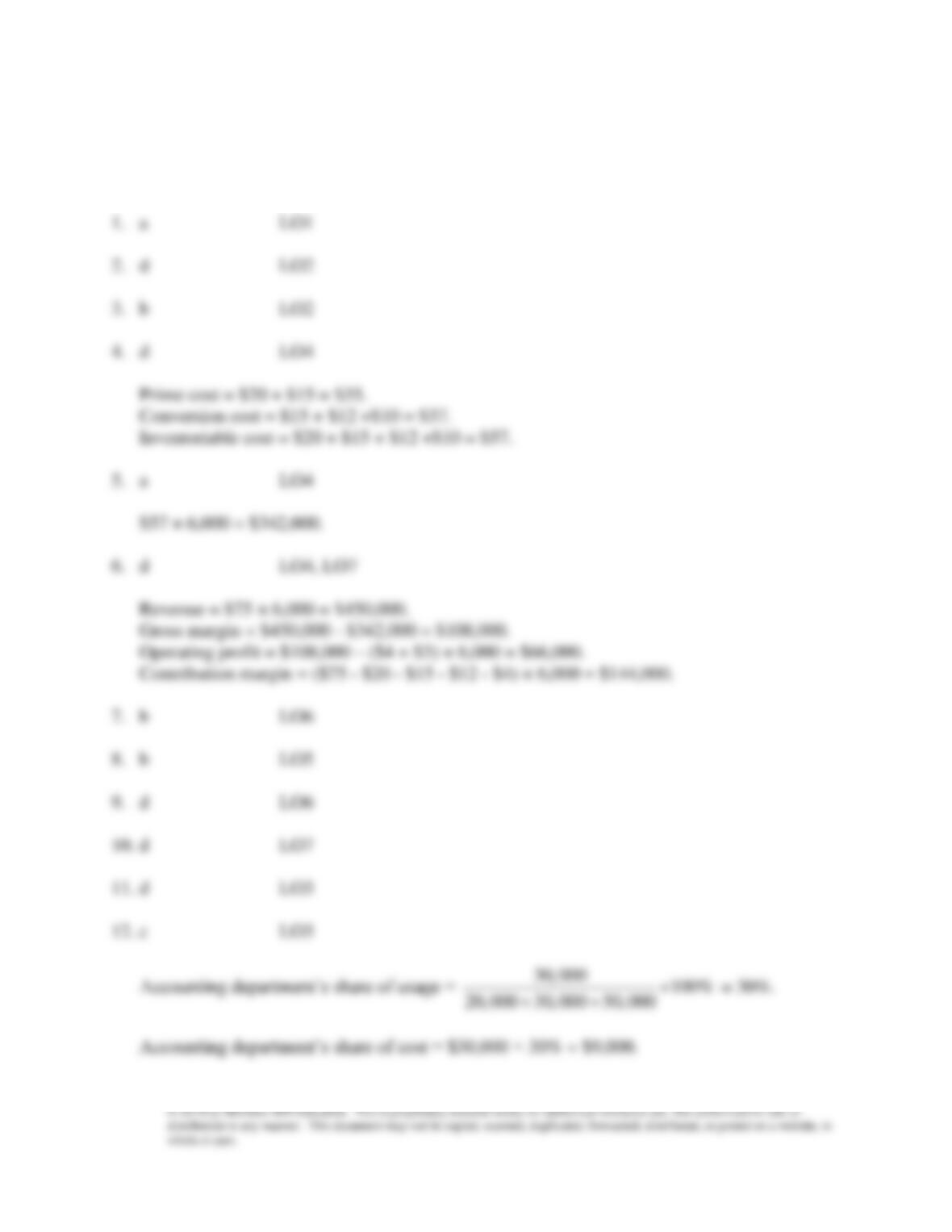
1. Which of the following statements is correct?
a. A cost is a sacrifice of resources.
b. Cost and expense are the same.
c. All assets will become expenses.
d. There is no guidance as to when costs are to be treated as expenses.
2. Cost of goods sold statement for a retail business
a. Includes transportation-in costs.
b. Has a cost of goods manufactured section.
c. Covers a period of time.
d. Both a and c.
3. Period cost
a. Is also known as manufacturing cost.
b. Includes both marketing and administrative costs.
c. Will be expensed when products are sold.
d. Is part of cost of goods sold.
The following information is for questions 4 – 7.
A product is sold for $75 each with unit cost of direct materials $20, direct labor $15, variable
manufacturing overhead $12, and fixed manufacturing overhead $10. The volume produced and
sold is 6,000 units. Variable and fixed marketing and administrative costs are $4 and $3,
respectively.
4. Which of the following statements is correct?
a. Prime cost is $35.
b. Conversion cost is $37.
c. Inventoriable cost is $57.
d. All of the above.
5. Cost of goods sold is
a. $342,000.
b. $201,500.
c. $364,000.
d. None of the above.
6. Which of the following statements is correct?
a. Operating profit is $66,000.
b. Gross margin is $108,000.

Chapter 02 – Cost Concepts and Behavior
c. Contribution margin is $144,000.
d. All of the above.
7. Full absorption cost is
a. The same as full cost.
b. The same as inventoriable cost.
c. $55.
d. The sum of variable manufacturing cost and variable marketing and administrative cost.
8. Which of the following statements is incorrect?
a. Within the relevant range, total fixed cost remains the same.
b. Fixed cost per unit remains constant.
c. Variable cost per unit remains constant.
d. Semivariable cost is also called mixed cost.
9. Unit fixed cost
a. Is treated as variable cost when allocated to each unit.
b. Can be used for decision making under any circumstances.
c. Is misleading as the total fixed cost does not change.
d. Both a and c.
10. Value income statement
a. Is developed for managerial decision making.
b. Distinguishes between value-added and nonvalue-added activities.
c. Is governed by GAAP.
d. Both a and b.
11. Which of the following statements is correct?
a. Cost object is any end to which a cost is assigned.
b. Cost pool is the collection of costs to be assigned to the cost objects.
c. Cost flow diagram is a diagram illustrating the cost allocation process.
d. All of the above.
12. The annual operating expense of running a copy center is shared by the three departments
that use its service: Human resource, Accounting, and Legal. Last year, the copy center
incurred $30,000 while HR copied 20,000 pages, Accounting 30,000 pages, and Legal
50,000 pages. What was Accounting department’s share of the copy center cost?
a. $15,000.
b. $6,000.
c. $9,000.
d. $7,500.
Chapter 02 – Cost Concepts and Behavior
2-25
Answers