
Chapter 02 – Cost Concepts and Behavior
2-1
Chapter 2
Cost Concepts and Behavior
Learning Objectives
1. Explain the basic concept of “cost.”
2. Explain how costs are presented in financial statements.
3. Explain the process of cost allocation.
4. Understand how material, labor, and overhead costs are added to a product at each stage
of the production process.
5. Define basic cost behaviors, including fixed, variable, semivariable, and step costs.
6. Identify the components of a product’s costs.
7. Understand the distinction between financial and contribution margin income statements.
Chapter Outline
I. WHAT IS A COST?
♦ Cost versus expenses
II. PRESENTATION OF COSTS IN FINANCIAL STATEMENTS
A. Service organizations
B. Retail and wholesale companies
C. Manufacturing companies
D. Direct and indirect manufacturing (product) costs
E. Prime costs and conversion costs
F. Nonmanufacturing (period) costs
III. COST ALLOCATION
♦ Direct versus indirect costs
IV. DETAILS OF MANUFACTURING COST FLOWS
V. HOW COSTS FLOW THROUGH THE STATEMENTS
A. Income statements
B. Cost of goods manufactured and sold
C. Direct materials
D. Work in process
E. Finished goods inventory
F. Cost of goods manufactured and sold statement
VI. COST BEHAVIOR
♦ Fixed versus variable costs

Chapter 02 – Cost Concepts and Behavior
2-2
VII. COMPONENTS OF PRODUCT COSTS
♦ Unit fixed costs can be misleading for decision making
VIII. HOW TO MAKE COST INFORMATION MORE USEFUL FOR MANAGERS
A. Gross margin versus contribution margin income statements
B. Developing financial statements for decision making
IX. SUMMARY
Key Concepts
LO1 Explain the basic concept of “cost.”
♦ The cost accounting system records and maintains the use of economic resources by the
organization.
• The financial statements prepared by the firm for external reporting use information
from the cost accounting system.
• Cost accounting systems also provide information to help managers make better
decisions. Managers need to understand the common terms (“the language”) used in cost
accounting.
• A case in point is the calculation of product cost of e-books vs. paper books (see In
Action box for information).
♦ Cost represents a sacrifice of resources (typically cash or a line of credit). The price of each
item purchased measures the sacrifice made to acquire it.
• Cost may be recorded as an asset (such as prepaid rent for an office space) or an
expense (such as phone bills). Some costs may never be recorded (such as lost sales) in
the financial accounting system.
• Expense is a cost charged against (i.e., deducted from) revenue in an accounting period.
• Cost initially recorded as an asset becomes an expense when the asset has been
consumed (e.g., the prepaid rent becomes rent expense after the office space has been
used for a period of time). Generally accepted accounting principles (GAAP) and
regulations such as tax laws govern when and how costs are to be treated as expenses.
• Cost accounting focuses on costs; expenses are referred to only in the context of
external financial reporting (in this text).
• The two major categories of costs are

Chapter 02 – Cost Concepts and Behavior
2-3
(1) Outlay cost: a past, present, or future cash outflow, such as tuition, books, and fees
paid for a college education, and
(2) Opportunity cost: the foregone benefit from the best (forgone) alternative course of
action, such as the time and income sacrificed to get a college education.
Example 1: A developer plans to buy a parcel of land and construct an office building
on top of it. He narrows his search to four possible lots in adjacent states with
convenient access to highways. The expected returns from Lots A, B, C and D are,
$120,000, $190,000, $160,000, $210,000, respectively.
The developer chooses to buy Lot D in the hope of realizing the highest return from the
money invested. The opportunity cost of the decision is the best alternative foregone,
$190,000 from Lot B.
• Managers tend to overlook or ignore opportunity costs while making decisions because
(1) It is difficult to consider all alternatives, and
(2) Typical accounting system only records outlay costs but not opportunity costs,
• Opportunity costs are relevant for managerial decisions and should be captured in a
well-designed cost accounting system.
LO2 Explain how costs are presented in financial statements.
♦ Information generated by the cost accounting system is used to help managers make decisions
that improve firm value. It is a means to an end.
• Such information is best (in terms of relevancy) for various decisions but not
necessarily most accurate.
• How the cost information is used in decision making and the costs of preparing and
using such information should also be considered.
♦ Operating profit is the excess of operating revenues over the operating costs necessary to
generate those revenues.

Chapter 02 – Cost Concepts and Behavior
2-4
• Operating costs consist of
(1) Cost of goods (or services) sold, whose format varies with different types of business
under consideration, and
(2) Marketing and administrative costs. Marketing costs include the salaries of
salespeople while administrative costs include the salaries of top executives.
• Gross margin is the difference between revenues and cost of goods (or services) sold.
• Operating profit adjusted for interest, income taxes, extraordinary items, and other
adjustments determines net income, in compliance with GAAP or other regulations.
• A typical income statement has the following format:
Company name
Income statement
The period of time covered
Sales revenue
xx
Less: Cost of goods (or services) sold
(xx)
Gross margin
xx
Less: Marketing and administrative costs
(xx)
Operating profit
xx
Less: Interest, income taxes, extraordinary items, and other adjustments
(xx)
Net income
xx
♦ Service organizations provide customers an intangible product, such as advice and analysis.
Labor costs and/or costs of information technology represent the most significant cost category
for service organizations.
• Exhibit 2.2 shows the income statement of a typical service company. Cost of services
sold includes costs of billable hours plus the cost of other items billed to clients.
Operating costs not included in the costs of services billable to clients are part of
marketing and administrative costs, such as the costs of developing project proposals for
new business.
♦ Retail and wholesale companies sell but do not make a tangible product, such as food, clothes,
or a book.
• Exhibit 2.3 shows an income statement for a merchandising company. Cost of goods
sold represents the expense assigned to products sold during a period and keeps track of
the tangible goods the company buys and sells.

Chapter 02 – Cost Concepts and Behavior
2-5
• A typical income statement for a merchandising company has the following format:
Company name
Income statement
The period of time covered
Sales revenue
xx
Less: Cost of goods sold
(xx)
Gross margin
xx
Less: Marketing and administrative costs
(xx)
Operating profit
xx
• The cost of goods sold statement accounts for the inventories, purchases, and sales of
tangible goods. The typical format follows:
Company name
Cost of goods sold statement
The period of time covered
Cost of goods in beginning inventory
xx
Plus: Cost of goods purchased
Merchandise cost
xx
Transportation-in costs
xx
Total costs of goods purchased
xx
Cost of goods available for sale
xx
Less: Cost of goods in ending inventory
(xx)
Cost of goods sold
xx
• Total costs of goods purchased includes both the merchandise cost and the
transportation-in costs. Total costs of goods purchased are added to the beginning
inventory to determine the cost of goods that the company could have sold – the cost of
goods available for sale. After subtracting the cost of goods still available (i.e., left
unsold) at the end of the period, the company comes up with the cost of goods sold
during the period and inserts the number into the income statement to determine gross
margin.
• The gross margin reflects the ability to price the products; the marketing and
administrative costs reflect relative efficiency in operating the business.
♦ Manufacturing companies make the goods for sale and need to know the different costs
associated with making them. These companies monitor costs based on not only the relative
magnitude but also the ability to control them.

Chapter 02 – Cost Concepts and Behavior
2-6
• Product (manufacturing) costs are those assigned to the manufacture of products and
recognized (i.e., expensed) for financial reporting when sold. Product costs follow the
product through inventory.
∙ Direct manufacturing costs are product costs that can be feasibly identified
with units of production, including
– Direct materials are those that can be identified directly with the
product at reasonable cost, including purchased parts and transportation-in.
Direct materials are often called raw materials.
– Direct labor represents labor costs that can be identified with the
product at reasonable cost. Direct labor of workers transforms the
materials into a finished product.
– Prime costs = Direct materials + Direct labor.
Companies with relatively low manufacturing overhead tend to focus on
managing prime costs.
∙ Indirect manufacturing costs are all product costs except direct costs, often
referred to in total as manufacturing overhead.
– Manufacturing overhead represents all other costs of transforming the
materials into a finished product, including
(1) Indirect materials (materials not a part of the finished product but are
necessary to manufacture it, such as lubricants, polishing and cleaning
materials, etc.),
(2) Indirect labor (the cost of workers who do not work directly on the
product, yet are required so that the factory can operate, such as
supervisors, maintenance workers, inventory storekeepers, etc.), and
(3) Other manufacturing costs (expenses incurred to keep the factory
running, such as depreciation of the factory building and equipment,
taxes and insurance on the factory assets, heat, light, power, etc.)
– In practice, manufacturing overhead is also called factory burden, factory
overhead, burden, factory expense, or just overhead.
– Conversion costs = Direct labor + Manufacturing overhead.

Chapter 02 – Cost Concepts and Behavior
2-7
Conversion costs are the costs that convert direct materials into the final
product. Companies with high direct labor and/or manufacturing overhead
tend to emphasize more about conversion costs.
∙ Exhibit 2.4 summarizes the relationship between prime costs, conversion costs,
and the three elements of manufactured product costs: direct materials, direct
labor, and manufacturing overhead.
• Period (nonmanufacturing) costs are all other costs recognized for financial reporting
when incurred, including marketing and administrative costs.
∙ Marketing costs are the costs required to obtain customer orders and provide
customers with finished products, including advertising, sales commissions, and
shipping costs.
∙ Administrative costs are the costs required to manage the organization and
provide staff support, including executive and clerical salaries, costs for legal,
financial, data processing, accounting services, and building space for
administrative personnel.
∙ For financial accounting purposes, nonmanufacturing costs are expensed in the
period incurred; for managerial purposes, however, these costs (especially
advertising and commissions) may be assigned to products.
• The distinction between manufacturing and nonmanufacturing costs is not always clear-
cut. Companies need to develop guidelines and follow them consistently.
• Service companies often have costs that are mostly indirect. Managing indirect costs is
extremely important in these firms if they are to remain profitable.
• Most firms are made up of activities that combine features of all three types of activities
(service, retailing, and manufacturing).
• In many of the firms which are usually considered to be of manufacturing type, virtually
all employees are engaged in service-related activities (see In Action box “A New
Manufacturing Mantra”).
• Many service firms are adopting cost management practices that were originally
developed in manufacturing.

Chapter 02 – Cost Concepts and Behavior
2-8
LO3 Explain the process of cost allocation.
♦ Cost allocation is the process of assigning indirect costs to product, services, people, business
units, etc. Cost allocation is necessary when several departments share facilities or services.
• Cost object is any end to which a cost is assigned. Examples include a unit of product
or service, a department, or a customer.
• Cost pool is the collection of costs to be assigned to the cost objects. Examples are
department costs, rental costs, or travel costs a consultant incurs to visit multiple clients.
• Cost allocation rule refers to the method or process used to assign costs in the cost
pool to the cost objects. There is often no “right” way to allocate costs.
• Cost flow diagram is a diagram or flowchart illustrating the cost allocation process.
Exhibit 2.5 shows an example of cost flow diagram.
• Fundamental approach to cost allocation:
(1) Identify the cost objects,
(2) Determine the cost pools, and
(3) Select a cost allocation rule.
• Cost flow diagrams help managers understand
(1) How a cost system works, and
(2) The likely effects on the reported costs of different cost objects from changes in the
cost allocation rule.
======================
Demonstration Problem 1
Kahn Industry, Inc. has three divisions. The following information was available for last quarter.
Division A
Division B
Division C
Company
Revenues
$200,000
$320,000
140,000
$660,000
Cost of goods (or services) sold
160,000
240,000
100,000
500,000
Gross margin
$40,000
$80,000
$40,000
$160,000
Marketing and administrative costs
18,000
20,000
12,000
50,000
Operating profit
$22,000
$60,000
$28,000
$110,000
Interest
10,000
Chapter 02 – Cost Concepts and Behavior
2-9
Income taxes (30%)
30,000
Net income
$70,000
The CEO of Kahn Industry wanted to allocate the interest cost of $10,000 to the three divisions.
Required:
1. Identify the cost object(s) and the cost pool.
2. Allocate the interest cost based on each division’s (1) revenues, (2) gross margin, and (3)
operating profit.
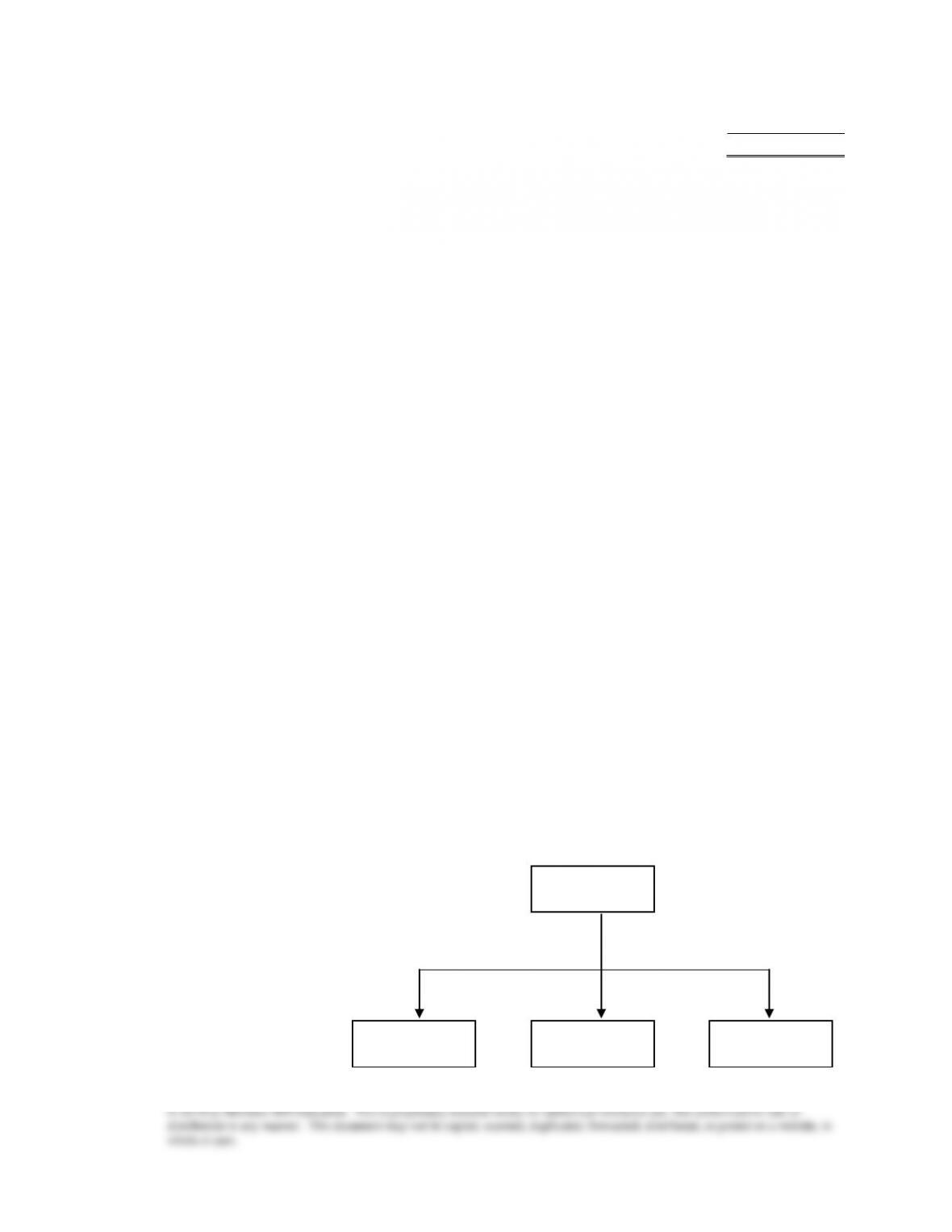
3. Draw a cost flow diagram for (1) above.
Solution:
1. The cost objects are the three divisions; the cost pool is the interest cost incurred for the
company as a whole.
2.
Division A
Division B
Division C
Total
(1) Revenues
$200,000
$320,000
$140,000
$660,000
Allocation rule
30.3%a
48.5%b
21.2%c
100%
Allocation
$3,030
$4,850
$2,120
$10,000
(2) Gross margin
$40,000
$80,000
$40,000
$160,000
Allocation rule
25%
50%
25%
100%
Allocation
$2,500
$5,000
$2,500
$10,000
(3) Operating profit
$22,000
$60,000
$28,000
$110,000
Allocation rule
20.0%
54.5%
25.5%
100%
Allocation
$2,000
$5,450
$2,550
$10,000
a $200,000 ÷ $660,000 = 0.303, or 30.3%.
b $320,000 ÷ $660,000 = 0.485, or 48.5%.
c $140,000 ÷ $660,000 = 0.212, or 21.2%.
3.
Cost Pool
Interest cost
$10,000
%Revenues
Cost
Allocation
Rule
30.3%
48.5%
21.2%
Cost
Objects
Division A
$3,030
Division B
$4,850
Division C
$2,120

Chapter 02 – Cost Concepts and Behavior
2-10
======================
♦ Direct cost is any cost that can be directly (unambiguously) related to a cost object at
reasonable cost; indirect cost is any cost that cannot be directly related to a cost object.
• A cost may be direct to one cost object and indirect to another.
• Whether a cost is considered direct or indirect also depends on the costs of linking it to
the cost object. Even though the information technology is such that almost all costs can
be traced directly to cost objects, cost-benefit consideration will dictate whether it is
economically feasible to do so.
• For labor and materials, the direct-indirect distinction is based on the cost object of the
units being produced.
LO4 Understand how material, labor, and overhead costs are added to a
product at each stage of the production process.
♦ Work in process is a product in the production process but not yet complete; finished goods
are products fully completed but not yet sold.
• Any production process involves three basic steps:
(1) Acquisition of direct materials,
(2) Transformation of direct materials in the assembly line, and
(3) Completion of finished goods.
• For manufacturing companies, there are three inventory accounts in a cost accounting
system:
(1) Direct Materials Inventory,
(2) Work-in-process Inventory, and
(3) Finished Goods Inventory.
• Each inventory account is likely to have the following structure (in T-account):
Inventory Account
(Direct materials, Work in process, or Finished goods)
Beginning inventory
Debit: Additions
Credit: Withdrawals
Ending inventory