
Chapter 18 – Performance Measurement to Support Business Strategy
18–17
– reflect individual unit’s role in the organization.
(3) Management must ensure that the performance measures are applied consistently and
accurately.
♦ Companies benefit from using nonfinancial performance measures, but their use is not free of
implementation difficulties.
• A strong fixation on financial measures works against effective use of nonfinancial
performance measures.
• Nonfinancial measures suffer from the lack of external review, are more subjective and
less reliable.
• The casual relationship between nonfinancial measures and financial results is not clear
for a number of reasons.
(1) The nonfinancial measures could be flawed.
(2) There might not be a real economic link between costly activities and profit.
(3) It is also difficult to measure the financial performance that results from the activities.
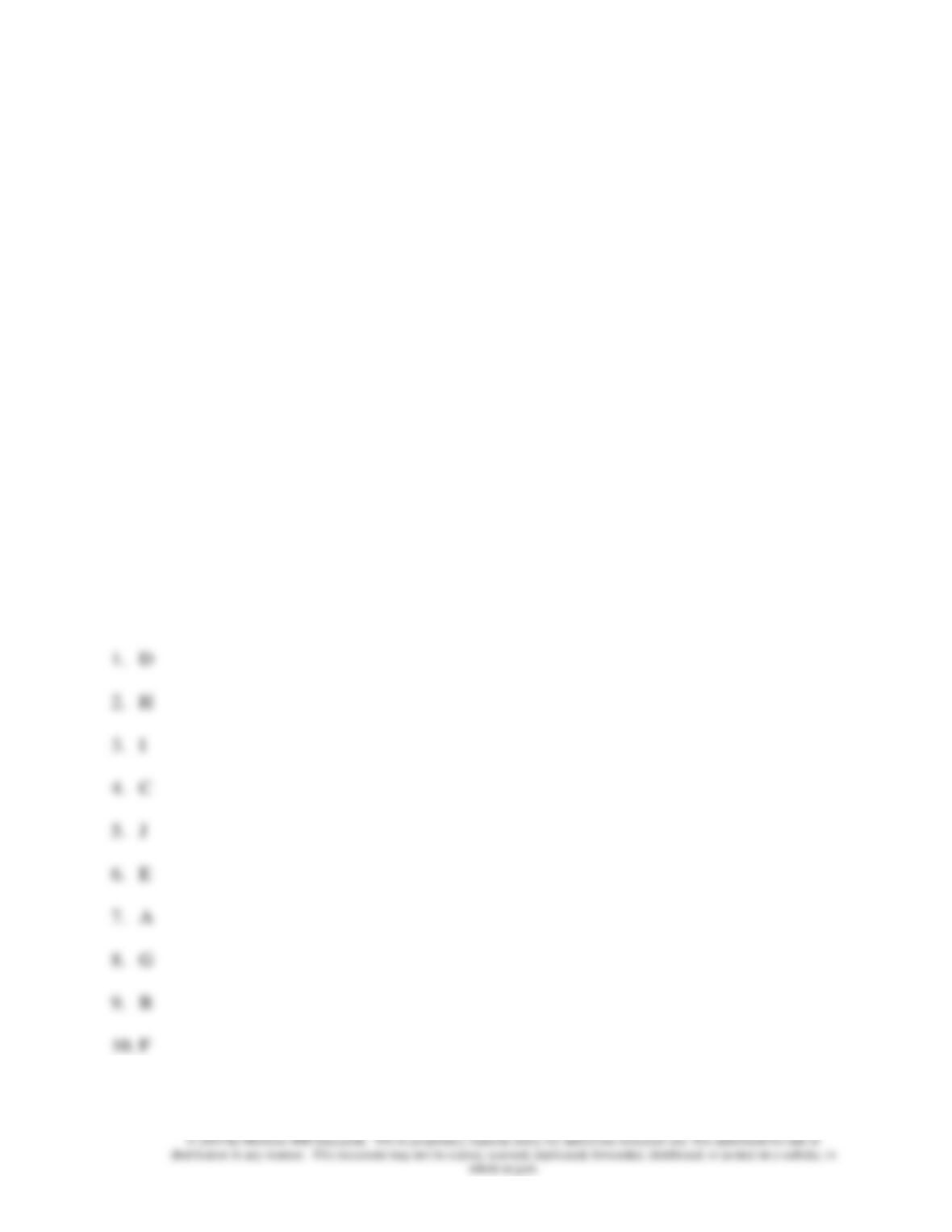
Matching
A.
Balanced scorecard
F.
Manufacturing cycle efficiency
B.
Benchmarking
G.
Manufacturing cycle time
C.
Business-level strategy
H.
Mission
D.
Business model
I.
Mission statement
E.
Continuous improvement
J.
Stakeholders
_____ 1. Description of how different levels and employees in the organization must perform
for the organization to achieve its goals.
_____ 2. An organization’s purpose.
_____ 3. Describes an organization’s values, defines its responsibilities to stakeholders, and
identifies its major strategies.
_____ 4. An organization’s plan to compete in each of its businesses.
Chapter 18 – Performance Measurement to Support Business Strategy
18–18
_____ 5. Groups or individuals, such as employees, suppliers, customers, shareholders, and the
community, who have an interest in what the organization does.
_____ 6. The continuous reevaluation and improvement of the efficiency of an organization’s
activities.
_____ 7. A set of performance targets and results that show how well an organization has
performed in meeting its objectives relating to its stakeholders.
_____ 8. The time involved in processing, moving, storing, and inspecting products and
materials.
_____ 9. Continuously identifying an activity that needs to be improved, finding an
organization (sometimes in one’s own organization) that is the most efficient in
performing the activity, studying its process, and then utilizing that process.
_____ 10. Measures the efficiency of the total manufacturing cycle.
Answers

Chapter 18 – Performance Measurement to Support Business Strategy
18–19
Multiple Choice
1. Which of the following is a nonfinancial measure?
a. Number of customer complaints.
b. Return on investment.
c. Prevention cost.
d. Opportunity cost.
2. Which of the following statements is correct?
a. The business model can suggest ways to evaluate performance that makes sense to the
organization.
b. A single measure of performance typically evaluates the result.
c. Multiple measures emphasize how the result was achieved.
d. All of the above.
3. Balanced scorecard
a. Emphasizes financial performance.
b. Caters to the needs of employees.
c. Tries to meet the organization’s responsibilities to stakeholders.
d. Is just a set of multiple performance measures.
4. Manufacturing cycle time is an example of a balanced-scorecard measure of
a. Financial performance.
b. Customer perspective.
c. Internal business process.
d. Learning and growth.
5. Continuous improvement
a. Is a philosophy of running the business.
b. Is independent of benchmarking.
c. Is looking to improve the efficiency of activities.
d. Both a and c.
6. Which of the following can be used to measure customer satisfaction?
a. Number of customer complaints.
b. Number of service calls.
c. Number or returns.
d. All of the above.
The following information is for questions 7 – 8.
A manufacturing company has the following average times.
Product transportation: 0.25 hour.

Chapter 18 – Performance Measurement to Support Business Strategy
18–20
Product manufacturing: 3.5 hours.
Inspection: 0.25 hour.
Inventory storage: 10 hours.
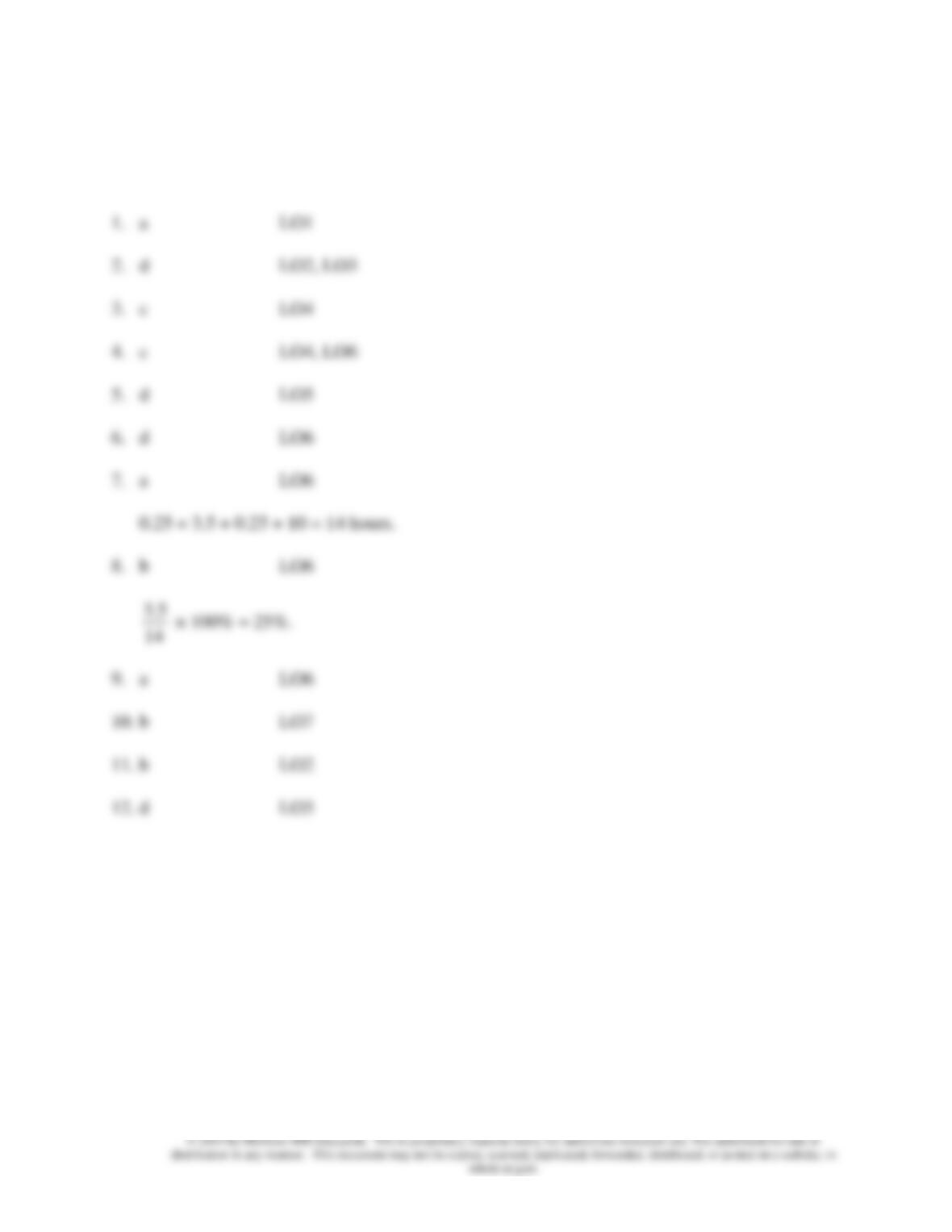
7. What is the average manufacturing cycle time (in hours)?
a. 14.00.
b. 13.75.
c. 13.50.
d. 10.00.
8. What is the manufacturing cycle efficiency?
a. 15%.
b. 25%.
c. 35%.
d. 45%.
9. Which of the following is an example of subjective measurement?
a. Economic conditions of the city where a branch is located.
b. Employee turnover.
c. Branch profits.
d. Defect rates.
10. Which of the statements regarding employee involvement is incorrect?
a. When workers take on real decision-making authority, their commitment to the
organization increases.
b. When decision-making responsibility lies with workers farther away from the customer,
workers are more responsive and make informed decisions.
c. Management must create a system that conveys the organization’s objectives to all
members.
d. Management must ensure that the performance measures are applied consistently and
accurately.
11. Which of the statements is incorrect?
a. People at different levels in the organization have different responsibilities.
b. At the lower levels, financial measures are critical.
c. At the middle levels, it is important to coordinate ongoing activities.
d. At the top levels, performance measures focus on meeting stakeholders’ needs.
12. Which of the following performance measures are appropriate for a regional manager?
e. Profitability.
f. Employee turnover.
g. Customer and employee satisfaction.
h. All of the above.
Chapter 18 – Performance Measurement to Support Business Strategy
18–21
Answers