
Chapter 18 – Performance Measurement to Support Business Strategy
18-1
Chapter 18
Performance Measurement to Support Business Strategy
Learning Objectives
1. Explain why management accountants should know the business strategy of their
organization.
2. Explain why companies use nonfinancial performance measures.
3. Understand the reasons why performance measures differ across levels of the
organization.
4. Understand how the balanced scorecard helps organizations recognize and deal with their
conflicting responsibilities.
5. Understand how to apply the methods involved in an effective performance measurement
system.
6. Identify examples of nonfinancial performance measures and discuss the potential for
improved performance resulting from improved activity management.
7. Explain why employee involvement is important in an effective performance
measurement system.
Chapter Outline
I. EXPLAIN WHY MANAGEMENT ACCOUNTANTS SHOULD KNOW THE
BUSINESS STRATEGY OF THEIR ORGANIZATION
II. BEYOND THE ACCOUNTING NUMBERS
III. RESPONSIBILITIES ACCORDING TO LEVEL OF ORGANIZATION
IV. BUSINESS MODEL
V. MULTIPLE MEASURES OR A SINGLE MEASURE OF PERFORMANCE?
A. Balanced scorecard
B. Continuous improvement and benchmarking
VI. PERFORMANCE MEASUREMENT FOR CONTROL

Chapter 18 – Performance Measurement to Support Business Strategy
18-2
VII. SOME COMMON NONFINANCIAL PERFORMANCE MEASURES
A. Customer satisfaction performance measures
1. Quality control
2. Delivery performance
3. Bookings and purchase orders
4. Market share
B. Functional performance measures
1. Manufacturing cycle time
2. Manufacturing cycle efficiency
C. Productivity
D. Nonfinancial performance and activity-based management
E. Objective and subjective performance measures
VIII. EMPLOYEE INVOLVEMENT
IX. DIFFICULTIES IN IMPLEMENTING NONFINANCIAL PERFORMANCE
MEASUREMENT SYSTEMS
A. Fixation on financial measures
B. Reliability of nonfinancial measures
C. Lack of correlation between nonfinancial measures and financial results
X. SUMMARY
Key Concepts
LO 18-1 Explain why management accountants should know the business
strategy of their organization.
♦ The performance measures that accountants develop must tie directly to concepts in strategy
and organizational behavior.
We have to know what kind of performance adds value to the company.
Business strategy is the company’s specific approach for deploying the
organizational assets and capabilities required to meet its customers’ needs while
delivering the desired returns to stakeholders.
LO 18-2 Explain why companies use nonfinancial performance measures.
♦ Financial performance measures, especially those that come from the company’s accounting
systems, are commonly used to evaluate employee performance.

Chapter 18 – Performance Measurement to Support Business Strategy
18-3
• Financial performance measures are easily quantifiable and can motivate employees to
improve the company’s accounting profits.
• Financial measures are good at getting managers’ attention.
• Financial measures suffer from several flaws that reduce their value as an operational
control device.
(1) They are not useful in identifying operational problems.
(2) As commonly reported only on a monthly, quarterly, or annual basis, they do not
provide real-time feedback on performance.
(3) There is a disconnect between the work performed and the financial results
• Recently, nonfinancial measures are used more often because
(1) They direct employees’ attention to those things that the employees can control, and
(2) They are often reported more frequently and provide more timely feedback to
employees about their performance.
♦ Performance evaluation starts by understanding the organization’s objectives and strategy.
• The organization evaluates performance by first defining what it wants to accomplish.
Then it develops criteria that help it evaluate its performance in achieving those
accomplishments.
• In management control systems (discussed in Chapter 12), performance measurement
must be consistent with the way in which subordinates are authorized to make decisions.
The assignment of decision authority, in turn, depends on the subordinate’s local
knowledge.
• Recall from Chapter 12 that conceptually, the components of a management control
system and their relationship can be depicted by the following diagram.
Delegated
decision
authority
Performance
evaluation
system
Compensation
and reward
system

Chapter 18 – Performance Measurement to Support Business Strategy
18-4
♦ The design of an effective management control system depends on the firm’s organizational
environment and business strategy.
• Explicitly articulating the goals of the firm, and its mission, is useful in developing
appropriate performance measures for managers and business units.
• Mission is an organization’s purpose.
• A mission statement describes an organization’s values, defines its responsibilities to
stakeholders, and identifies its major strategies.
• Business-level strategy is an organization’s plan to compete in each of its businesses.
• An organization’s stakeholders are groups or individuals, such as employees, suppliers,
customers, shareholders, and the community, who have an interest in what the
organization does.
• Mission statements should answer the following questions:
(1) Who are the organization’s stakeholders? Who matters to the organization?
(2) How will the organization add value to each stakeholder group? (Answering this
question identifies the critical success factors, the factors important for the
organization’s success.)
LO 18-3 Understand the reasons why performance measures differ across
levels of the organization.
♦ Effective performance measurement is based on two factors.
(1) It leads all organization members to focus on the organization’s objectives and reflects how
individuals or units contribute to those objectives.
(2) It is designed to reflect the decision authority delegated to local managers.
• People at different levels in the organization have different responsibilities.
• Effective performance measurement systems use measures that emphasize different
things at different levels of the organization.

Chapter 18 – Performance Measurement to Support Business Strategy
18-5
• In general, performance measures should relate to what people at different levels
control.
• At the lower levels in the organization, nonfinancial performance measures focus on
factors these employees can control, such as
– Customer satisfaction (for those dealing with customers directly) and
– Product quality (for those in production).
• At middle levels in organizations, nonfinancial performance measurement often focuses
on how well the operating systems work together and how effective these systems are in
comparison with those of competitors, such as
– Amount of unwanted employee turnover,
– Frequency of meeting customer delivery requirements,
– Employee development performance, and
– Success in dealing with business partners.
• At middle levels in organizations, coordination and improvement of ongoing activities
take place in addition to redesigning products and processes.
• At the top levels of the organization, performance measurement focuses on determining
whether the organization is meeting its responsibilities from the perspectives of its
stakeholders.
• Performance at top levels requires delicately balancing trade-offs.
♦ A business model is a description of how different levels and employees in the organization
must perform for the organization to achieve its goals.
• A business model is a framework that links the roles of various employees and levels in
the organization and that illustrates how the successful completion of these roles will
result in achievement of the organization’s goals.
• For a given strategy and environment, many possible business models could be
appropriate.

Chapter 18 – Performance Measurement to Support Business Strategy
18-6
Example 1: The business model for an investment firm describes how a profitable
branch operates in the retail investment business. The branch manager exercises
leadership to motivate and satisfy employees.
For operating personnel, their effectiveness drives efficient operations and control
costs. For investment advisers to satisfy customers, they must (1) be knowledgeable
and constantly develop their skills, and (2) act ethically to maintain the trust of the
clients.
Satisfied customers will return to the branch, building revenues. Combined with
effective cost control, the branch will return profits to the company.
• Failure to perform certain functions in the business model is likely to result in a failure
to achieve the organization’s strategy and goals.
LO 18-4 Understand how the balanced scorecard helps organizations
recognize and deal with their conflicting responsibilities.
♦ One structured approach to implementing a set of performance measures is the balanced
scorecard, which is a set of performance targets and results that show how well an organization
has performed in meeting its objectives relating to its stakeholders.
• A balanced scorecard is a management tool that recognizes organizational responsibility
to different stakeholder groups.
• The concept of a balanced scorecard is to measure how well the organization is doing in
view of those competing stakeholder concerns.
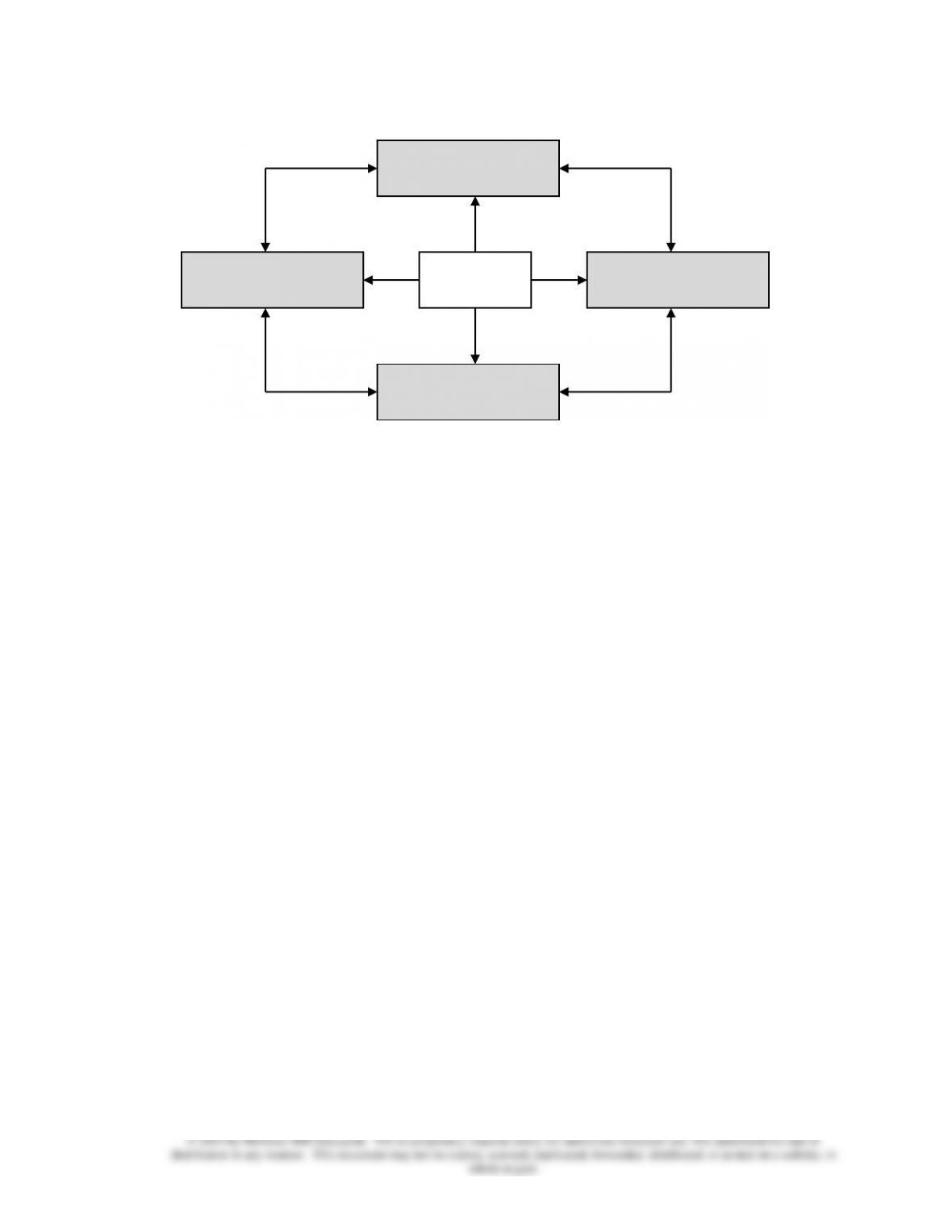
• An example of a balanced scorecard is shown in Exhibit 18.2.
Chapter 18 – Performance Measurement to Support Business Strategy
18-7
• The focus of the balanced scorecard is to balance the efforts of the organization in
meeting its financial, customer, process, and innovative responsibilities.
• The distinctive feature of the balanced scorecard is that the performance measures are
derived from identifying what drives an organization’s success as viewed from the
perspectives of different stakeholders in the organization.
• The balanced scorecard has four views or perspectives:
(1) Financial: To succeed financially, how should we appeal to our shareholders?
(2) Customer: To achieve our mission, how should we appeal to our customers?
(3) Internal business process: To satisfy our shareholders and customers, in what business
process must we excel?
(4) Learning and growth: To achieve our mission, how will we sustain our ability to
change and improve?
• A balanced scorecard for any particular organization could be based on any other
perspectives if they are important for the organization’s success.
• Within each perspective, the scorecard identifies the goals, or objectives, for the
organization as often shaped by the competitive environment.
• Once the organization specifies the goals, it identifies the measures that will be used to
evaluate its progress in meeting the goals.
• The organization sets targets for each of the measures.
Financial
perspective
Internal business
process perspective
Customer
perspective
Learning and growth
perspective
Vision and
strategy

Chapter 18 – Performance Measurement to Support Business Strategy
18-8
• With the measures and the targets, managers identify the initiatives, or plans, they have
for achieving these targets.
• A select list of organizations using the balanced scorecard is in Exhibit 18.3.
• The balanced scorecard primarily has been used at the top management level to support
the organization’s development of strategies.
• Top and middle management must shape and clarify the organization‘s goals and
strategy in the face of competing stakeholder expectations.
• A typical development of the balanced scorecard may involve the following:
Step1: A company’s top executives form a team to clarify the company’s strategy and
objectives to meet responsibilities.
Step 2: The top and middle managers of the company are brought together to discuss the
new strategy and to develop performance measures (i.e., scorecards) for each part
of the company.
Step 3: Managers begin eliminating programs that are not contributing to the company’s
objectives.
Step 4: Top management reviews the scorecards for each part of the organization.
Step 5: Based on its reviews in Step 4, top management goes back to Step 1 to refine and
further clarify the company’s strategy and objectives.
• The In-Action box mentions Sun Microsystems’s use of scorecards to monitor and
motivate suppliers in four categories: quality, lead-time/delivery flexibility, technology,
and support. Results from the scorecard are combined with a price index to compute
“Total Cost of Ownership (TCOO)” for sourcing and purchasing decisions.
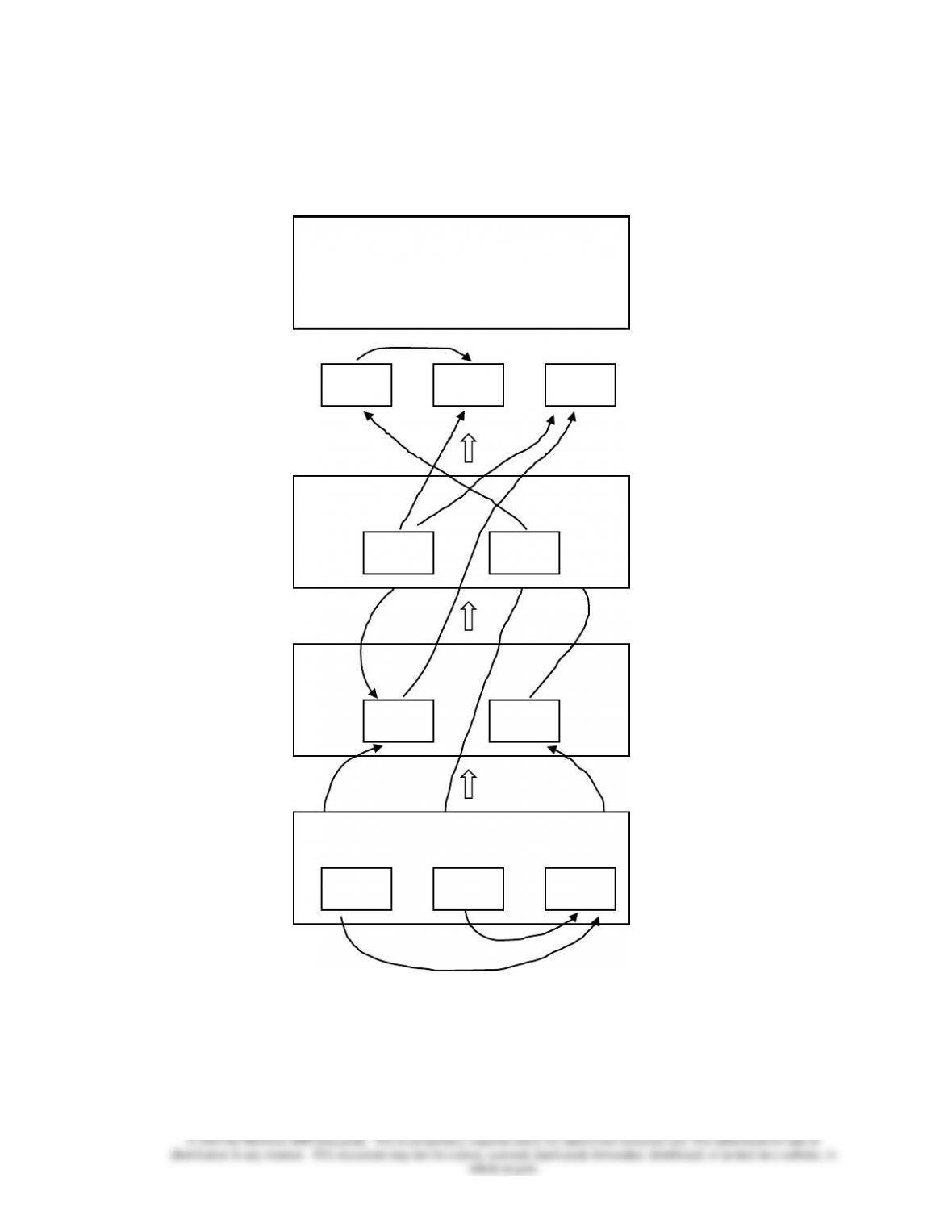
♦ A company’s strategy, as illustrated in the business model, can be linked to the balanced
scorecard through a strategy map, as shown in Exhibit 18.5. Specifically, the strategy map links
the objectives or goals in each of the perspectives.
• By drawing the strategy map, a company can determine if it is missing measures in any
of the perspectives or if it has goals that do not seem to be linked to other parts of the
map.
• In the strategy map, each of the goals has at least one arrow starting or ending at the
goal.
Chapter 18 – Performance Measurement to Support Business Strategy
18-9
• Each of the goals in the Learning & growth, Internal, and Customer perspectives has an
arrow leaving, indicating that these are not the ultimate objective of the organization, but
goals that need to be achieved if the ultimate objectives are to be met.
Financial perspective
Internal perspective
Goal
Goal
Goal
Goal
Goal
Learning and growth perspective
Goal
Goal
Goal
Customer perspective
Goal
Goal

Chapter 18 – Performance Measurement to Support Business Strategy
18–10
LO 18-5 Understand how to apply the methods involved in an effective
performance measurement system.
♦ Performance measurement is useful not only for evaluation, but also for control.
• Continuous improvement means the continuous reevaluation and improvement of the
efficiency of an organization’s activities.
• Continuous improvement is a philosophy that seeks to
(1) Improve the activities in
(2) which the organization engages through documentation and understanding,
(3) Eliminate activities that are nonvalue-added, and
(3) Improve the efficiency of activities that are value-added.
• Benchmarking involves continuously identifying an activity that needs to be improved,
finding an organization (sometimes in one’s own organization) that is the most efficient
in performing the activity, studying its process, and then utilizing that process.
• Benchmarks are used to evaluate the performance of an activity, operation, or
organization relative to its performance by other companies.
• Important guidelines for benchmarking include:
– Do not benchmark everything at the best-in-the-business level. No company can
be the best at everything.
– Benchmark only best-in-class processes and activities that are of the most
importance to the company strategically.
– Look for internal, regional, or industry benchmarks for less important support
activities.
• Exhibit 18.6 presents some common questions raised in the benchmarking process.