Chapter 17 – Additional Topics in Variance Analysis
17–18
• Variances may occur because conditions change during the year but the standards do
not.
• Planned variance is one that is expected to occur if certain conditions affect operations.
• Using a planned variance, the company sends managers the right signal that, for
example, the planned unfavorable production volume variance due to long-run excess
capacity will not affect the performance evaluation and control activities.
Matching
A.
Controllability
F.
Planned variance
B.
Impact
G.
Production mix variance
C.
Industry volume variance
H.
Production yield variance
D.
Management by exception
I.
Purchase price variance
E.
Market share variance
J.
Sales mix variance
K.
Sales quantity variance
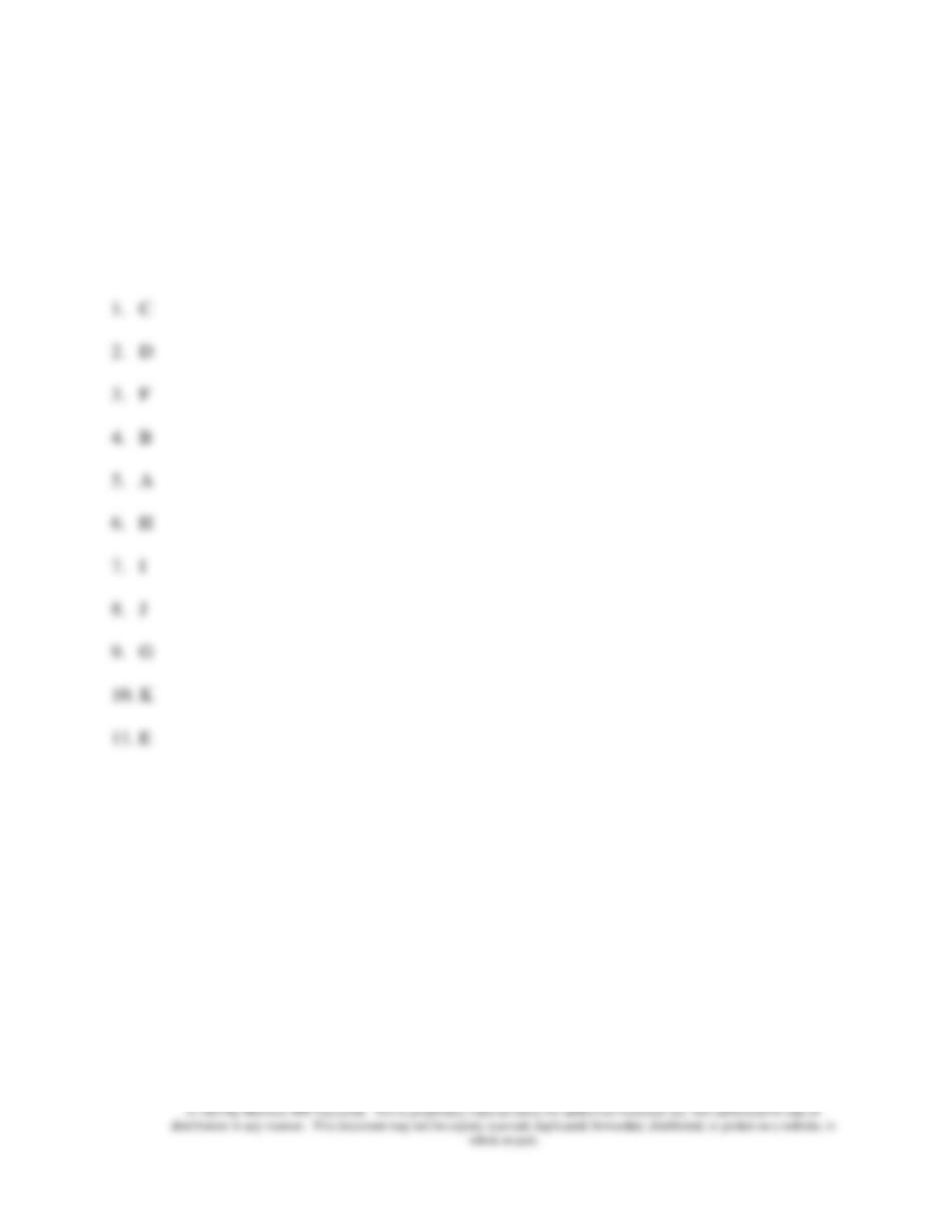
_____ 1. The portion of the sales activity variance attributable to changes in industry volume.
_____ 2. An approach to management requiring that reports emphasize the deviation from an
accepted base point.
_____ 3. A variance that is expected to occur if certain conditions affect operations.
_____ 4. The likely monetary effect from an activity.
_____ 5. The extent to which an item can be managed.
_____ 6. Measures the difference between expected output from a given level of inputs and the
actual output obtained from those inputs.
_____ 7. (Actual price – Standard price) × Actual quantity purchased.
_____ 8. Arises from the relative proportion of different products sold, holding constant the
quantity effects.
_____ 9. Arises from a change in the relative proportion of inputs.
_____ 10. Occurs in multiproduct companies from the change in volume of sales, independent
of any change in sales mix.
Chapter 17 – Additional Topics in Variance Analysis
17–19
_____ 11. The portion of the sales activity variance due to change in the company’s proportion
of sales in the markets in which the company operates.
Answers
Multiple Choice
1. Which of the following statements is incorrect?
a. The industry volume variance is usually more controllable by the marketing department
and is a measure of its performance.
b. The sooner the information is received, the sooner it can be used.
c. The materials efficiency variance is the same regardless of whether the quantities of
materials purchased and used are the same.
d. Using variable costing, the entire fixed production cost is expensed when incurred.
Chapter 17 – Additional Topics in Variance Analysis
17–20
The following information is for questions 2 – 3.
Marketing manager of Jean’s World estimated the sales of 20,000 jeans in August with an
industry volume of 200,000 jeans for the month and the standard contribution margin of $6 per
jean sold. The actual industry sales figure was around 160,000 jeans out of which Jean’s World
sold 18,000 jeans.
2. What is the industry volume variance for the month of August?
a. $24,000 F.
b. $12,000 F.
c. $24,000 U.
d. $28,000 U.
3. What is the market share variance for the month of August?
a. $24,000 U
b. $12,000 U.
c. $18,000 F.
d. $12,000 F.
4. Which of the following statements is incorrect?
a. The sales mix variance measures the impact of substitution.
b. The sales quantity variance measures the variance in sales quantity, holding the sales mix
constant.
c. The sales activity variance can be divided into two components: sales mix and market
share.
d. A sales mix variance provides useful information for a company that sells multiple
products
The following information is for questions 5 – 6.
Toy Kingdom sells two similar products: Big Bear and Little Bear. Data on the two products for
October are as follows.
Big Bear
Little Bear
Standard unit contribution margin
$8
$4
Budgeted sales quantity
2,000
8,000
Actual sales quantity
2,500
7,500
5. What is Little Bear’s sales mix variance?
a. $0.
b. $1,000 F
c. $2,000 U.
d. $2,400 U.
Chapter 17 – Additional Topics in Variance Analysis
17–21
6. What is Big Bear’s sales quantity variance?
a. $0.
b. $1,000 F.
c. $2,000 U.
d. $2,400 U.
The following information is for questions 7 – 8.
Home Lab supplies chemical solutions for high school labs. Its Coloration Kit uses two inputs, A
and B, during production. The standard cost and quantity data follow.
Direct
materials
Standard
price per
gallon
Standard quantity (gallon)
of input per gallon of
Coloration Kit
Chemical A
$10
.4
Chemical B
4
.6
During February, the following results were available:
Units produced
10,000 gallons of Coloration Kit
Materials purchased and used
Chemical A
4,200 gallons at $10.10 per gallon
Chemical B
5,900 gallons at $3.80 per gallon
7. What is the production mix variance for Chemical A?
a. $240 U.
b. $1,600 U.
c. $1,180 F.
d. $420 U.
8. What is the production yield variance for Chemical B?
a. $1,600 U.
b. $240 U.
c. $1,180 F.
d. $420 U.
9. Which of the following statements is correct?
a. The computation of efficiency variance requires a reliable measure of output activity that
is linked to input.
b. By substituting different types of labor, service organizations calculate labor price
variance.
c. In general, jobs with nonroutine tasks lend themselves to efficiency measures
Chapter 17 – Additional Topics in Variance Analysis
17–22
d. Merchandising organizations focus on Cost of goods sold to measure efficiency and
control costs.
10. Which of the following statements is incorrect?
a. Standards are estimates that require updating to reflect current conditions.
b. The issue of impact asks the question, “Can we do something about it?”
c. Only the variances for which the benefits of correction exceed the costs of follow-up
should be investigated.
d. Many variances occur because of errors in recording, bookkeeping adjustments, or timing
problems.
11. The following budget information is available for September.
Products
Unit
contribution
margin
Sales
volume
Standard Set
$6
50,000
Deluxe Set
10
30,000
80,000
What is the composite contribution margin per unit?
a. $8.40.
b. $7.50.
c. $7.20.
d. $6.80.
12. Which of the following statements is incorrect?
a. Management by exception emphasizes materiality.
b. The shorter the time interval, the greater is the ability to control an item.
c. Most variances are controllable in the long run.
d. Planned variance is one that is expected to occur if certain conditions affection operations.
Chapter 17 – Additional Topics in Variance Analysis
17–23
Answers