
Chapter 16 – Fundamentals of Variance Analysis
16–20
a Favorable variances should be credited; unfavorable variances should be debited. The
variances are debited here for illustration only.
• Direct labor
Work–in–process inventory
xx
Direct labor price variance
xx
Direct labor efficiency variance
xx
Wages payable
xx
(To record the purchase and use of direct labor at actual cost and the transfer to work in
process at standard cost)
• Variable manufacturing overhead
Work–in–process inventory
xx
Variable overhead applied
xx
(To record the application of Variable overhead to Work in process on the basis of
standard input allowed)
Variable overhead (actual)
xx
Miscellaneous payables
xx
(To record actual Variable overhead costs)
Variable overhead applied
xx
Variable overhead price variance
xx
Variable overhead efficiency variance
xx
Variable overhead (actual)
xx
(To record Variable overhead variances and close the applied and actual accounts)
• Fixed manufacturing overhead
Work–in–process inventory
xx
Fixed overhead applied
xx
(To record the application of Fixed overhead to Work in process on the basis of
standard input allowed)
Fixed overhead (actual)
xx
Miscellaneous payables
xx

Chapter 16 – Fundamentals of Variance Analysis
16–21
(To record actual Fixed overhead costs)
Fixed overhead applied
xx
Fixed overhead price variance
xx
Fixed overhead production volume variance
xx
Fixed overhead (actual)
xx
(To record Fixed overhead variances and close the applied and actual accounts)
• Transfer to Finished goods inventory
Finished goods inventory
xx
Work–in–process inventory
xx
(To record the transfer to Finished goods inventory at standard cost)
• Transfer to Cost of goods sold
Accounts receivable
xx
Sales revenue
xx
(To record Sales revenue)
Cost of goods sold
xx
Finished goods inventory
xx
(To record Cost of goods sold at standard cost)
• Close out variance accounts to Cost of goods sold
Cost of goods sold
xx
Materials price variance
xx
Materials efficiency variance
xx
Direct labor price variance
xx
Direct labor efficiency variance
xx
Variable overhead price variance
xx
Variable overhead efficiency variance
xx
Fixed overhead price variance
xx
Fixed overhead production volume variance
xx
(To close the variance accounts to Cost of goods sold)

Chapter 16 – Fundamentals of Variance Analysis
16–22
Matching
A.
Cost variance analysis
G.
Price variance
B.
Efficiency variance
H.
Variance
C.
Favorable variance
I.
Static budget
D.
Financial budgets
J.
Standard costing
E.
Flexible budget
K.
Spending variance
F.
Operating budgets
L.
Sales activity variance
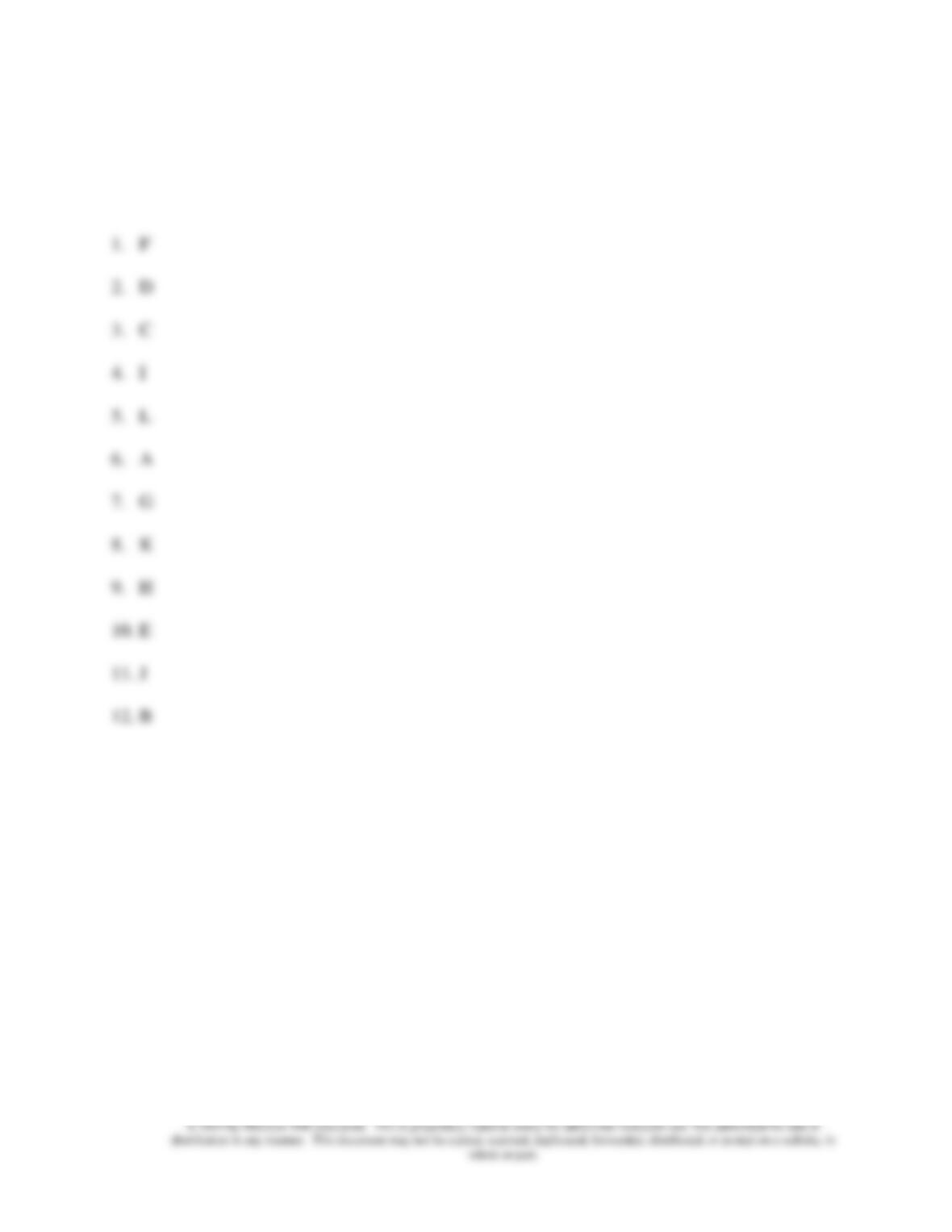
_____ 1. Budgeted income statement, production budget, budgeted cost of goods sold, and
supporting budgets.
_____ 2. Budgets of financial resources, including the cash budget and the budgeted balance
sheet.
_____ 3. Variance that, taken alone, results in an addition to operating profit.
_____ 4. Developed in detail for one level of anticipated activity, such as a master budget.
_____ 5. The difference between operating profit in the master budget and operating profit in
the flexible budget that arises because the actual number of units sold is different
from the budgeted number.
_____ 6. Uses a conceptual model that compares actual input amounts and prices with standard
input amounts and prices.
_____ 7. The difference between actual costs and budgeted costs arising from changes in the
cost of inputs to a production process or other activity.
_____ 8. The difference between the flexible budget and the actual fixed overhead and is
entirely due to changes in the costs that make up fixed overhead.
_____ 9. The difference between planned result and actual outcome.
_____ 10. Indicates budgeted revenues, costs, and profits for virtually all feasible levels of
activities.
_____ 11. An accounting method that assigns costs to cost objects at predetermined amounts.
_____ 12. SP × (AQ – SQ).
Chapter 16 – Fundamentals of Variance Analysis
16–23
Answers
Multiple Choice
1. Which of the following statements is incorrect?
a. Unfavorable variance occurs when actual costs are lower than budgeted costs.
b. The labels “favorable” and “unfavorable” should not be considered as evaluations of
performance without additional investigation.
c. An important part of variance analysis is to understand what might cause a difference
between actual and budgeted results.
d. Variance = Actual result – Budgeted performance.
2. With a planned volume of 15,000 units, the master budget includes variable costs of
$450,000 and fixed costs of $350,000. If the actual volume is 12,000 units, the total costs
under flexible budget should be

Chapter 16 – Fundamentals of Variance Analysis
16–24
a. $490,000.
b. $560,000.
c. $650,000.
d. $710,000.
3. Which of the following is correct regarding sales activity variance?
a. Sales activity variance is driven by the volume difference between actual results and
flexible budget.
b. Variable costs are expected to decrease when volume is higher than planned.
c. Sales activity variance is the difference between operating profit in the master budget and
operating profit in flexible budget.
d. Sales activity variance can be seen on the master budget’s profit-volume line.
4. Which of the following statements is correct?
a. Marketing and administrative cost variances are treated differently from production cost
variances.
b. The fixed production cost variance is the difference between flexible budget and master
budget costs.
c. Variable cost variances are output variances.
d. Profit variance analysis shows the causes of differences between budgeted profits and the
actual profits earned.
The following information is for questions 5 – 8.
Actual results
Budget data
20,000 units produced and sold
19,000 units planned
Direct materials: 62,300
units of input purchased and
used @ $29 per input unit
Direct materials: 3 units of
input allowed per output unit
@ $30 per input unit
$1,806,700
$90
Direct labor: 51,500 hours
used @ $21.50 per hour
1,107,250
Direct labor: 2.5 hours of
input allowed per output unit
@ $20 per hour
50
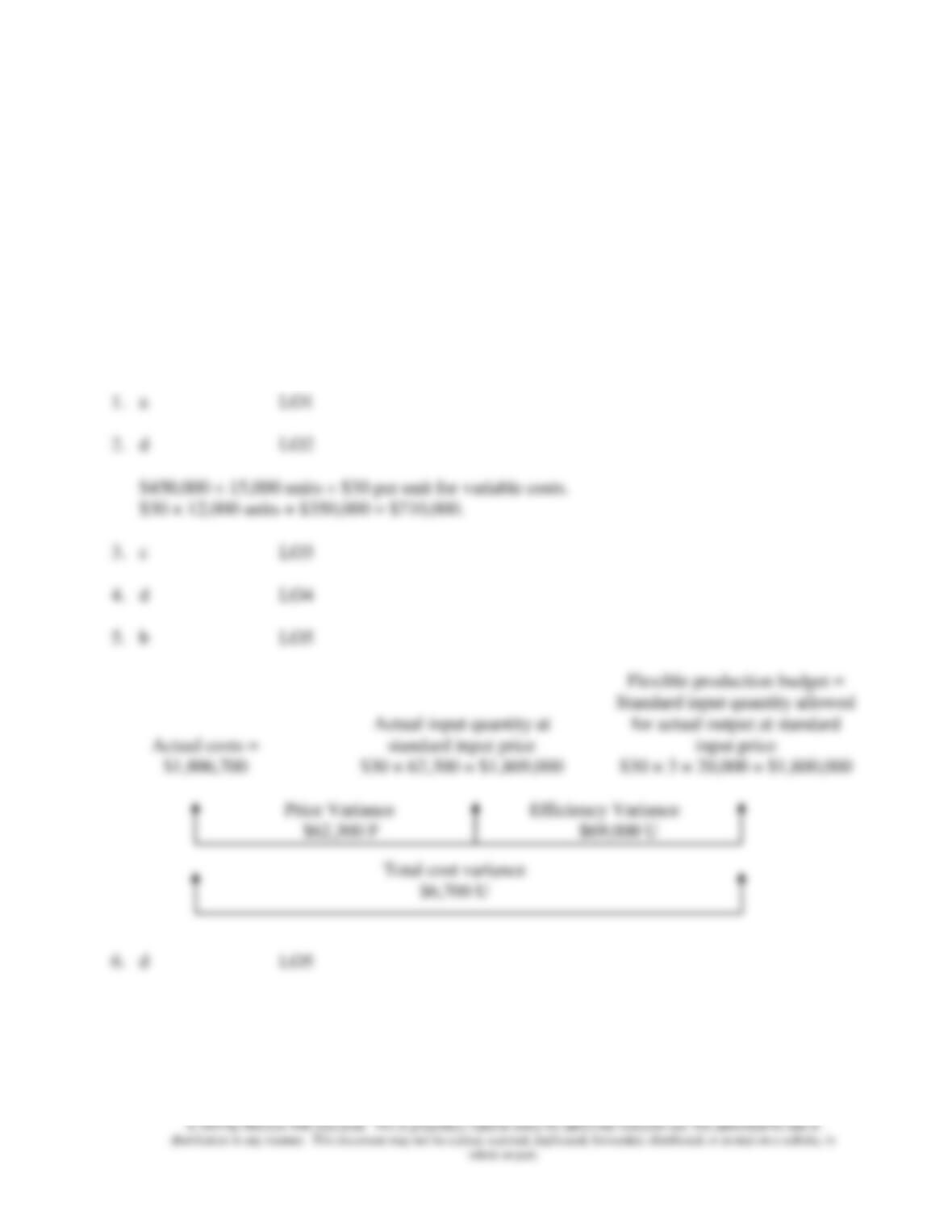
5. What is the materials price variance?
a. $62,300 Unfavorable.
b. $62,300 Favorable.
c. $69,000 Favorable.
d. $77,250 Favorable

Chapter 16 – Fundamentals of Variance Analysis
16–25
6. What is the materials total cost variance?
a. $7,500 Unfavorable.
b. $11,250 Unfavorable.
c. $7,500 Favorable.
d. $6,700 Unfavorable.
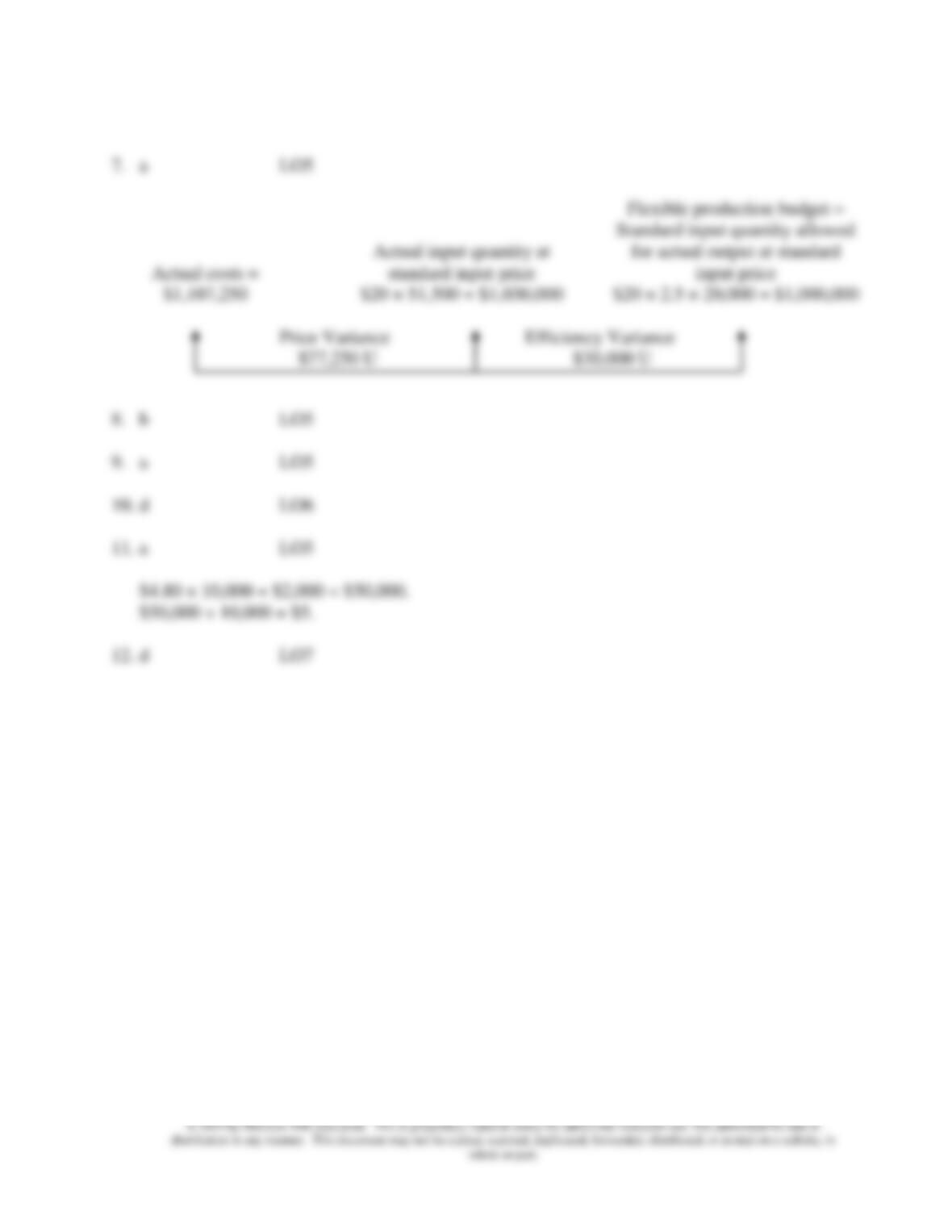
7. What is the labor price variance?
a. $77,250 Unfavorable.
b. $30,000 Unfavorable.
c. $62,300 Favorable.
d. $69,000 Unfavorable.
8. What is the labor efficiency variance?
a. $77,250 Unfavorable.
b. $30,000 Unfavorable.
c. $62,300 Favorable.
d. $69,000 Unfavorable.
9. Which of the following statements regarding variable overhead variances is correct?
a. The variable overhead price variance could have occurred because actual costs are
different from those expected.
b. The relationship between variable production overhead costs and the basis chosen is
perfect.
c. The variable overhead price variance usually contains only the efficiency items.
d. The variable overhead efficiency variance is related to the use of variable costs.
10. Which of the following statements regarding fixed overhead is correct?
a. Production volume variance is the difference between the actual and applied fixed
overhead.
b. When the income statement is prepared using variable costing, there is no absorption of
the fixed costs by units of production.
c. Production volume variance applies only to fixed costs.
d. Both b and c are correct.
11. A company purchased and used 10,000 pounds of materials while incurring $2,000
unfavorable price variance. The standard cost for materials is $4.80 per pound. What was the
actual price of materials per pound?
a. $5.00.
b. $4.90.
c. $5.10.
d. $5.20.
Chapter 16 – Fundamentals of Variance Analysis
16–26
12. Which of the following statements regarding standard costing system is incorrect?
a. The difference between actual costs assigned and the standard costs of the work done
determines the variance.
b. Favorable variances should be credited.
c. The use of standard costs contributes to management control.
d. Standard costing system complicates the costing of inventories.
Answers
Chapter 16 – Fundamentals of Variance Analysis
16–27