
Chapter 13 – Planning and Budgeting
13–18
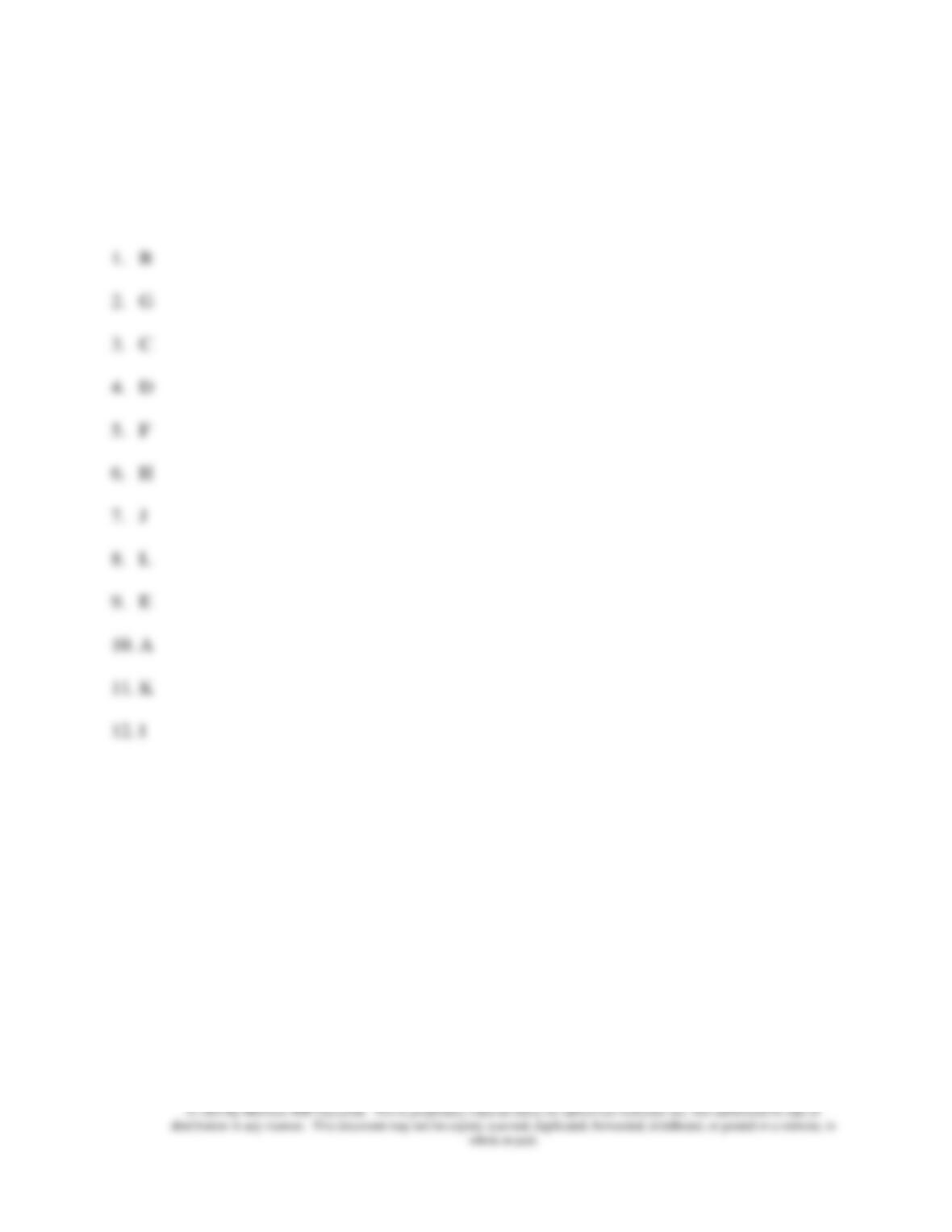
_____ 1. A statement of cash on hand at the start of the budget period, expected cash receipts,
expected cash disbursements, and the resulting cash balance at the end of the budget
period.
_____ 2. A company’s broad objectives established by management that employees work to
achieve.
_____ 3. Strengths of a company that enable it to outperform competitors.
_____ 4. A forecasting method in which individual forecasts of group members are submitted
anonymously and evaluated by the group as a whole.
_____ 5. The financial plan of an organization for the coming year or other planning period.
_____ 6. The use of input from lower- and middle-management employees for budget
preparation.
_____ 7. The income statement portion of the master budget.
_____ 8. A forecasting method that ranges from simple visual extrapolation of points on a
graph to highly sophisticated computerized time series analysis.
_____ 9. Statistical methods of forecasting economic data using regression models.
_____ 10. A financial plan of the resources needed to carry out activities and meet financial
goals.
_____ 11. A statement detailing steps to take to achieve a company’s organization goals.
_____ 12. The production plan of resources needed to meet current sales demand and ensure
that inventory levels are sufficient for future sales.
Chapter 13 – Planning and Budgeting
13–19
Answers
Multiple Choice
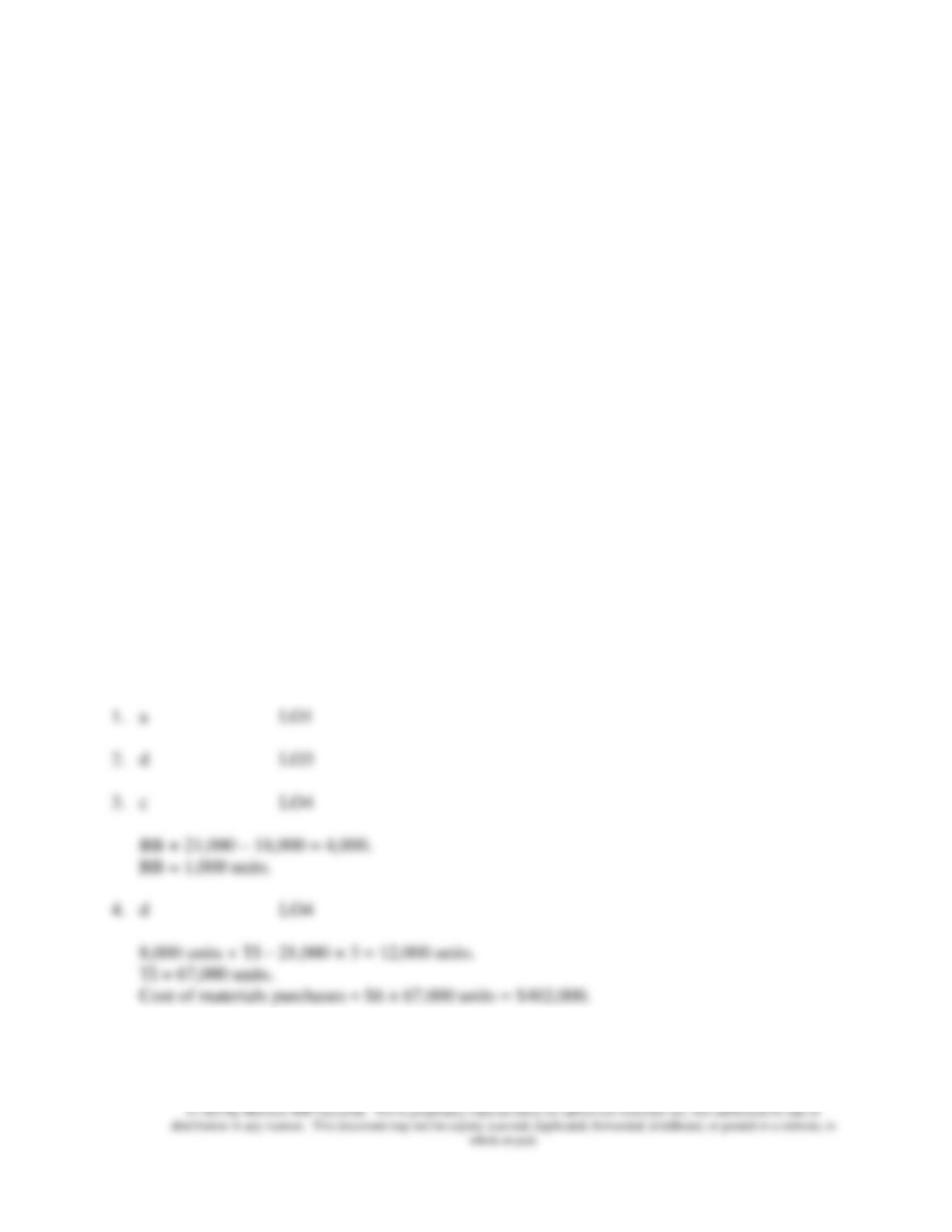
1. Which of the following statements is correct?
a. Critical success factors are strengths of a company that enable it to outperform
competitors.
b. The strategic long-range profit plan is a statement detailing steps to take to achieve a
company’s budget.
c. The master budget is a long-range financial plan of an organization.
d. Budgeting is a static process.

Chapter 13 – Planning and Budgeting
13–20
2. Which of the following method(s) can be used to extract sales forecast?
a. Delphi technique.
b. Trend analysis.
c. Econometric models.
d. All of the above.
3. Jim is preparing the production budget for his company. He estimates that 21,000 units have
to be produced to meet the sales forecast of 18,000 units and the desired ending inventory of
4,000 units. How many units should be in the beginning inventory?
a. 750 units.
b. 800 units.
c. 1,000 units.
d. 1,200 units.
4. For next year, 21,000 units of finished goods have to be produced, each consuming 3 units of
materials at $6. The expected beginning and ending materials inventories are 8,000 units and
12,000 units, respectively. How much is expected to be spent for materials purchases next
year?
a. $360,000.
b. $372,000.
c. $390,000.
d. $402,000.
5. For next year, 21,000 units of finished goods have to be produced, each requiring 1.5 hours
of labor. The prevailing hourly rate is expected to be $12 per hour. What is the direct labor
cost for next year?
a. $332,000.
b. $356,000.
c. $378,000.
d. $412,000.
6. Which of the following statements is incorrect?
a. To simplify the budgeting process, overhead costs are usually divided into fixed and
variable components.
b. Most companies estimate work-in-process inventories.
c. The budget usually undergoes a good deal of coordinating and revising.
d. Budgeting marketing and administrative costs is very difficult because managers have
discretion about how much money is spent and the timing of the expenditures.

Chapter 13 – Planning and Budgeting
13–21
7. The following information is available.
Cash collected from current month’s sales
40%
Cash collected from last month’s sales
55%
Uncollectible sales
5%
100%
The expected credit sales of the second quarter are:
April
$400,000
May
450,000
June
500,000
How much cash will be collected in May?
a. $360,000.
b. $400,000.
c. $420,000.
d. $480,000.
8. The following information is available.
Cash payment for current month’s purchases
30%
Cash payment for last month’s purchases
67%
Cash discount taken
3%
100%
The expected credit purchases of the second quarter are:
April
$180,000
May
250,000
June
300,000
How much cash will be paid in May?
a. $184,500.
b. $195,600.
c. $200,750.
d. $221,400.
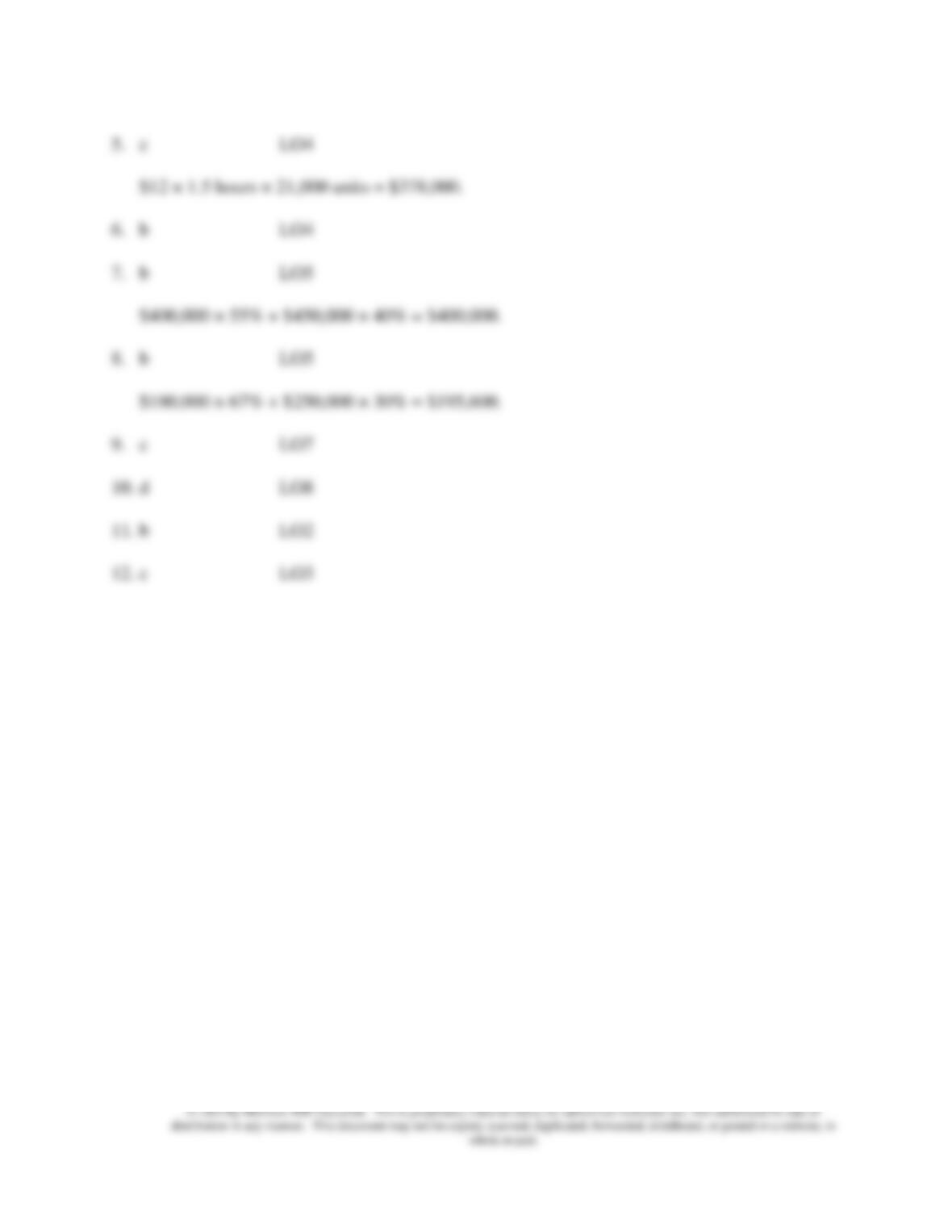
9. Which of the following statements is incorrect?
a. A key difference in the master budget between a service enterprise and a manufacturing
firm is the absence of product or material inventories.
b. Service businesses need to carefully coordinate sales with the necessary labor.
c. The purchase budget in retail and wholesale businesses drives the rest of the budgeted
income statement.
Chapter 13 – Planning and Budgeting
13–22
d. A merchandiser has no production budget.
10. Which of the following statements is correct?
a. Managers and employees provide much of the information for the budget.
b. Performance of managers and employees is compared with the budget they help develop.
c. The company must recognize the trade-off between encouraging unbiased reporting by
managers and the use of this information in performance evaluation and reward.
d. All of the above.
11. Participative budgeting
a. Relies on input from top management for budget preparation.
b. Is also called grass root budgeting.
c. Is efficient and expedient.
d. Prevents employees from accepting the goals of their organization.
12. Which of the following statements is correct?
a. Sales forecast can be done after sales budget is prepared.
b. Market researchers are concerned with short-term sales.
c. Salespeople have an incentive to bias their sales forecasts.
d. Delphi technique encourages participants to identify themselves and foster
communication.
Answers
Chapter 13 – Planning and Budgeting
13–23