
Chapter 13 – Planning and Budgeting
13–11
• An easy and inexpensive way is to start with a previous period’s actual or budgeted
amounts and make adjustments for inflation, changes in operations, and similar changes
between periods.
• Exhibit 13.7 shows a schedule of budgeted marketing and administrative costs. Variable
marketing costs vary with sales. Fixed marketing costs are usually those that can be
changed at management’s discretion.
♦ The budgeting process culminates in the projected operating profits reported in the budgeted
income statement, as shown in Exhibit 13.8.
• The budgeted income statement also includes estimated federal and other income taxes.
• The process will be repeated to see if sales revenue can be increased, or costs cut, until
the desired financial results can be reached.
======================
Demonstration Problem 3
Emerson Manufacturing Company produces two products: Model S and Model Z. The following
income statement shows this year’s operating results.
Emerson Manufacturing Company
Income Statement
For the year ended December 31
Revenue:
Model S
$300,000
Model Z
200,000
$500,000
Cost of goods sold:
Model S
$150,000
Model Z
120,000
(270,000)
Gross margin
$230,000
Operating costs:
Marketing
$60,000
Distribution
50,000
Depreciation
21,000
Administration
30,000
(161,000)
Operating income
$69,000

Chapter 13 – Planning and Budgeting
13–12
Emerson’s management is in the process of preparing next year’s budget. The following
information is under consideration.
1. The selling price of Model S is expected to remain the same, but the units sold will
increase by 6 percent
2. The selling price and units of Model Z will increase by 5 percent and 10 percent,
respectively.
3. As indicated by the suppliers of key components, the cost of each unit sold will increase
by 3 percent.
4. Marketing costs are expected to increase by $20,000.
5. Distribution costs remain the same fixed percentage of total sales revenue.
6. Depreciation costs remain unchanged.
7. A new administrative aide will be hired part time for $25,000.
8. There is no beginning or ending inventory.
Required:
Prepare a budgeted income statement for next year.
Solution: Emerson Manufacturing Company
Budgeted Income Statement
For the budget year ended December 31
Revenue:
Model S
$318,000a
Model Z
231,000b
$549,000
Cost of goods sold:
Model S
$154,500c
Model Z
123,600d
(278,100)
Gross margin
$270,900
Operating costs:
Marketing
$80,000e
Distribution
54,900f
Depreciation
21,000
Administration
55,000g
(210,900)
Operating income
$60,000
a $300,000 × 1.06 = $318,000.
b $200,000 × 1.05 × 1.10 = $231,000.
c $150,000 × 1.03 = $154,500.
d $120,000 × 1.03 = $123,600.
e $60,000 + $20,000 = $80,000.
f $50,000 ÷ $500,000 = 0.1; $549,000 × 0.1 = $54,900.
g $30,000 + $25,000 = $55,000.
Chapter 13 – Planning and Budgeting
13–13
======================
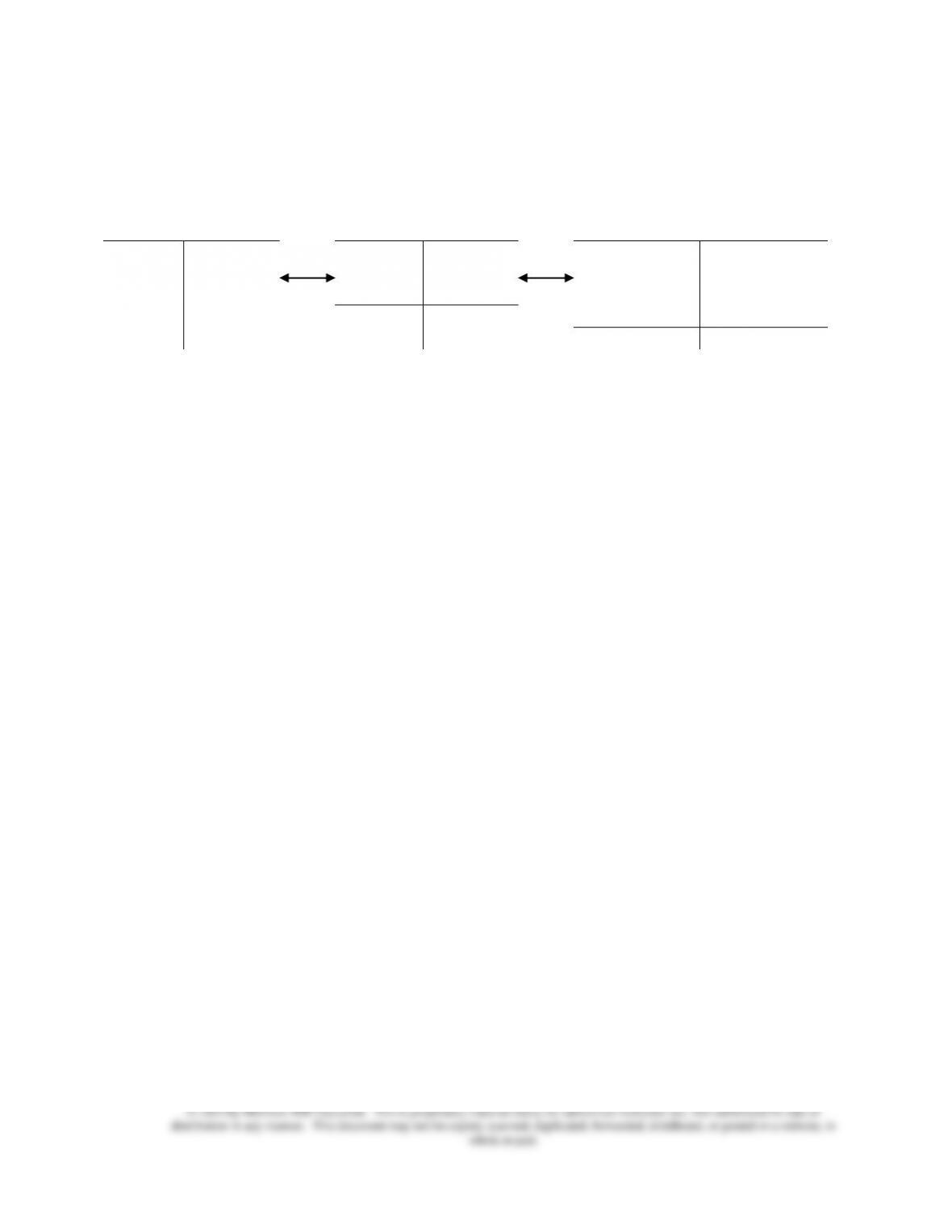
♦ The master budget is rooted in some key relations among sales, accounts receivable, and cash
flows in the sales cycle. That is,
Sales
Accounts receivable
Cash
BB
BB
Budgeted
sales
Budgeted
sales
Collection
Collection on
account
Disbursements
EB
Other receipts
EB
BB and EB refer to beginning and ending balances, respectively. All sales are assumed to be on
account.
• If an amount in the sales cycle is unknown, the basic accounting equation (BB + TI –
TO = EB) can be used to find it.
LO 13-5 Estimate cash flows.
♦ The cash budget refers to a statement of cash on hand at the start of the budget period,
expected cash receipts, expected cash disbursements, and the resulting cash balance at the end of
the budget period.
• Cash budgeting is important to ensure company solvency, maximize interest earned on
cash balances, and determine whether the company is generating enough cash for present
and future operations.
• Preparing a cash budget requires that all revenues, costs, and other transactions be
examined in terms of their effects on cash.
• Cash receipts come from the collection of accounts receivable, cash sales, sale of assets,
borrowing, issuing stock, and other cash-generating activities.
• Cash disbursements are used to pay for materials purchases, manufacturing and other
operations, federal income taxes, and stockholder dividends.
• A cash budget is shown in Exhibit 13.9.
• A more detailed analysis looks at multiperiod cash receipts (Exhibit 13.10) and cash
disbursements (Exhibit 13.11) to ensure that the company will not run out of cash during
the year.

Chapter 13 – Planning and Budgeting
13–14
======================
Demonstration Problem 4
The management at Emerson Manufacturing Company is studying the cash inflow pattern in
preparation for its cash budget. The following information is available.
Cash collected from current month’s sales
40%
Cash collected from last month’s sales
55%
Cash discount taken
2%
Uncollectible sales
3%
100%
For the second quarter of next year, the beginning balance of accounts receivable ($23,000) is
expected to be collected in full in April. The expected credit sales of the second quarter are:
April
$40,000
May
45,000
June
50,000
Required:
Prepare a multiperiod schedule of cash collections for the second quarter of next year.
Solution:
Emerson Manufacturing Company
Multiperiod Schedule of Cash Collections
For the quarter ended June 30
Month
April
May
June
Total
Accounts receivable, April 1
$23,000
$23,000
April credit sales
16,000a
$22,000b
38,000
May credit sales
18,000c
$24,750d
42,750
June credit sales
20,000e
20,000
Total cash collection
$39,000
$40,000
$44,750
$123,750
a $40,000 × 40% = $16,000.
b $40,000 × 55% = $22,000.
c $45,000 × 40% = $18,000.
d $45,000 × 55% = $24,750.
e $50,000 × 40% = $20,000.

Chapter 13 – Planning and Budgeting
13–15
======================
LO 13-6 Develop budgeted financial statements.
♦ Budgeted balance sheets are statements of budgeted financial position.
• Budgeted balance sheets combine an estimate of financial position at the beginning of
the budget period with the estimated results of operations for the period and estimated
changes in assets and liabilities.
• Decision making in these areas is, for the most part, the treasurer’s function.
• Exhibit 13.12 presents budgeted balance sheets at the beginning and end of the budget
period.
♦ A model of the budgeting process for a manufacturing firm is presented in Exhibit 13.13.
• Assembling a master budget is a complex process requiring careful coordination of
many different organization segments.
LO 13-7 Explain budgeting in merchandising and service organizations.
♦ Budgeting is used extensively in different types of organizations.
• As in manufacturing, the sales budget in retail and wholesale (often called
merchandising) businesses drives the rest of the budgeted income statement.
• A merchandiser has no production budget but a merchandise purchases budget, which is
much like the direct materials purchases budget in manufacturing.
• Exhibit 13.14 presents a merchandise purchases budget.
• Because of the critical importance of timing and seasonality in merchandising, special
attention is usually given to short-term budgets. The budget helps formalize an ongoing
process of coordinating buying and selling.
• A key difference in the master budget of a service enterprise is the absence of product
or material inventories. Neither a production budget (for manufacturing firms) nor a
merchandise purchases budget (for merchandising firms) is needed.

Chapter 13 – Planning and Budgeting
13–16
• Service businesses need to carefully coordinate sales with the necessary labor.
Managers must ensure that personnel with the right skills are available at the right times.
Example: Revenue projections for a consulting firm may be based on estimates of the
number and types of clients to be served in the budget year and the amount of services
requested. The forecasts stem primarily from services provided in previous years with
adjustments for new clients, new services to existing clients, loss of clients, and
changes in the rates charged for services.
Once the amount of services is forecast, the firm develops its budget for personnel. The
firm faces a trade-off between not having the staff to do the work and having costly
staff who are underemployed.
• In governmental organizations, the budget serves as an expression of the legislature’s
desires and is a legally binding authorization.
LO 13-8 Explain why ethical issues arise in budgeting.
♦ Budgeting creates serious ethical issues for many people.
• Managers and employees provide much of the information for the budget. Their
performance then is compared with the budget they help develop.
• Part of the problem is the form of the merit pay schedule that creates strong incentives
right around the target.
• The company must recognize the trade-off between encouraging unbiased reporting by
local managers and the use of this information in performance evaluation and reward.
• While the conflict cannot be avoided, managers who are aware of the potential
problems are in a position to take steps to mitigate the consequences.

Chapter 13 – Planning and Budgeting
13–17
LO 13-9 Explain how to use sensitivity analysis to budget under
uncertainty.
♦ Formal planning models allow many alternatives and options to be explored in the planning
process.
• Any projection of the future is uncertain.
• Managers often perform sensitivity analysis on their projections.
• By asking and answering hypothetical questions during the planning phase,
management can determine the risk of various phases of its operations and can develop
contingency plans.
• Local managers can be asked to provide three forecasts of prices and quantities: a best
estimate, an optimistic estimate (an estimate so high that there is only a 10 percent or less
chance that conditions will be better than the optimistic estimate), and a pessimistic
estimate (an estimate so low that there is only a 10 percent or less chance that conditions
will be worse than the pessimistic estimate). Nine possible scenarios can be defined by
selling prices and sales quantity combinations.
• The incorporation of uncertainty into budget estimates can be quite useful.
• Spreadsheets are extremely useful in preparing budgets, which require considerable
what-if thinking.
• Exhibit13.15 shows a spreadsheet analysis of alternative budgeting scenarios.
Matching
A.
Budget
G.
Organization goals
B.
Cash budget
H.
Participative budgeting
C.
Critical success factors
I.
Production budget
D.
Delphi technique
J.
Profit plan
E.
Econometric models
K.
Strategic long-range plan
F.
Master budget
L.
Trend analysis