
Chapter 12 – Fundamentals of Management Control Systems
12-1
Chapter 12
Fundamentals of Management Control Systems
Learning Objectives
1. Explain the role of a management control system.
2. Identify the advantages and disadvantages of decentralization.
3. Describe and explain the basic framework for management control systems.
4. Explain the relation between organization structure and responsibility centers.
5. Understand how managers evaluate performance.
6. Analyze the effect of dual- versus single-rate allocation systems.
7. Understand the potential link between incentives and illegal or unethical behavior.
8. Understand how internal controls can help protect assets.
Chapter Outline
I. WHY A MANAGEMENT CONTROL SYSTEM?
A. Alignment of managerial and organizational interests
B. Evolution of the control problem: An example
II. DECENTRALIZED ORGANIZATIONS
A. Why decentralize the organization?
B. Advantages of decentralization
C. Disadvantages of decentralization
III. FRAMEWORK FOR EVALUATING MANAGEMENT CONTROL SYSTEMS
A. Organizational environment and strategy
B. Results of the management control system
C. Elements of a management control system
1. Delegated decision authority
2. Performance evaluation and measurement systems
3. Compensation and reward systems
D. Balancing the elements
IV. DELEGATED DECISION AUTHORITY: RESPONSIBILITY ACCOUNTING
A. Cost centers
B. Discretionary cost centers

Chapter 12 – Fundamentals of Management Control Systems
12-2
C. Revenue centers
D. Profit centers
E. Investment centers
F. Responsibility centers and organization structure
V. MEASURING PERFORMANCE
A. The two basic questions
B. Cost centers
C. Revenue centers
D. Profit centers
E. Investment centers
VI. EVALUATING PERFORMANCE
A. Relative performance versus absolute performance standards
B. Evaluating managers’ performance versus economic performance of the
responsibility center
C. Relative performance evaluations in organizations
VII. COMPENSATION SYSTEMS
VIII. ILLUSTRATION: CORPORATE COST ALLOCATION
A. Incentive problems with allocated costs
B. Effective corporate cost allocation system
IX. DO PERFORMANCE EVALUATION SYSTEMS CREATE INCENTIVES TO
COMMIT FRAUD?
X. INTERNAL CONTROLS TO PROTECT ASSETS AND PROVIDE QUALITY
INFORMATION
♦ Internal auditing
XI. SUMMARY
Key Concepts
LO 12-1 Explain the role of a management control system.
♦ The cost management system is concerned about providing better information to improve the
decisions made by the managers. The management control system, on the other hand, focuses on
aligning more closely the interests of managers with those of the organization.
• Managers are no longer assumed to make decisions just to benefit the organization; they
also take into consideration the impact of their decisions on their own well-being, which
may not be in line with the organization’s goals.
• The manager is considered a rational, calculating economic actor that has interests that
are not always the same as the organization’s.

Chapter 12 – Fundamentals of Management Control Systems
12-3
♦ When the owner of the business also manages and works for the business, the decisions made
by the manager are in the organization’s interest, by definition.
• When business is growing and professional managers are hired to handle new product
development, deploy a distribution network, promote products, and so on, the decisions
they make are no longer guaranteed to benefit the organization.
• The purpose of a management control system is to help resolve this interest-alignment
problem.
♦ The primary managerial function is decision making.
• Decentralization is the delegation of decision-making authority in the organization’s
name to subordinates.
• When authority is decentralized, a superior (called a principal) delegates duties to a
subordinate (called an agent). This is known as the principal-agent relationship.
Example 1: The following list shows a sample of principals and the corresponding
agents.
Principals
Agents
Stockholders of a company
The company’s board of directors
A company’s board
The company’s CEO
A company’s CEO
The company’s vice presidents
A company’s VP – Finance
The company’s treasurer and controller
Your boss
You
You
Your dentist, stockbroker, travel agent, etc.
• A major role of the management control system is to measure the performance of agents.
• Accounting information can be used in setting conditions of employment contracts, and
employee compensation often is based on accounting performance measures.
LO 12-2 Identify the advantages and disadvantages of decentralization.
♦ Being centralized describes those organizations in which decisions are made by a relatively
few individuals in the high ranks of the organization. At the other extreme, being decentralized
describes those organizations in which decisions are spread among relatively many divisional
and departmental managers.

Chapter 12 – Fundamentals of Management Control Systems
12-4
Centralization: Concentration of decision-
making authority at the top
Decentralization: Decision-
making authority permeates the
organization
• The majority of companies fall between these two extremes. For example, a company
may maintain centralized control over financing and R&D while decentralize operating
decisions among business units.
• Many companies begin with a centralized structure but become more and more
decentralized as they grow.
• Good decisions need good information which, especially for geographically dispersed
organizations, is specific to the local conditions.
• Local knowledge is knowledge about local conditions, markets, regulations, etc.
• The larger and more complex an organization is, the more advantages decentralization
offers.
• Advantages of decentralization include:
(1) Better use of local knowledge. By delegating decision authority to local managers, top
managers are delegating decisions to the managers more likely to possess this local
knowledge.
(2) Faster response. Local managers can react to a changing environment more quickly
than top management can.

Chapter 12 – Fundamentals of Management Control Systems
12-5
(3) Wiser use of top management’s time. Delegation of many decisions allows top
managers to focus on strategic issues.
(4) Reduction of problems to manageable size. By dividing large problems into smaller,
more manageable pieces, decentralization reduces the complexity of problems.
(5) Training, evaluation, and motivation of local managers. Decentralization allows
managers to receive on-the-job training in decision making, to be motivated for
implementing their own decisions, and to be evaluated on the outcomes of smaller
decisions before advancing to make bigger decisions.
• Disadvantages of decentralization include:
(1) Dysfunctional decision making. Local managers may make decisions that are in
their own interests, but not in the best interests of the organization. The costs of
monitoring and controlling the activities of local managers are thus incurred to
alleviate their negative impact on the organization, in addition to the costs that result
when local managers make decisions and take actions that do not benefit the
organization.
(2) Administrative duplication. Often in decentralized firms, there are offices and
managers making the same decisions being made at headquarters.
(3) Poor decisions based on incomplete information. While local information benefits
local decision making, its lack of global perspective (and thus incompleteness) may
damage other business units as a result.
• The advantages (disadvantages) of centralization mirror the disadvantages (advantages)
of decentralization.
• A company must weigh the costs and benefits of decentralization and decide on an
economically optimal level that will change as the organization and the environment
change.
• This chapter emphasizes control systems in decentralized organizations because of the
control problems facing owners when they delegate decision making to subordinates.

Chapter 12 – Fundamentals of Management Control Systems
12-6
LO 12-3 Describe and explain the basic framework for management
control systems.
♦ A management control system is the structure and procedures that the principals (owners) use
to influence agents (managers) of the organization to act in the organization’s interests and to
implement the organization’s strategies.
• Decentralization necessitates the development of a management control system to
reduce the impact of dysfunctional decision making.
• The management control system anticipates the decisions that subordinates will make
and determines whether their interests are aligned with those of the organization.
• The appropriate management control system depends on the environment (as defined by
regulations, customs, and industry characteristics, among other factors) in which the
organization operates.
• The management control system is based on the strategy of the organization and should
influence local managers to take actions that promote the strategy.
• A successful management control system results in higher organization value such as
higher share prices.
• In general, the right management control system will lead to the attainment of the
organization’s goals as articulated in its strategy and circumscribed by the business
environment.
• The role of the management control system is to provide procedures and practices in an
organization that ensure that organization members work to achieve the best results
possible given the strategy and the business environment.
♦ Organizational economics is the study of how firms are structured and operated.
• According to organizational economics literature, management control systems consist
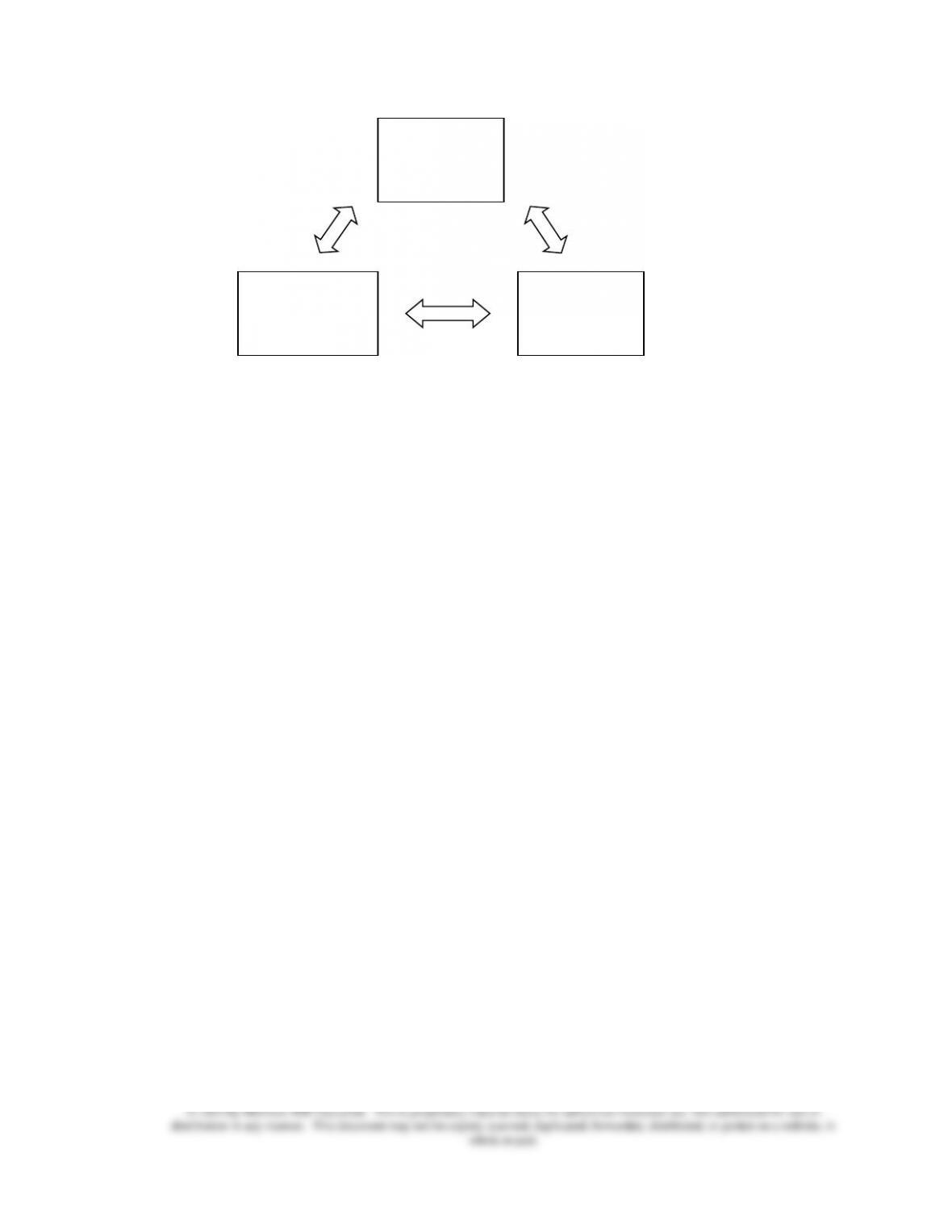
of three interconnected elements:
(1) Delegated decision authority,
(2) Performance evaluation and measurement systems, and
(3) Compensation and reward systems.
Chapter 12 – Fundamentals of Management Control Systems
12-7
• Delegated decision authority is the specification of the authority to make decisions in
the organization’s name. This is the essence of decentralization.
• Performance evaluation and measurement system is a system that specifies how the
performance of the subordinates will be measured and how the results of the
measurement will be used in evaluating the subordinates. Performance measures do not
have to be financial or objective.
• For a division manager, a common performance measure is divisional accounting
income. Other common measures include costs and returns, which can be computed in
different ways. Common nonfinancial measures include customer satisfaction ratings,
defect rates, and delivery times.
• The compensation and reward system defines the specification of how the
subordinates will be compensated for their performance based on a stated measure of
performance.
• Compensation consists of explicit rewards (salary, cash bonus, stock, stock options,
perquisites, etc.) and rewards that are not so explicit (improved promotion opportunities,
respect of peers and superiors, general recognition, etc.)
♦ An effective, well-functioning management control system balances these three elements and
defines them consistently.
Delegated
decision
authority
Performance
evaluation and
measurement
systems
Compensation
and reward
systems

Chapter 12 – Fundamentals of Management Control Systems
12-8
LO 12-4 Explain the relation between organization structure and
responsibility centers.
♦ The cost accounting system in an organization supports the management control system by
structuring accounts to reflect the delegation of decision authority. The structure is then used for
performance evaluation purposes.
• Responsibility accounting is a system of reporting tailored to an organizational
structure so that costs and revenues are reported at the level within the organization
having the related responsibility.
• Responsibility accounting classifies organization units into centers based on the
decision authority delegated to the center’s manager.
• The five basic decentralized units are
(1) cost centers,
(2) discretionary cost centers,
(3) revenue centers,
(4) profit centers, and
(5) investment centers.
• The responsibility accounting classification is useful because it suggests the type of
performance measure appropriate for a center.
• A cost center is an organization subunit responsible only for the cost of an activity for
which a well-defined relationship exists between inputs and outputs.
• Cost centers are often found in manufacturing operations where inputs can be specified
for each output. The concept has been applied to nonmanufacturing settings as well.
• Managers of cost centers are held responsible for the costs and volumes of inputs used
to produce an output.
• If a plant is operated as a cost center, manufacturing cost variances typically are used to
help measure performance.
• A standard cost center is an organization subunit whose manager is held responsible
for costs and in which the relationship between costs and outputs is well defined.
• A discretionary cost center is an organization subunit whose manager is held
responsible for costs when the relationship between costs and outputs is not well
established. Examples of discretionary cost centers are legal, accounting, R&D, and
advertising departments.

Chapter 12 – Fundamentals of Management Control Systems
12-9
• Discretionary cost centers are also common in government and nonprofit organizations
whose budgets are used as a ceiling on expenditures. Managers are often evaluated on
bases other than costs, but penalties usually exist for exceeding the budget ceiling.
• A revenue center is an organization subunit responsible for revenues and typically,
marketing costs.
• Managers of revenue centers are responsible for selling a product and its associated
sales price or sales activity variances.
• A profit center is an organization subunit responsible for profits and thus responsible
for revenues, costs, production, and sales volumes.
• Managers of profit centers have more autonomy than do managers of cost or revenue
centers.
• An investment center is an organization subunit responsible for profits and for
investment in assets.
• Managers of investment centers have relatively large amounts of money with which to
make capital budgeting and other decisions affecting the use of assets.
• Investment centers are evaluated using some measure of profits related to the invested
assets in the center.
• Exhibit 12.1 shows the relationship between organizational structure and responsibility
centers.
• The type of responsibility center is closely related to the manager’s position in the
organizational structure. A broader scope of authority and responsibility is found at
higher levels in an organization.
♦ Total Goal congruence exists when all members of an organization have incentives to perform
in the common interest.
• Goal congruence occurs when the group acts as a team in pursuit of a mutually agreed
upon objective.
• Individual goal congruence occurs when an individual’s personal goals are congruent
with organizational goals.
• Performance evaluation and incentive systems are designed to encourage employees to
behave as if their goals are congruent with organization goals.

Chapter 12 – Fundamentals of Management Control Systems
12–10
• Behavioral congruence exists when individuals behave in the best interest of the
organization regardless of their own goals.
• Some managers may have incentives to not take risks that might benefit the firm, other
managers may have incentives to take excessive risks that can threaten the existence of a
firm.
• Although such conflicts cannot be totally removed, they can be minimized if they are
recognized.
• Managers must address two questions when designing their performance evaluation
systems:
(1) Does the measure reflect the results of the actions that improve the organization’s
performance?
(2) What actions can be taken to improve reported performance, but are detrimental to
organizational performance?
♦ Performance measures for responsibility centers and other considerations:
• Ideally, managers should design performance evaluation systems to reward people for
doing the right thing.
• At the most basic level, managers should design systems that do not punish people for
doing the right things.
• No accounting measures can fully measure the performance of an organizational unit or
its manager. The higher the responsibility center is located in organization structure, the
broader the range of performance measures will be adopted.
• The performance of cost centers is typically measured based on the costs incurred.
• For discretionary cost centers, the relationship between costs and output is not clear and
the performance measures are difficult to define. Therefore it is difficult to provide
incentives for employees to perform at the levels that best achieve organization goals.
• Managers of discretionary cost centers are typically given a budget and instructed not to
exceed it without higher-level authorization. Two potential problems follow:
(1) Suboptimal behavior. Managers have incentives to spend all of their budgets even if
some savings could be achieved in order to support their request for the same or
higher budgets in the following year.