Chapter 11 – Service Department and Joint Cost Allocation
11–20
• It is important to note that the allocation of the joint costs is irrelevant for the current
decision. The only costs and revenues relevant to the decision are those that result from it.
======================
Demonstration Problem 8
(Continued from Demonstration Problems 5 and 6)
Products M1 and M2 can be sold immediately after the split-off point. They can also be
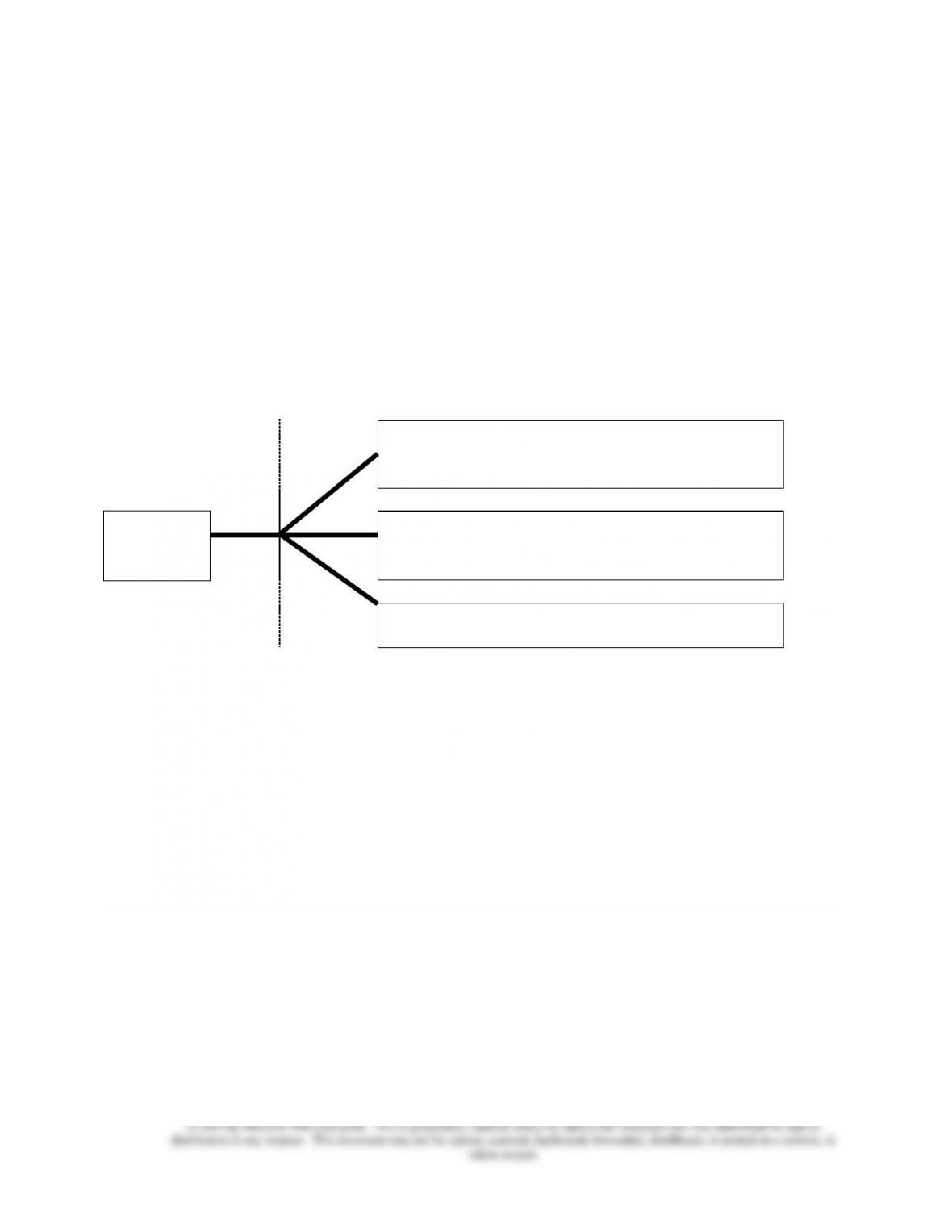
processed further and sold at higher prices. The following diagram shows the process.
M1
Sale value at the split-off point $200,000
Processing cost $120,000, New sale value $300,000
Joint costs
$450,000
M2
Sale value at the split-off point $300,000
Processing cost $80,000, New sale value $400,000
M3
Sale value $500,000
Required:
Determine whether to sell M1 and M2 right after the split-off point, or process them further
to be sold at higher prices.
Solution:
Processing M1 further will reduce profit by $20,000 while processing M2 further will
increase profit by $20,000. It is beneficial to sell M1 right after the split-off point and process
M2 further to improve revenue.
======================
Product
Sale value at
split-off point
(1)
Sale value after
processing
(2)
Processing
cost
(3)
Margin
(4) = (2) – (3)
Additional profit
from processing
further
(4) – (1)
M1
$200,000
$300,000
$120,000
$180,000
$(20,000)
M2
300,000
400,000
80,000
320,000
20,000

Chapter 11 – Service Department and Joint Cost Allocation
11–21
LO 11–10 Account for by-products.
♦ By-products are outputs from a joint production process that are relatively minor in quantity
and/or value when compared to the main products.
• By-product accounting attempts to reflect the economic relationship between the by-
products and the main products with a minimum of recordkeeping for inventory valuation
purposes.
• Two common methods of accounting for by-products are:
(1) The net realizable value from sale of the by-products is deducted from the joint cost
of the main product(s). The remaining joint costs are allocated to the main products.
(2) The proceeds from sale of the by-products are treated as other revenue. All joint costs
are allocated to the main products.
• A complication can arise under both methods if the cost of processing by-products
occurs in one period but they are not sold until the next period. Companies may find it
necessary to keep an inventory of the by-product processing cost in the Additional by-
product cost account until the by-products are sold.
• Some companies expense the by–products’ costs in the period they are incurred and then
record the total revenue from by-products when they are sold, a simple approach that
technically violates the matching principle.
======================
Demonstration Problem 9
(Continued from Demonstration Problem 5)
Superior Refinery produces oil products in a joint production process. For the month of October,
$450,000 of materials, labor, and overhead were added to produce the three main products: M1,
M2, and M3. The sale values were available right after the split-off point.
Superior Refinery also produced a by-product, B, in October that was sold for $30,000. The
following diagram shows the process.
M1
Sale value $200,000
Joint costs
M2

Chapter 11 – Service Department and Joint Cost Allocation
11–22
$450,000
Sale value $300,000
M3
Sale value $500,000
B
Sale value $30,000
Required:
Discuss the accounting treatments for the by-product.
Solution:
There are two methods of accounting for by-products. The first method deducts the net
realizable value from sale of the by-products from the cost of the main products, as shown
below.
Total costs to be allocated = Joint costs – Net realizable value from the by-product, or
$420,000 = $450,000 – $30,000.
Product
Sale value
Proportion
Allocation
M1
$200,000
20%a
$84,000b
M2
300,000
30%
126,000
M3
500,000
50%
210,000
Total
$1,000,000
$420,000
a 20% = $200,000 ÷ $1,000,000.
b $84,000 = $420,000 × 20%.
The second method treats the proceeds from sale of the by-product as other revenue. The
joint costs will be allocated to the main products without adjustment, as in Demonstration
Problem 5.
======================
LO 11–11 (Appendix) Use spreadsheets to solve reciprocal cost allocation
problems.
♦ The reciprocal method requires that cost relationships be written in equation form. The method
then solves the equations for the total costs to be allocated to each department.

Chapter 11 – Service Department and Joint Cost Allocation
11–23
• For any department (both service and production), the following equation applies:
Total costs = Direct costs + Allocated costs.
• The total costs are the unknowns that will be solved.
• The analysis can be expanded to any number of service departments and production
departments.
• The set of equations can be rewritten and expressed in matrix form, and solved using
the matrix functions of a spreadsheet program such as Microsoft Excel.
• The process has three steps:
Step 1. The coefficients of the service matrix are entered.
Step 2. The inverse of the service matrix is computed.
Step 3. Multiply the inverse matrix by the vector (or array) of direct costs of the
departments.
[Assign Problem 11-45]
Matching
A.
Direct method
G.
Service department
B.
Estimated net realizable value
H.
Split-off point
C.
Final cost center
I.
Step method
D.
Joint cost
J.
User Department
E.
Physical quantities method
K.
By-products
F.
Reciprocal method
L.
Intermediate cost center
_____ 1. The method to allocate service department costs that recognizes all services provided
by any service department, including services provided to other service departments.
_____ 2. The stage of processing when two or more products are separated.
_____ 3. Allocates joint costs based on measurement of the volume, weight, or other physical
measure of the joint products at the split-off point.
_____ 4. Outputs from a joint production process that are relatively minor in quantity and/or
value when compared to the main products.

Chapter 11 – Service Department and Joint Cost Allocation
11–24
_____ 5. Sales price of a final product after further processing less the additional processing
costs necessary to prepare a product for sale.
_____ 6. The method of service department cost allocation that allocates some service
department costs to other service departments.
_____ 7. A cost center, such as a production or marketing department, whose costs are not
allocated to another cost center.
_____ 8. Uses the functions of service departments.
_____ 9. A cost of a manufacturing process with two or more different outputs.
_____ 10. A cost allocation method that charges costs of service departments to user
departments without making allocations between or among service departments.
_____ 11. Any cost center whose costs are charged to other departments in the organization.
_____ 12. Provides services to other departments in the organization.
Answers

Chapter 11 – Service Department and Joint Cost Allocation
11–25
© 2014 by McGraw-Hill Education. This is proprietary material solely for authorized instructor use. Not authorized for sale or
distribution in any manner. This document may not be copied, scanned, duplicated, forwarded, distributed, or posted on a website, in
whole or part.
10. A
11. L
12. G
Multiple Choice
1. Which of the following statements is incorrect?
a. Service departments provide services to other departments.
b. Service departments are not the same as user departments.
c. An intermediate cost center is any cost center whose costs are charged to other
departments.
d. A final cost center is any cost center whose costs are not allocated to other cost centers.
The following information is for questions 2 – 6.
A company has two service departments (S1 and S2) and two manufacturing divisions (M1 and
M2). The following information is available.
Proportion of services provided to:
Costs
incurred
Service
department
S1
S2
M1
M2
$290,000
S1
–
20%
30%
50%
500,000
S2
50%
–
20%
30%
2. Using the direct method, what proportion of S1’s costs will be allocated to M2?
a. 20%.
b. 37.5%.
c. 50%.
d. 62.5%.
3. Using the direct method, how much of the service department costs will be allocated to M1?
a. $195,250.
b. $205,750.
c. $308,750.
d. $326,450.

Chapter 11 – Service Department and Joint Cost Allocation
11–26
4. Using the step method, how much of the service department costs will be allocated to M1?
a. $243,000.
b. $265,700.
c. $295,400.
d. $302,500.
5. Using the reciprocal method, how should the total service department costs of S1 be
expressed?
a. S1 = $290,000 + .5 × S2.
b. S1 = $290,000 + .2 × S2.
c. S1 = $290,000 + .3 × S2.
d. S1 = $500,000 + .5 × S2.
6. Using the reciprocal method, how much of the service department costs will be allocated to
M1?
a. $241,000.
b. $286,000.
c. $304,000.
d. $403,000.
The following information is for questions 7 – 9.
A joint production process that cost $240,000 generated two main products. P1 has 15,000 units
and can be sold at the split-off point for $300,000. P2 has 25,000 units and can be sold at the
split-off point for $200,000. A by-product can be sold for $30,000.
7. Using the net realizable value method, how much of the joint costs would be allocated to P1?
a. $120,000.
b. $144,000.
c. $156,000.
d. $183,000.
8. Using the physical quantities method, how much of the joint costs would be allocated to P1?
a. $90,000.
b. $120,000.
c. $150,000.
d. $180,000.
9. If the sale value of the by-product is deducted from the joint costs of the main products, how
much is P1’s share of the total costs?
a. $126,000.
b. $216,000.
c. $105,000.
d. $184,000.
Chapter 11 – Service Department and Joint Cost Allocation
11–27
10. The relevant data for deciding whether to process further are
a. Additional revenue after further processing.
b. Joint costs.
c. Additional costs of processing further.
d. Both a and c.
11. Which of the following is not a service department?
a. Human resources.
b. Accounting.
c. Mailroom.
d. Production.
12. Which of the following allocation methods does not consider any mutual support among
service departments?
a. Step method.
b. Direct method.
c. Reciprocal method.
d. None of the above.
Answers
Chapter 11 – Service Department and Joint Cost Allocation
11–28
© 2014 by McGraw-Hill Education. This is proprietary material solely for authorized instructor use. Not authorized for sale or
distribution in any manner. This document may not be copied, scanned, duplicated, forwarded, distributed, or posted on a website, in
whole or part.
6. c LO4
S1 = $290,000 + .5 × S2.
S2 = $500,000 + .2 × S1.
S1 = $600,000 and S2 = $620,000.
$304,000 = $600,000 × 30% + $620,000 × 20%.
7. b LO7
$144,000 = $240,000 ×
$300,000
$300,000 + $200,000
.
8. a LO8
$90,000 = $240,000 ×
15,000
15,000 + 25,000
.
9. a LO10
$126,000 = ($240,000 – $30,000) ×
$300,000
$300,000 + $200,000
.
10. d LO9
11. d LO1
12. b LO2, LO3, LO4