Chapter 02 – Understanding How Economics Affects Business
2-70
critical
thinking exercises
Name: ___________________________
Date: ___________________________
critical thinking exercise 2-1
KNOW YOUR HISTORY OF ECONOMICS
Go to the Internet and look up the following economists: Adam Smith, Jeremy Bentham, David
Ricardo, and T. R. Malthus. Choose one of these economists and answer the following questions that de-
scribe their contributions to the field of economics.
1. Describe the personality of your chosen economist.
2. What major contributions did this chosen economist contribute to the field of economics regard-
ing:
a. Microeconomics
b. Macroeconomics
3. How does the works of your chosen economist have any relevance to our economy today?
4. How did your chosen economist further the field of economic study?
Chapter 02 – Understanding How Economics Affects Business
2-71
Name: ___________________________
Date: ___________________________
critical thinking exercise 2-2
APPLYING ECONOMIC PRINCIPLES TO EDUCATION
Recently, the U.S. Supreme Court ruled that cities could have voucher programs that give money
directly to parents, and the parents can then choose between competing schools: public and private. The
idea for promoting such a ruling was to create competition among schools. As with businesses, schools
were expected to improve their products (how effectively they teach) to win students from competitors.
Supposedly, that would mean an improvement in all schools, private and public, and would benefit many
students.
1. Do you believe that such economic principles apply in both private and public organizations? Be
prepared to defend your answer.
2. Are there other public functions that might benefit from more competition, including competition
from private firms?

Chapter 02 – Understanding How Economics Affects Business
2-72
Name: ___________________________
Date: ___________________________
critical thinking exercise 2-3
FINDING THE EQUILIBRIUM POINT
In 2014, Knight Electronics sold 350,000 digital video recorders (DVRs). Based on the compa-
ny’s analysis of the DVR market, the company believed that $160 was the equilibrium price based on the
following supply and demand schedules.
2014 Price Amount Supplied Amount Demanded
$120 290,000 390,000
140 320,000 370,000
160 350,000 350,000
180 380,000 330,000
200 410,000 310,000
220 440,000 290,000
As the price of gasoline rose and the economy hit the skids, consumers began driving less and go-
ing out less frequently for entertainment. With more people staying at home, DVR usages increased. In
2015 Knight revised its estimate of the amount of product demanded. At each of the above price points, it
estimates that consumers will purchase (demand) 50,000 more DVRs. For instance, at $140, now 420,000
DVRs will be sold. The price–amount supplied relationship remains the same.
1. Describe what has happened to the supply and demand curves for Knight DVRs in 2014.
2. What is the new equilibrium price?
3. How many DVRs will be produced at the new equilibrium price?
4. Knight revised its estimate of the amount of product demanded for 2015 as described above. In
2016 a new technology became available enabling DVRs to communicate over cell phones and
the Internet. Knight’s competitors are selling this new DVR, called SuperDVR, for $150. What
will happen to the supply and demand curves for Knight DVRs now?
Chapter 02 – Understanding How Economics Affects Business
2-73
notes on critical thinking exercise 2-3
1. Describe what has happened to the supply and demand curves for Knight DVRs in 2014.
2. What is the new equilibrium price?
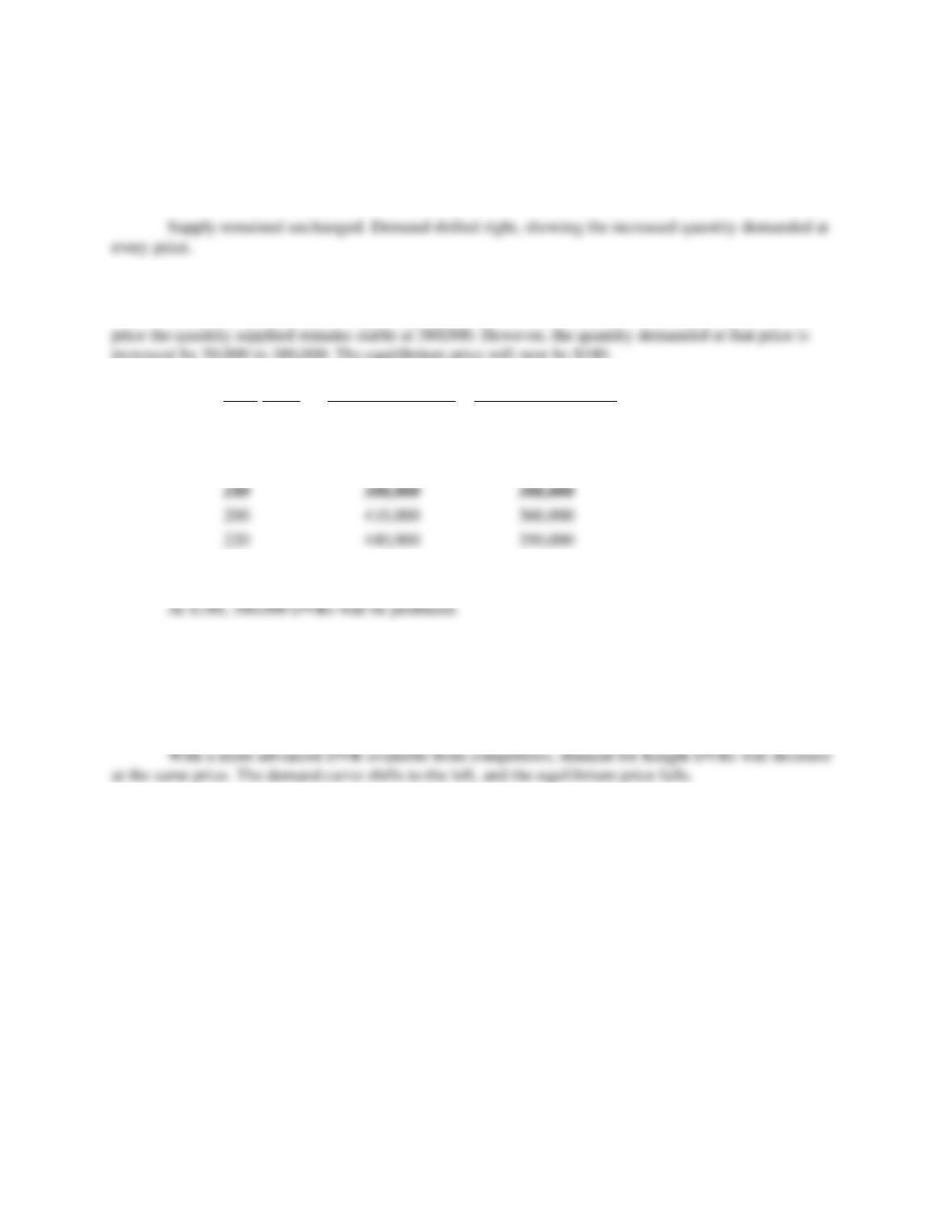
The quantity demanded and quantity supplied are now identical at $180, a higher price. At that
increased by 50,000 to 380,000. The equilibrium price will now be $180.
2014 Price Amount Supplied Amount Demanded
$120 290,000 440,000
140 320,000 420,000
160 350,000 400,000
3. How many DVRs will be produced at the new equilibrium price?
4. Knight revised its estimate of the amount of product demanded for 2015 as described above. In
2016 a new technology became available enabling DVRs to communicate over cell phones and
the Internet. Knight’s competition are selling this new DVR, called SuperDVR, for $150. What
will happen to the supply and demand curves for Knight DVRs now?

Chapter 02 – Understanding How Economics Affects Business
2-74
Name: ___________________________
Date: ___________________________
critical thinking exercise 2-4
STANDARD OF LIVING COMPARISON
Is the standard of living different in capitalist, socialist, and communist economies? Which eco-
nomic system provides the highest standard of living? One way of answering these questions is by com-
paring economic data you might find in the library or on the Internet. (Hint: Try the CIA website.)
Choose one capitalist country, one socialist country, and one communist country. Use the following chart
to record your findings.
CAPITALIST
COUNTRY
SOCIALIST COUN-
TRY
COMMUNIST
COUNTRY
Country Chosen
Gross Domestic
Product
Consumer Prices
Unemployment Rate
Average Income
Average Education
Chapter 02 – Understanding How Economics Affects Business
2-75
bonus
case
bonus case 2-1
FOUNDATIONS OF THE CAPITALIST SYSTEM
Throughout the history of capitalism there has been one persistent criticism: The whole system
seems to be based on selfishness⎯the more one works, the more one prospers. If a person is unable to
work, the system seems to have no answer to his or her problems. Furthermore, there does not seem to be
any moral or spiritual foundation to the system. Where do businesses get their values? What about con-
cepts such as sharing, helping neighbors, and protecting the environment?
It is important to make a distinction between plain capitalism and democratic capitalism. Demo-
ist” countries headed by right-wing dictators that do not have democratic capitalism and do not have the
relative prosperity and social justice that we have in the United States.
Let’s explore democratic capitalism in more detail so that you can understand how the system
works. One of the most important elements of democratic capitalism is its moral and spiritual base. When
the United States was being settled, there was so much religious debate and rivalry among religions that
people were tortured and killed for their beliefs. When it came time to establish a free and separate United
States, however, the founding fathers were adamant about freedom of religion. They were very religious
people themselves.
Thomas Jefferson was proud of his religious heritage and his fight for religious freedom in the
United States He asked that his epitaph read: “Author of the Declaration of Independence, of the Statute
of Virginia for Religious Freedom, and Father of the University of Virginia.” Jefferson felt that freedom
of religion was one of his most important contributions. He felt it was as important as being president of
the United States.
Democratic capitalism cannot work effectively and fairly without all three components. With all
three, the democratic capitalist system can become the fairest and most equitable economic system in the
world. Not everyone agrees on the role of government in the democratic system and on how much of the
total gross national product the government should control. (Recent history indicates that somewhere be-
tween 20% and 25% of GDP gives the government the funds it needs to create more social justice and
more equitable distribution of wealth.) A freely elected government is important to democratic capitalism
because if the people feel that the system is not fair, they can elect new politicians to change the rules.
Chapter 02 – Understanding How Economics Affects Business
2-76
discussion questions for bonus case 2-1
1. Do you see any evidence that the moral, ethical, and spiritual foundation of the American demo-
cratic capitalist system is eroding? How does that affect the ability of capitalist proponents to
promote capitalism in other countries such as China and India?
2. Why is it so necessary to have a freely elected government for democratic capitalism to create a
prosperous and fair economy?
3. Go through the three components of democratic capitalism and picture an economy without each
one. What happens to freedom, fairness, and moral and ethical behavior? Which part of the sys-
tem seems weakest today? What can be done about it?
notes on discussion questions for bonus case 2-1
1. Do you see any evidence that the moral, ethical, and spiritual foundation of the American demo-
cratic capitalist system is eroding? How does that affect the ability of capitalist proponents to
promote capitalism in other countries such as China and India?
When one of the authors was in elementary school, the codes of what was moral forbid him to see
The Moon Is Blue because the movie used the word virgin in it. Now movies include more adult language
and more violence and sexual content. In fact, many such movies are now available in prime time on TV.
2. Why is it so necessary to have a freely elected government for democratic capitalism to create a
prosperous and fair economy?
Because any kind of dictatorship hinders the operation of free markets, or at least tends to do so.
3. Go through the three components of democratic capitalism and picture an economy without each
one. What happens to freedom, fairness, and moral and ethical behavior? Which part of the sys-
tem seems weakest today? What can be done about it?
Without free enterprise, shortages develop and the whole economy tends to slow. Poverty, hunger

Chapter 02 – Understanding How Economics Affects Business
2-77
endnotes
i Sources: Peter Coy, “If Demography Is Destiny, Then India Has the Edge,” Bloomberg Businessweek, January 13,
2011; Madelene Pearson and Malavika Sharma, “Where Are India’s Skilled Laborers?” Bloomberg Businessweek,
January 6, 2011.
ii Source: Peter Wonacott, “A New Class of Consumers Grows in Africa,” The Wall Street Journal, May 2, 2011.
iii Source: Joshua Zumbrun, More Americans Work in the Underground Economy,” Bloomberg BusinessWeek,
March 28, 2013.
iv Source: Josh Zumbrun, “Sex, Drugs and GDP: the Challenge of Measuring the Shadow Economy,” The Wall
Street Journal, June 8, 2014.
v Sources: Mike Moffatt, “A Beginner’s Guide to Economic Indicators,” About.com, May 16, 2006; “Economic
Indicators,” Investopedia.com; “Leading Indicators Index Shows Economy Braking,” The Clarion-Ledger, May 19,
2006, p. 3C; and “Economic Indicators,” GPOAccess, Council of Economic Advisors, www.gpoaccess.gov.
vi Source: Zachary Karabell, “It’s an Old Numbers Game. What if They’re Wrong?” The Washington Post, April 19,
2013.
vii Sources: Howard Schneider, “Honda Becomes a U.S. Exporter,” The Washington Post, January 29, 2014.
viii Sources: Tom Raym “The D–Word: Will Recession Become Something Worse?” ABC News, March 2, 2009; and
“Fed’s Yellen: Economy Similar to Great Depression,” CNNMoney.com, February 7, 2009.