Suggested answers to questions and problems
1. Disagree. Borrowing from foreign lenders provides a net gain to the borrowing country,
as long as the money is used wisely. For instance, as long as the money is used to
2. Disagree. In a sense a national government cannot go bankrupt, because it can print its
own currency. But a national government can refuse to honor its obligations, even if it
3. The surge in bank lending to developing countries during 1974–1982 had these main
causes: (1) a rise in bank funds from the “petrodollar” deposits by newly wealthy
oil-exporting governments; (2) bank and investor concerns that investments in
4. The debt crisis in 1982 was precipitated by (a) increased cost of servicing debt, because
of a rise in interest rates in the United States and other developed countries as tighter
monetary policies were used to fight inflation, (b) decreased export earnings in the debtor
5. a. World product without international lending is the shaded area. We first need to calculate
the intercepts for the two MPK lines. The negative of the slope of MPKJapan is 1 percent per
600, so the intercept for Japan is 12 percent. The “negative” of the slope of MPKAmerica is
also 1 percent per 600, so the intercept for America is about 14.7 percent. Japan’s product is
b. Free international lending adds area RST (54), so total world product rises to 928.
c. The 2 percent tax results in a loss of area TUV (6), so total world product falls to 922.
166
© 2016 by McGraw-Hill Education. This is proprietary material solely for authorized instructor use. Not authorized for sale or distribution in
any manner. This document may not be copied, scanned, duplicated, forwarded, distributed, or posted on a website, in whole or part.
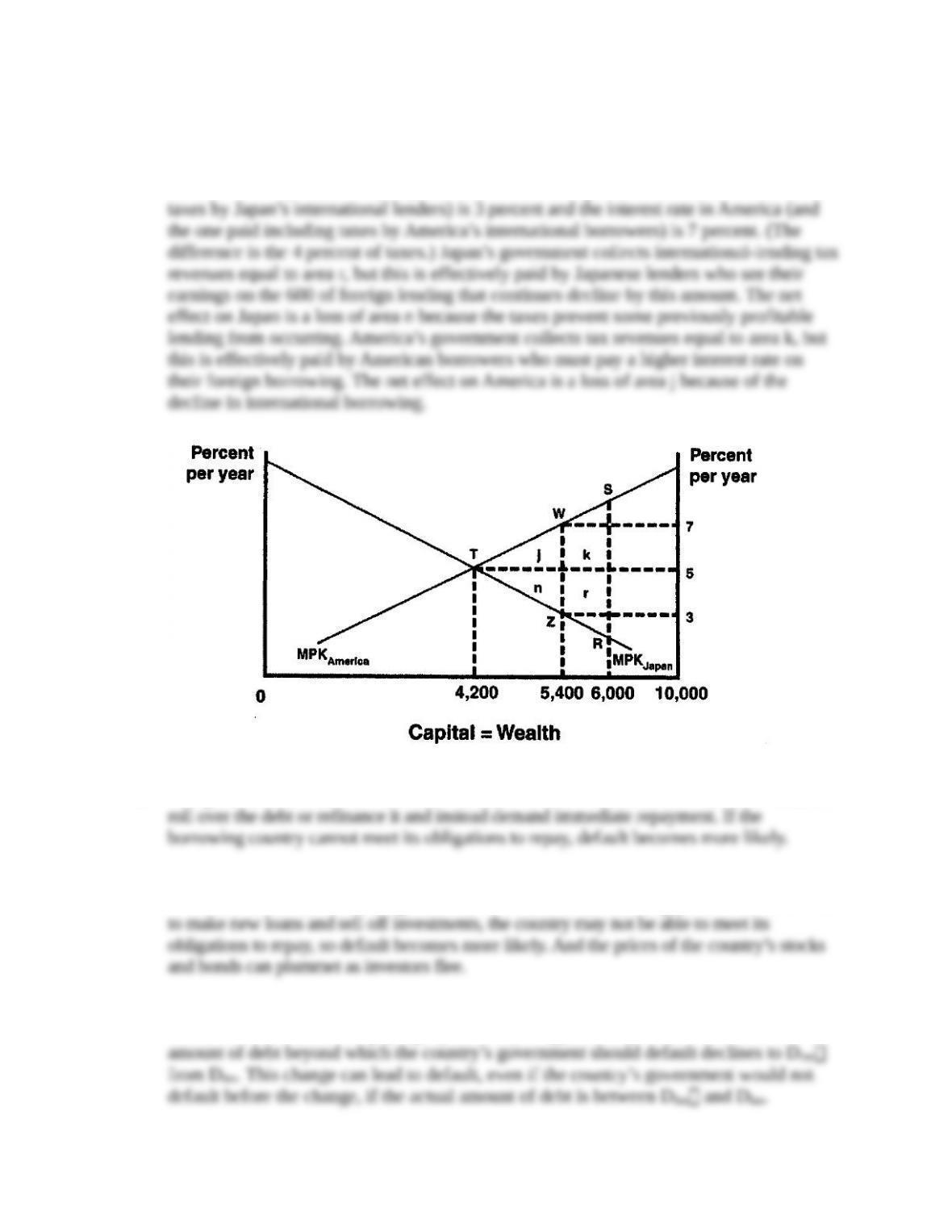
6. With free international lending Japan lends 1,800 (= 6,000 − 4,200) to America, at point
T. If Japan and America each impose a 2 percent tax on international lending, the total tax
is 4 percent. The gap WZ restores equilibrium, and the amount lent internationally
declines to 600 (= 6,000 − 5,400). The interest rate in Japan (and the one received net of
7. a. A large amount of short-term debt can cause a financial crisis because lenders can refuse to
b. Lenders can become concerned that other countries in the region are also likely to be hit
with financial crises. This contagion can then become a self-fulfilling panic. If lenders refuse
8. a. The increase in the interest rate rotates the line showing the debt service due, which is
also the benefit from not repaying, upward to (1 + i)D from (1 + i)D. The threshold
167
© 2016 by McGraw-Hill Education. This is proprietary material solely for authorized instructor use. Not authorized for sale or distribution in
any manner. This document may not be copied, scanned, duplicated, forwarded, distributed, or posted on a website, in whole or part.
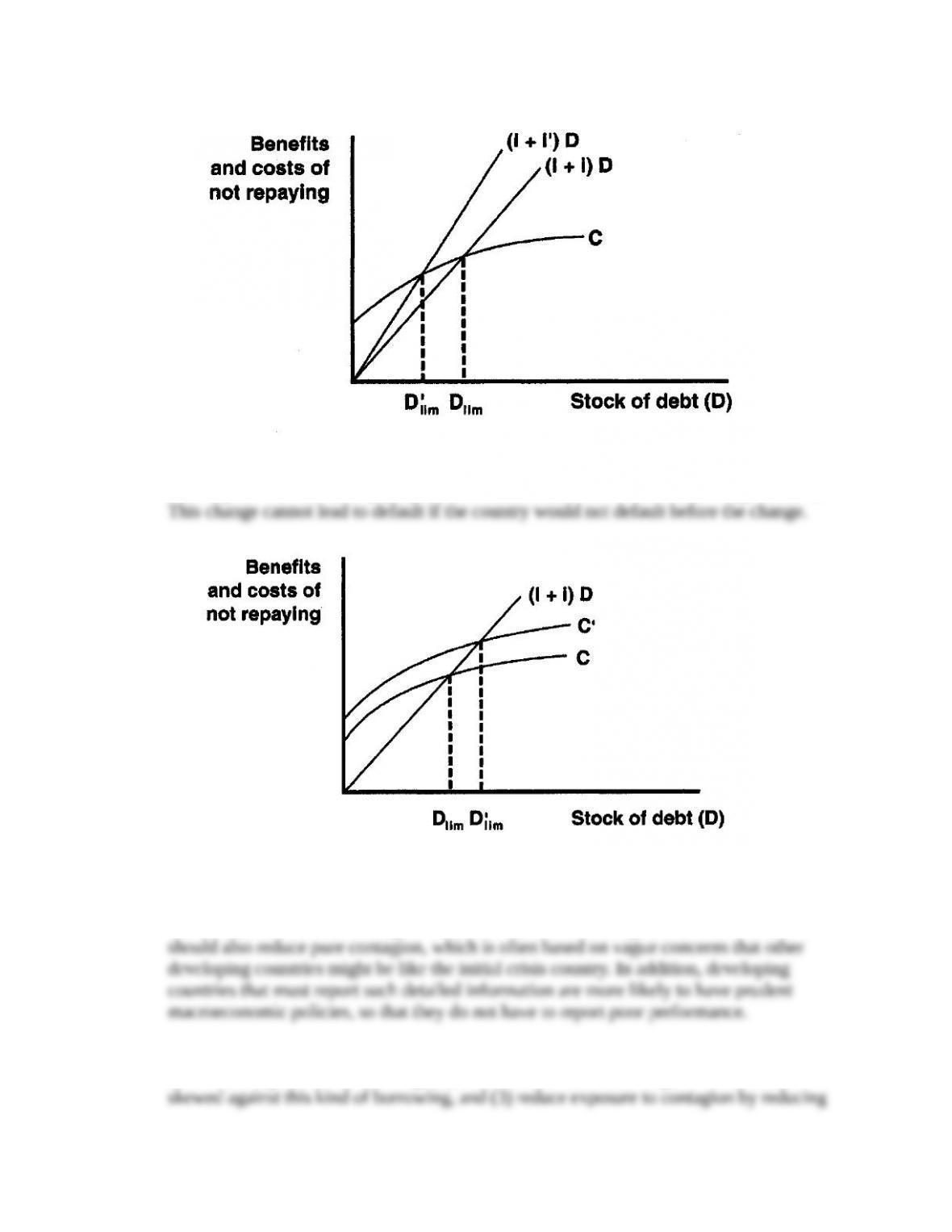
b. The increase in the cost of defaulting causes an upward shift to C from C in the curve
showing the costs of not repaying. In this case the threshold increases to Dlim from Dlim.
9. a. If lenders had detailed, accurate, and timely information on the debt and official reserves
of a developing country, they should be able to make better lending and investing
decisions, to avoid overlending or too much short-term lending. Better information
b. Controls on capital inflows can (1) limit total borrowing by the country to reduce the risk
of overlending and overborrowing, (2) reduce short-term borrowing if the controls are
168
© 2016 by McGraw-Hill Education. This is proprietary material solely for authorized instructor use. Not authorized for sale or distribution in
any manner. This document may not be copied, scanned, duplicated, forwarded, distributed, or posted on a website, in whole or part.
10. Disagree. The IMF can make loans to governments of countries that have serious balance
of payments problems (including a national inability to borrow internationally to finance
current account deficits) or serious problems repaying government debt, especially debt
11. The likelihood of a banking crisis following an unexpected depreciation of the local
currency is fairly high. Banks in this country appear to have substantial exposure to
12. If a default has no other effect on Puglia, its government should default when the
incremental cost of servicing the debt (interest payment plus repayment of principal)
169
© 2016 by McGraw-Hill Education. This is proprietary material solely for authorized instructor use. Not authorized for sale or distribution in
any manner. This document may not be copied, scanned, duplicated, forwarded, distributed, or posted on a website, in whole or part.