
Chapter 05 – The Accounting Cycle: Reporting Financial Results
5 THE ACCOUNTING CYCLE:
REPORTING FINANCIAL RESULTS
Chapter Summary
Chapter 5 completes the treatment of the accounting cycle for service type businesses. It
focuses on the year-end activities culminating in the annual report. These include the preparation
of the financial statements, adequate disclosure, closing the accounts, and preparing for the audit.
These topics form the content of Chapter 5.
The preparation of the statements from an adjusted trial balance is explained and
illustrated. Added to this coverage are a discussion of adequate disclosure and the preparation of
footnotes to the statements. The closing process is described in detail and illustrated for the
Overnight Auto Service Case. Overnight’s financial results are analyzed briefly in terms of
profitability and solvency.
The chapter ends with a discussion of how interim financial statements are prepared by a
business that closes its accounts only at year-end.
Our Supplemental Topic on the worksheet is repeated from the prior edition. We
approach the worksheet as a pedagogical tool intended to provide the student with a better grasp
of the year-end procedures.
Learning Objectives
1. Prepare an income statement, a statement of retained earnings, and a balance sheet.
2. Explain how the income statement and the statement of retained earnings relate to the balance
sheet.
3. Explain the concept of adequate disclosure.
4. Explain the purpose of closing entries; prepare these entries.
5. Prepare an after–closing trial balance.
6. Use financial statement information to evaluate profitability and liquidity.
7. Explain how interim financial statements are prepared in a business that closes its accounts
only at year-end.
*8. Prepare a worksheet and explain its uses. (Supplemental Topic)
Brief topical outline
APreparing financial statements
1The income statement
2The statement of retained earnings
a A word about dividends
Chapter 05 – The Accounting Cycle: Reporting Financial Results
a Separate balance sheet subtotals – see Case in Point (page 198)
BRelationship among the financial statements
1Drafting the notes that accompany financial statements
2What types of information must be disclosed? – see Your Turn (page 200)
CClosing the temporary accounts
1Closing entries for revenue accounts
2Closing entries for expense accounts
3Closing the income summary account
4Closing the dividends account
DSummary of the closing process
EAfter-closing trial balance
1A last look at Overnight: was 2015 a good year?
a Evaluating profitability
b Evaluating liquidity
FFinancial analysis and decision making
1Preparing financial statements covering different periods of time – see
Ethics, Fraud & Corporate Governance (page 208)
GConcluding remarks
Supplemental Topic
*H The worksheet
1Isn‘t this really a “spreadsheet”?
2How is a worksheet used?
3The mechanics: how it’s done
a Computers do the pencil-pushing
4What–if: a special application of worksheet software
Topical coverage and suggested assignment
Homework Assignment
(To Be Completed Prior to Class)
Class
Meetings
on Chapter
Topical
Outline
Coverage
Discussion
Questions
Brief
Exercises Exercises Problems
Critical
Thinking
Cases
1 A – C 2, 3, 4 1, 3 2, 3 1 1
2 D – F 5, 6, 7, 13 4, 6 4, 7, 9, 10 2, 3, 5, 8 2
3 G – *H *15 10 4, 6
*Optional assignment, time permitting.
Comments and observations
Teaching objectives for Chapter 5
In Chapter 5 we cover the numerous accounting activities, both analytical and procedural, that
take place at the end of a fiscal year. The worksheet is discussed in a Supplemental Topic section
which we view as optional. In covering this chapter, our teaching objectives are to:
1Show how the financial statements may be prepared from the adjusted trial balance.

Chapter 05 – The Accounting Cycle: Reporting Financial Results
2Explain relationships among the financial statements.
3Discuss drafting of the notes that accompany the financial statements.
4 Present closing entries and an after-closing trial balance.
*5Explain and illustrate the use of a worksheet (optional topic).
General comments
We consider our emphasis on adequate disclosure and the preparation of footnotes a significant
feature of Chapter 5. This material is clearly important to the user of financial statements, and
should be given sufficient time for class discussion. We find Case 2 well suited to this purpose.
We then spend quite a bit of class time on closing entries and preparing an after-closing
trial balance. The chapter has several good assignments on closing entries, including Discussion
Questions 9 and 10, Exercise 5, and Problem 2. We always assign at least two of these and
discuss them in class.
How much time, if any, should you spend covering the worksheet? There is no question
that the importance of a worksheet in actual accounting practice has declined significantly. Most
computer–based systems do not print out a 10-column worksheet. Rather, they print the various
elements of the worksheet–trial balances, adjusting entries, and financial statements–as a series of
separate schedules. In manual accounting systems, many accountants carry the worksheet only
through the adjusted trial balance columns and then prepare formal financial statements. Thus,
one might argue that today’s students are not likely to see a 10-column worksheet outside of their
accounting class.
Still, we find the worksheet to be a valuable pedagogical tool, and have therefore retained
it in this edition as a Supplemental Topic. Preparing a worksheet gives students a better
understanding of the end-of-period adjusting and closing procedures. It helps them to see the
relationships between the trial balance and financial statements, as well as the relationship between
the income statement and the balance sheet. In short, we now view a 10-column worksheet as a
teaching device: a flowchart with numbers, rather than a schedule that students should learn to
prepare. Thorough coverage can be achieved by assigning Problem 7.
Supplemental Exercise
Group Exercise
This exercise modies Case 5-2. Have the groups follow the same
instructions given in the case but now use the question: Is it ethical for a
CPA (or a CPA ‘rm) to provide both consulting services and audits
to the same companies?
Internet Exercise
Visit the homepage of Ford at www.ford.com. Access the annual report for 2009. Find
the footnotes to the statements and read the disclosures in the note titled “Contingencies.”

Chapter 05 – The Accounting Cycle: Reporting Financial Results
Regarding the events described, do you think Ford is providing adequate disclosure to its
stockholders?
CHAPTER 5 NAME #
10-MINUTE QUIZ A SECTION
The accountant for Sheldrake Consulting prepared the following “Adjusted” Trial
Balance at December 31, 2011, after one year of operations:
Debit Credit
Cash………………………………………………….…. $
7,590
Accounts Receivable…………..………..………… 5,910
Unexpired Insurance…………………………….... 2,550
O9ce Equipment……………….…………..……… 25,230
Accumulated Depreciation: O9ce
Equipment…….….….….……………………………
$ 450
Unearned Consulting Fees..……..……………... 4,230
Capital Stock…………………………………….…… 21,030
Retained Earnings, January 1, 2011.…………. 3,390
Dividends……………………………………....…….. 1,150
Consulting Fees Earned…………………………… 28,150
Salaries Expense………………………………….... 8,850
Utilities Expense………………..……………..…… 2,130
Rent Expense……………………………...………… 3,390
Depreciation Expense……………..……………... 45
0
______
$57,2
50
$57,2
50
Prepare closing entries for Sheldrake Consulting.
CHAPTER 5 NAME #
10-MINUTE QUIZ B SECTION
SUNDIAL Inc.
Trial Balance
December 31
Debit Credit
Cash………………………………………………….…. $ 16
Accounts Receivable…………..………..………… 26
Equipment…………………....……………..………. 191
Accounts Payable………………………..…………. $ 21
Capital Stock…………………………………….…… 106
Retained Earnings……………………….……….... 56
Dividends……………………………………....…….. 11
Service Revenue………………..…………..……… 189
Salaries Expense………………………………….... 86
Depreciation….….….….…………………………… 26

Chapter 05 – The Accounting Cycle: Reporting Financial Results
Supplies Expense………………………………..…. 16 ____
$372 $372
1 What is the balance in Income Summary before it is closed to
Retained
Earnings?
a$61.
b$50.
c$73.
d$145.
2 What is the balance in Retained Earnings after posting closing
entries at December 31?
a$117.
b$106.
c$61.
d$45.
3 What is the total debits on the after–closing trial balance?
a$222.
b$372.
c$233.
d$161.
4 Which accounts are closed to Income Summary?
aAll accounts.
bRevenue and expenses.
cRevenue, expenses, and dividends.
dAll accounts that are not nominal.
5 Which accounts will appear on the balance sheet?
aRetained earnings of $56.
bDividends of $11.
cNet income of $60.
dNone of the above.
CHAPTER 5 NAME #
10-MINUTE QUIZ C SECTION
The accountant for Successful Consulting prepared the following “Adjusted” Trial
Balance at December 31, 20__ after one year of operations:
Debit Credit
Cash………………………………………………….…. $
5,700
Accounts Receivable…………..………..………… 4,500
Unexpired Insurance…………………………….... 2,100
O9ce Equipment……………….…………..……… 18,300
Accumulated Depreciation: O9ce
Equipment…….….….….……………………………
$ 600
Unearned Consulting Fees..……..……………... 3,600

Chapter 05 – The Accounting Cycle: Reporting Financial Results
Capital Stock…………………………………….…… 15,300
Retained Earnings, January 1, 20__……...…… 2,700
Dividends……………………………………....…….. 1,100
Consulting Fees Earned…………………………… 21,200
Salaries Expense………………………………….... 6,600
Utilities Expense………………..……………..…… 1,800
Rent Expense……………………………...………… 2,700
Depreciation Expense……………..……………... 60
0
______
$43,4
00
$43,4
00
Prepare an After-Closing Trial Balance.
CHAPTER 5 NAME #
10-MINUTE QUIZ D SECTION
DAVID’S, INC.
Trial Balance
December 31
Debit Credit
Cash………………………………………………….…. $ 21
Accounts Receivable…………..………..………… 39
Equipment…………………....……………..………. 175
Accounts Payable………………………..…………. $ 27
Capital Stock…………………………………….…… 117
Retained Earnings……………………….……….... 39
Dividends……………………………………....…….. 13
Service Revenue………………..…………..……… 203
Salaries Expense………………………………….... 95
Depreciation….….….….…………………………… 27
Advertising Expense……….……………..………. 16 ____
$386 $386
Prepare the closing entries.
SOLUTIONS TO CHAPTER 5 10-MINUTE QUIZZES
QUIZ A
DR CR
Consulting Fees Earned…………………………… 28,150
Income Summary 28,150
To close the revenue account.
Income Summary 14,820
Salaries Expense....……………......... 8,850
Chapter 05 – The Accounting Cycle: Reporting Financial Results
Utilities Expense………..……………... 2,130
Rent Expense……………………...……. 3,390
Depreciation Expense……..…………. 450
To close the expense accounts.
Income Summary…………………………………… 13,330
Retained Earnings……………….…….. 13,330
To close the income summary account.
Retained Earnings……………………….……….... 1,150
Dividends……………………………....… 1,150
To close the dividends account.
Learning Objective: 4
QUIZ B
Learning Objective: 4, 5
QUIZ C
Debit Credit
Cash………………………………………………….…. $
5,700
Accounts Receivable…………..………..………… 4,500
Unexpired Insurance…………………………….... 2,100
O9ce Equipment……………….…………..……… 18,300
Learning Objective: 5
QUIZ D
Chapter 05 – The Accounting Cycle: Reporting Financial Results
Income Summary 138
Salaries Expense....……………......... 95
Depreciation Expense……..…………. 27
Advertising Expense 16
To close the expense accounts.
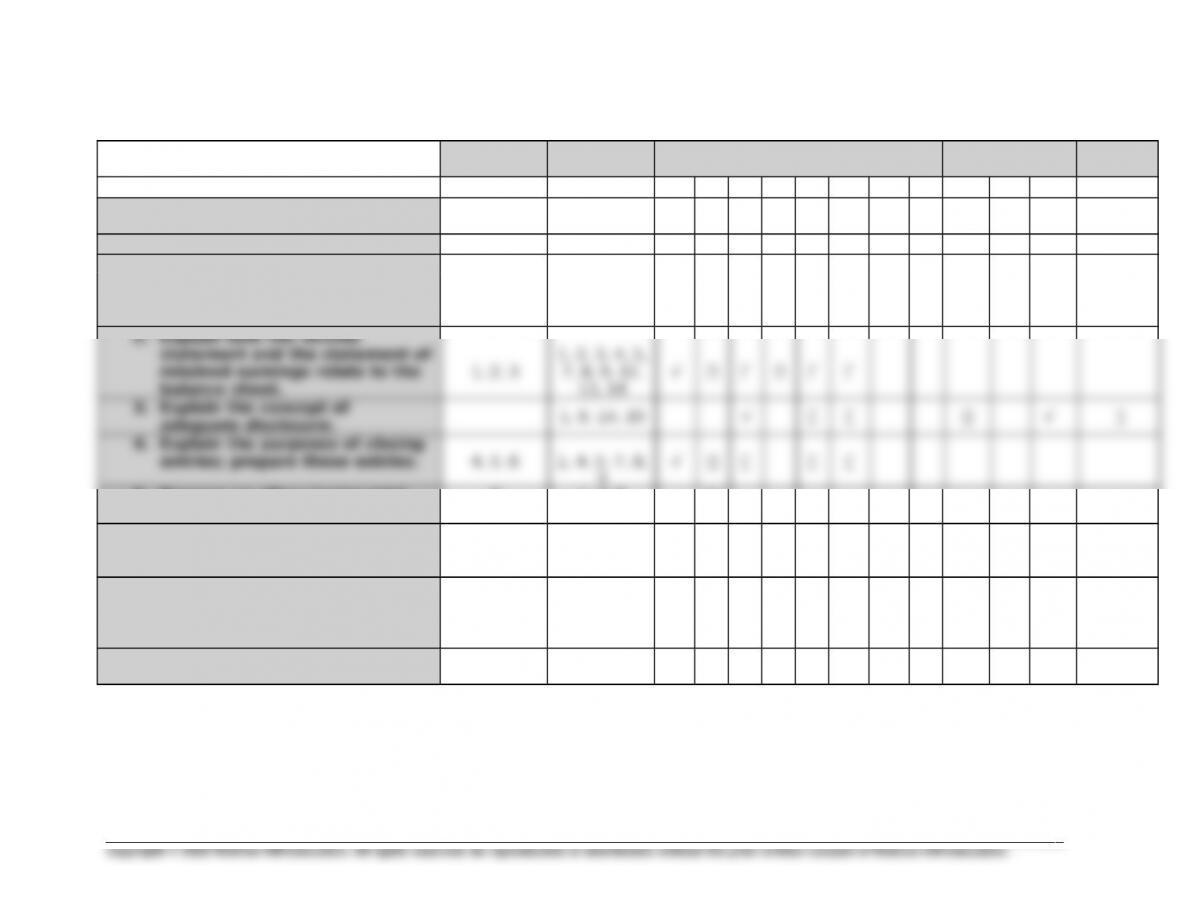
Assignment Guide to Chapter 5
Brief
Exercises Exercises Problems Cases Net
1 – 10 1 – 15 1 2 3 4 5 6 7 8 1 2 3 4
Time estimate (in minutes) <10 <15 40 4
0
4
0
2
5
3
0
60 40 2
0
25 30 5 15
difficulty rating E E M M M S M S M E S M E E
Learning Objectives:
1, 2, 3 1, 2, 3, 12,
13
√
1. Prepare an income statement, a
statement of retained earnings,
and a balance sheet.
9
5. Prepare an after-closing trial
balance.
7 1, 4, 5
6. Use ?nancial statement
information to evaluate
pro?tability and liquidity.
8
1, 2, 3, 10,
11, 15 √ √
7. Explain how interim ?nancial
statements are prepared in a
business that closes its
accounts only at year-end.
9 1, 12, 13
*8. Prepare a worksheet and
explain its uses.
10 √
Financial Accounting, 16e 5- 9