
Chapter 03 – The Accounting Cycle: Capturing Economic Events
3 THE ACCOUNTING CYCLE:
CAPTURING ECONOMIC EVENTS
Chapter Summary
Maintaining a set of accounting records is not optional for a business. The IRS requires
businesses to maintain records that can be audited. In addition, a business that does not maintain
adequate records will likely operate inefficiently.
The recording process lies at the foundation of the financial statements. This chapter
presents a comprehensive introduction to the accounting cycle. Coverage includes debit and
credit rules for both balance sheet and income statement accounts, recording transactions in the
journal and posting to the ledger, and the preparation of the trial balance.
In addition to the mechanical aspects of the accounting cycle, the student is also
confronted with several major concepts from accounting theory. Net income is introduced as an
increase in owner’s equity resulting from profitable operations. The nature of revenue and
expense is explored in detail as is the realization and matching principles underlying accrual
accounting.
The comprehensive coverage has resulted in a relatively lengthy chapter. However, use of
the continuing illustration of Overnight Auto is intended to allow for a reasonably efficient
presentation of this significant material. All of the transactions dealing with balance sheet
accounts are repeated from Chapter 2. Although the revenue and expense transactions are new to
this chapter, the exposure to the income statement and statement of cash flows in the previous
chapter should also shorten the time needed to cover recording such transactions.
Learning Objectives
1. Identify the steps in the accounting cycle and discuss the role of accounting records in an
organization.
2. Describe a ledger account and a ledger.
3. Understand how balance sheet accounts are increased or decreased.
4. Explain the double-entry system of accounting.
5. Explain the purpose of a journal and its relationship to the ledger.
6. Explain the nature of net income, revenue, and expenses.
7. Apply the realization and matching principles in recording revenue and expenses.
8. Understand how revenue and expense transactions are recorded in an accounting system.
9. Prepare a trial balance and explain its uses and limitations.
10. Distinguish between accounting cycle procedures and the knowledge of accounting.

Chapter 03 – The Accounting Cycle: Capturing Economic Events
Brief topical outline
AThe accounting cycle
1The role of accounting records
BThe ledger
CThe use of accounts
DDebit and credit entries
1Determining the balance of a T account
2Debit balances in asset accounts
3Credit balances in liability and owners’ equity accounts
4Concise statement of the debit and credit rules
5Double-entry accounting–the equality of debits and credits
EThe journal
1Posting journal entries to the ledger accounts (and how to
“read” a journal entry)
FRecording balance sheet transactions: an illustration (illustrated
on pages 92-95)
GLedger accounts after posting (illustrated on page 96)
HWhat is net income?
1Retained earnings
2 The income statement: a preview
aIncome must be related to a speci.ed period of time – see
Case in
Point (page 99)
bAccounting periods
3Revenue
aThe realization principle: when to record revenue
4Expenses
aThe matching principle: when to record expenses
bExpenditures bene.ting more than one accounting period –
see Case
in Point (page 102)
5The accrual basis of accounting
6 Debit and credit rules for revenue and expenses
IDividends
JRecording income statement transactions (illustrated on pages
103 –
107) – see Your Turn (page 107)
1The journal
KFebruary’s ledger balances
LThe trial balance
1Uses and limitations of the trial balance – see Ethics, Fraud
& Corporate Governance (page 113)
MConcluding remarks
1The accounting cycle in perspective
Topical coverage and suggested assignment
Chapter 03 – The Accounting Cycle: Capturing Economic Events
Homework Assignment
(To Be Completed Prior to Class)
Class
Meetings
on Chapter
Topical
Outline
Coverage
Discussion
Questions
Brief
Exercises Exercises Problems Critical
Thinking
Cases
1 A – D 1, 4, 6, 7 1, 3, 4 1
2 E – G 10, 13, 14 5, 6, 7 2, 4, 7, 8, 11 1, 2, 3 1, 3
3 H – M 15 9, 10 12 4, 5
Comments and observations
Teaching objectives for Chapter 3
Our objectives in presenting this chapter are to:
1 Establish the usefulness of accounting records in organizations.
2 Explain and illustrate the purpose, unit of organization, and format of ledger accounts.
3 Relate the rules for debiting and crediting balance sheet accounts to the “side” of the balance
sheet on which the account appears.
4 Explain the double-entry system of accounting.
5Explain and illustrate the purpose, unit of organization, and format of a general journal.
6 Explain the flow of financial information from the journal into the ledger accounts.
7 Explain the nature of net income, and define the terms revenue and expenses.
8 Illustrate the recording of revenue and expense transactions. Explain the debit and credit
rules for these transactions in the context of the effects upon owner’s equity.
9 Explain the realization principle and the matching principle, providing common
examples. Contrast accrual accounting with cash flows.
General comments
Overnight Auto Service is used as a continuing example in Chapters 2 through 4. At the
outset in Chapter 3, the activities of the company are limited to balance sheet transactions. This
allows us to illustrate the mechanics of double-entry accounting and to show how changes in
assets, liabilities, and owners’ equity are recorded in accounting records before discussing the
more complicated concepts of revenue and expense. This approach also enables us to illustrate a
very simple “accounting cycle“ — the “flow” of information from the initial recording of
transactions through the accounting records — without first having to cover adjusting entries and
closing entries.
Chapter 03 – The Accounting Cycle: Capturing Economic Events
Among the important concepts introduced in Chapter 3 is double-entry accounting.
Although double-entry accounting and the related rules of debit and credit may sound procedural
to some, we view the double-entry system as a truly ingenious device. Johann Goethe, the
renowned eighteenth-century German poet and novelist, described this system as “one of the
finest discoveries of the human intellect.” The great power of double-entry accounting is its
ability to record the components of profit and loss, that is, revenue and expenses, simultaneously
with the related changes in assets and liabilities. Thus, any accounting system that develops an
income statement as well as a balance sheet uses the principles of double entry.
In the first class meeting on Chapter 3, we introduce students to the uses of accounting
records in organizations. It is fairly obvious that accounting records will be used to record day-
to-day transactions and serve as the basis for developing financial statements, tax returns, and
other accounting reports. Less obvious to students are the other purposes of accounting records
including internal control and performance evaluation. Discussion Question 1 can be used as the
basis for class discussion of these uses of accounting information. We go on to introduce ledger
accounts as a vehicle for illustrating double-entry accounting. We stress the relationship between
the entry to record an increase in an account’s balance and the “side” of the balance sheet upon
which the account appears. This simple relationship is not only useful to students in learning the
rules of debits and credits, but is the very device that makes the double-entry system work.
In the first class meeting, we go on to introduce the general journal and focus upon the
“flow” of information through the accounting records and into the financial statements (balance
Our next overall objective in Chapter 3 is to show how business profits are defined and
measured in an accounting system. We emphasize the definitions of revenue and expenses, and the
realization and matching principles. We find Exercise 7 useful in making the point that net income
is a change in owners’ equity, not a change in assets.
Careful attention should be given to both the realization principle and the matching
Supplemental Exercises
Group Exercise
Chapter 3 begins with the assertion that a basic objective of every business is to earn a
profit. Proof of this can usually be found in the self-stated missions and objectives of a business
enterprise. Access the annual reports of various corporations and cite evidence that the pursuit of
profit is a major objective. What other objectives or goals do these companies set forth?
Internet Exercise

Chapter 03 – The Accounting Cycle: Capturing Economic Events
In Chapter 3 we have learned that net income is an increase in owners’ equity resulting
from profitable operations. Previously, Chapter 2 explained that when a business is organized as a
corporation, retained earnings represents the increase in stockholders’ equity that has accumulated
over the years as a result of profitable operations. Thus, net income for any one year should
explain a large part of the change in retained earnings from the beginning of the year to the end.
Go to http://www.jcpenney.com
Find net income for 2009. Now compute the difference between retained (reinvested)
earnings at the beginning of the year and at the end. How closely does this approximate the 2008
net income?
CHAPTER 3 NAME #
10-MINUTE QUIZ A SECTION
Indicate the best answer for each question in the space provided.
The account balances for Creative Band, Inc. as of May 31, 2009, are listed below in alphabetical order:
Accounts Payable……..…..$12,000 Equipment..…………......$18,000
Accounts Receivable........$14,000 Land….…..…………….....$52,000
Building…...……………......$42,000 Notes Payable…..….......$30,000
Cash………………………….. $8,000……………………..Capital
Stock $92,000
On June 3, Creative Band, Inc collected $4,000 of its accounts receivable
and paid $7,000 of its accounts payable. In addition, 2,000 of additional
shares of capital stock are issued for $5,600.
1Refer to the above data. In a trial balance prepared on May 31,
2009, the sum of the debit column is:
a$120,000. c$134,000.
b$156,000. dSome other amount.
2Refer to the above data. On June 4, the balance in the Cash
account is:
a$17,600. c$10,600.
b$ 5,000. dSome other amount.
3Refer to the above data. On June 4, the balance in the Capital
Stock account is:
a$86,400. c$94,000.
b$97,600. dSome other amount.
4Refer to the above data. In a trial balance prepared on June 4, the
sum of the credit column is:
a$130,000. c$127,000
b$132,600. dSome other amount.
5Refer to the above data. On June 6, the bookkeeper for Creative
Band, Inc makes this entry:
Financial Accounting, 16e 3- 5

Chapter 03 – The Accounting Cycle: Capturing Economic Events
Equipment…………………………………………..……. 7,400
Cash…………………………….……..………. 4,200
Accounts Payable…………………………… 3,200
This transaction:
aDecreases total assets.
bInvolves the sale of equipment for $7,400.
cIncreases total assets $7,400.
dIncreases liabilities.
CHAPTER 3 NAME #
10-MINUTE QUIZ B SECTION
Enter the following transactions in the two-column journal provided for Charlie’s
Cabinetry. You may omit explanations.
Mar. 2 Purchased auto cleaning supplies from Robert Suppliers for $750 on
account.
4 Collected an account receivable of $525 from a customer, Elegant
Kitchens.
5 Paid $275 in partial payment of an account payable to Lucy Co for
equipment purchased in February.
7 Issued capital stock in exchange for $5,600 cash.
9 Purchased oGce equipment from Diamond’s Warehouse for $3,700; paid
$1,700 cash and issued a note payable due in 90 days for the balance.
Date General Journal
20__
Mar 2
CHAPTER 3 NAME #
10-MINUTE QUIZ C SECTION
Capital Financial Advisors, Inc. had the following transactions during January, its
.rst month of operations:
aIssued to Marvin Tycoon 9,000 shares of capital stock in exchange for his
investment of $45,000 cash.
bBorrowed $30,000 from a bank and signed a note payable due in three
months.
cPurchased oGce furniture costing $19,750; paid $6,000 cash and charged
the balance on account.
dPaid $6,000 of the amount owed for oGce furniture.
eIssued an additional 2,000 shares of capital stock to an individual who
invests $10,000 in the business.

Chapter 03 – The Accounting Cycle: Capturing Economic Events
Instructions
Record the above transactions directly in the T accounts below. Identify
each entry in a T
account with the letter shown for the transaction.
Cash O.ce Furnishings Notes Payable
Accounts Payable Capital Stock
CHAPTER 3 NAME #
10-MINUTE QUIZ D SECTION
The following transactions occurred during June, the .rst month of operations for
Accurate Manufacturing.:
*Issued 60,000 shares of capital stock to the owners of the corporation in
exchange for $600,000 cash.
*Purchased a piece of land for $250,000, making an $80,000 cash down
payment and signing a note payable for the balance.
*Made a $100,000 cash payment on the note payable from the purchase of
land.
*Purchased equipment on credit from National Supply for $40,000.
1Refer to the above data. The balance in the Cash account at the
end of June:
a$52,000. c$420,000.
b$350,000. d$380,000.
2Refer to the above data. What are total assets of Precision
Manufacturing at the end of June?
a$710,000. c$630,000.
b$890,000. d$460,000.
3Refer to the above data. What is the total of Precision’s liabilities at
the end of June?
a$70,000. c$200,000.
b$110,000. d$240,000.
4Refer to the above data. What is the total owners’ equity at the end
of June?
a$60,000. c$240,000.
b$110,000. d$600,000
Chapter 03 – The Accounting Cycle: Capturing Economic Events
SOLUTIONS TO CHAPTER 3 10-MINUTE QUIZZES
QUIZ A
Learning Objective: 2, 3, 4, 9
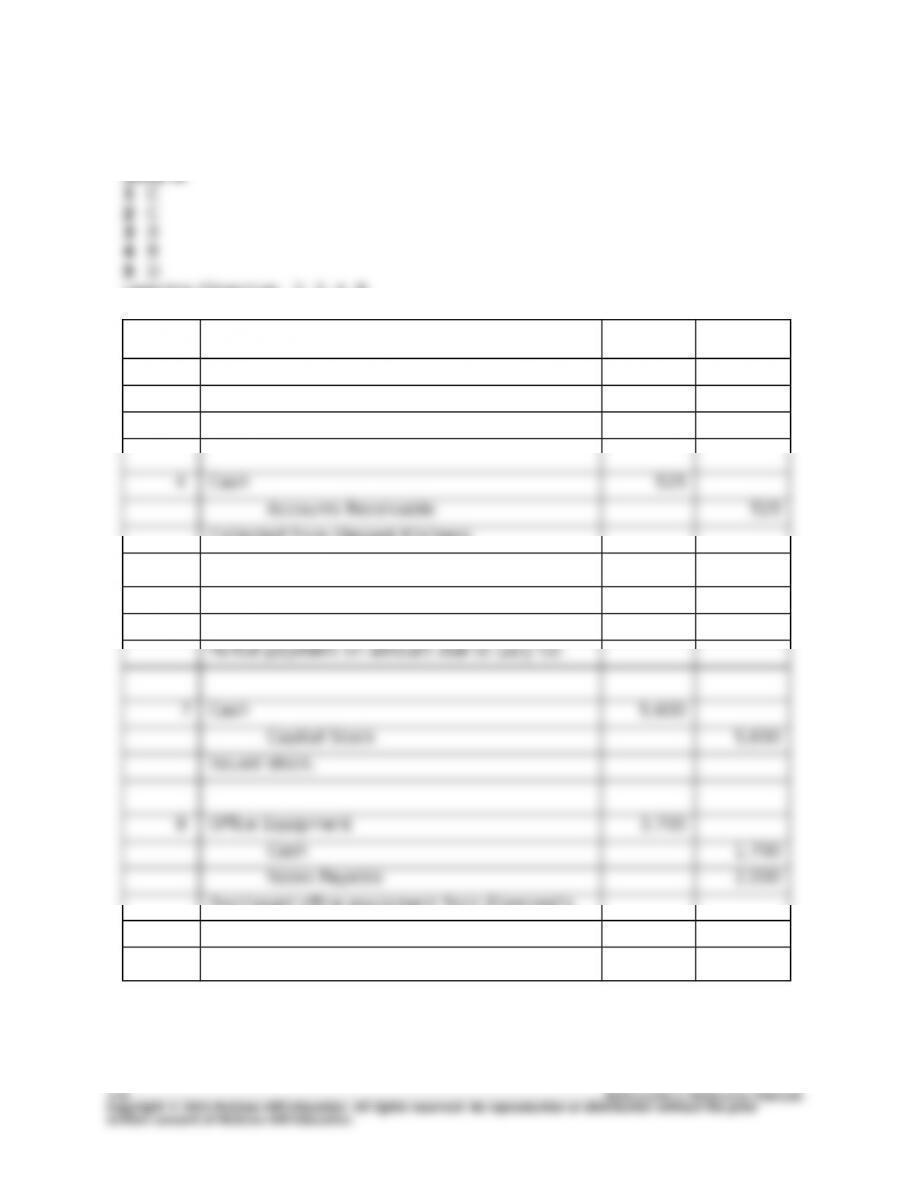
Date General Journal
20__
Mar 2 Supplies 750
Accounts Payable 750
Bought supplies from Robert Suppliers.
Collected from Elegant Kitchens
5 Accounts Payable 275
Cash 275
Purchased oGce equipment from Diamond’s
Warehouse; note due in 90 days.
QUIZ C
Learning Objective: 2, 3. 4
Chapter 03 – The Accounting Cycle: Capturing Economic Events
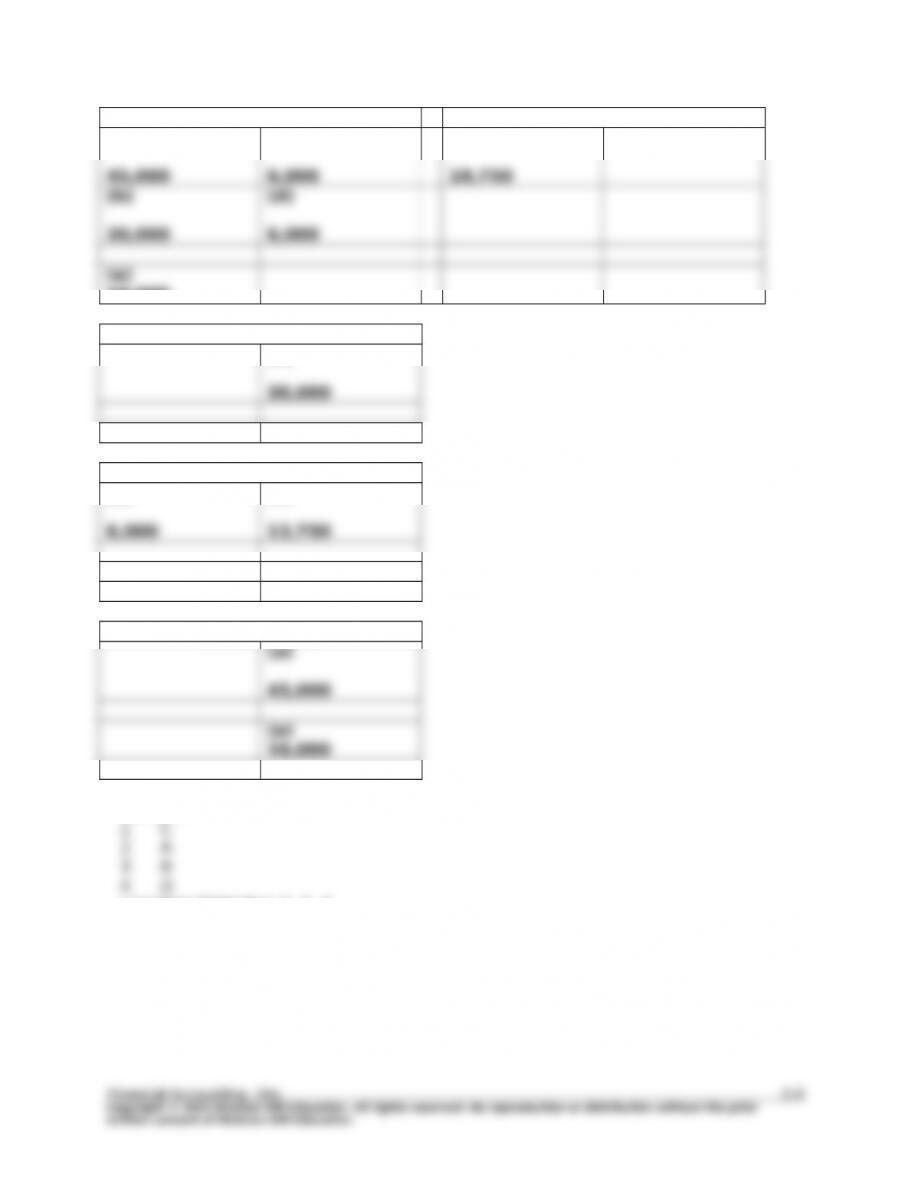
Cash O.ce Furnishings
(a)
(c)
(c)
10,000
Notes Payable
(b)
Accounts Payable
(d)
(c)
Capital Stock
QUIZ D
Learning Objective 2, 3, 4
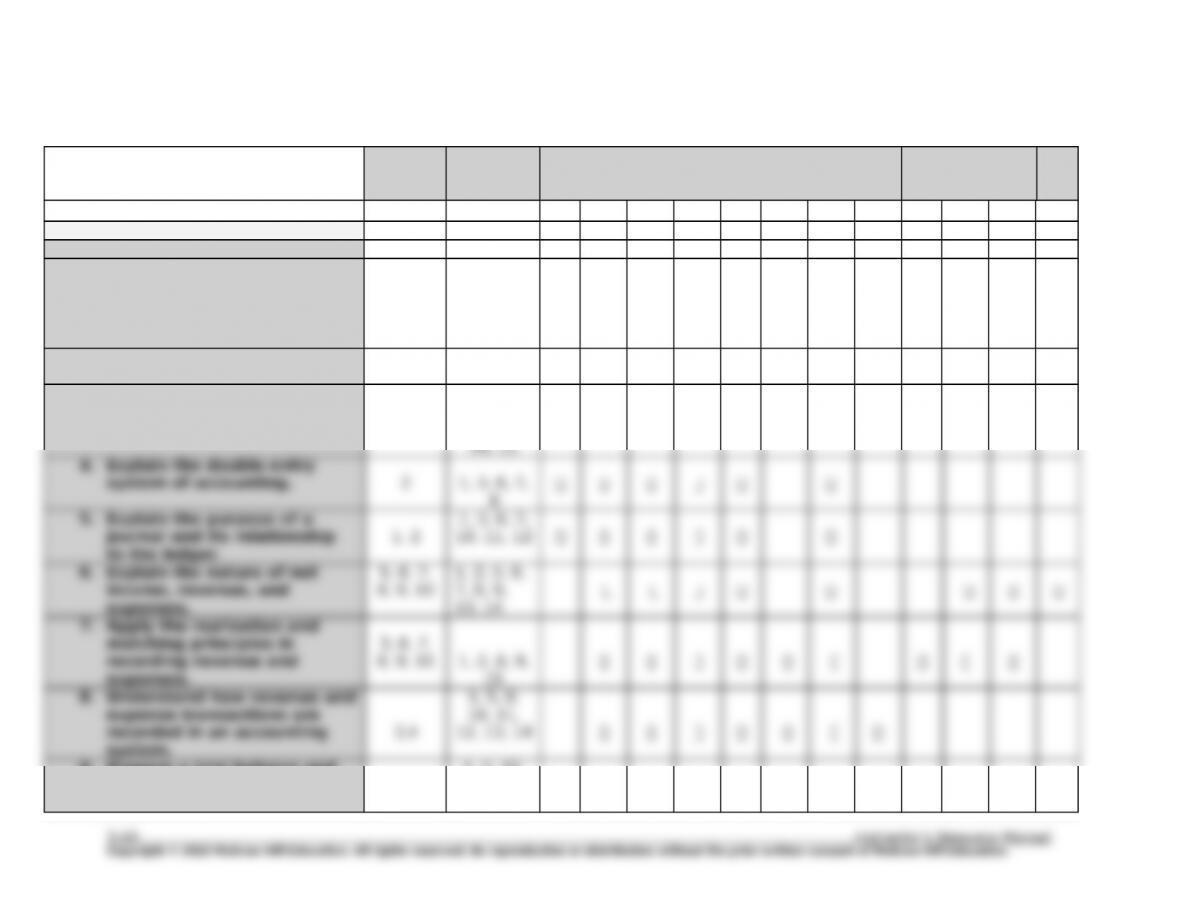
Chapter 03 – The Accounting Cycle: Capturing Economic Events
Brief
Exercis
es
Exercise
sProblems Cases Ne
t
1-10 1 – 15 1 2 3 4 5 6 7 8 1 2 3 4
Time estimate (in minutes) < 10 < 15 30 30 30 30 35 50 60 60 15 30 5 10
Di.culty rating E E M M M M M S S S M S E E
Learning Objectives:
1 1, 15
1. Identify the steps in the
accounting cycle and discuss
the role of accounting
records in an organization.
2. Describe a ledger account
and a ledger.
1 1, 3, 6, 7,
15
3. Understand how balance
sheet accounts are increased
or decreased. 2,4,5
1, 3, 6, 7,
9, 10, 11,
12, 13,
system.
9. Prepare a trial balance and
explain its uses and
limitations.
1
1, 4, 10,
11, 12
Assignment Guide to Chapter 3
10.Distinguish between
accounting cycle procedures