25 Minutes, Medium
(Dollar Amounts
in Thousands)
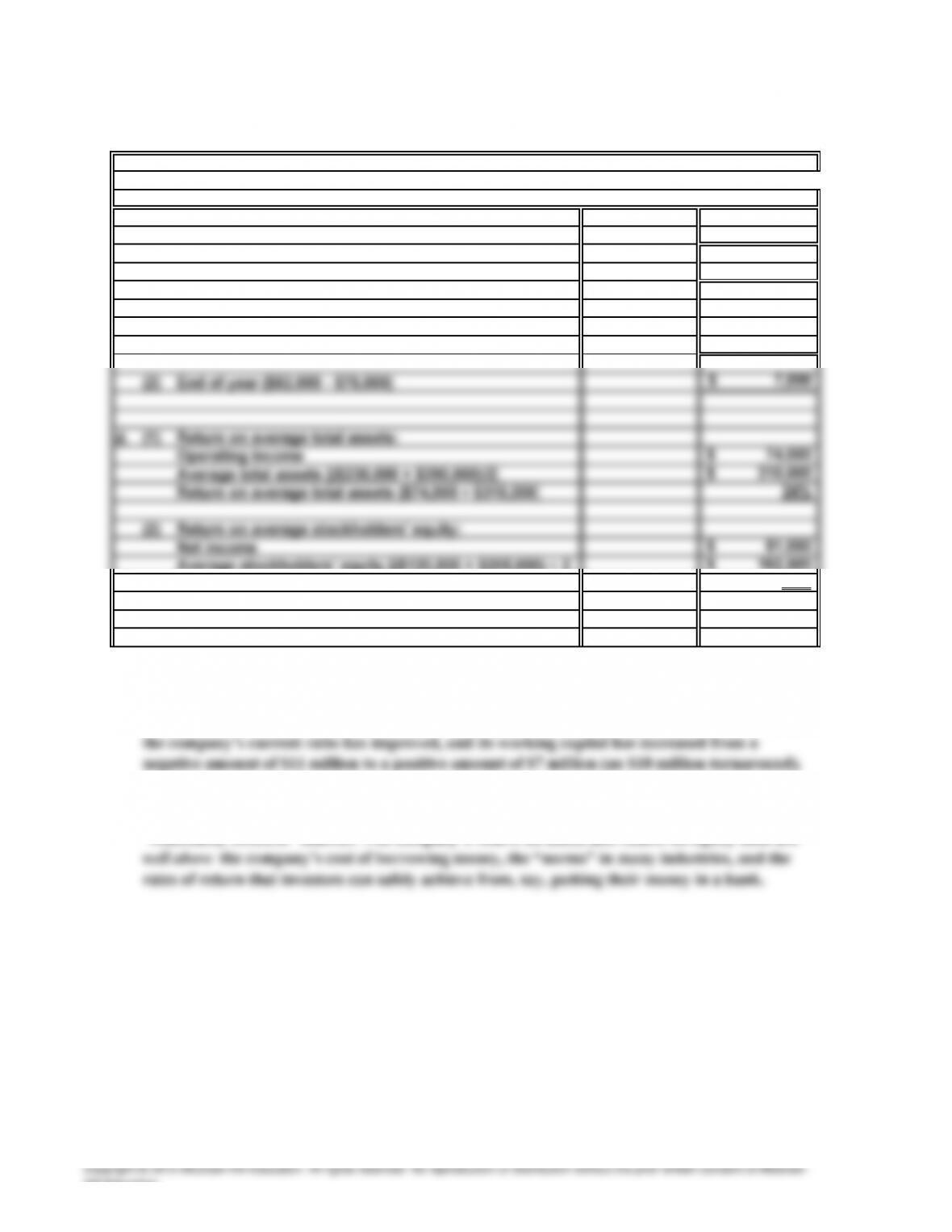
a. Current ratio:
(
1
)
Be
g
innin
g
of
y
ear
(
$43,000 ÷ $54,000
)
0.80 to 1
(
2
)
End of
y
ear
(
$82,000 ÷ $75,000
)
1.09 to 1
b. Workin
g
ca
p
ital:
(
1
)
Be
g
innin
g
of
y
ear
(
$43,000 – $54,000
)
(11,000)
$
(
)
y
(
)
$
g
g
%
(
)
g
q
y:
Avera
g
e stockholders’ e
q
uit
y
[(
$120,000 + $205,000
)
÷ 2
]
162,500$
Return on avera
g
e stockholders’ e
q
uit
y:
31
%
(
$51,000 ÷ $162,500
)
c.
PROBLEM 14.7B
ROCHESTER CORPORATION
c. and e.
Rochester’s short-term debt-paying ability appears to be improving. In the course of the year,
Hill Education.
25 Minutes, Medium
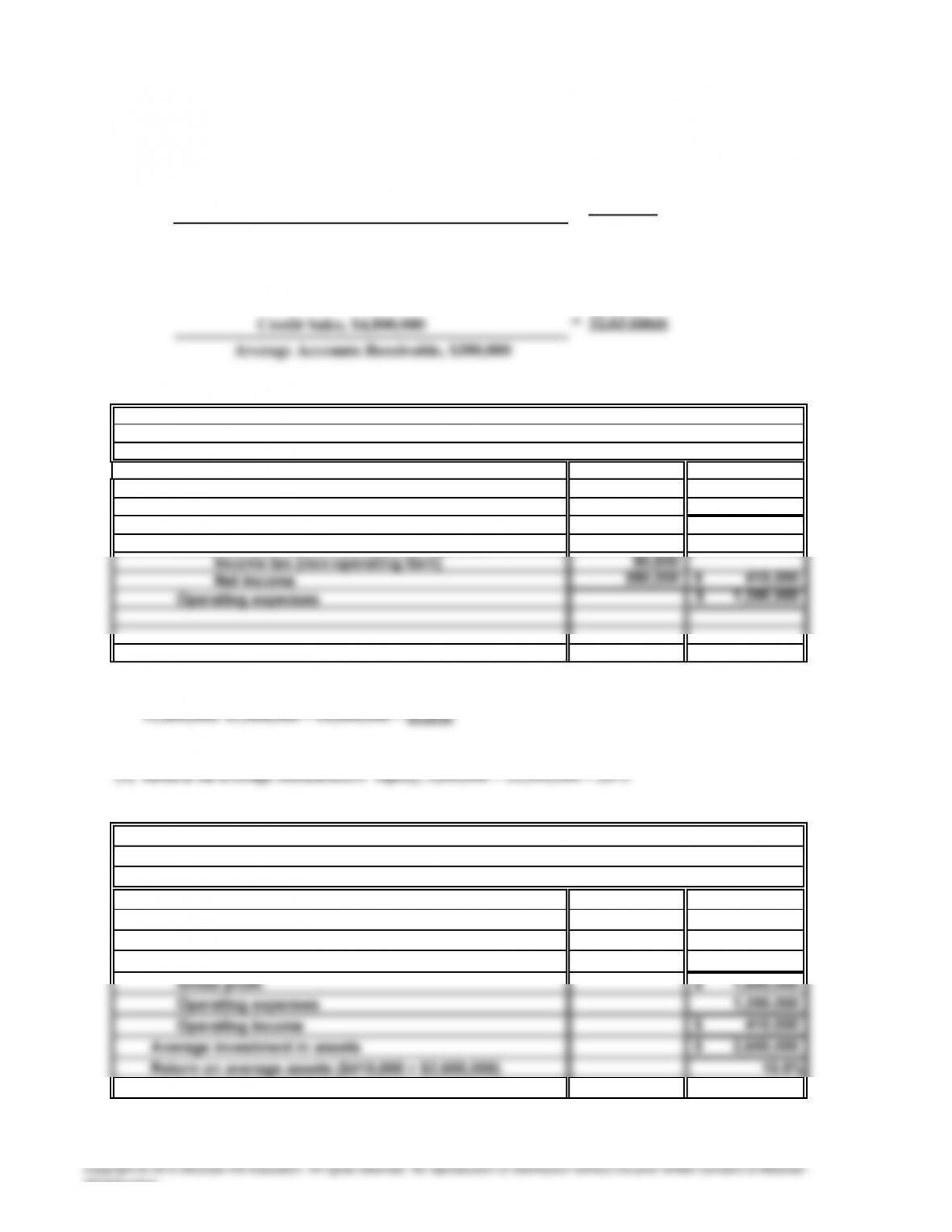
a. (1) Inventory turnover:
= 7.14 times
(2) Accounts receivable turnover:
(
3
)
Total o
p
eratin
g
ex
p
enses:
Sales 4,800,000$
Less: Cost of
g
oods sold 3,000,000
Gross
p
rofit 1,800,000$
Less: Interest ex
p
ense
(
non-o
p
eratin
g
item
)
50,000$
p
(4)
(6) Return on average assets:
Operating income:
Sales 4,800,000$
Cost of goods sold 3,000,000
PROBLEM 14.8B
SOLAR SYSTEMS, INC.
Cost of Goods Sold, $3,000,000
Average Inventory, $420,000
Gross profit percentage: Sales, $4,800,000 − cost of goods sold, $3,000,000 = gross profit,
Hill Education.
b. Obtaining the loan will be desirable to stockholders because the return on average assets
(15.8%) is greater than the prospective rate of payment to creditors (8%). In other words, the
stockholders will gain from applying leverage, which is a form of financing using fixed-return
securities as capital.
Taking on additional long-term debt would increase the risk to the stockholders. In the event
PROBLEM 14.8B
SOLAR SYSTEMS, INC. (concluded)
35 Minutes, Medium
a.
THIS THA
T
STA
R
STA
R
(
1
)
Workin
g
ca
p
ital:
(
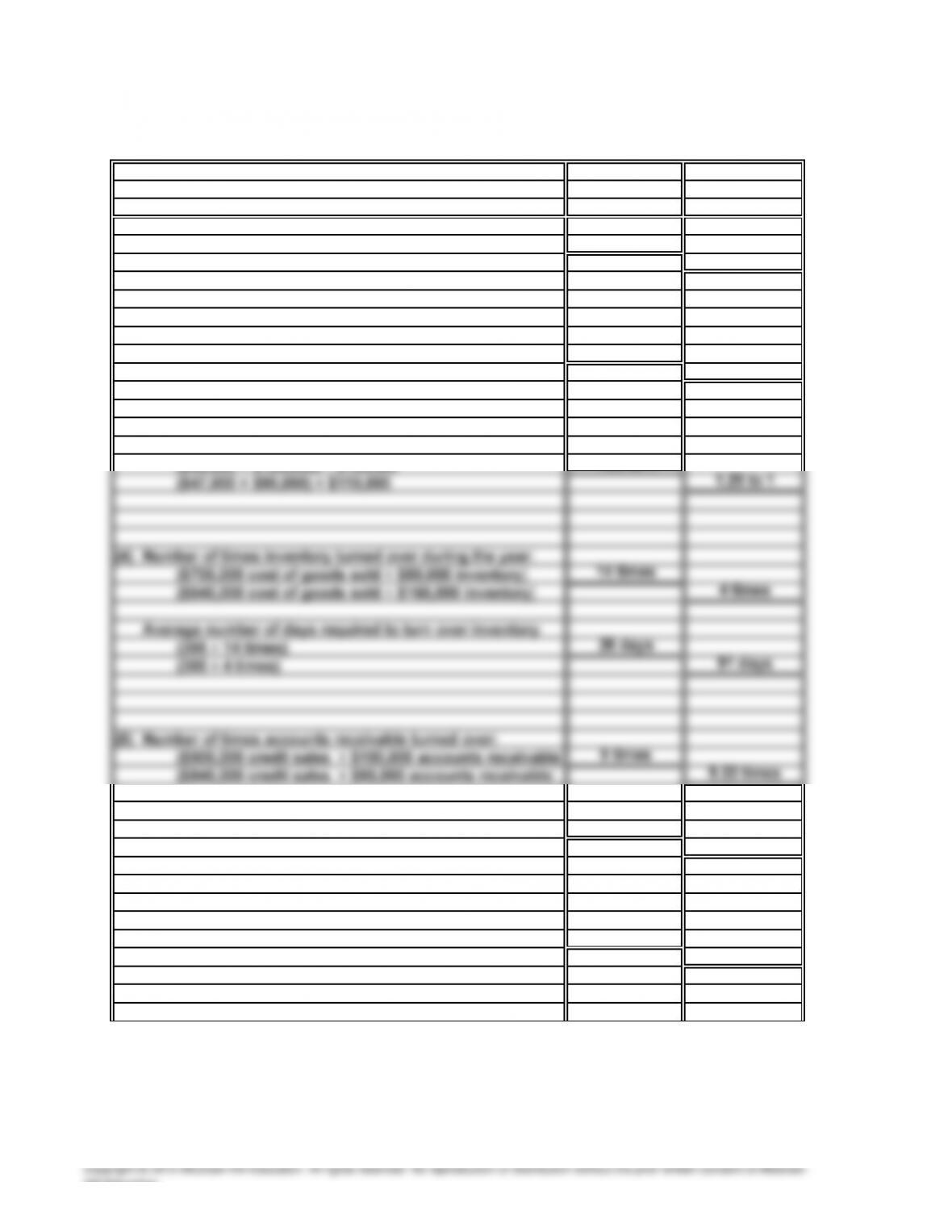
$95,000 + $100,000 + $50,000 – $120,000
)
125,000
$
(
$47,000 + $90,000 + $160,000 – $110,000
)
187,000
$
(
2
)
Current ratio:
(
$95,000 + $100,000 + $50,000
)
÷ $120,00
0
2.04 to 1
(
$47,000 + $90,000 + $160,000
)
÷ $110,000 2.70 to 1
(
3
)
Quick ratio:
(
$95,000 + $100,000
)
÷ $120,00
0
1.63 to 1
(
(
)
(
(
(
(
(
)
(
(
(
(
)
(
PROBLEM 14.9B
THIS STAR, INC. AND
THAT
S
TAR, IN
C
.
b.
PROBLEM 14.9B
THIS STAR, INC. AND THAT STAR, INC. (concluded
)
Although THAT Star, Inc., has a larger dollar amount of working capital and a higher
current ratio, THIS Star, Inc. has the higher-quality working capital. The quality of working
capital is determined by the nature of the current assets comprising the working capital and
the length of time required to convert these assets into cash. Over half of THIS Star’s current
Hill Education.
25 Minutes, Medium
a.
$450 − $100 = 350%
$100
Holcomb computed the 350% increase in fourth-quarter profits by comparing the fourth-
quarter profits of 2015 to those of the third quarter. The computation is:
Holcomb’s conclusion that profits for the “entire year” were up by “over 100%” came from
SOLUTIONS TO CRITICAL THINKING CASE
S
HOLIDAY GREETING CARD
S
CASE 14.1
15 Minutes, Easy
Nebraska The
Steak Ranch Stockyards
a. $75,000 $24,000
Current liabilities ……………………………………….. $30,000 $30,000
CASE 14.2
THIRD NEBRASKA BAN
K
Current ratio:
Current assets …………………………………………..
Hill Education.
a. (1)
b.
CASE 14.3
NASHVILLE DO-IT-YOURSELF
25 Minutes, Strong
total current assets and the current ratio would decrease.
Note to instructor: This concept can be illustrated by assuming that all of the current liabilities were
paid. In this case, some current assets would remain, current liabilities would be reduced to zero, and
the current ratio would be infinite.
Increase. Paying current liabilities reduces current assets and current liabilities by the
same dollar amount. As the current ratio exceeds 1 to 1, however, reducing both current
assets and current liabilities by an equal amount will increase the ratio.
One means of improving the current ratio is to increase current assets without increasing
current liabilities. This could be done by selling noncurrent assets, by borrowing cash on a long-
term basis, or by the owners investing cash in the business. The increase in the current ratio
Hill Education.
No time estimate, Strong
ETHICS, FRAUD & CORPORATE GOVERNANCE
size of between eight and 12 is often viewed as optimal.
Board Expertise — It is typically advantageous if board members have experience serving on the
boards of other public companies. However, serving on too many boards concurrently may
prevent a director from spending enough time on the affairs of each company. A rule of thumb is
that an individual should not concurrently sit on the boards of more than three public companies,
particularly if the director works full-time for another company.
CASE 14.4
Although there are many possible “solutions” to this case, depending on the companies that
students choose for analysis, students should talk about most of these factors in evaluating the
quality of a company’s board of directors.
Board composition — The board of directors should be comprised of a majority of independent
directors (i.e., an independent director is a director with no ties to the company or its management
other than his or her service as a director). In fact, the NYSE and Nasdaq now require that listed
companies have boards with a majority of independent directors.
Nominating committee — Companies should have a separate committee of the board to handle the
process of nominating individuals to join the board of directors. The nominating committee
EVALUATING CORPORATE GOVERNANCE QUALITY
Hill Education.
CASE 14.4
(concluded)
EVALUATING CORPORATE GOVERNANCE QUALITY
Chairman/CEO Separation — Shareholder activities prefer that the same individual who serves
as CEO also doesn’t serve as chairman of the board of directors (COB). However, in the U.S., the
same individual who serves as CEO also typically serves as COB. As an alternative, a number of
some boards meet more frequently than six times per year. And all directors should have
attended no less than 75 percent of all meetings held during the year. The proxy discloses the
number of board meetings held and director attendance.
No time estimate, Strong
Current ratio
c.
Again, student responses will likely vary, but reasons for the popularity of the Internet for
receiving financial information include the following:
Return on equity
Timeliness and ease and frequency with which information can be updated.
CASE 14.5
Student responses will vary, but they should indicate an understanding that companies have
unique operating characteristics, and understanding those before diving into financial
analysis will allow one to better understand the financial information. For example, a
merchandising company has significant inventory issues that a service company does not
have. Some companies rely heavily on plant and equipment-type assets while others do not.
Some companies have significant international activities while others operate primarily in a
single country. These and other operating characteristics are important to understand as one
begins to do serious financial analysis.
Because students can choose both the company and the ratios they compute, no set answer
can be given for this question. The following are probably the ratios in the categories of
liquidity and profitability that are most likely to be selected by students:
EVALUATING LIQUIDITY AND PROFITABILITY
Liquidity
INTERNET
a.
b.
Hill Education.