

Brief Learning
Exercises Objectives Skills
B. Ex. 14.1 Dollar and percentage change 14-1 Analysis
B. Ex. 14.2 Trend percentages 14-1 Analysis
B. Ex. 14.3 Component percentages 14-1 Analysis
B. Ex. 14.4 Working capital and current ratio 14-4 Analysis
B. Ex. 14.5 Current and quick ratios 14-4 Analysis
B. Ex. 14.6 Debt ratio 14-4 Analysis
B. Ex. 14.7 Net income as percentage of sales 14-6 Analysis
B. Ex. 14.8 Earnings per share 14-6 Analysis
B. Ex. 14.9 Return on assets 14-7 Analysis, judgmen
t
B. Ex. 14.10 Return on equity 14-7 Analysis, judgmen
t
Skills
14.1 Percentages changes 14-1 Analysis
14.2 14-1
14.3 14-1
14.4 Measures of liquidity 14-3, 14-4
14.5 Multi
p
le-ste
p
income statement
s
14-5 Anal
y
sis
,
communicatio
n
14.6 14-6 Analysis, communication,
judgment
14.7 14-1, 14-6
14.8 Research problem 14-6
14.9
14.10 Evaluating employment opportunities 14-4, 14-6
14.11 Ratios for a retail store 14-7
14.12 Computing ratios 14-7 Analysis
14.13 14-6, 14-7 Analysis
14-3, 14-4,
14-6
TopicExercises
Common size statements
Analysis, communication,
judgment
Computing and interpreting rates of
change
CHAPTER 1
4
FINANCIAL STATEMENT ANALYSI
S
Learning
Objectives
Trend percentages Analysis, communication,
judgment
OVERVIEW OF BRIEF EXERCISES, EXERCISES, PROBLEMS, AND CRITICAL
THINKING CASES
Topic
Current ratio, debt ratio, and earnings
per share
Analysis, communication,
judgment
Analysis, communication,
judgment
Analysis, communication,
judgment
Analysis, communication,
judgment, research,
technology
Real World: Kimberly Clark Corporation,
ROI
Analysis, communication,
judgment
Communication,
judgment, research
Real World: Home Depot
Management analysis and discussion

Topic Skills
14.14 14-7
14.15 14-6, 14-7
Skills
14.1 A,B 14-1, 14-5
14.2 A,B 14-3, 14-5
14.3 A,B Measures of liquidity 14-3, 14-4
14.4 A,B Real World: The Kroger
Company Liquidity 14-3, 14-4,
14-7
14.5 A,B 14-3, 14-4,
14.6 A,B Financial statement analysis
14.7 A,B
Basic ratio analysis
14.8 A,B 14-5, 14-7
14.9 A,B
14.1 Season’s greetings 14-1
14.2 Evaluating debt-paying ability 14-3–14-5
14.3 Strategies to improve current ratio 14-5 Communication, judgment
14.4 Real World: Calpers 14-5 Analysis, communication,
judgment, research, technology
Real World: Various Companies
14.5 14-7, 14-8
(
Internet
)
14-4, 14-5,
14-7
14-5, 14-7,
14-8 Analysis, communication,
judgment
Analysis, communication,
judgment
Analysis, communication,
judgment
Exercises
Problems
Learning
Objectives
Ratio analysis for two similar
companies
Sets A, B
Analysis, communication,
judgment
Balance sheet measures of liquidity
and credit risk
Analysis, communication,
judgment
Analysis, communication,
judgment
Real World: Johnson &
Johnson. Ratio analysis
Real World: Medtronics
Analysis to identify favorable and
unfavorable trends Analysis, communication,
judgment
Analysis, communication,
judgment, research
Analysis, communication,
judgment
14-4, 14-5,
14-7
Analysis, communication,
judgment
Evaluating corporate governance
quality (Ethics, fraud, and
corporate governance)
Ratios; consider advisability of
incurring long-term debt
Ratios; evaluation of two companies
Topic
Critical Thinking Cases
Learning
Objectives
Comparing operating results with
average performance in the industry Analysis, communication,
judgment
Analysis, communication,
judgment, research, technology
Evaluating liquidity and profitability
Analysis, communication,
judgment
Analysis, communication,
judgment


DESCRIPTIONS OF PROBLEMS AND CRITICAL THINKING CASE
S
Problems (Sets A and B)
Designed to develop student’s awareness of percentage
relationships on an income statement. Requires preparation of a
comparative income statement, when given amounts of net income,
gross profit, and some ratios. Also calls for identification of
favorable and unfavorable trends.
25 Medium
15 Easy
25 Easy
Rogand Grocery, Inc./Glaven, Inc.
Given a list of accounts in random order, students are to prepare the
current assets and current liabilities sections of the balance sheet,
compute the current ratio and amount of working capital, and
comment upon the company’s financial position.
From “live data,” students are to evaluate the liquidity of Kroger
(for 14.4A), the world’s largest chain of supermarkets. They also
are to discuss characteristics of a supermarket’s operating cycle.
Compute various measures of liquidity, and discuss the liquidity of
a company from the perspectives of different groups. Especially
interesting because the business may be excessively liquid.
45 Strong
35 Medium
Compute various measures of liquidity and profitability, and
comment upon the relationships. Includes data from the statement
of cash flows.
Sweet Tooth, Inc./Sweet as Sugar
Dickson, Inc./Hamilton Stores
14.5 A,B
14.6 A,B
Below are brief descriptions of each problem and case. These descriptions are accompanied by the
estimated time (in minutes) required for completion and by a difficulty rating. The time estimates assume
use of the partially filled-in working papers.
14.1 A,B 20 Easy
The Kroger Company/Chezo, Inc.14.4 A,B
Outdoor World, Inc./Décor, Inc.
14.2 A,B
14.3 A,B
Prepare a common size income statement and compare it with the
average for the industry. Discuss the significance of results.
Donelson, Inc./Free Time, Inc.
Hill Education.


Medtronics/Rochester Corporation
Harrison Electronics, Inc./Solar Systems, Inc.
Another World and Imports, Inc./ THIS Star, and THAT Star,
Inc.
25 Medium
Requires computation of the following: inventory turnover, accounts
receivable turnover, total operating expenses, gross profit percentage,
rate earned on average stockholders’ equity, and rate earned on
average assets. Also calls for a decision on advisability of the company
incurring long-term debt.
14.9 A,B 35 Medium
14.7 A,B 25 Medium
14.8 A,B
Compute the current ratio and working capital at both the beginning
and end of the year and also the returns on assets and on stockholders’
equity for the year. Evaluate whether debt-paying ability is increasing
or deteriorating and whether management appears to be using
resources efficiently.
Computation for two companies of various ratios and turnover rates
relating to liquidity. Students are asked to evaluate the companies from
the viewpoint of a short-term creditor.
Hill Education.


Critical Thinking Cases
Holiday Greeting Cards
Third Nebraska Bank
Nashville Do-It-Yourself
Evaluating Corporate Governance Quality
Ethics, Fraud, and Cor
p
orate Governance
No time
estimat
e
Stron
g
14.5 Evaluating Liquidity and Profitability No time
Internet estimate
Strong
14.3
Students are asked to evaluate the effects of several transactions upon
the current ratio and to suggest ethical means by which management
may increase a company’s current ratio.
25 Strong
14.1 25 Medium
14.2 15 Easy
A newscaster has developed percentage-change statistics in which
fourth-quarter profits of a seasonal business are compared to those of
the third quarter, and the second year’s operations are compared to a
partial first year. Students are asked to comment on whether the
newscaster’s statistics present a realistic picture of the company’s rate
of growth.
A true “critical thinking” problem. Students are asked to evaluate two
small businesses that have applied for loans to finance expansion.
Although current ratio and working capital computations are required,
neither are important considerations. The real issue is the extent of the
owner’s personal liability.
14.4
A research problem involving the evaluation of the quality of boards o
f
directors.
An Internet research problem involving a company selected by the
student. Students are required to perform solvency and profitability
measures.
Hill Education.

SUGGESTED ANSWERS TO DISCUSSION QUESTION
S
1.
2.
3.
4.
5.
In a balance sheet: current assets, plant and equipment, other assets, current liabilities, long-term
The purpose of classifications in financial statements is to develop useful subtotals, which help
users analyze the statements. The most commonly used classifications are:
Observation of trends is useful primarily in determining whether a situation is improving,
deteriorating, or remaining constant. By comparing current data with similar data of prior periods
we gain insight into the direction in which future results are likely to move.
A ratio is a mathematical expression of the relation of one figure to another. The purpose in
computing a ratio is simply to draw attention to this relationship. The reader of a financial
Trend percentages are used to show the increase or decrease in an amount over a period of years
by comparing the amount in each year with the base-year amount. A component percentage is the
percentage relationship between some financial amount and a total of which it is a part.
The comparison of financial data over several time periods (over many years, second quarter of the
Hill Education.

6.
7.
8.
9.
10.
Operating income is the difference between (1) revenue earned from customers, and (2)
profit or loss resulting from all business activities, some of which may not relate directly to
A large corporation may have thousands or even millions of individual stockholders. The
extent of each stockholder’s ownership of the business is determined by the number of shares
buy a share of stock.
In classified financial statements, items with similar characteristics are grouped together to
produce subtotals which may assist users in their analyses. Comparative financial statements
Current assets are expected to be converted into cash (or substituted for cash), or used up,
within one year or an operating cycle, whichever is the longer period of time. The receivables
Return on assets (operating income divided by average total assets).
Return on stockholders’ equity (net income divided by average stockholders’ equity).
Ratios and other measures used in evaluating profitability include (four required):
Percentage change in net income from the prior year (dollar amount of the change divided
by the amount in the prior year).
Hill Education.

11.
12.
13.
14.
15. The investor is calculating the rate of return by dividing the dividend by the purchase price of the
investment ($5 ÷ $50 = 10%). A more meaningful figure for rate of return on investment is
the original investment, but this is not particularly useful for decision-making purposes.
From the viewpoint of Moffett’s stockholders, this situation represents a favorable use of leverage. It
residual equity holders—the common stockholders—raising the return on stockholders’ equity.
The length of the operating cycle of the two companies cannot be determined from the fact that one
P/e ratios reflect investors’ expectations concerning future profits. If Congress announced an
intention to limit the prices and profits of pharmaceutical companies, these expectations would likely
be abruptly lowered. [Note to the instructor: President Clinton made such an announcement in 1993.
If the company’s earnings are very low, they may become almost insignificant in relation to stock
a value based upon expected future earnings.
Hill Education.
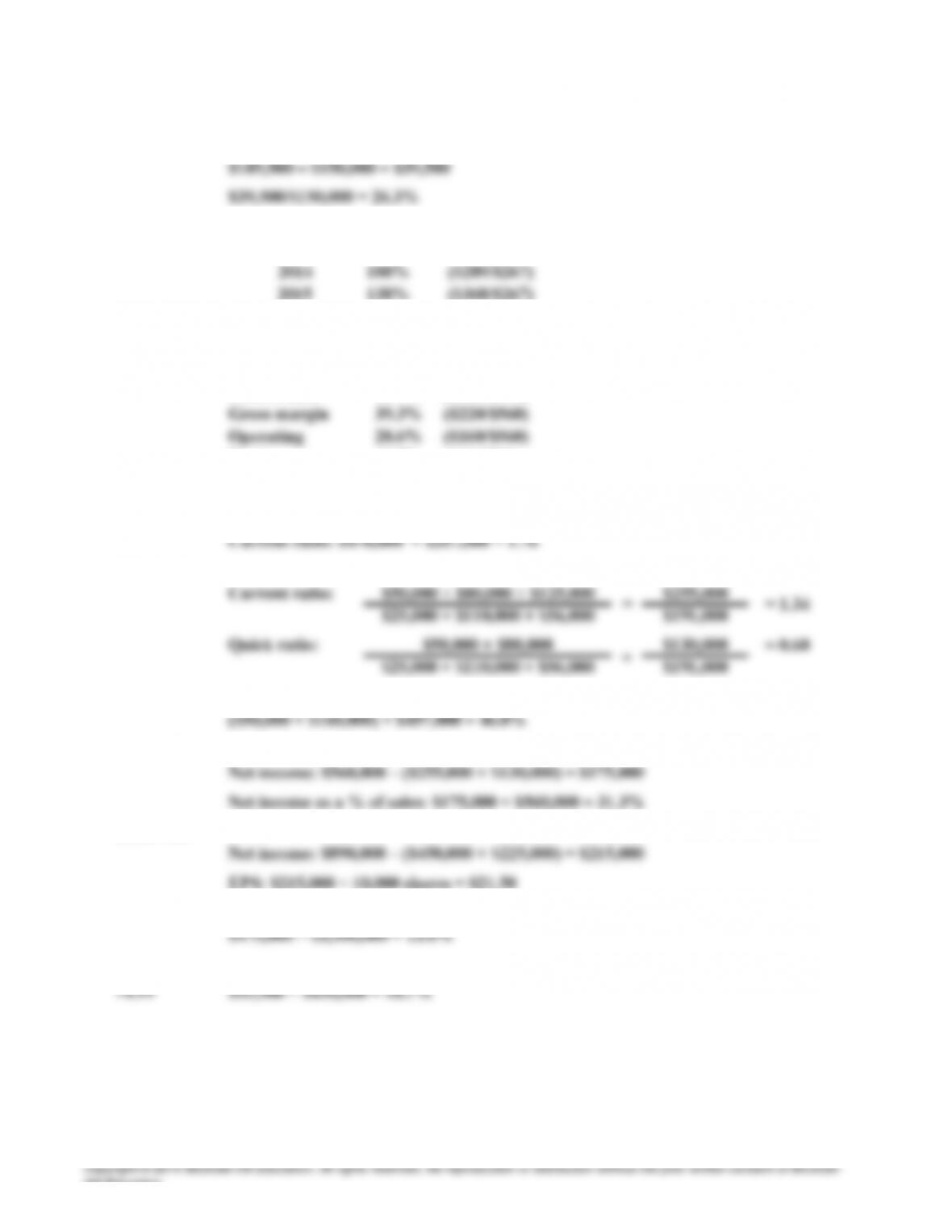

B.Ex. 14.1
2013 100%
B.Ex. 14.3
Sales 100.0%
Cost of sales 60.7% ($340/$560)
Net income 10.7% ($60/$560)
B.Ex. 14.5
B.Ex. 14.6
B.Ex. 14.7
B.Ex. 14.8
B.Ex. 14.9
B.Ex.
SOLUTIONS TO BRIEF EXERCISES
B.Ex. 14.4
Working capital: $470,000 – $267,000 = $203,000
B.Ex. 14.2
Hill Education.
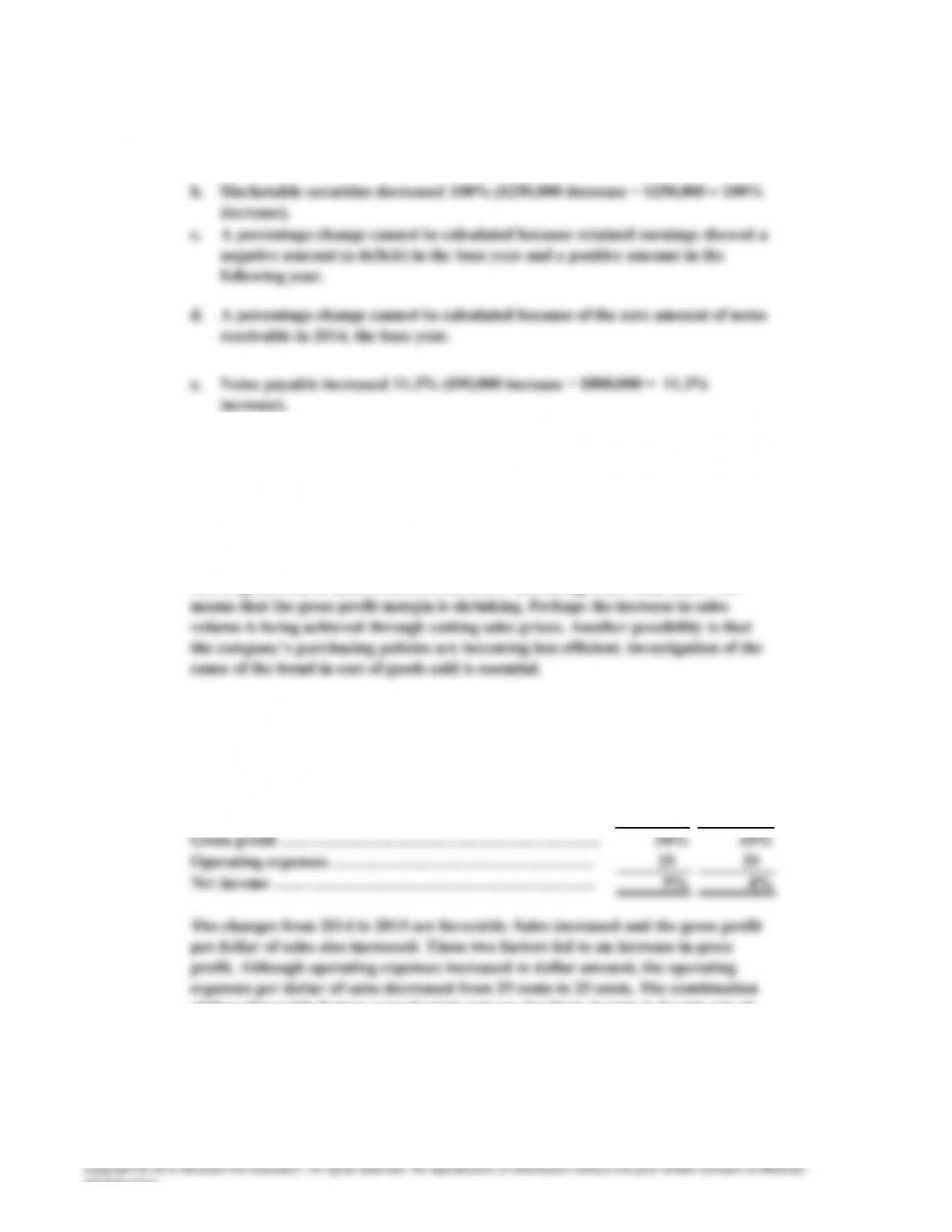

Ex. 14.1 a.
f.
g.
Ex. 14.2 2015 2014 2013 2012 2011
163% 148% 123% 118% 100%
195% 160% 135% 123% 100%
Ex. 14.3
2015 2014
Sales …………………………………………………………. 100% 100%
Cost of goods sold ………………………………………….. 66 67
of these favorable factors caused net income to rise from 4 cents to 9 cents out of
each dollar of sales.
SOLUTIONS TO EXERCISES
Sales …………………….
Cost of goods sold …….
Accounts receivable decreased 21% ($34,000 decrease ÷ $160,000 = 21%
decrease).
Sales increased 7% ($60,000 increase ÷ $910,000 =% increase).
The trend of sales is favorable with an increase each year. However, the trend of
cost of goods sold is unfavorable, because it is increasing faster than sales. This
Common size income statements for 2015 and 2014.
Cash increased 5% ($4,000 increase ÷ $80,000 = 5% increase).
Hill Education.