Chapter 25 – Capital Budgeting and Managerial Decisions
EXERCISES
Exercise 25-1 (20 minutes)
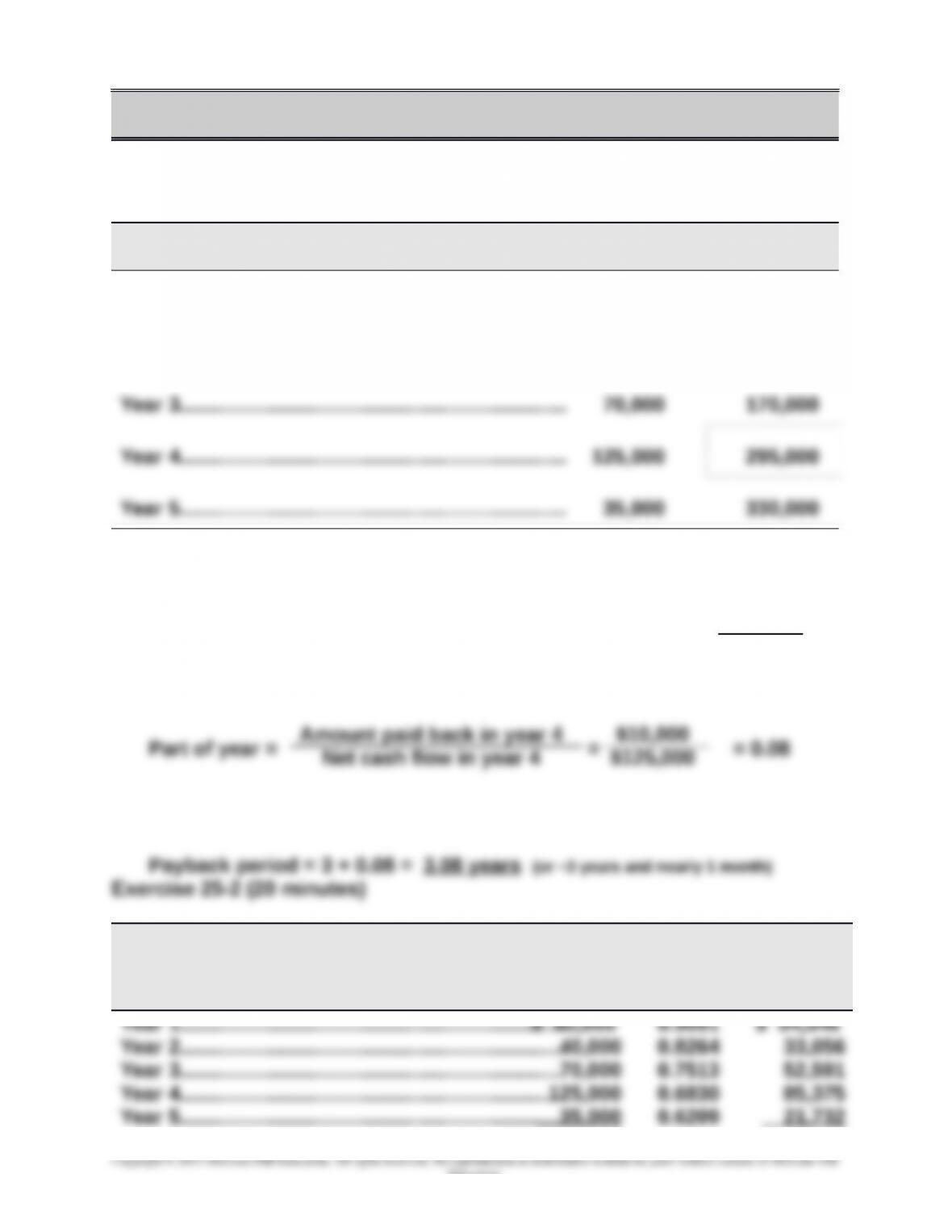
Annual Net Cumulative
Cash Flows Cash Flows
Year 1…………………………………………………………... $ 60,000 $ 60,000
Year 2…………………………………………………………... 40,000 100,000
Cost of investment………………………………………………………….….……$180,000
Paid back in years 1-3……………………………………………………………... 170,000
Paid back in year 4…………………………………………………………………..$ 10,000
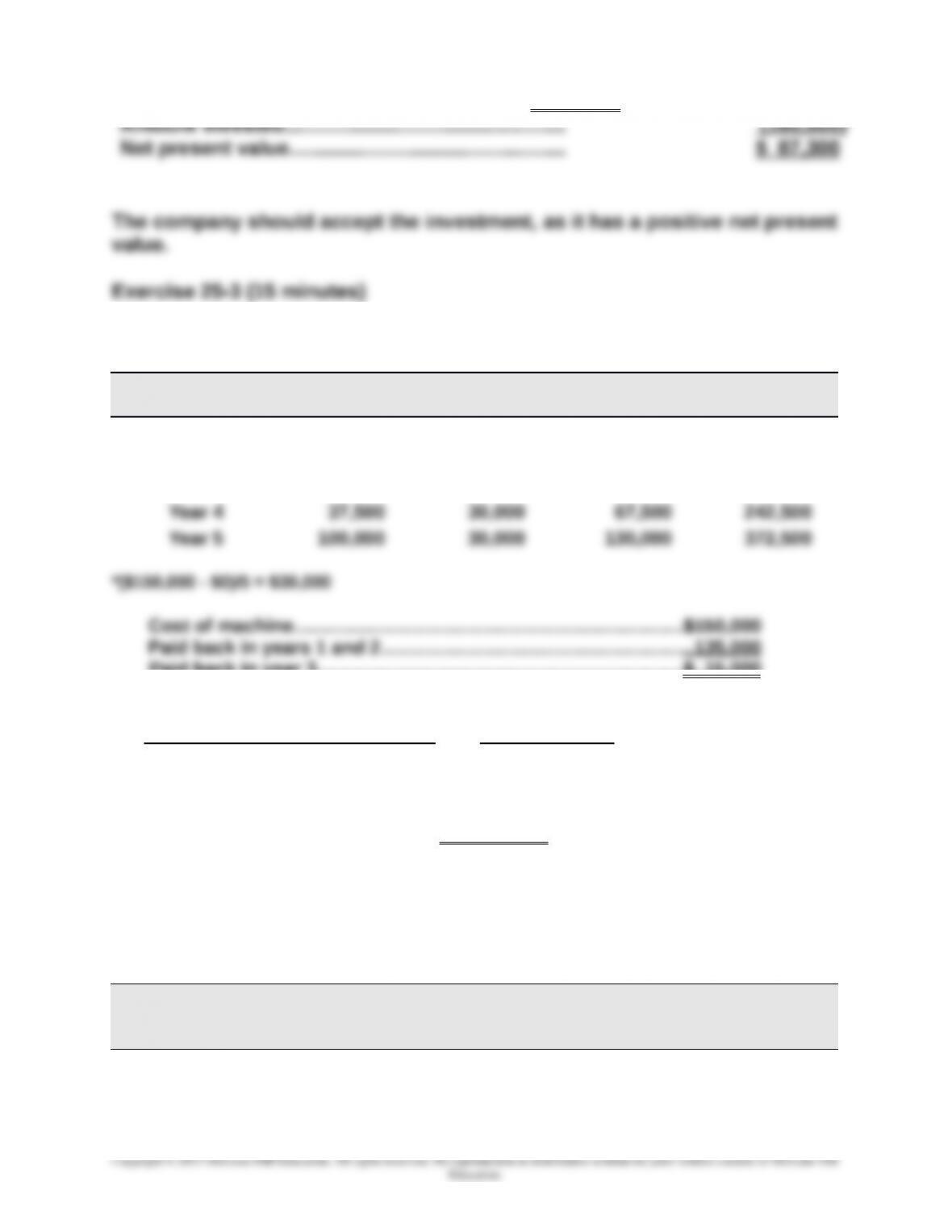
Net Cash
Flows
Present
Value of
1 at 10%
Present
Value of Net
Cash Flows
25-1481
Education.
Chapter 25 – Capital Budgeting and Managerial Decisions
Totals…………………………………………………….….….$330,000 247,300
ANNUAL CASH FLOWS
Net
Income Depreciation*
Net Cash
Flow
Cumulative
Cash Flow
Year 1 $ 10,000 $30,000 $ 40,000 $ 40,000
Year 2 25,000 30,000 55,000 95,000
Year 3 50,000 30,000 80,000 175,000
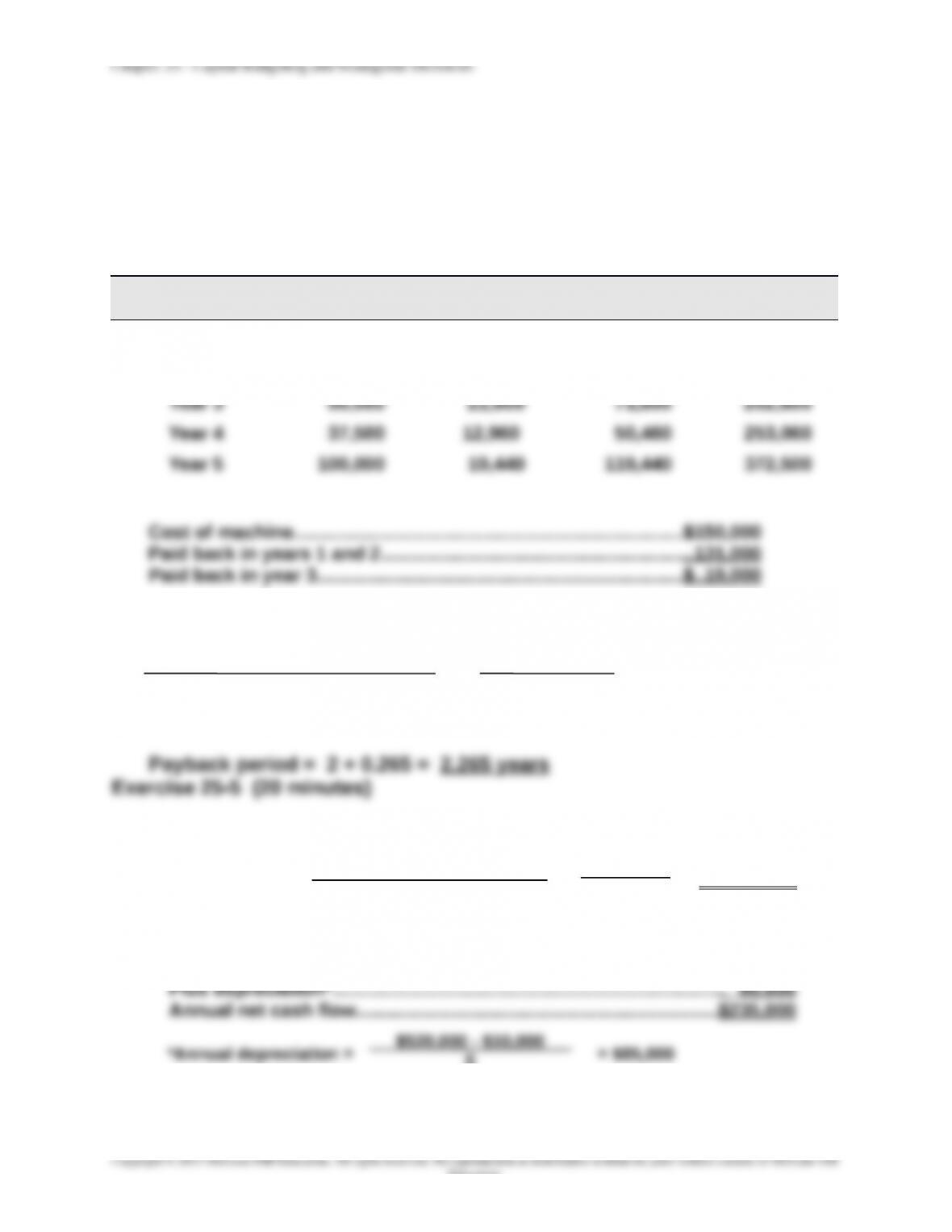
Paid back in year 3………………..………..……….………..………..…..…….$ 15,000
= = 0.188
Payback period = 2 + 0.188 = 2.188 years
Exercise 25-4 (30 minutes)
COMPUTATION OF ANNUAL DEPRECIATION EXPENSE
Double-declining balance rate = (100% / 5) x 2 = 40%
Annual Depr.
Beginning (40% of Accum. Depr. Ending
Year Book Value Book Value) at Year-End Book Value
1 $150,000 $60,000 $ 60,000 $90,000
2 90,000 36,000 96,000 54,000
25-1482
$15,000
$80,000
Amount paid back in year 3
Net cash flows in year 3
3 54,000 21,600 117,600 32,400
4 32,400 12,960 130,560 19,440
5 19,440 19,440 150,000 0
ANNUAL CASH FLOWS
Net
Income Depreciation
Net Cash
Flow
Cumulative
Cash Flow
Year 1 $ 10,000 $60,000 $ 70,000 $ 70,000
Year 2 25,000 36,000 61,000 131,000
= = 0.265
a.
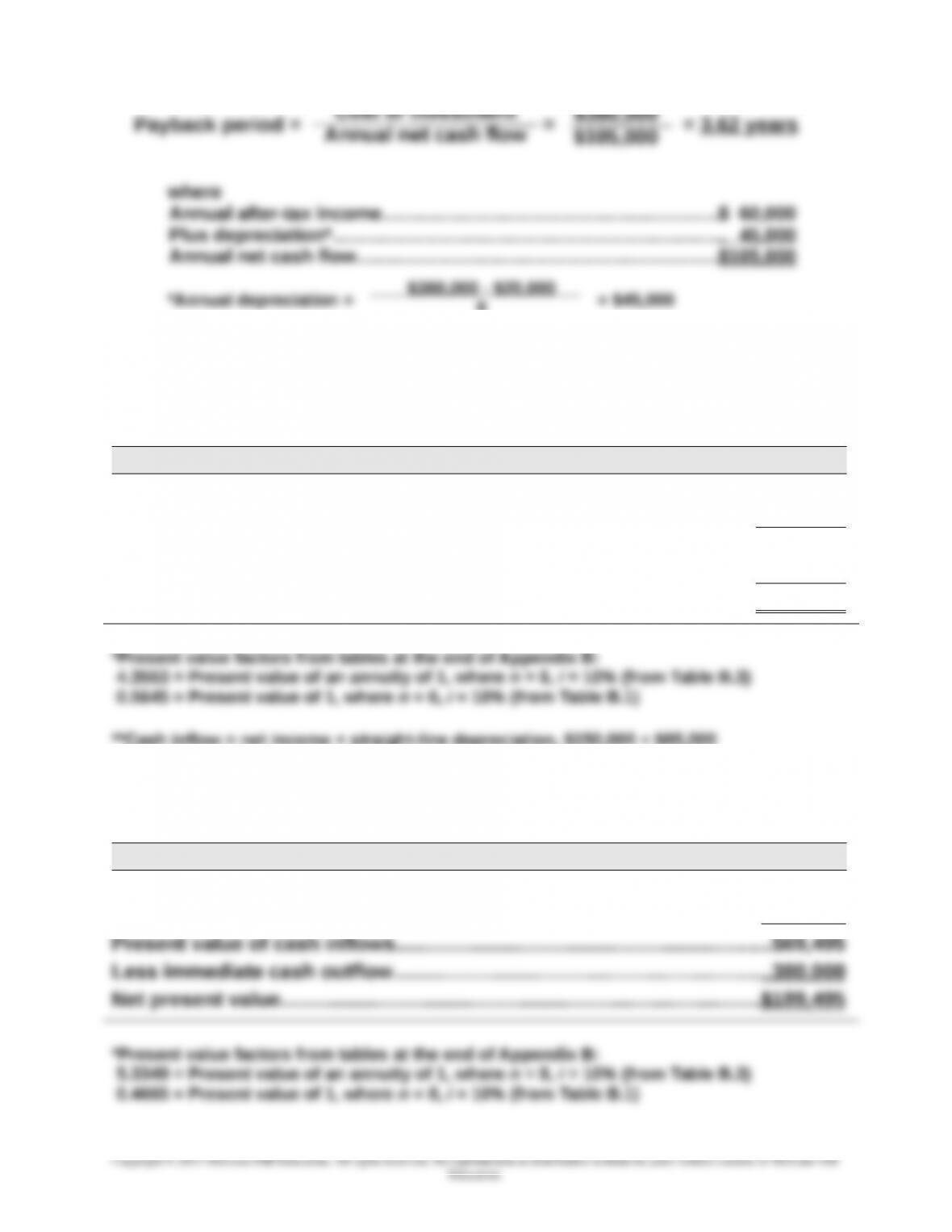
Payback period = = = 2.21 years
where
Annual after-tax income…………….……….………..………..……………....$150,000
b.
25-1483
Education.
$19,000
$71,600
Amount paid back in year 3
Net cash flows in year 3
Cost of investment
Annual net cash flow
$520,000
$235,000
6
Chapter 25 – Capital Budgeting and Managerial Decisions
Exercise 25-6 (20 minutes)
a.
Net present value of investment*
Present value of six $235,000** cash inflows ($235,000 x 4.3553)..........
$1,023,496
Present value of $10,000 at end of six years ($10,000 x 0.5645)............. 5,645
Present value of cash inflows……………………………………………….…….……. 1,029,411
Less immediate cash outflow…………………………………….…….…….…….….. 520,000
Net present value…………………………………………………..….…….…….…….…..$ 509,141
**Cash inflow = net income + straight-line depreciation, $150,000 + $85,000
Exercise 25-6 (continued)
b.
Net present value of investment*
Present value of eight $105,000** cash inflows ($105,000 x 5.3349)……..$560,165
Present value of $20,000 at end of eight years ($20,000 x 0.4665)..…..... 9,330
25-1484
Copyright © 2015 McGraw-Hill Education. All rights reserved. No reproduction or distribution without the prior written consent of McGraw-Hill
Education.
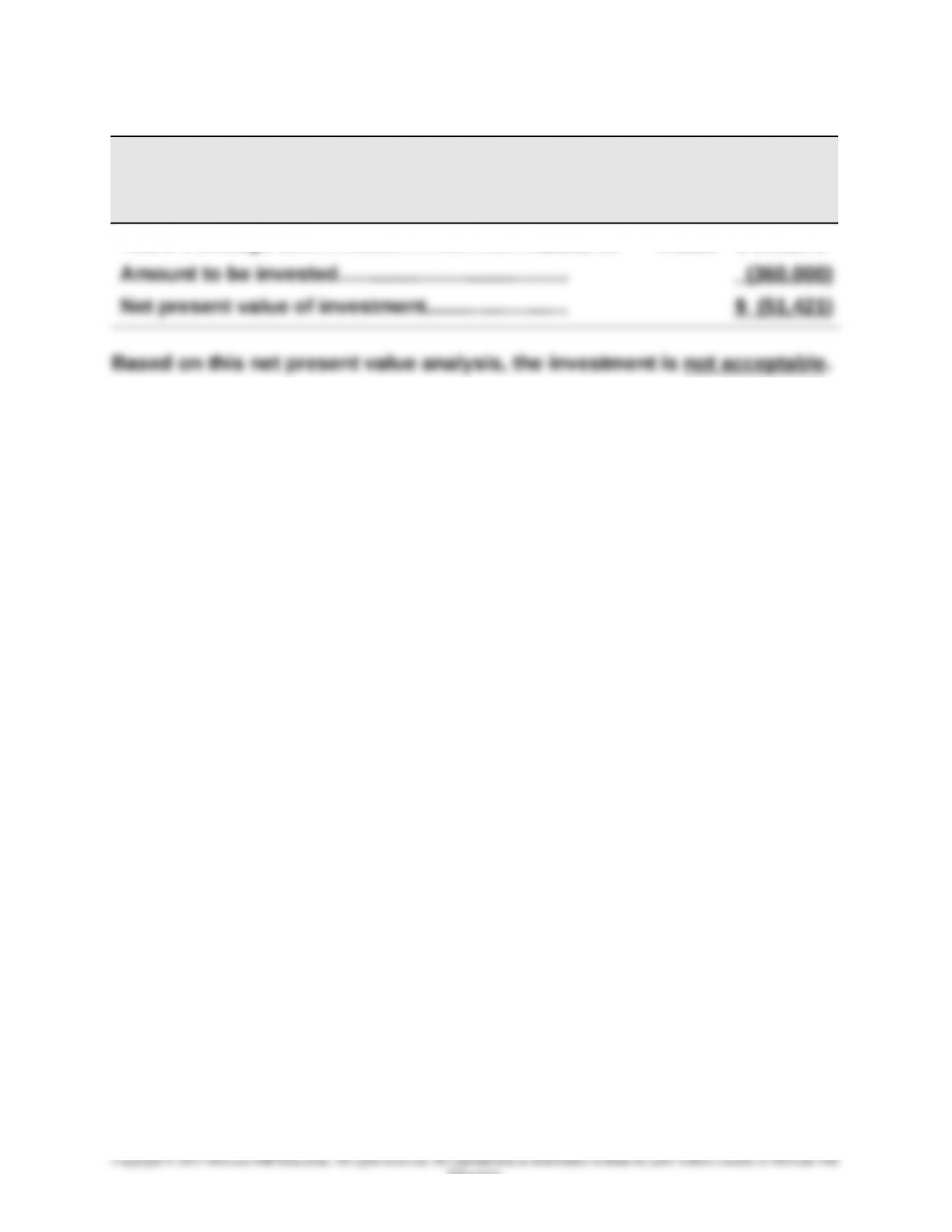
$380,000
Cost of investment
8
Chapter 25 – Capital Budgeting and Managerial Decisions
**Cash inflow = net income + straight-line depreciation, $60,000 + $45,000
Exercise 25-7 (15 minutes)
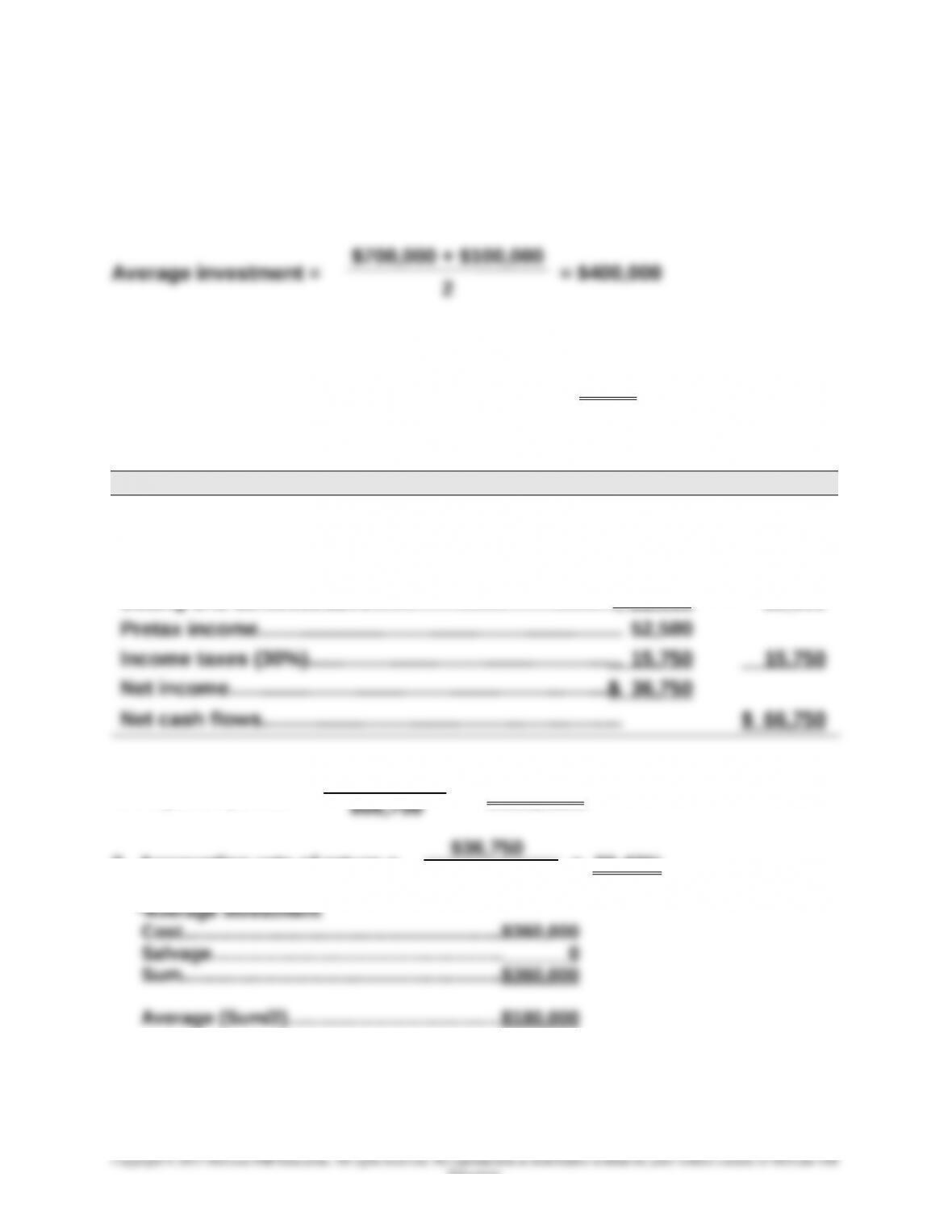
Accounting rate of return = $52,000 / $400,000 = 13.0%
Exercise 25-8 (20 minutes)
COMPUTING NET CASH FLOWS FROM NET INCOME
Net income Cash flows
Sales……………………………………………………………………..$225,000 $225,000
Materials, labor & overhead………………….….…….……...120,000 120,000
Depreciation………………………………..….…….…….…….…. 30,000
Selling and administrative……………………………………… 22,500 22,500
1. Payback period = = 5.39 years
2. Accounting rate of return = = 20.42%
25-1485
Education.
$360,000
$180,000*
Chapter 25 – Capital Budgeting and Managerial Decisions
Exercise 25-9 (15 minutes)
Annual
Net Cash
Flows
Present
Value of
Annuity
at 8%
Present
Value of
Net Cash
Flows
Years 1 through 6……………………..…….…….……...$ 66,750 4.6229 $ 308,579
25-1486
Education.
Chapter 25 – Capital Budgeting and Managerial Decisions
Exercise 25-10 (20 minutes)
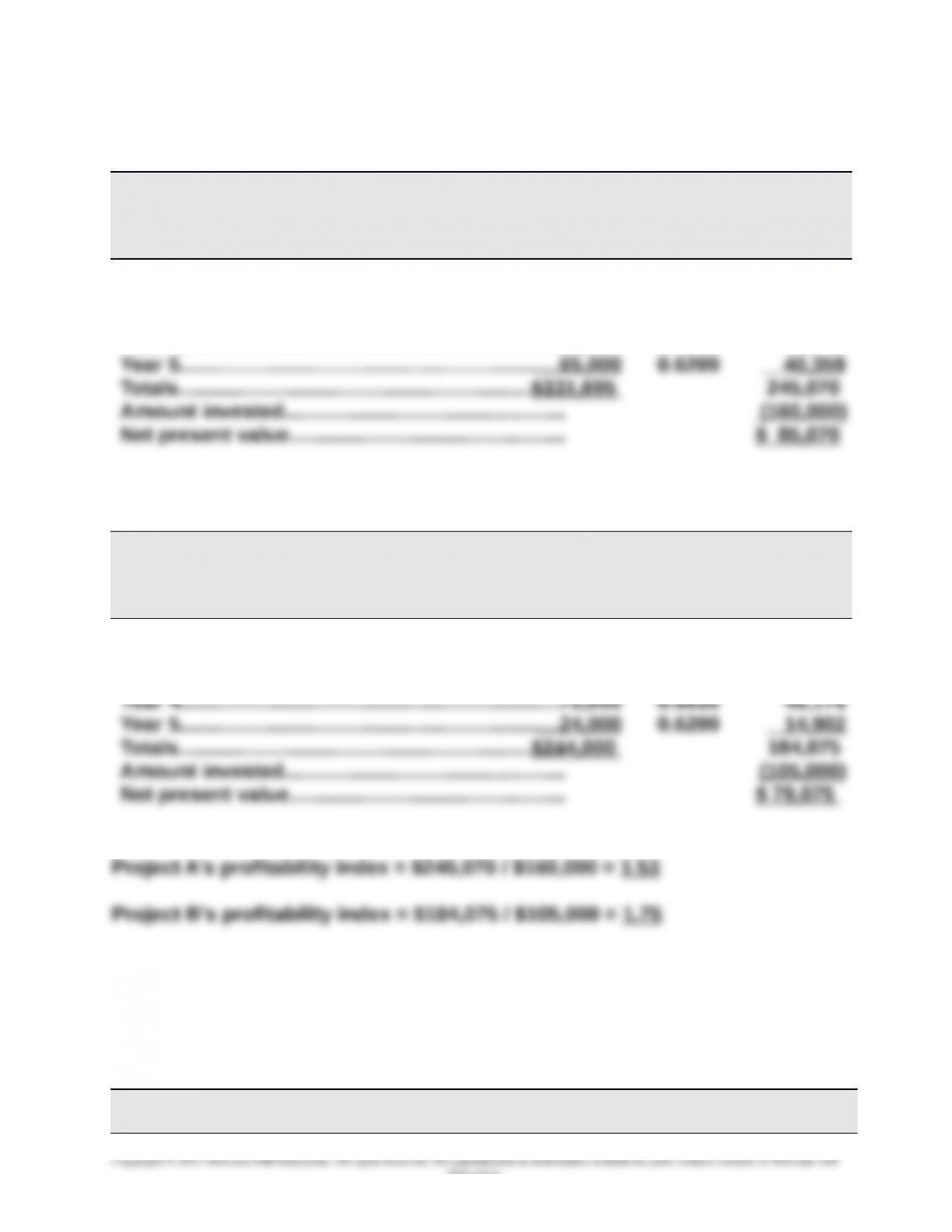
PROJECT A
Net Cash
Flows
Present
Value of
1 at 10%
Present
Value of Net
Cash Flows
Year 1……………………………………………………………$ 40,000 0.9091 $ 36,364
Year 2……………………………………………………………56,000 0.8264 46,278
Year 3……………………………………………………………80,295 0.7513 60,326
Year 4……………………………………………………………90,400 0.6830 61,743
PROJECT B
Net Cash
Flows
Present
Value of
1 at 10%
Present
Value of Net
Cash Flows
Year 1…………………………………………………………… $ 32,000 0.9091 $ 29,091
Year 2……………………………………………………………50,000 0.8264 41,320
Year 3……………………………………………………………66,000 0.7513 49,586
Both projects have positive net present values. However, if the company
can choose only one project, it should select project B, since it has a
higher profitability index.
Exercise 25-11 (25 minutes)
a.
Present
Present
Value of Net
25-1487
Education.
Chapter 25 – Capital Budgeting and Managerial Decisions
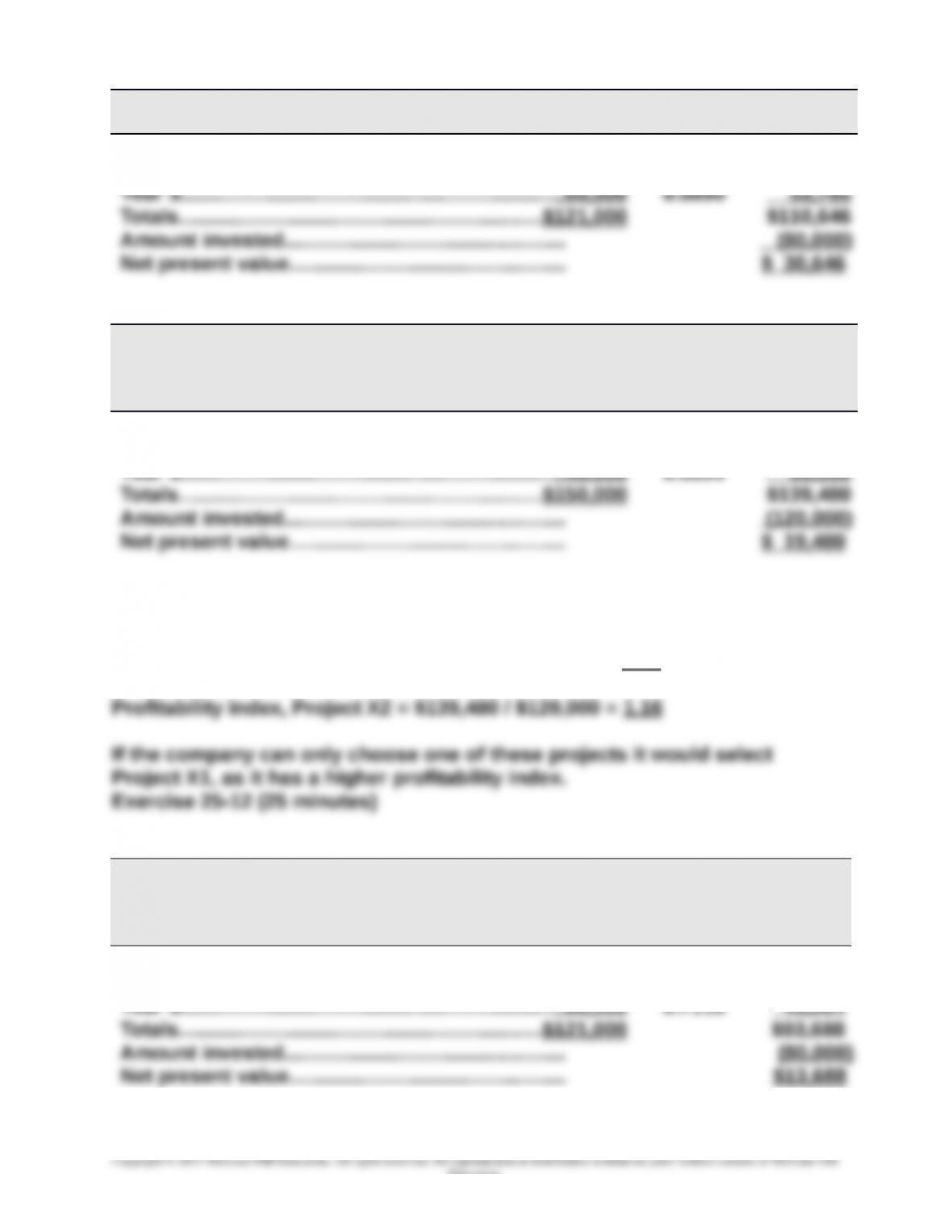
Project X1 Net Cash
Flows
Value of
1 at 4%
Cash Flows
Year 1……………………………………………………………$ 25,000 0.9615 $ 24,038
Year 2……………………………………………………………35,500 0.9246 32,823
Project X2 Net Cash
Flows
Present
Value of
1 at 4%
Present
Value of Net
Cash Flows
Year 1……………………………………………………………$ 60,000 0.9615 $ 57,690
Year 2……………………………………………………………50,000 0.9246 46,230
b.
Profitability index, Project X1 = $110,646 / $80,000 = 1.38
a.
Project X1 Net Cash
Flows
Present
Value of
1 at 12%
Present
Value of
Net Cash
Flows
Year 1……………………………………………………………$ 25,000 0.8929 $ 22,323
Year 2……………………………………………………………35,500 0.7972 28,301
25-1488
Education.
Chapter 25 – Capital Budgeting and Managerial Decisions
Project X2 Net Cash
Flows
Present
Value of
1 at 4%
Present
Value of Net
Cash Flows
Year 1……………………………………………………………$ 60,000 0.8929 $ 53,574
Year 2……………………………………………………………50,000 0.7972 39,860
Year 3…………………………………………………………… 40,000 0.7118 28,472
b.
Profitability index, Project X1 = $93,688 / $80,000 = 1.17
Exercise 25-13 (20 minutes)
Using Excel, Project X1 (X2) has an internal rate of return of 20.34% (12.99%).
Project X1 Project X2
A B C D
1 Initial investment -80000 -120000
8 Formula for IRR =IRR(C1:C5) =IRR(D1:D5)
25-1489
Chapter 25 – Capital Budgeting and Managerial Decisions
Exercise 25-14 (35 minutes)
1.
PROJECT C1
Net Cash
Flows
Present
Value of
1 at 12%
Present
Value of Net
Cash Flows
Year 1……………………………………………………………$ 12,000 0.8929 $ 10,715
Year 2……………………………………………………………108,000 0.7972 86,098
25-1490