Chapter 18 – Managerial Accounting Concepts and Principles
Chapter 18
Managerial Accounting Concepts and
Principles
QUESTIONS
1. The managerial accountant plays an important role in preparing the information
necessary for effective planning and control decisions. One example is the budget,
2.
Financial Accounting Managerial Accounting
(a) Users and decision
makers
Investors, creditors, and
other users external to the
organization
Managers, employees, and
decision makers internal to
the organization
3. A customer orientation has led companies to adopt the principles of the lean
business model in response to consumer demands. The essence of customer
18-1011
4. Direct labor refers to the efforts of employees who physically convert materials to
finished product. Indirect labor refers to the efforts of factory employees who do not
5. Factory overhead is limited to indirect costs that are incurred in the production
process. That is, it consists of activities that support the production process, such
6. Direct materials are raw materials that physically become part of the product and
can be clearly traced to specific units or batches of product. Indirect materials are
7. Direct labor can be either a prime cost or a conversion cost.
8. Direct costs include: costs of materials such as circuit boards, wires, television
tubes, smartphone cameras, memory chips, and processors, as well as the labor of
9. The production manager should likely not be evaluated on the basis of operating
expenses. Operating expenses are not under the influence of production managers,
and they should not be held accountable for them.
10. Management usually must be able to predict financial performance to be successful.
11. Product costs are capitalized because they represent a future value (an asset) to the
18-1012
12. A manufacturing business produces a product, whereas in a merchandising or
service business this is not the case. In making a product, the manufacturing
13. To run a successful business, management must make predictions and estimates
about what will occur in the future. Thus, managerial accountants must project how
the numbers will look under different possibilities.
14. A manufacturing firm converts raw materials into finished products. A
manufacturing company would report three types of inventories on its balance
sheet: raw materials, work in process, and finished goods. The finished goods are
15. Manufacturers’ balance sheets usually include small tools, factory buildings, factory
16. Manufacturing firms have inventories at various states of completion. Manufacturing
a product requires raw materials, which are converted to finished goods.
17. Manufacturing activities of a company are described in the Schedule of Cost of
18. The three categories of manufacturing costs are: direct materials, direct labor, and
factory overhead.
19. Examples of factory overhead costs include: indirect materials, indirect labor,
depreciation of the factory equipment and plant, amortization of patents, the cost of
20. Components of Schedule of COGM Apple Examples
Direct material……………………………………………………….....Processors, chips, covers
18-1013
Chapter 18 – Managerial Accounting Concepts and Principles
21. Google
Schedule of Cost of Goods Manufactured
For Year Ended December 31, 2015
22. The income statement describes the revenues and expenses for the year. Included in
the calculation of the cost of goods sold is a line item identified as the cost of goods
23. Raw materials inventory turnover and days’ sales in raw materials inventory can be
used to assess raw materials inventory management. Raw materials inventory
24. Yes. Apple can use the concepts and measures of cycle time and cycle efficiency to
evaluate performance on its product offerings.
25. Inventory Components ($ millions) Dell (February 1, 2013)
Production materials………………………..………................... $ 593
QUICK STUDIES
Quick Study 18-1 (5 minutes)
1. Its primary users are company managers. Managerial
2. Its information is often available only after an audit is
Quick Study 18-2 (5 minutes)
1. At her normal usage, your sister’s total cost with Plan A is $80 (fixed).
18-1014
Chapter 18 – Managerial Accounting Concepts and Principles
2. If her usage doubles, your sister’s total cost remains fixed at $80 under
Quick Study 18-3 (5 minutes)
Quick Study 18-4 (10 minutes)
1. Direct materials
Quick Study 18-5 (10 minutes)
1. Product cost
2. Period cost
Quick Study 18-6 (5 minutes)
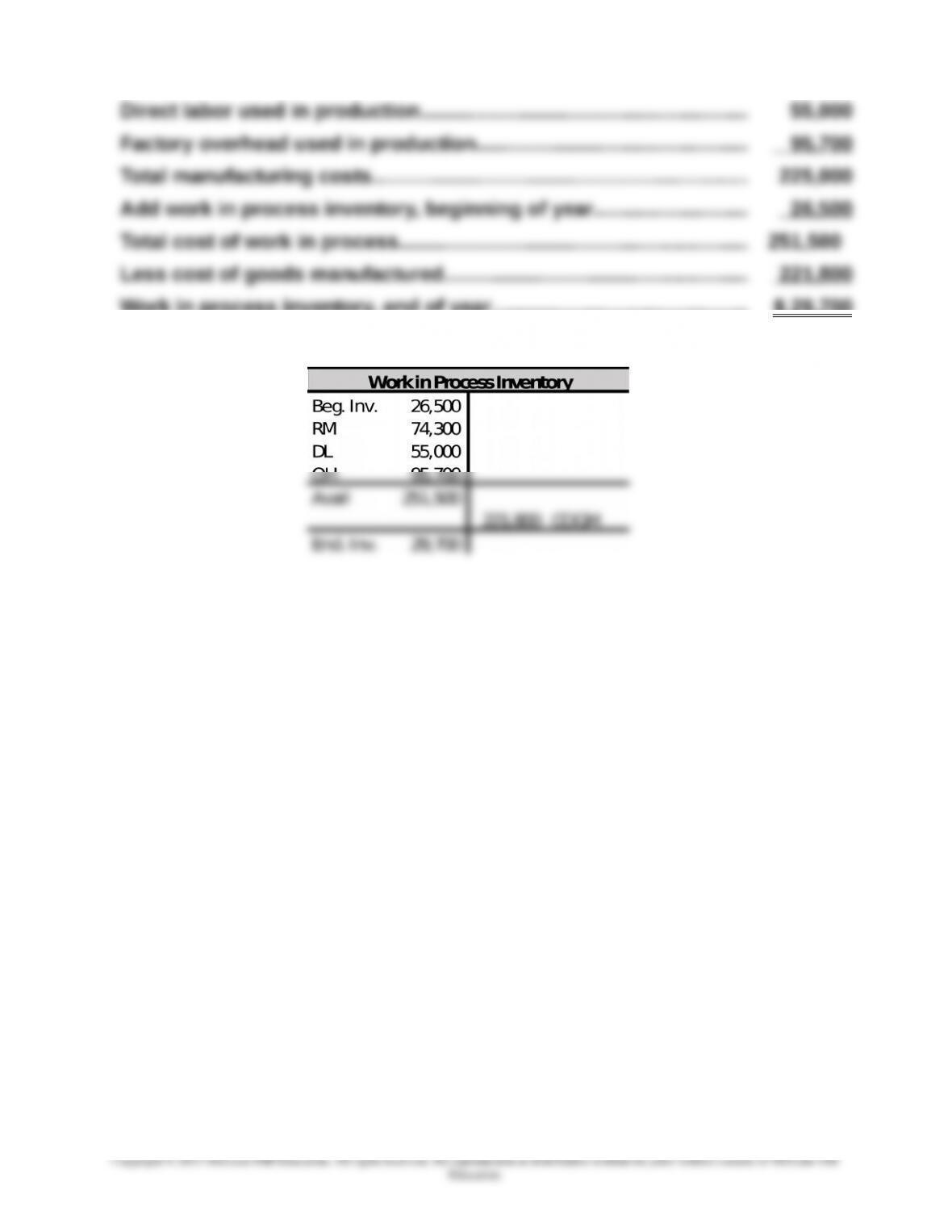
Ending work in process inventory is computed as:
Raw materials used in production………………………………..………..….. $74,300
18-1015
Chapter 18 – Managerial Accounting Concepts and Principles
Work in process inventory, end of year…………………..…………..…….. $ 29,700
18-1016
Chapter 18 – Managerial Accounting Concepts and Principles
Quick Study 18-7 (10 minutes)
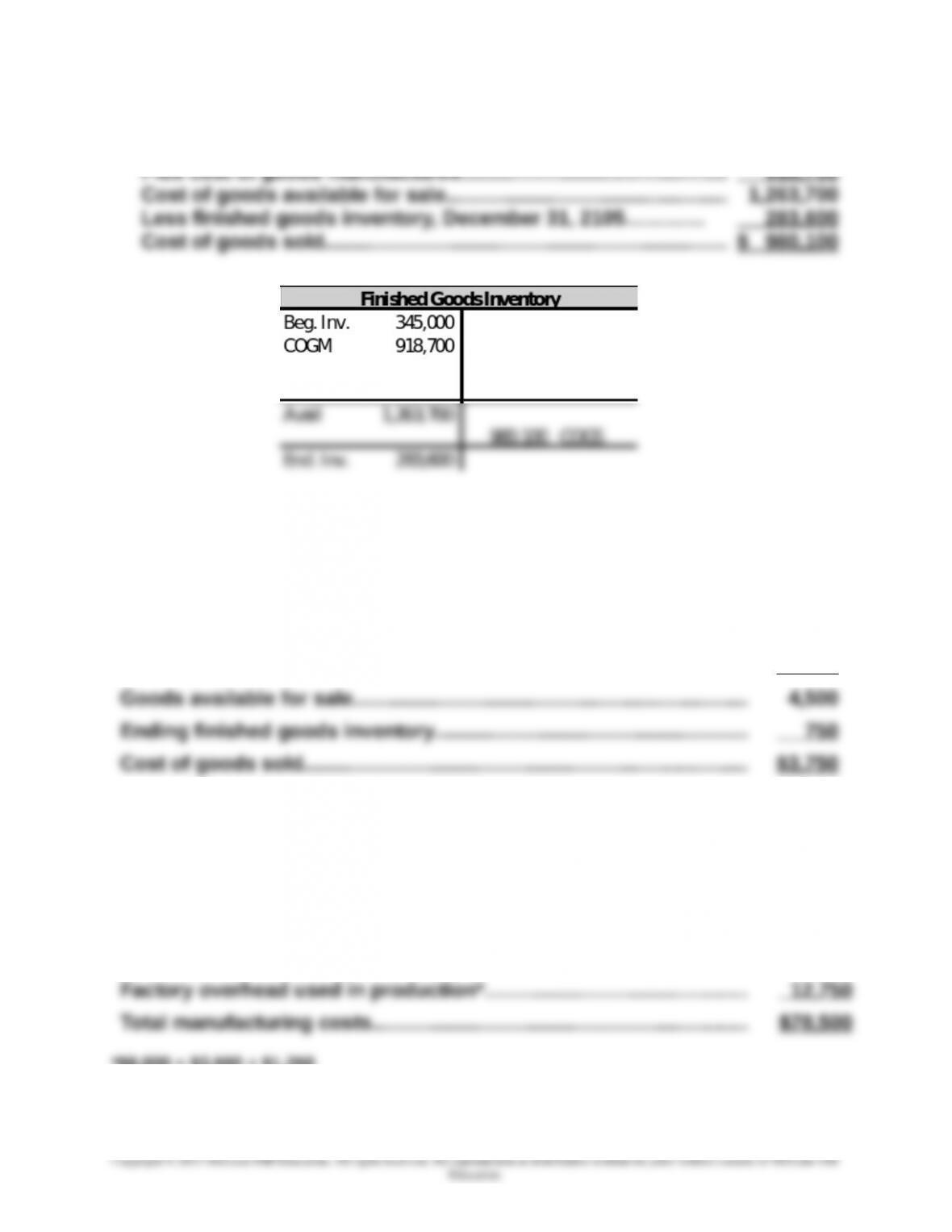
Finished goods inventory, December 31, 2014………………..…… $ 345,000
Quick Study 18-8 (10 minutes)
Cost of goods sold is computed as:
Beginning finished goods inventory………………………..…………..……. $ 500
Cost of goods manufactured……………………………………………………... 4,000
Quick Study 18-9 (5 minutes)
Total manufacturing cost is computed as:
Raw materials used in production………………………………..………..….. $53,750
Direct labor used in production…………………………….………..…………. 12,000
*$8,000 + $3,500 + $1,250
18-1017
Chapter 18 – Managerial Accounting Concepts and Principles
Quick Study 18-10 (15 minutes)
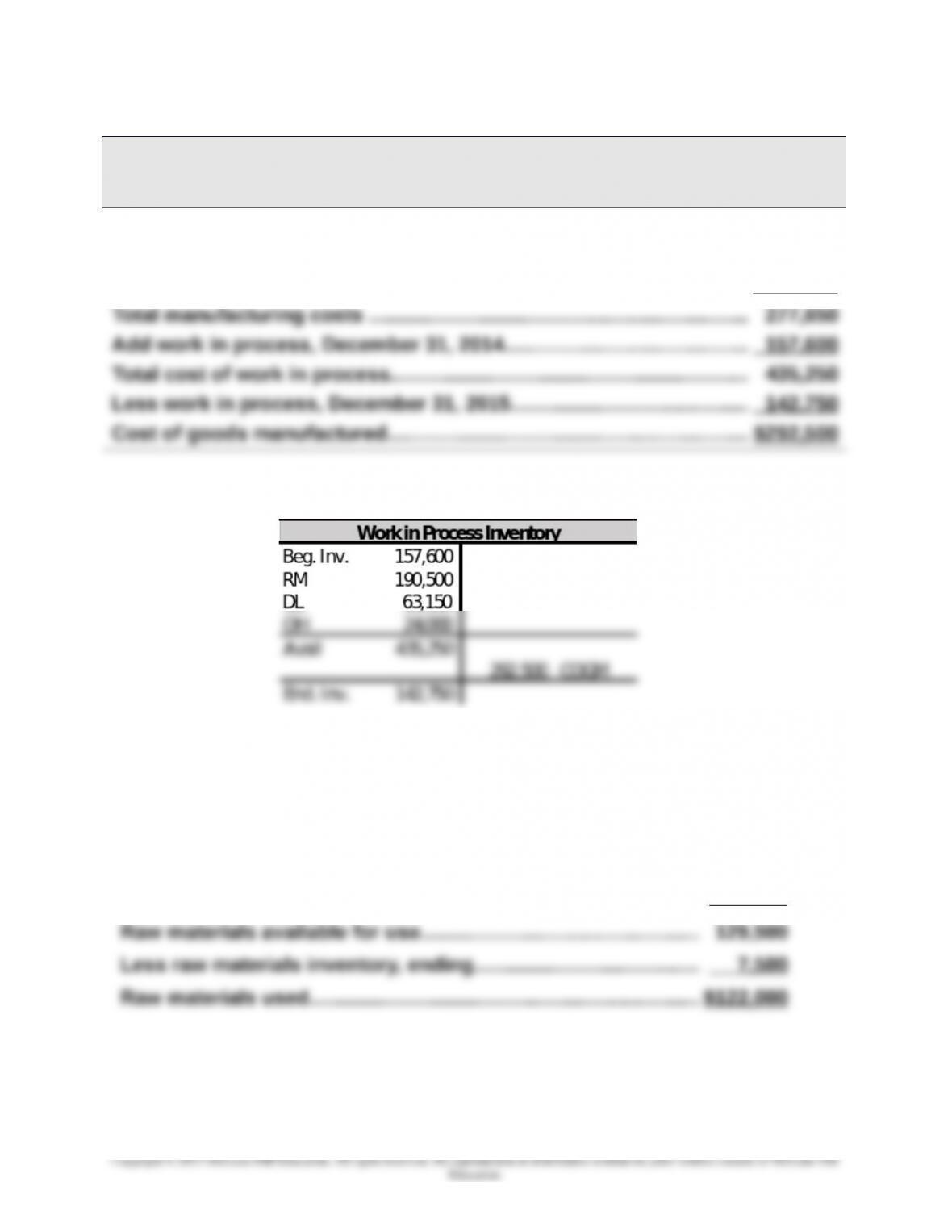
Barton Company
Schedule of Cost of Goods Manufactured
For Year Ended December 31, 2015
Direct materials……………………………………………………….……..………….. $190,500
Direct labor …………………………………………………………………..………..…. 63,150
Factory overhead costs…………………………………………………………....… 24,000
Quick Study 18-11 (5 minutes)
Raw materials inventory, beginning……………..…………..……….. $ 6,000
Plus raw materials purchased……………………………....…………... 123,500
Quick Study 18-12 (10 minutes)
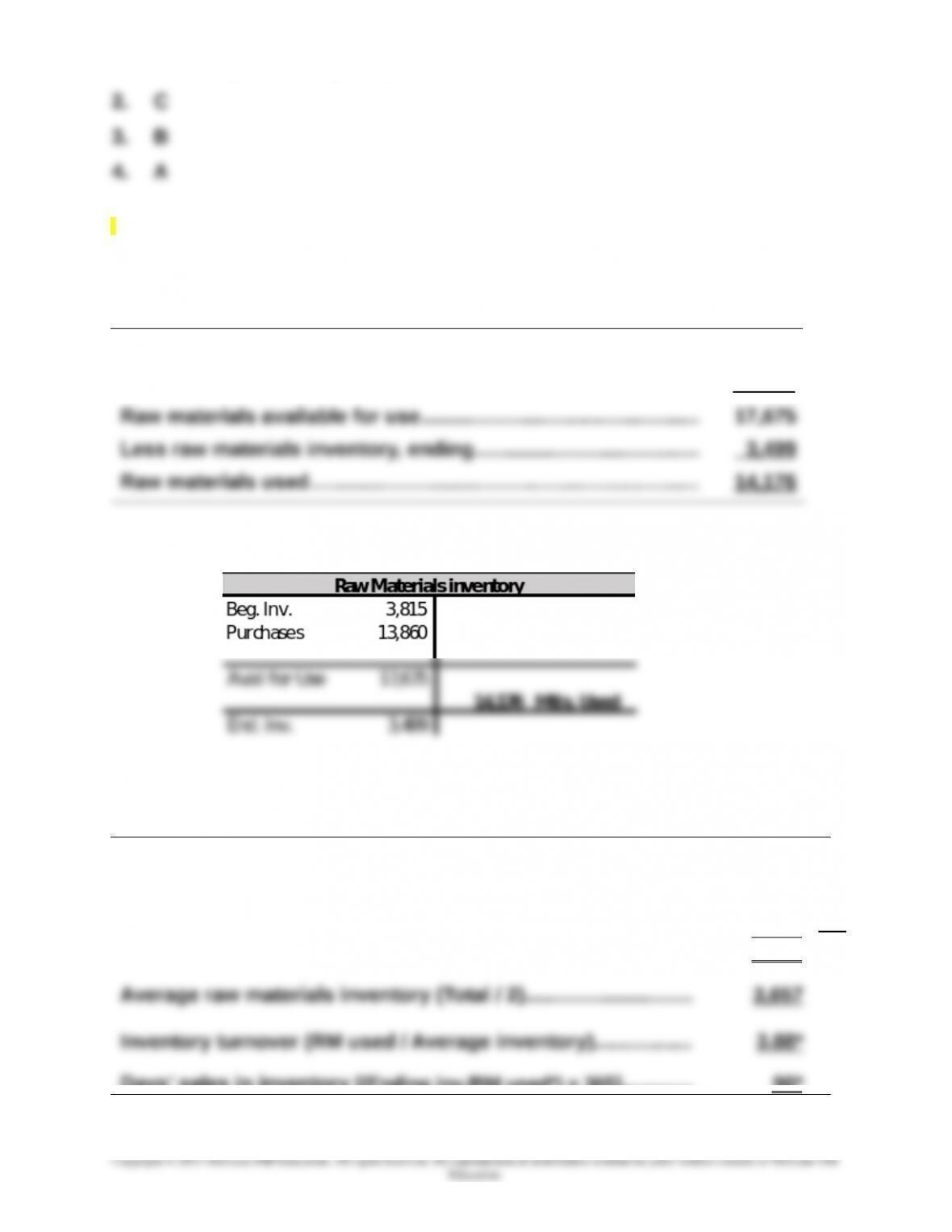
1. D
18-1018
Chapter 18 – Managerial Accounting Concepts and Principles
Quick Study 18-13 (5 minutes)
(Amounts in millions of Swiss francs)
Raw materials inventory, beginning……………..…………..……….. 3,815
Plus raw materials purchased……………………………....…………... 13,860
Quick Study 18-14 (10 minutes)
(in millions of Swiss francs)
Cost of raw materials used………………………………………..……… 14,176
Beginning raw materials inventory……………………………..…..… 3,815
Ending raw materials inventory…………………….……..………..…. 3,499
Total beginning plus ending raw materials inventory…………. 7,314
Days’ sales in inventory [(Ending inv./RM used*) x 365]............ 90*
*Rounded
18-1019

18-1020