Chapter 9
2. The formula for free cash flow is as follows:
FCF = EBIT(1 – Tax rate) + Depreciation – Capital expenditures – Working capital
investments
EBIT = Earnings before taxes + Interest expense = 200 + 50 = 250
Tax rate = 80/200 = 0.4
FCF = 250(1 – 0.4) + 50 – 150 – 20 = 30 or $30,000.
4. a. The terminal value = 700 × (1 + 0.04)/(0.08 – 0.04) = $18,200. Discounting the annual
free cash flows plus the terminal value at 8 percent, the MAP = $11,926.
c. The MAP increases 116 percent when the discount rate falls one percentage point and the
6. a. EBIT = $50 million. As a stand-alone company, typical debt would be 0.40 × $250 million
= $100 million. At a 10% interest rate, interest expense would be $10 million. Therefore,
This should be the owner’s minimum acceptable price.
b. From the acquirer’s perspective, this is essentially a “make-or-buy” decision. Because the
c. An acquisition appears feasible; the owner’s minimum price is less than the buyer’s
maximum.
= $26.4 × 15 = $396, and adding liabilities, the value of the division is now $396 + 100 =
e. The answer to (d) suggests that acquisition activity will decrease when market value rises
above replacement value. In this situation, companies find it more expensive to “buy”
8. a. Negative free cash flow simply means that the company will not be able to fund all
companies.
b. Negative free cash flows do not compromise or invalidate the notion that the value of the
firm equals the present value of free cash flows, provided the securities sold to make up
raised from new investors.
c. The going-concern value of a company with negative expected free cash flows in all future
periods is negative. Nonetheless, an equity investor might buy shares in such a company
for at least two reasons: the expected liquidation value of equity might be positive, and
10. The median and mean values for Scotts’s peers appear below.
Values excluding Scotts
Median
Mean
5-year growth rate in sales (%)
8.5
7.0
5-year growth rate in EPS (%)
5.1
3.7
Analysts’ projected growth (%)
9.2
9.8
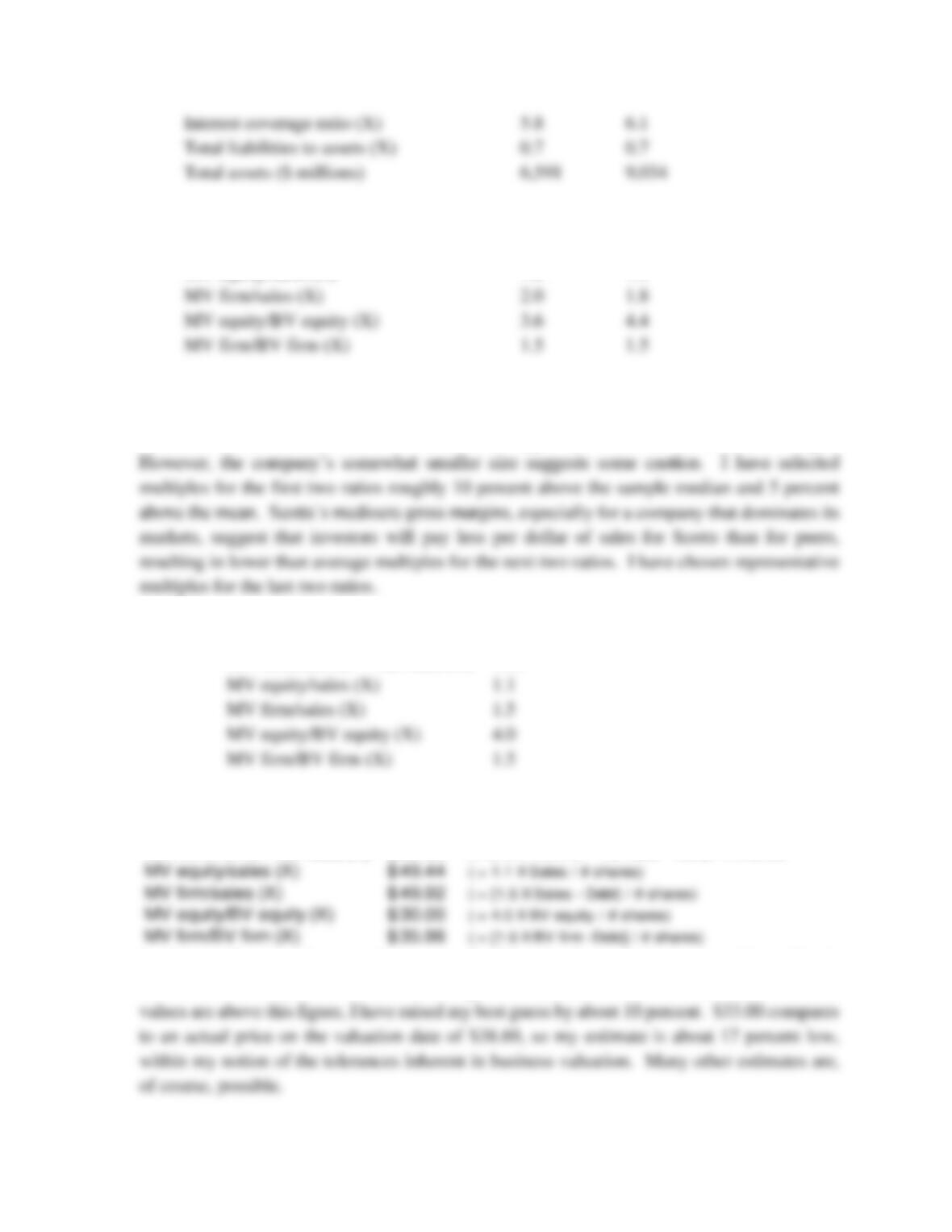
Interest coverage ratio (X)
5.8
6.1
Total liabilities to assets (X)
0.7
0.7
Total assets ($ millions)
6,591
9,034
Price/earnings (X)
16.9
17.9
MV firm/EBIT(1 – Tax rate) (X)
17.8
18.0
MV equity/sales (X)
1.6
1.3
MV firm/sales (X)
2.0
1.8
MV equity/BV equity (X)
3.6
4.4
MV firm/BV firm (X)
1.5
1.5
Here are my indicators of value for Scotts. In coming to these numbers, I believe that Scotts’s
somewhat higher historical and projected growth rates, combined with dominant positions in
its chosen markets, warrant numbers that are in the upper half of the indicated valuation ranges.
Price/earnings (X)
18.7
MV firm/EBIT(1 – Tax rate) (X)
19.4
MV equity/sales (X)
1.1
MV firm/sales (X)
1.5
MV equity/BV equity (X)
4.0
MV firm/BV firm (X)
1.5
The implied value of Scotts’s common stock for each indicator is:
Price/earnings (X) 33.19$ ( = 18.7 X Net income / # shares)
MV firm/EBIT(1-Tax rate) (X) 29.88$ ( = [19.4 X EBIT(1 – Tax rate) – Debt] / # shares)
MV equity/sales (X) 49.44$ ( = 1.1 X Sales / # shares)
MV firm/sales (X) 49.92$ ( = [1.5 X Sales – Debt] / # shares)
MV equity/BV equity (X) 30.00$
( = 4.0 X BV equity / # shares)
MV firm/BV firm (X) 35.96$ ( = [1.5 X BV firm -Debt] / # shares)
Looking at these numbers, my best guess of a fair price for Scotts’s shares on November 1,
2007 is $33.00. I think $29.88 is the best single estimate, but because all of the other estimated
12. Price per share = $5 million/400,000 shares = $12.50 per share. Pre-money value = 1.6 million
14.
Value of firm at year 6 240.00$ =20*12
Round 1
Investment 6.00
Time 0 PV @ 60% 14.31 =240/(1+.60)^6
% ownership at time 6 41.9% =6/14.31
Round 2
Investment 8.00
Time 2 PV @ 40% 62.47 =240/(1+.40)^4
% ownership at time 6 12.8% =8/62.47
Round 3
Investment 12.00
Time 4 PV @ 30% 142.01 =240/(1+.30)^2
% ownership at time 6 8.5% =12/142.01
Employee bonus and option ownership
15.0%
Round 3 retention ratio 85.0% =(1-.15)
Round 3 % ownership at time 4 9.9% =8.5/.85
Round 2 retention ratio 0.77 =(1-.15)*(1-.099))
Round 2 % ownership at time 2 16.7% =12.8/0.77
Round 1 retention ratio 0.64 =(1-.15)*(1-.099)*(1-.167)
Alternatively, = pre-money value +$6 million
($ in millions)
16. See Excel solutions at mhhe.com/higgins11e.