LG3 11-1 WACC Johnny Cake Ltd. has ten million shares of stock outstanding selling at $23 per
share and an issue of $50 million in 9 percent, annual coupon bonds with a maturity of 17
years, selling at 93.5 percent of par. If Johnny Cake’s weighted average tax rate is 34
percent, its next dividend is expected to be $3 per share, and all future dividends are
expected to grow at 6 percent per year, indefinitely, what is its WACC?
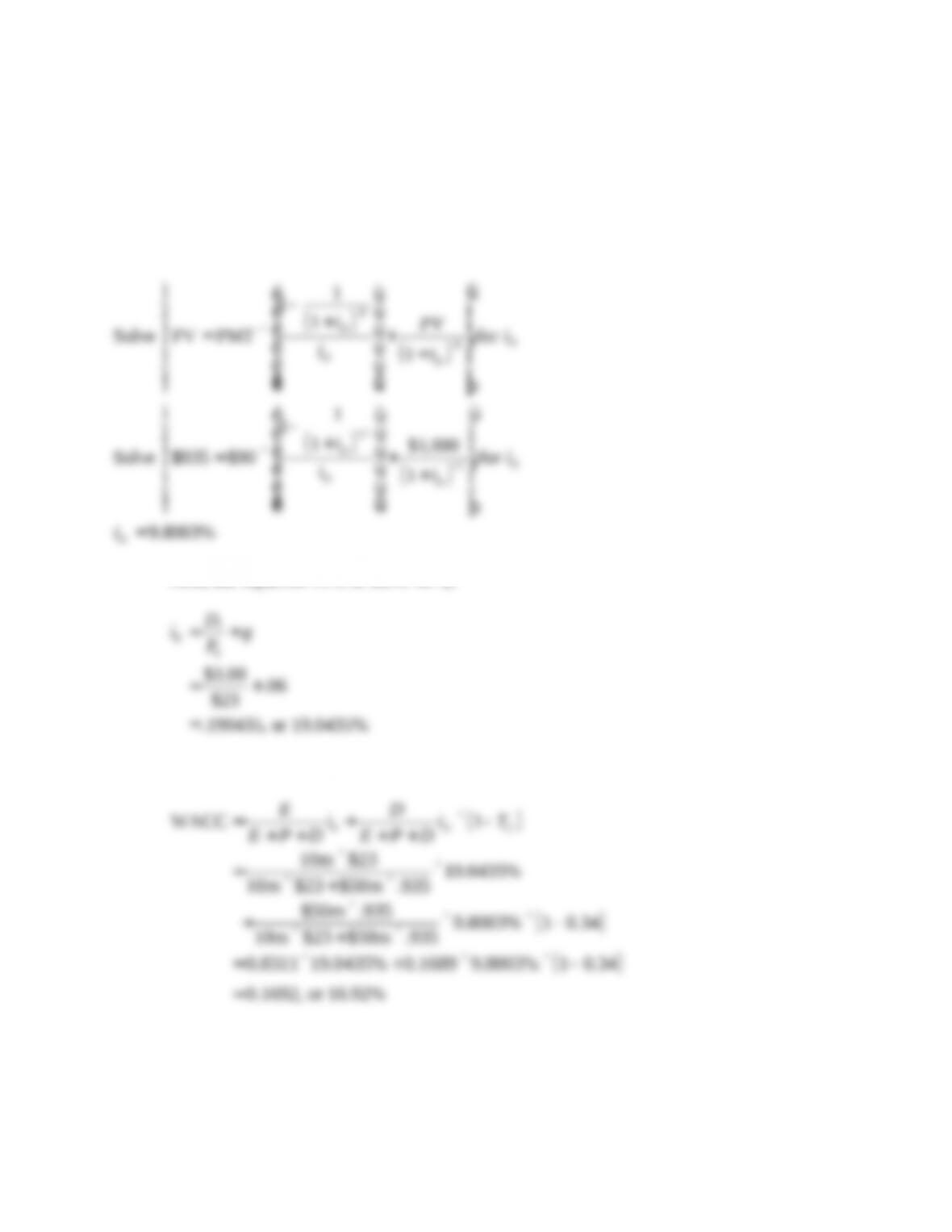
First, solve equation 11-5 for iD:
( )
( )
( )
( )
17
17
1
1
1
Solve PV PMT for
1
1
1
1$1,000
Solve $935 $90 for
1
9.8003%
N
D
D
N
DD
D
D
DD
D
iPV i
ii
ii
ii
i
ì ü
é ù
–
ï ï
ê ú
+
ï ï
ê ú
= ´ +
í ý
ê ú +
ï ï
ê ú
ï ï
ê ú
ë û
î þ
ì ü
é ù
–
ï ï
ê ú
+
ï ï
ê ú
= ´ +
í ý
ê ú +
ï ï
ê ú
ï ï
ê ú
ë û
î þ
=
Next, use equation 11-3 to solve for iE:
1
0
$3.00 .06
$23
.190435, or 19.0435%
E
D
i g
P
= +
= +
=
Then, using equation 11-1, solve for WACC:
( )
( )
( )
WACC 1
10m $23 19.0435%
10m $23 $50m .935
$50m .935 9.8003% 1 0.34
10m $23 $50m .935
0.8311 19.0435% 0.1689 9.8003% 1 0.34
0.1692, or 16.92%
E D C
E D
i i T
E P D E P D
= + ´ –
+ + + +
´
= ´
´ + ´
´
+ ´ ´ –
´ + ´
= ´ + ´ ´ –
=
per share, and the bonds are selling for 99 percent of par, what would be the weights used
in the calculation of BetterPie’s WACC?
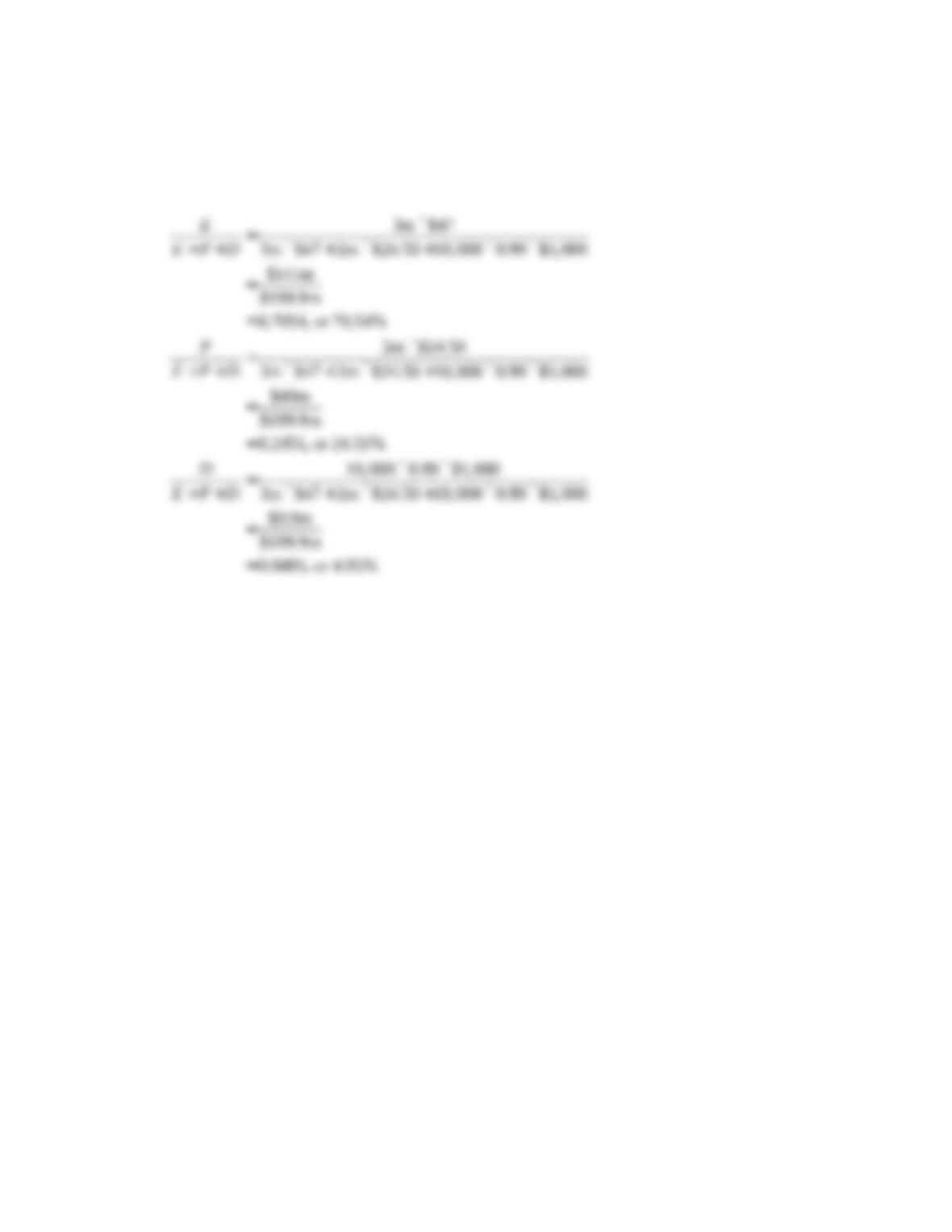
Using the computations for component weights given in equation 11-1:
3m $47
3m $47 2m $24.50 10, 000 0.99 $1, 000
$141m
$199.9m
0.7054, or 70.54%
2m $24.50
3m $47 2m $24.50 10, 000 0.99 $1, 000
$49m
$199.9m
0.2451, or 24.51%
10,000 0.99 $1,000
3m $47 2m $24.5
E
E P D
P
E P D
D
E P D
´
=
+ + ´ + ´ + ´ ´
=
=
´
=
+ + ´ + ´ + ´ ´
=
=
´ ´
=
+ + ´ + ´ 0 10,000 0.99 $1, 000
$9.9m
$199.9m
0.0495, or 4.95%
+ ´ ´
=
=
LG4 11-3 WACC Weights WhackAmOle has two million shares of common stock outstanding, 1.5
million shares of preferred stock outstanding, and 50,000 bonds. If the common shares
are selling for $63 per share, the preferred shares are selling for $52 per share, and the
bonds are selling for 103 percent of par, what would be the weights used in the
calculation of WhackAmOle’s WACC?
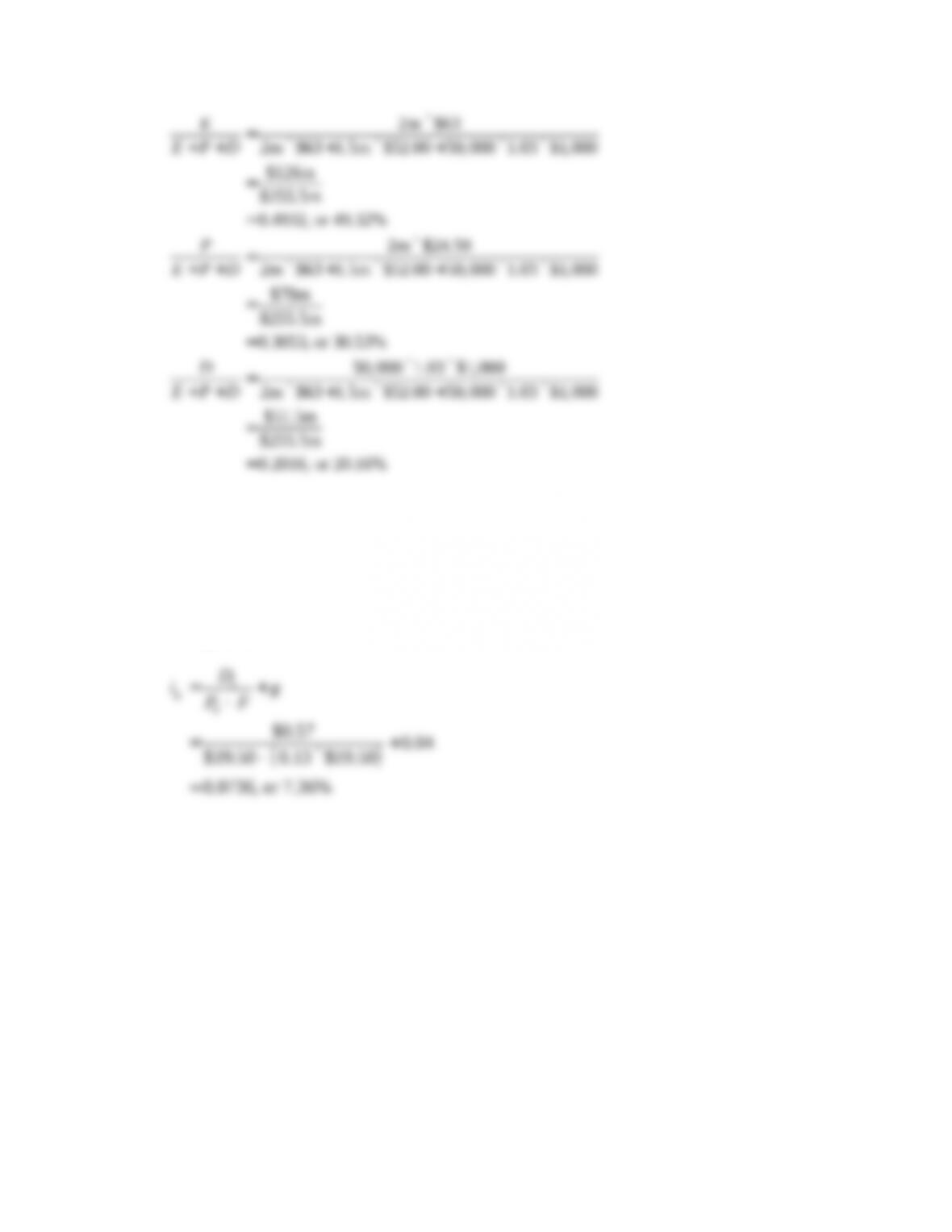
Using the computations for component weights given in equation 11-1:
2m $63
2m $63 1.5m $52.00 50,000 1.03 $1, 000
$126m
$255.5m
0.4932, or 49.32%
2m $24.50
2m $63 1.5m $52.00 50,000 1.03 $1, 000
$78m
$255.5m
0.3053, or 30.53%
50,000 1.03 $1,000
2m $63 1.5m
E
E P D
P
E P D
D
E P D
´
=
+ + ´ + ´ + ´ ´
=
=
´
=
+ + ´ + ´ + ´ ´
=
=
´ ´
=
+ + ´ + $52.00 50,000 1.03 $1,000
$51.5m
$255.5m
0.2016, or 20.16%
´ + ´ ´
=
=
LG8 11-4 Flotation Cost Suppose that Brown-Murphies’ common shares sell for $19.50 per
share, that the firm is expected to set their next annual dividend at $0.57 per share, and that all
future dividends are expected to grow by 4 percent per year, indefinitely. If Brown-Murphies
faces a flotation cost of 13 percent on new equity issues, what will be the flotation-adjusted cost
of equity?
Using equation 11-8:
( )
1
0
$0.57 0.04
$19.50 0.13 $19.50
0.0736, or 7.36%
E
D
i g
P F
= +
–
= +
– ´
=
advanced problems
( )
WACC 1
0.5556 14% 0.4444 4%
9.56%
E D C
E D
i i T
E P D E P D
= + ´ –
+ + + +
= ´ + ´
=
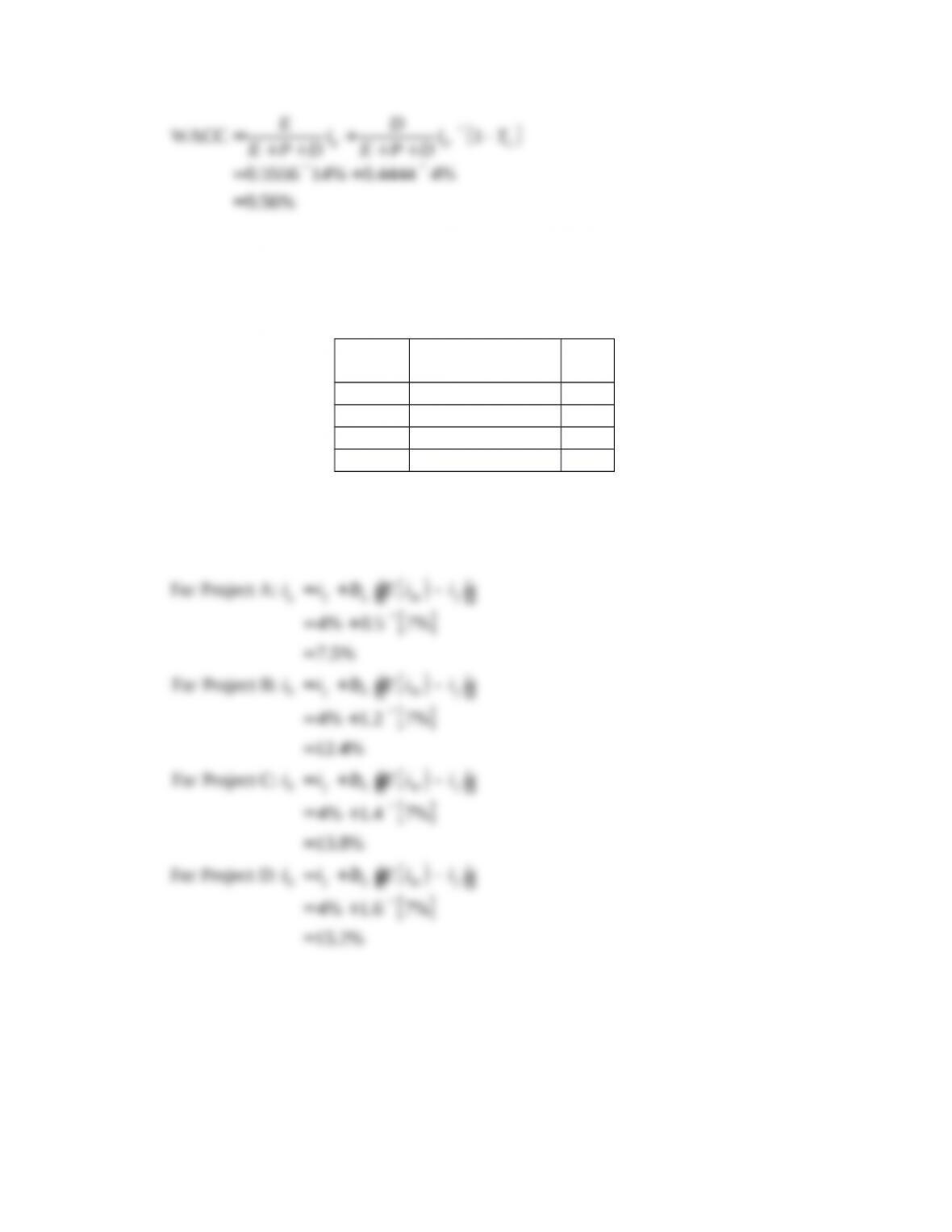
LG6 11-6 Firmwide vs. Project-Specific WACCs An all-equity firm is considering the projects
shown as follows. The T-bill rate is 4 percent and the market risk premium is 7 percent.
If the firm uses its current WACC of 12 percent to evaluate these projects, which
project(s), if any, will be incorrectly rejected?
Project Expected
Return
Bet
a
A 8.0% 0.5
B 19.0 1.2
C 13.0 1.4
D 17.0 1.6
Using the firm’s WACC of 12 percent as the IRR benchmark, project A would be
rejected. Using equation 11-2, the project-specific benchmarks for each project should be:
( )
[ ]
( )
[ ]
( )
[ ]
For Project A:
4% 0.5 7%
7.5%
For Project B:
4% 1.2 7%
12.4%
For Project C:
4% 1.4 7%
13.8%
E f E M f
E f E M f
E f E M f
i i E i i
i i E i i
i i E i i
b
b
b
é ù
= + –
ë û
= + ´
=
é ù
= + –
ë û
= + ´
=
é ù
= + –
ë û
= + ´
=
If the firm uses its current WACC of 12 percent to evaluate these projects, which
project(s), if any, will be incorrectly accepted?
Using the firm’s WACC of 12 percent as the IRR benchmark, projects B, C, and D would
be accepted. Using equation 11-2, the project-specific benchmarks for each project
( )
[ ]
( )
[ ]
( )
[ ]
( )
[ ]
For Project A:
4% 0.5 7%
7.5%
For Project B:
4% 1.2 7%
12.4%
For Project C:
4% 1.4 7%
13.8%
For Project D:
4% 1.6 7%
15.2%
E f E M f
E f E M f
E f E M f
E f E M f
i i E i i
i i E i i
i i E i i
i i E i i
b
b
b
b
é ù
= + –
ë û
= + ´
=
é ù
= + –
ë û
= + ´
=
é ù
= + –
ë û
= + ´
=
é ù
= + –
ë û
= + ´
=
( )
( )
( )
( )
13% 7% 1.0 7%
6% 7%
13%
E f E M f
M
M
M
i i E i i
E i
E i
E i
bé ù
= + –
ë û
é ù
= + –
ë û
é ù
= –
ë û
=
Reusing equation 11-2, we can solve for the divisional costs of equity using the average
divisional betas:
( )
[ ]
( )
[ ]
( )
[ ]
( )
For Division A: 7% 0.6 13% 7% 10.6%
For Division B: 7% 1.0 13% 7% 13.0%
For Division C: 7% 1.3 13% 7% 14.8%
For Division D:
E f E M f
E f E M f
E f E M f
E f E M f
i i E i i
i i E i i
i i E i i
i i E i i
b
b
b
b
é ù
= + – = + ´ – =
ë û
é ù
= + – = + ´ – =
ë û
é ù
= + – = + ´ – =
ë û
é ù
= + –
ë û
[ ]
7% 1.6 13% 7% 16.6%= + ´ – =
Finally, we can solve for the divisional WACCs using equation 11-1:
( )
( )
( )
For Division A: WACC 1 0.5 10.6% 0.5 8% 9.3%
For Division B: WACC 1 0.5 13.0% 0.5 8% 10.5%
For Division C: WACC 1 0.5 14.8% 0.5 8% 11.4%
For
E D C
E D C
E D C
E D
i i T
E P D E P D
E D
i i T
E P D E P D
E D
i i T
E P D E P D
= + ´ – = ´ + ´ =
+ + + +
= + ´ – = ´ + ´ =
+ + + +
= + ´ – = ´ + ´ =
+ + + +
( )
Division D: WACC 1 0.5 16.6% 0.5 8% 12.3%
E D C
E D
i i T
E P D E P D
= + ´ – = ´ + ´ =
+ + + +
LG7 11-9 Divisional WACCs Suppose your firm has decided to use a divisional WACC approach
to analyze projects. The firm currently has four divisions, A through D, with average
betas for each division of 0.9, 1.1, 1.3, and 1.5, respectively. If all current and future
projects will be financed with 25 percent debt and 75 percent equity, and if the current
cost of equity (based on an average firm beta of 1.2 and a current risk-free rate of 4
percent) is 12 percent and the after-tax yield on the company’s bonds is 9 percent, what
will the WACCs be for each division?
Using equation 11-2, we can solve for the expected rate of return on the market:
( )
( )
( )
( )
12% 4% 1.2 4%
8% 4%
1.2
10.67%
E f E M f
M
M
M
i i E i i
E i
E i
E i
bé ù
= + –
ë û
é ù
= + –
ë û
é ù
= –
ë û
=
Reusing equation 11-2, we can solve for the divisional costs of equity using the average
divisional betas:
( )
[ ]
( )
[ ]
( )
[ ]
For Division A: 4% 0.9 10.667% 4% 10.00%
For Division B: 4% 1.1 10.667% 4% 11.33%
For Division C: 4% 1.3 10.667% 4% 12.67%
For Division D:
E f E M f
E f E M f
E f E M f
E
i i E i i
i i E i i
i i E i i
i
b
b
b
é ù
= + – = + ´ – =
ë û
é ù
= + – = + ´ – =
ë û
é ù
= + – = + ´ – =
ë û
=
( )
[ ]
4% 1.5 10.667% 4% 14.00%
f E M f
i E i ibé ù
+ – = + ´ – =
ë û
Finally, we can solve for the divisional WACCs using equation 11-1:
( )
( )
( )
For Division A: WACC 1 0.75 10% 0.25 9% 9.75%
For Division B: WACC 1 0.75 11.33% 0.25 9% 10.75%
For Division C: WACC 1 0.75 12.67% 0.25 9%
E D C
E D C
E D C
E D
i i T
E P D E P D
E D
i i T
E P D E P D
E D
i i T
E P D E P D
= + ´ – = ´ + ´ =
+ + + +
= + ´ – = ´ + ´ =
+ + + +
= + ´ – = ´ + ´ =
+ + + +
( )
11.75%
For Division D: WACC 1 0.75 14% 0.25 9% 12.75%
E D C
E D
i i T
E P D E P D
= + ´ – = ´ + ´ =
+ + + +