CHAPTER 20 INTERNATIONAL TRADE FINANCE
ANSWERS & SOLUTIONS TO END-OF-CHAPTER QUESTIONS AND PROBLEMS
QUESTIONS
1. Discuss some of the reasons why international trade is more difficult and risky from the
exporter’s perspective than is domestic trade.
Answer: International trade is more difficult and risky for a firm than is domestic trade. In
foreign trade, the exporter may not be familiar with the buyer, and thus not know if the importer
2. What three basic documents are necessary to conduct a typical foreign commerce trade?
Briefly discuss the purpose of each.
Answer: The three basic documents necessary to conduct a typical foreign commerce trade
are: letter of credit, time draft, and a bill of lading. A letter of credit (L/C) is a guarantee from the
importer’s bank that it will act on behalf of the importer and pay the exporter for the merchandise
3. How does a time draft become a banker’s acceptance?
Answer: When the goods are shipped by the exporter via common carrier, the exporter’s bank
presents the shipping documents and the time draft to the importer’s bank. After taking title to
4. Discuss the various ways the exporter can receive payment in a foreign trade transaction
after the importer’s bank accepts the exporter’s time draft and it becomes a banker’s
acceptance.
Answer: The exporter can hold the B/A until maturity and present it to the importer’s bank for
5. What is a forfaiting transaction?
Answer: Forfaiting is a form of medium-term trade financing used to finance the sale of capital
goods. A forfaiting transaction involves the sale by the exporter of promissory notes signed by
the exporter in favor of the importer. The forfait, usually a bank, buys the notes at a discount
6. What is the purpose of the Export-Import Bank?
Answer: The Export-Import Bank (Eximbank) of the United States was founded as an
independent government agency to facilitate and finance U.S. export trade. Eximbank’s
purpose is to provide financing in situations where private financial institutions are unable or
7. Do you think that a country’s government should assist private business in the conduct of
international trade through direct loans, loan guarantees, and/or credit insurance?
Answer: When a country’s government offers below-market financing directly to foreign
importers, or offers loan guarantees to domestic banks financing the foreign import, or provides
low cost credit insurance to U.S. exporters to alleviate the commercial and political risk in the
8. Briefly discuss the various types of countertrade.
Answer: Countertrade is an umbrella term used to describe six types of international trade:
Barter is the direct exchange of goods between two parties. While money does not
exchange hands in a barter transaction, it is common to value the goods each party exchanges
in an agreed-upon currency. A clearing arrangement is a form of barter in which the
counterparties contract to purchase a certain amount of goods and services from one another.
Both parties set up accounts with each other that are debited whenever one country imports
A buy-back transaction involves a technology transfer via the sale of a manufacturing
plant. As part of the transaction, the seller agrees to purchase a certain portion of the plant
output once it is constructed. First, the plant buyer borrows hard currency in the capital market
to pay the seller for the plant. Second, the plant seller agrees to purchase enough of the plant
output over a period of time to enable the buyer to pay back the borrowed funds. A
9. Discuss some of the pros and cons of countertrade from the country’s perspective and the
firm’s perspective.
Answer: Arguments both for and against countertrade transactions can be made. There are
both negative and positive incentives for a country to be in favor of countertrade. Negative
incentives are those that are forced upon a country or corporations whether or not they desire to
engage in countertrade. Negative reasons include: the conservation of cash and hard
Those against countertrade transactions claim that such transactions tamper with the
fundamental operation of free markets, and therefore, resources are used inefficiently.
10. What is the difference between a buy-back transaction and a counterpurchase?
Answer: A buy-back transaction involves a technology transfer via the sale of a manufacturing
plant. As part of the transaction, the seller agrees to purchase a certain portion of the plant
output once it is constructed to enable the buyer to pay back the borrowed funds. In a
PROBLEMS
1. Assume the time from acceptance to maturity on a $2,000,000 banker’s acceptance is 90
days. Further assume that the importing bank’s acceptance commission is 1.25 percent and
that the market rate for 90-day B/As is 7 percent. Determine the amount the exporter will
receive if he holds the B/A until maturity and also the amount the exporter will receive if he
discounts the B/A with the importer’s bank.
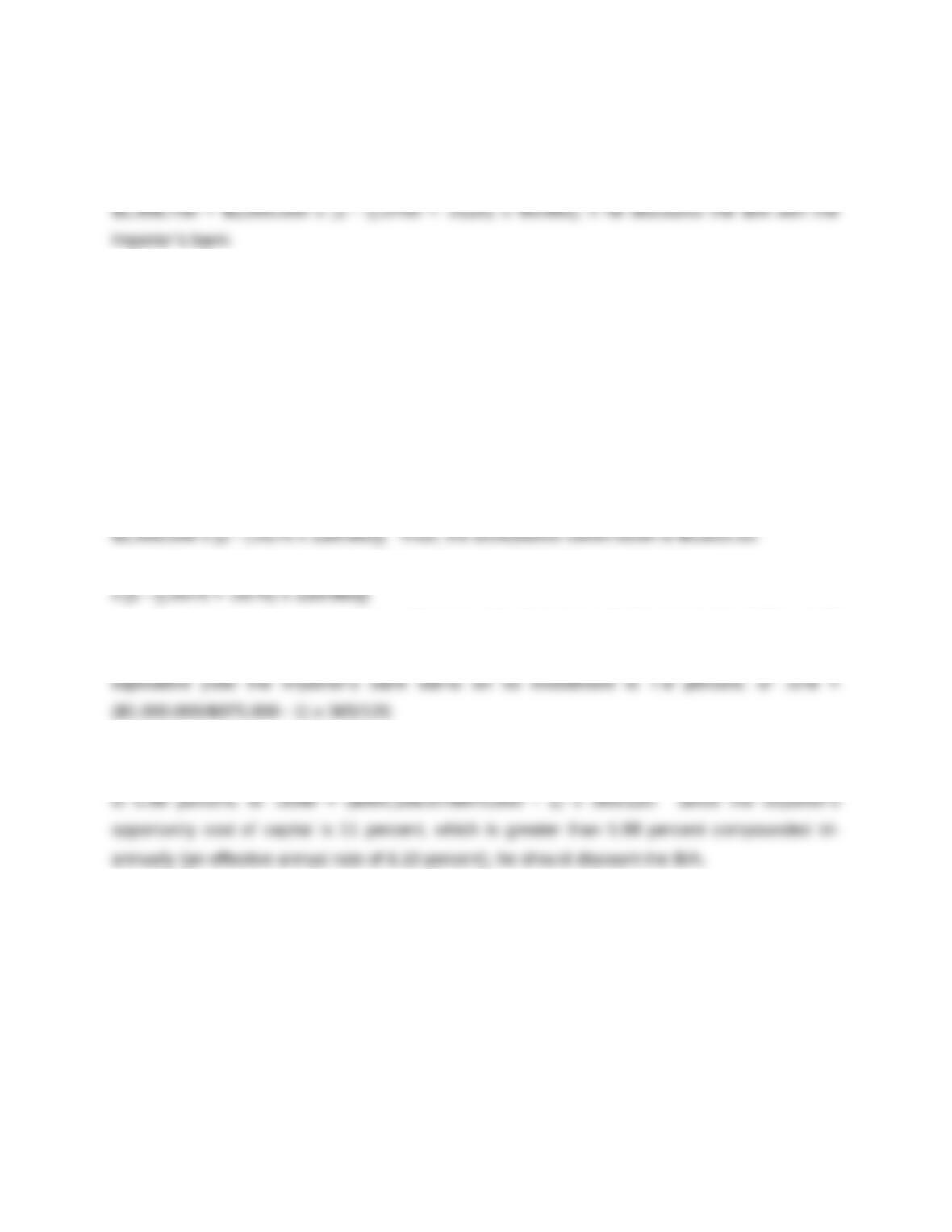
Solution: The exporter will receive $1,993,750 = $2,000,000 x [1 – (.0125 x 90/360)] if he holds
the B/A to maturity. The acceptance commission is $6,250. The exporter will receive
2. The time from acceptance to maturity on a $1,000,000 banker’s acceptance is 120 days.
The importer’s bank’s acceptance commission is 1.75 percent and the market rate for 120-day
B/As is 5.75 percent. What amount will the exporter receive if he holds the B/A until maturity? If
he discounts the B/A with the importer’s bank? Also determine the bond equivalent yield the
importer’s bank will earn from discounting the B/A with the exporter. If the exporter’s opportunity
cost of capital is 11 percent, should he discount the B/A or hold it to maturity?
Solution: If the exporter holds the B/A until maturity, he will receive $994,166.67 =
If the exporter discounts the B/A he will receive $975,000 = $1,000,000
The importer’s bank receives a discount rate of interest of 7.5 percent (= 5.75 + 1.75
percent) on its investment. At maturity it will receive $1,000,000 from the importer. The bond
The exporter pays the acceptance commission regardless of whether he discounts the B/A
or holds it to maturity. The bond equivalent rate the exporter receives from discounting the B/A
MINI CASE: AMERICAN MACHINE TOOLS, INC.
American Machine Tools is a mid-western manufacturer of tool-and-die-making equipment.
The company has had an inquiry from a representative of the Estonian government about the
terms of sale for a $5,000,000 order of machinery. The sales manager spoke with the Estonian
representative, but he is doubtful that the Estonian government will be able to obtain enough
hard currency to make the purchase. While the U.S. economy has been growing, American
Machine Tools has not had a very good year. An additional $5,000,000 in sales would definitely
help. If something cannot be arranged, the firm will likely be forced to lay off some of its skilled
workforce.
Is there a way that you can think of that American Machine Tools might be able to make the
machinery sale to Estonia?
Suggested Solution to American Tools, Inc.
American Machine Tools needs a manager in charge of countertrade. This manage would
be skilled in negotiating trades for his firm’s machine tools. Since the U.S. economy is fairly
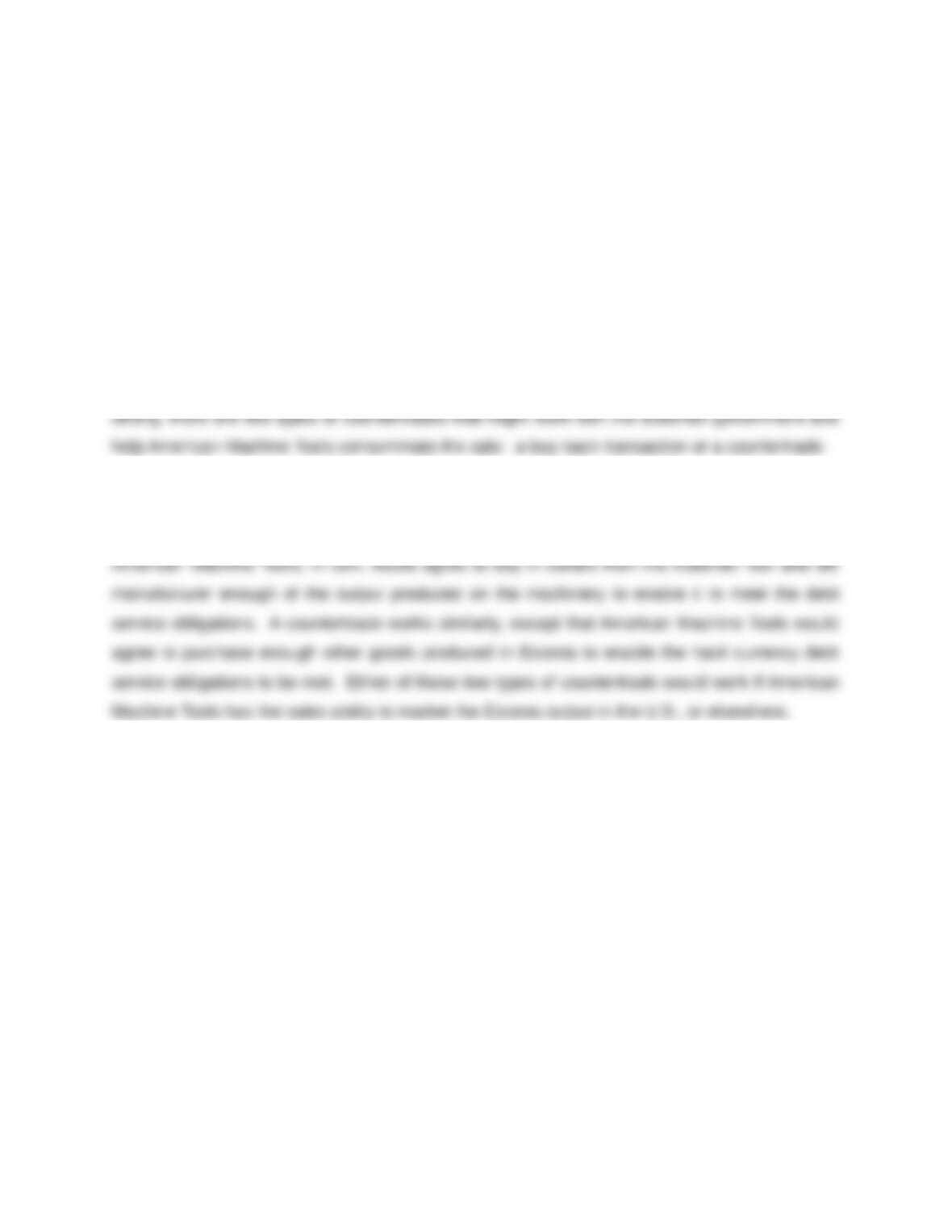
In a buy-back transaction, the Estonian government would issue debt denominated in a
hard currency to obtain the funds to purchase the equipment from American Machine Tools. It
should be able to obtain hard currency debt financing if it is likely that it can service the debt.