
Chapter 13 – Project Planning and Scheduling
Chapter 13
Project Planning and Scheduling
Teaching Notes
This chapter describes planning and scheduling methods for projects including Gantt
charts and CPM. In the beginning of the chapter the emphasis is on setting project objectives
and on general planning and control ideas. Later in the chapter detailed scheduling methods are
developed.
In teaching this chapter we emphasize that scheduling is only one aspect of project
management, but that network scheduling methods are very helpful for a complex project. We
also stress the importance of critical path and slack concepts as applications of the management
by exception principle. Finally, we spend some time illustrating how project scheduling
problems are related to the scheduling problems of batch and line operations.
Answers to Questions
1. Project scheduling differs from on-going scheduling because project scheduling involves
2. Audit by comparing expenses for the project to those budgeted; time when major
3. Three examples – designing and constructing a dress; commissioned painting; planting a
4. Similarities: both are scheduling methods, both assume activity precedence is given and
both use a network for computations of forward and backward passes.
5. Critical path – the longest path through the network.
Early Start (ES) – the earliest that an activity can start based on the early finish time of all

13-2
6. The management significance of the critical path is that it constrains the completion date
of the project since it is the longest path of activity times from the start to the end of the
7. The Gantt chart indicates activity duration; when each activity is scheduled to begin and
8. Since cost, performance and schedule are three conflicting objectives of a project;
tradeoffs among them must constantly be made in the course of project management.
9. Forward and backward passes are needed for the calculation of early start, early finish,
10. Earliest Start, ES – earliest time an activity can start based on completion (earliest finish)
of all immediate predecessor activities
Chapter 13 – Project Planning and Scheduling
13-3
Answers to Problems
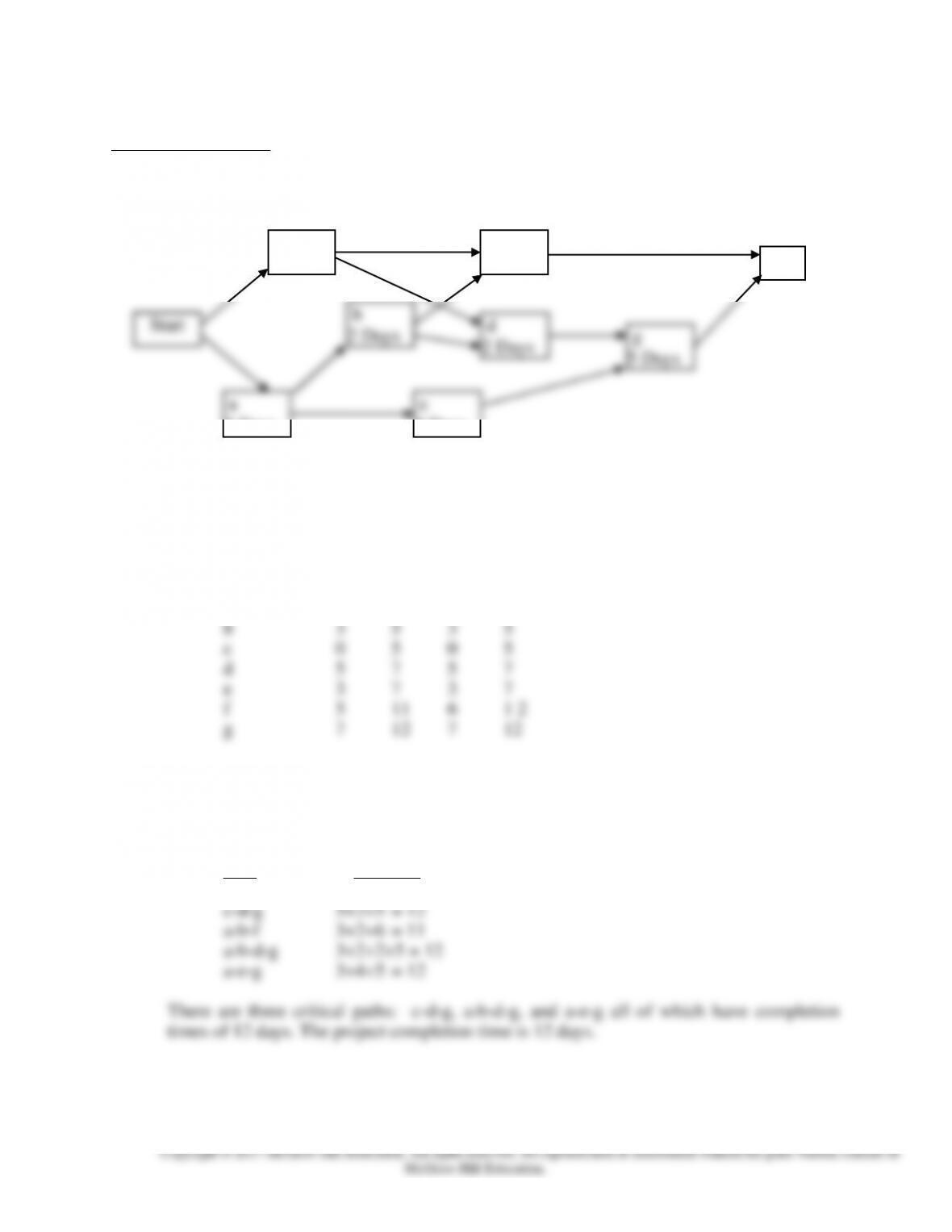
1. a. Network:
a
e
g
5 Days
b. The ES, EF, LS and LF times are as follows
Activity ES EF LS LF
a 0 3 0 3
c. There are 5 project paths:
Path Duration
c-f 5+6 = 11 days
c
5 Days
f
6 Days
3 Days
4 Days
End
Chapter 13 – Project Planning and Scheduling
d. If project completion must be reduced by 2 days, activities on each of the three critical
paths will be affected for the first day. When multiple critical paths exist, it may be
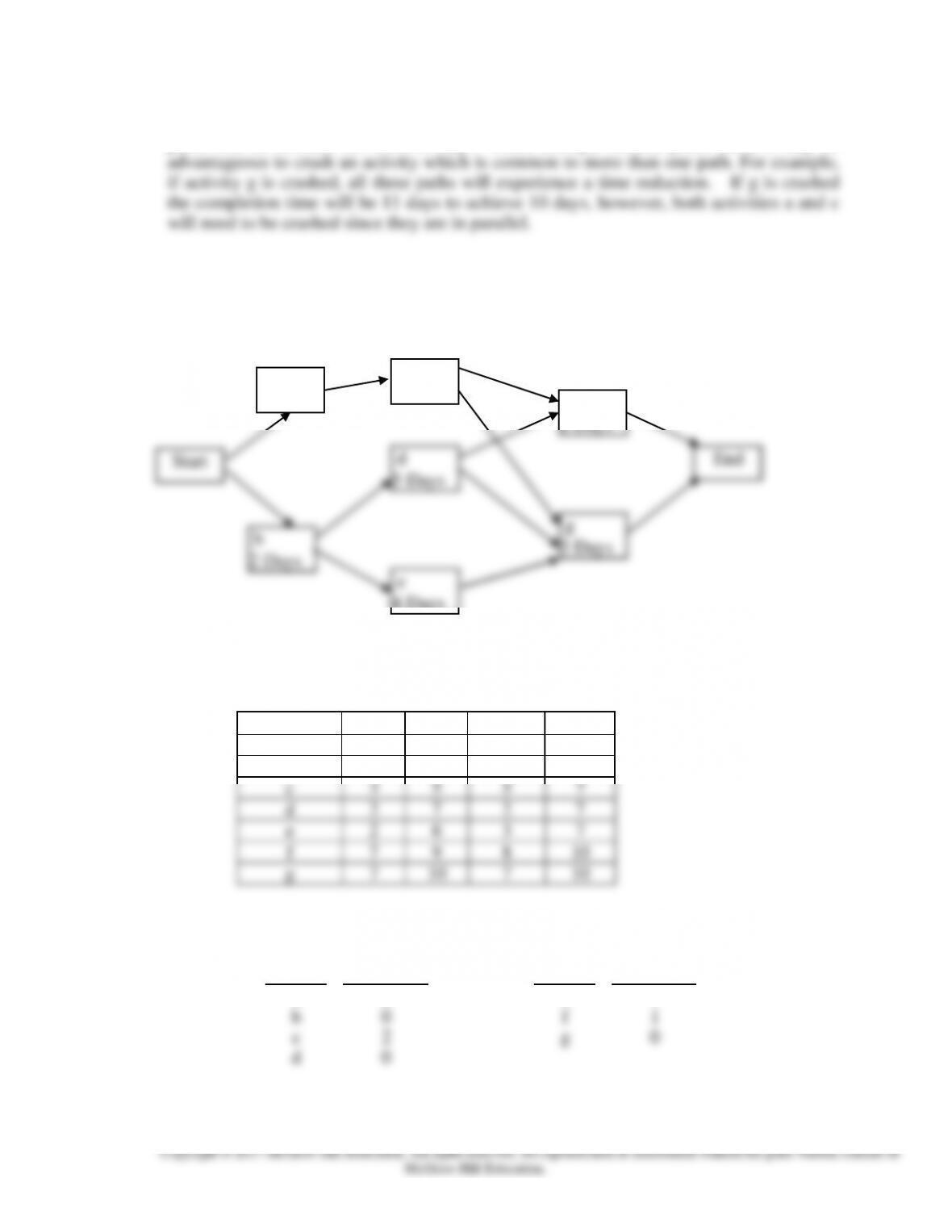
2. a. Network:
b.
c
2
g
0
d
0
Activity
ES
EF
LS
LF
a
0
3
2
5
b
0
2
0
2
c
3
5
5
7
d
2
7
2
7
e
2
6
3
7
f
7
9
8
10
g
7
10
7
10
c.
Activity
Total Slack
Activity
Total Slack
a
2
e
1
b
0
f
1
a
3 Days
c
2 Days
Start
b
2 Days
d
5 Days
f
2 Days
e
4 Days
g
3 Days
End
Chapter 13 – Project Planning and Scheduling
d.
Time period
F
1
3
3
5
G
1
4
7
10
H
5
5
10
Activity
1
2
3
4
5
6
7
8
9
10
a
b
c
d
e
f
g
3.
a. Forward and Backward pass
Activity
ES
EF
LS
LF
A
0
2
0
2
B
2
7
5
10
C
2
5
2
5
D
0
3
2
5
E
0
1
2
3
A
2 Days
B
5 Days
Start
E
1 Day
F
2 Days
G
3 Days
H
5 Days
End
C
3 Days
D
3 Days

Chapter 13 – Project Planning and Scheduling
13-6
b. Activity Slack
A 0
B 3
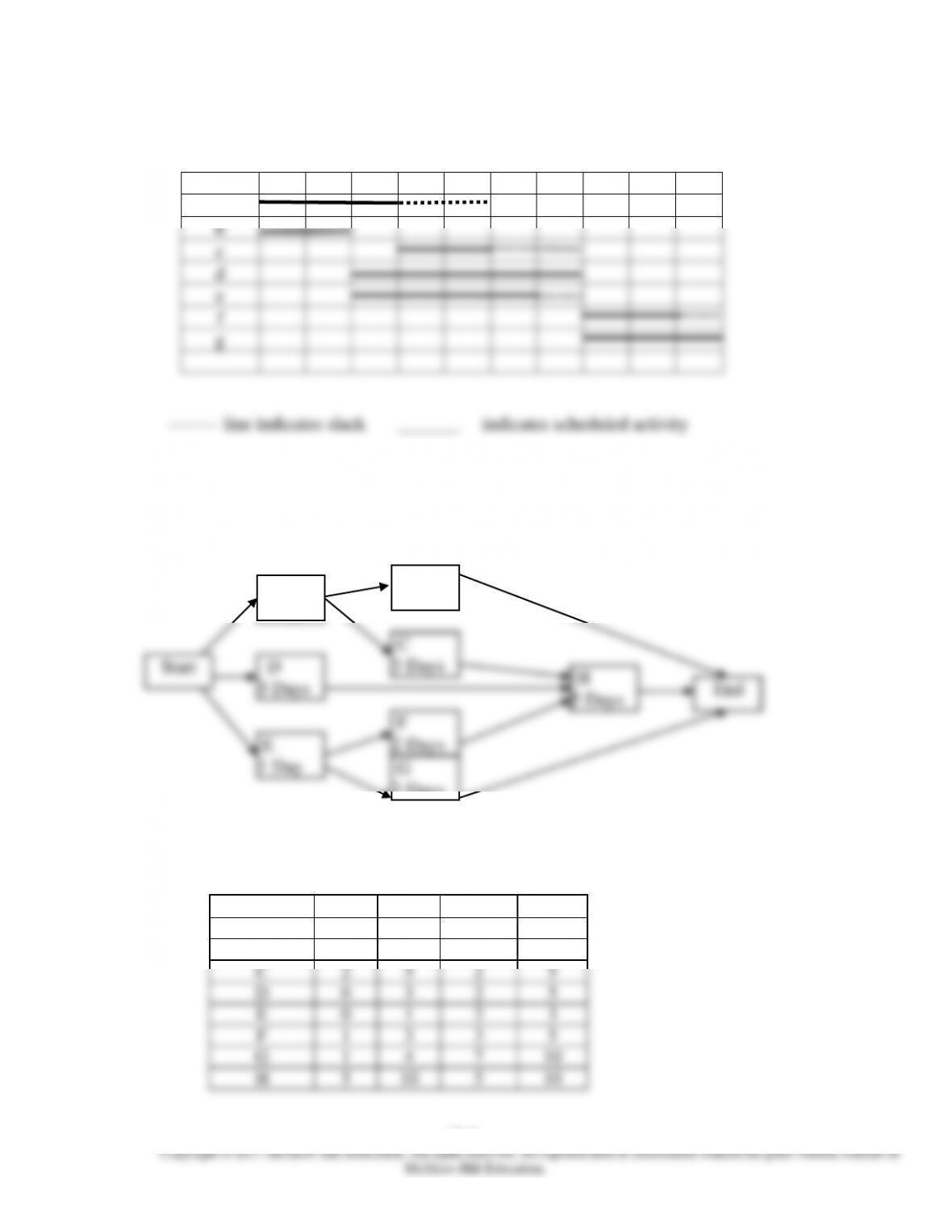
c. Gantt Chart
Time Period
Activity
1
2
3
4
5
6
7
8
9
10
A
B
C
D
E
F
G
H
d. Delay of activity D by 1 day will have no effect on the project completion time. It
also has no effect on the early start of the next activity which is H.
Chapter 13 – Project Planning and Scheduling
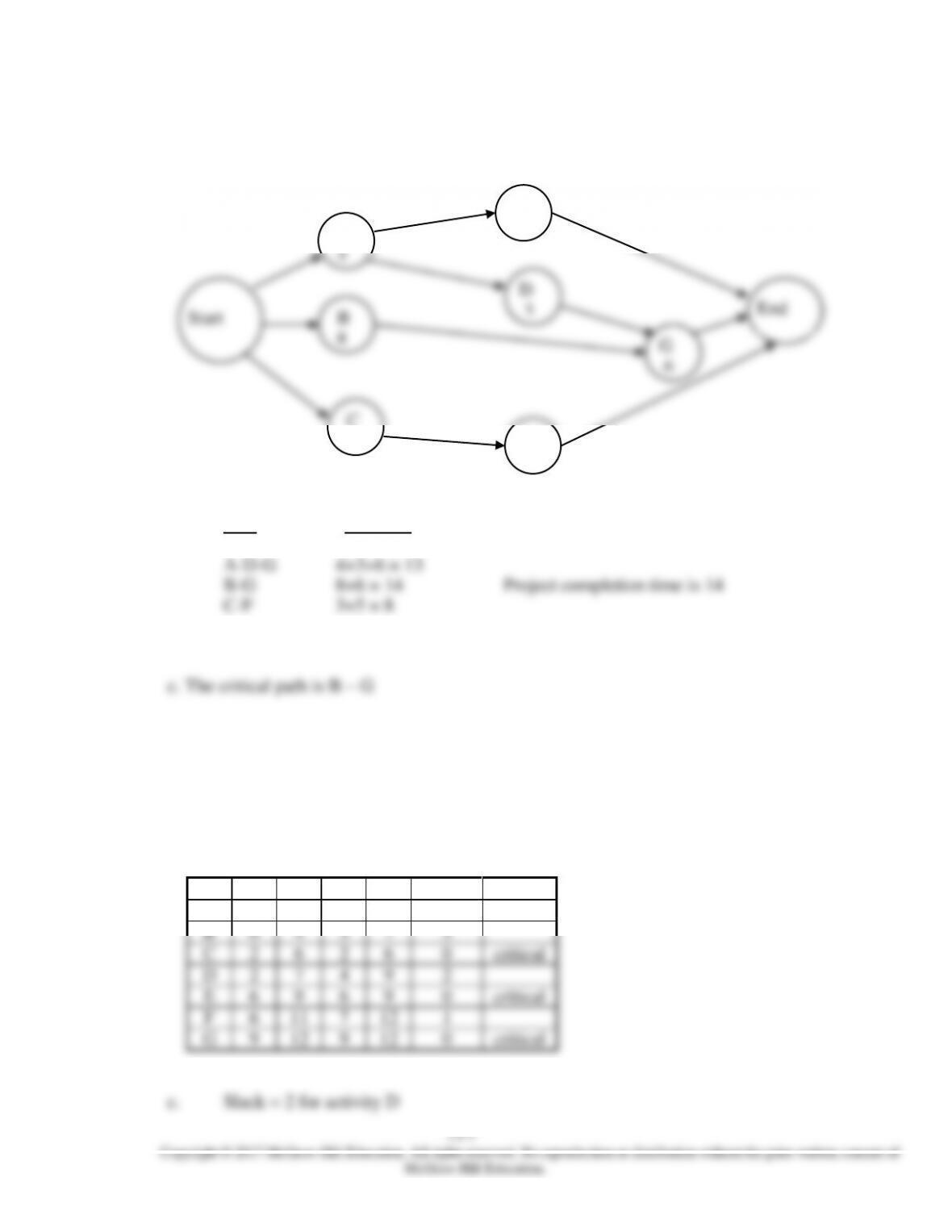
4. a. Network
B
8
D
3
G
6
End
b. Path Duration
A-E 4+6 = 10
5. a. Critical path A – C – E – G
Completion Time = 12
b. Schedule of Activities
ES
EF
LS
LF
Slack
A
0
2
0
2
0
critical
B
0
4
3
7
3
C
2
6
2
6
0
critical
D
2
7
4
9
2
E
6
9
6
9
0
critical
F
6
11
7
12
1
G
9
12
9
12
0
critical
C
3
A
4
E
6
F
5

13-9
8. a. The T.A. should perform activity D to reduce the project completion time by one day.
The cost will be the total cost for the project plus $150 for crashing activity D by one