
Chapter 02 – Implementing Strategy: The Value Chain, the Balanced Scorecard, and the Strategy Map
2-64 (continued -1)
Source: James R. Hagerty, “Harley, With Macho Intact, Tries to Court More
Women,” The Wall Street Journal, October 31, 2011, p B1’ “Harley Shows
Its Feminine Side,” Bloomberg Businessweek, October 4, 2010, p 25;
James R. Hagerty, “Harley Roars On U.S. Rebound,” The Wall Street
Journal, July 20, 2011, p B4; Kyle Stock, “Can Harley-Davidson Finally
Woo Women?” Businessweek.com, June 2, 2014. Patrick Clark and Lee
Wilson, “High-End Motorcycles Meet India’s Mopeds,” Bloomberg
Businessweek, August 25, 2014, pp 52-4.
2-51
Education.
Chapter 02 – Implementing Strategy: The Value Chain, the Balanced Scorecard, and the Strategy Map
2- 65 The Balanced Scorecard; Strategy Map (20 min)
1. Most students will argue that McDonald’s is a cost leader based on its
low cost menus. In a class discussion of the question, I would carefully
distinguish the fast-food restaurant (which may or may not be a cost
leader) from a cost leader type of restaurant. Fast-food restaurants
can offer more than low prices, and convenience and comfort are
important to many of them, especially the more high-end restaurants
such as Chipotle Mexican Grill (“gourmet burritos and tacos”).
McDonald’s current emphasis on the dollar menu indicates that the
company does succeed as a cost leader.
Taco Bell and Wendy’s may be best described as cost leaders as well,
that Wendy’s and Taco Bell are also cost leaders. It may have been
true that sometime ago Wendy’s or Taco Bell were differentiated in
some way in the fast food market, but the current economic
circumstances have changed that. As a Wendy’s executive stated,
“We are refining our promotional calendar for the rest of this year…with
modestly more emphasis on price-value.”
2. Ray Kroc, the founder of McDonald’s chose as his founding strategy to
produce a restaurant that would focus on high quality and consistency
in all of its locations. He developed the concept into a widely-known
pledge: “Quality, Service, Cleanliness, and Value.” By reinforcing this
pledge in training and evaluations throughout the company, he was able
to achieve the success that McDonald’s enjoys today.
2-52
Education.
Chapter 02 – Implementing Strategy: The Value Chain, the Balanced Scorecard, and the Strategy Map
2-65 (continued -1)
3. Currency fluctuation is a significant matter for McDonald’s which
operates in more than 100 countries worldwide. Currency fluctuation
can affect the company’s profitability when the currencies of the foreign
locations fall relative to the U.S. dollar. In that case, there is a foreign
currency translation loss for McDonald’s. The reverse is true when the
foreign currency gains versus the dollar. McDonald’s 2013 annual
report states that the company works to mitigate the risk of foreign
exchange exposure by “…purchasing goods and services in local
Source: Annie Gasparro, “McDonald’s, Wendy’s in Price Fight,” The Wall
Street Journal, May 9, 2013, p B3.
2-53
Chapter 02 – Implementing Strategy: The Value Chain, the Balanced Scorecard, and the Strategy Map
2-66 Value Chain; Choosing Which Activity (10 min)
The value chain for the Asda jeans, as described, is a three step process,
beginning with manufacturing in Bangladesh and then shipping from
Bangladesh to the UK, and then presentation and sale in the Asda store. A
manager would consider how to improve quality and reduce cost
throughout the value chain, perhaps by resourcing the manufacturing to
reduce shipping costs or reducing in-store selling costs. Another approach
might be to add cost and add value through a redesign of the jean. For
The role of the value chain is to provide a basis for identifying where in the
life cycle of the product it might be possible to reduce cost, increase value,
or become more competitive. It is pretty clear from the example that the
downstream activities of shipping and sales together generate the greatest
cost. Do they also generate the greatest value?
Source: “Correlations: Perilous Arithmetic,” Bloomberg Businessweek,
June 10, 2013, p 25; Susan Berfield, “Levi’s Has a New Color for Blue
Jeans: Green,” Bloomberg Businessweek, October 22, 2012, pp 26-28.
2-54
Education.
Chapter 02 – Implementing Strategy: The Value Chain, the Balanced Scorecard, and the Strategy Map
2-67 Value Chain: Multiple Industries (20 min)
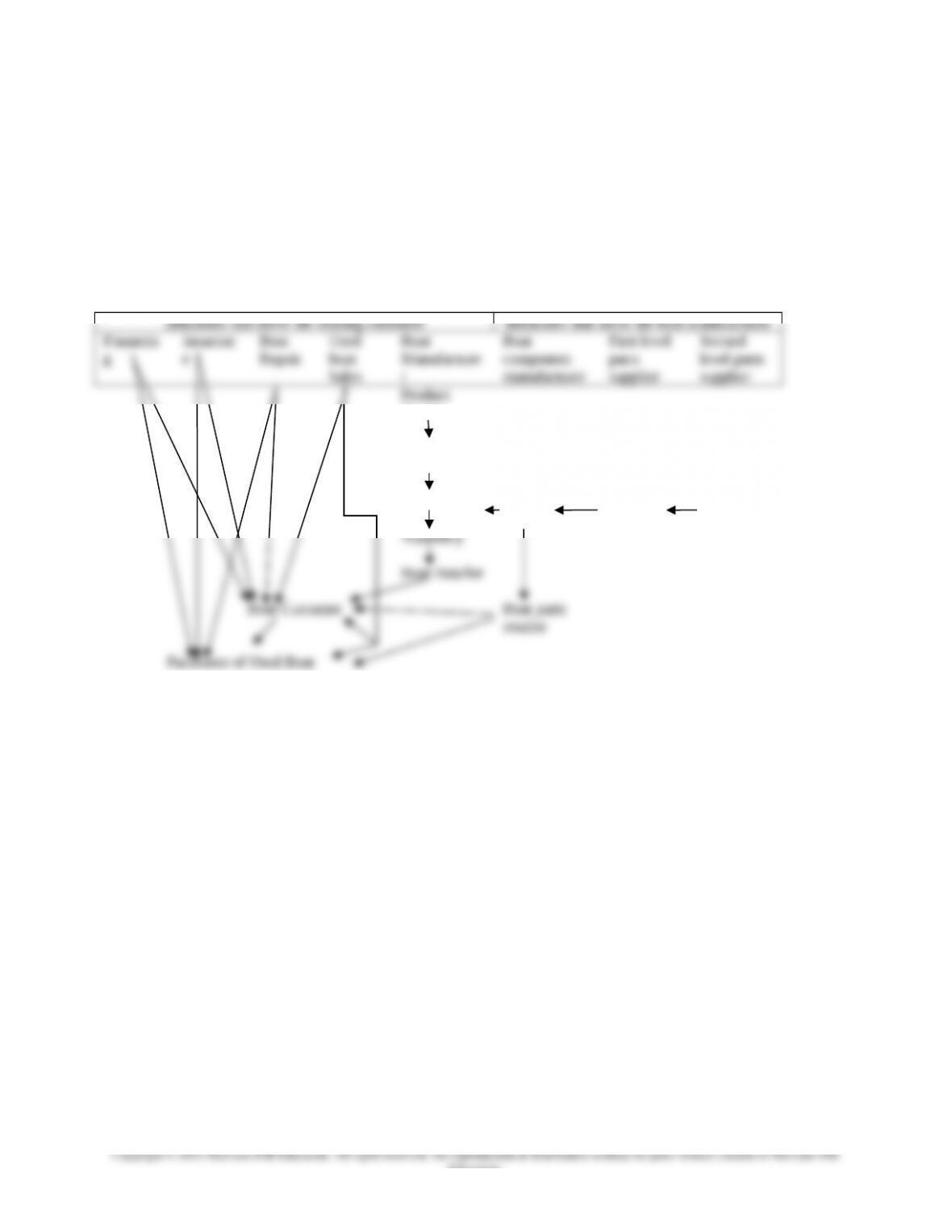
An example for the boating industry is shown below, and is based upon the
illustration in the text of this problem. The example in the text refers to the
auto industry, while the example here refers to the boating industry.
Design
Materials;
metal, fabric
Components Rigging
systems
Parts
supplier
Parts
supplier
2-55
Education.
Chapter 02 – Implementing Strategy: The Value Chain, the Balanced Scorecard, and the Strategy Map
2-68 Follow up to Problem 2-67: Value Chain for Financing Auto
Purchases (30 min)
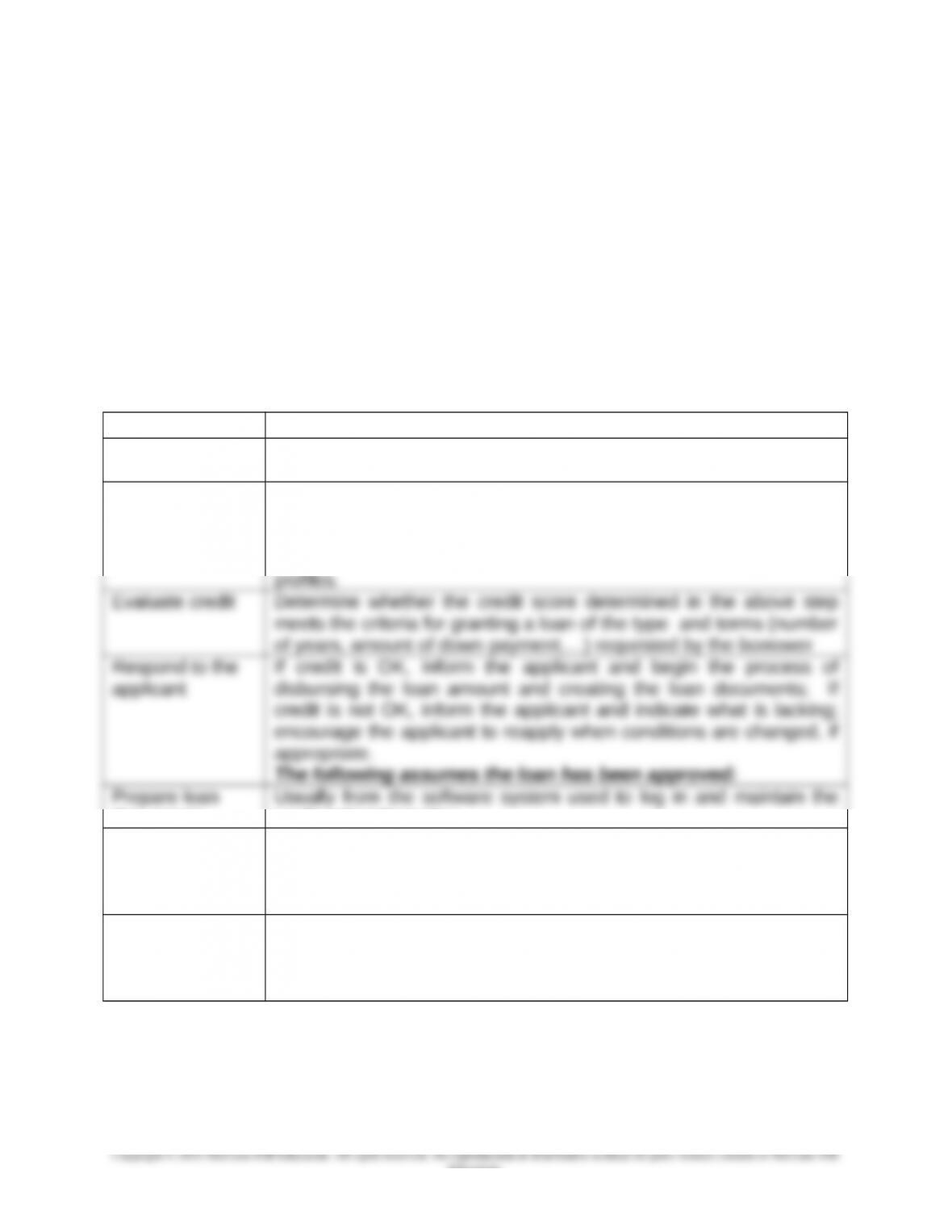
Steps in the value chain for obtaining a loan for a car purchase. This is a
short example, and other variations would be acceptable. Emphasize the
importance of both speed and comprehensive analysis in this process.
Speed is necessary to compete effectively for the loan with other financial
institutions, and is desirable for the auto dealer, a related party in the
transaction. Also, the comprehensive analysis is necessary to avoid the
risk of loan default and therefore loan losses in the coming months and
years; make sure the applicant is credit worthy.
Step Description of the step
Receive
application
Log in the application and file it appropriately into the loan
application database
Research credit Research the credit worthiness of the applicant by using the FICO®
score produced by Fair Issac Corp or by using one of the credit
reporting systems – Experian, Equifax or TransUnion — the three
national credit bureaus that maintain and sell credit reports and
documents
applicant’s information
Prepare
cashier’s check
made out to auto
dealer
Use careful cash controls in this step to avoid employee fraud
Deliver loan
documents and
cashier check to
auto dealer
Make sure loan documents are properly signed, dated, and returned
promptly to the finance office.
Note (re: problem 2-67), the same value chain shown above for the auto
industry would also be applicable to the finance function in the boating
industry.
2-56
Education.
1. For 2008 through February 2015, many Asian currencies have been
generally stable relative to the U.S.$, particularly the South Korean won
and Taiwanese dollar. The Chinese yuan was slowly appreciating relative
to the dollar during the period, but has been stable since 2012. India’s
rupee and Japan’s yen were gradually falling against the dollar until 2012
but have been rising since. The New Zealand and Australian currencies
were also increasing in value relative to the dollar in 2008-2011 but
decreasing relative to the dollar in 2012-2015.
Stable exchange rates are favorable for manufacturers such as
General Motors, making it simpler to manage its global sales and product
sourcing operations. It also removes the uncertainty about exchange rate
2. Since falling against the dollar in late 2008, the Euro rose against the
dollar in mid-2009 and since then has fluctuated less than 5% up and
down versus the U.S. dollar into mid-2014. However, the euro began to fall
against the dollar since August 2014; in March 2015 the euro is at the
lowest level versus the dollar for many years,
A fall in the dollar against the Euro helps U.S. exporters as the effective
cost of U.S. products and services fall in the Euro countries. A retailer
such as Walmart benefits potentially in two ways: (1) sales in Euro
countries are converted to U.S. dollars at a higher rate, resulting in
exchange rate gains, (2) to the extent that Walmart products are made in
2-57
Education.