
Chapter 19 – Strategic Performance Measurement: Investment Centers
Chapter 19
Strategic Performance Measurement: Investment Centers
Teaching Notes for Cases
Case 19-1: Investment Centers
1. The prior performance measurement system was called “performance income,” and is best described as
a profit center method. The focus was on divisional profits.
2. The new system called “asset management,” is best described as an investment-center method. The
system is focused on return on investment (ROI), as described in the case, where it is called “return on
capital.” The advantage of the investment-center approach is that it focuses managers’ attention on the
management of assets. Also, it brings managers’ incentives in line with that of the entire firm, to increase
the ROI of the firm.
The change to an investment center is consistent with Polymer’s new strategy, which is to
withdraw from activities, which do not fit the overall firm’s competitive advantage. The investment-
center approach is useful here to identify those units where the profitability is marginal, since the firm
wishes to focus on the most profitable units, and divest or consolidate the others. ROI provides a useful
basis to make this analysis. Thus, choosing investment centers is consistent with the present competitive
strategy.
ROI is often the desired performance measure in firms such as Polymer, where the activities are
diverse and complex, and comparison among the activities is difficult.
3. A common view is that foreign exchange gains and losses are a non-controllable element that should be
excluded from the manager’s evaluation. In contrast, many now view the manager’s responsibility more
broadly and urge that foreign exchange can be managed. The potential for exchange rate losses can be
managed by hedging, that is, purchasing financial instruments, which protect the firm from significant
swings in currencies. A common argument is that the firm is in the business of making and selling
products and services, and the management of foreign exchange can be delegated to financial service
firms, banks, etc., which will provide the desired hedging. The cost of hedging is small relative to the
potential losses.
Also, managers can adapt to foreign exchange changes by relocating manufacturing and other
activities over the longer term. Overall, the firm should be watchful of what individual managers are
doing to adapt to foreign exchange changes, both favorable and unfavorable. For this reason, it is
desirable to include foreign exchange gains and losses in the manager’s performance evaluation, as
Polymer Products is doing.
Income taxes, like foreign exchange, are often viewed as uncontrollable to the manager.
However, this overlooks the fact that the manager can often take steps to reduce taxes, by relocating
operations and changing sources of supply, etc. Thus, in a manner similar to that of foreign exchange
noted above, it is desirable for income taxes to be also included in the manager’s performance evaluation.
This places the appropriate incentive for the manager to reduce taxes for the benefit of the firm as a
whole.
A common problem with both profit centers and investment centers is that the performance
measures promote short-term decision making. In this case, Polymer Products has adopted a
“performance shares” approach. This is described in the next to last paragraph of the case: “...stock which
is accessible only after 3 years…” Performance shares are a type of deferred income in which the
compensation to the manager depends on the success of certain critical financial and non-financial
measures over a period of time (see Chapter 20 for a discussion of this method). In effect, Polymer
19-1

Chapter 19 – Strategic Performance Measurement: Investment Centers
Products has recognized the inherent bias to the short-term in the ROI measure, and is using performance
shares to provide an incentive for longer term thinking and action by the managers.
19-2
Education.

Chapter 19 – Strategic Performance Measurement: Investment Centers
Case 19-2: Transfer Pricing
1. In order to maximize short-run contribution margin, the Cole Division should accept the contract from
Wales Company. This conclusion is supported by the following calculations ($000’s omitted throughout
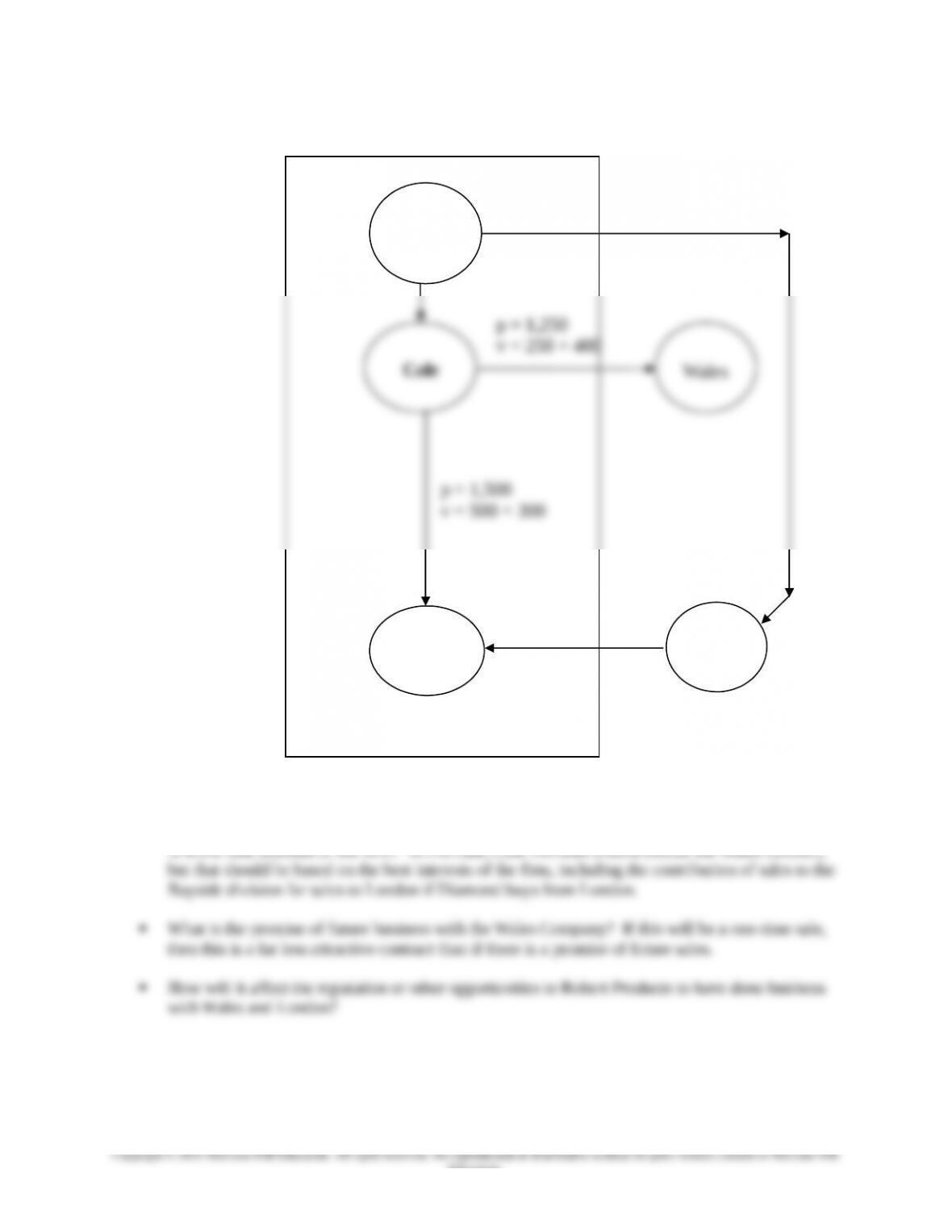
the calculations.). See graphic below which shows product flows, prices and variable costs to assist in
understanding the analysis.
From the Cole Division Point of view
a. Cole transfers to Diamond
Transfer price: Cole to Diamond
(3,000 units @ $1,500 each) $4,500
Variable cost:
Purchase from Bayside
(3,000 units @ $600 each) $1,800
Processing by Cole
(3,000 units @ $500 each) 1,500
Total variable cost 3,300
Contribution margin $1,200
b. Cole accepts Wales contract
Selling Price (3,500 units @ $1,250 each) $4,375
Variable cost:
Purchase from Bayside
(3,500 units @ $500 each) $1,750
Processing by Cole
(3,500 units @ $400 each) 1,400
Total variable cost 3,150
Contribution margin $1,225
Conclusion for the Cole Division
Contribution margin from Wales contract $1,225
Contribution margin from Diamond sale 1,200
Difference in favor of Wales contract $ 25
19-3
Education.

Chapter 19 – Strategic Performance Measurement: Investment Centers
From the point of view of the cost to the entire company:
a. Cole transfers to Diamond
Variable cost
Bayside
(3,000 units @ $300 each) $900
b. Cole accepts Wales contract; then the following shows the three parts to the calculation, including
the opportunity cost of lost contribution to Bayside and Cole:
1. Contribution of Wales Contract to Cole
Selling Price (3,500 units @ $1,250 each) $4,375
Variable cost:
Purchase from Bayside
(3,500 units @ $250 each) $875
2. Plus: Contribution of London Contract to Bayside
3. Less: Cost of outside purchase to Diamond
Conclusion for the Entire Company; Relevant Costs
19-4
Education.
Chapter 19 – Strategic Performance Measurement: Investment Centers
2. The strategic issues Robert Products should consider include:
Is the structure of the transfer pricing system set properly so that division managers choose what
Will the product from London be equivalent in quality and service to the product from the Dole
division?
19-5
Education.
p = 400
v = 200
Bayside
p = 1,500
v = 500 + 300
p = 1,250
v = 250 + 400
p = 1,500
London
Diamond

Chapter 19 – Strategic Performance Measurement: Investment Centers
Case 19-3: Transfer Pricing (Foreign Sales Corporations)
1. A wide variety of responses are likely for this case exercise, depending on the depth of the student’s
research. There are a number of useful references on Foreign Sales Corporations (FSCs), one of which is
noted in the case assignment. Also, two recent articles in Business Week are useful: “This Tax Break
Could Trigger a War,” by Paul Magnusson, September 4, 2000, p.103 and “U.S. Exporters Get the Word:
Guilty,” by Paul Magnusson, August 16, 1999, p. 42.
Note: The status of FSCs was under active consideration within the U.S. Congress at the time
(April 2001) this case was written, it is possible that the matter might have been settled by the
time the case is assigned. If the matter has been settled, then the nature of the assignment should
shift to an understanding and critique of the nature of the settlement or legal change that was
enacted, including the expected effects on U.S. exporters and the firms with which they compete
globally.
2. We would expect students to address at least a number of the following issues (in no particular order):
a) The ethical issue: should U.S. exporters have what appears to be an unfair advantage in
international trade?
b) The legal issue: are FSCs in conflict with international law?
c) Have FSCs accomplished the goal set in 1971 when the law establishing FSCs was enacted?
19-6
Education.

Chapter 19 – Strategic Performance Measurement: Investment Centers
Case 19-4: Interior Systems, Inc.
The purpose of this case is to introduce and critique the use of “residual income” measures for decision
making, performance evaluation and incentive compensation. As indicated in the case, Stern Stewart’s
version of residual income is referred to as Economic Value Added (EVA®). EVA® has received
favorable press coverage and adoptions from major corporations including Briggs & Stratton Corp.,
Coca-Cola Co., and Eli Lilly and Co (see Tully 1993, 1998; Fisher 1995). The case has been used
successfully at the undergraduate level, in M.B.A. programs and in executive programs. At the M.B.A.
level, the authors have used the case with both traditional full-time students as well as Executive M.B.A.
students. As indicated by our dedication on the title page, the case was inspired by our interaction with
Professor Bill Alberts. Although the case materials are fictitious, they benefited greatly from discussions
with Bill and a number of executives at companies that considered or adopted EVA®. For example, the
situation in Airline Interiors division (discussed below) is loosely based on the Boeing Company.
The Setting
Each division of Interior Systems (the Company) has a different market and different key drivers for
success; e.g, Airline Interiors’ (AI) key drivers are innovation, new orders (leading to a backlog) and,
probably, productivity improvements (though this latter item is not discussed in the case). Since sales lag
orders (potentially by years), accounting numbers are slow in reporting performance and are likely to be
poorly correlated with stock price movements (once the Company is publicly traded). In contrast, Office
Solutions (OS) is selling in the intensely price-competitive office furniture market. Current period sales
and expenses are key indicators of success. The division shows earnings and sales growth, but ROA is
declining. (ROA is not explicitly provided but can be easily calculated.) OS has excess capacity and
proposes to add a “profitable” new product to its line of office furniture, the E-chair.
19-7
Education.
Chapter 19 – Strategic Performance Measurement: Investment Centers
19-8
Education.

Chapter 19 – Strategic Performance Measurement: Investment Centers
Suggested Solution to Case Questions in the Engagement Letter (Exhibit 7)
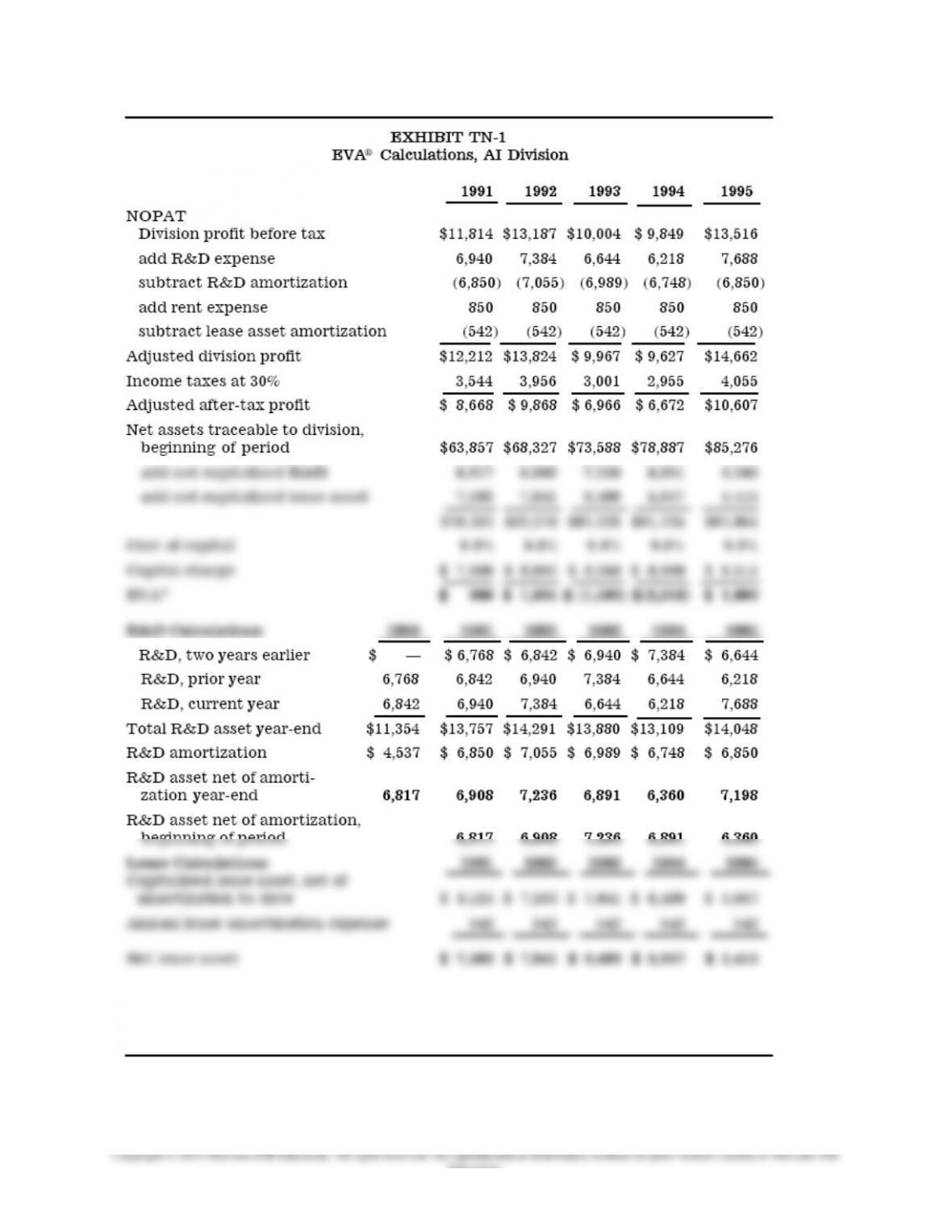
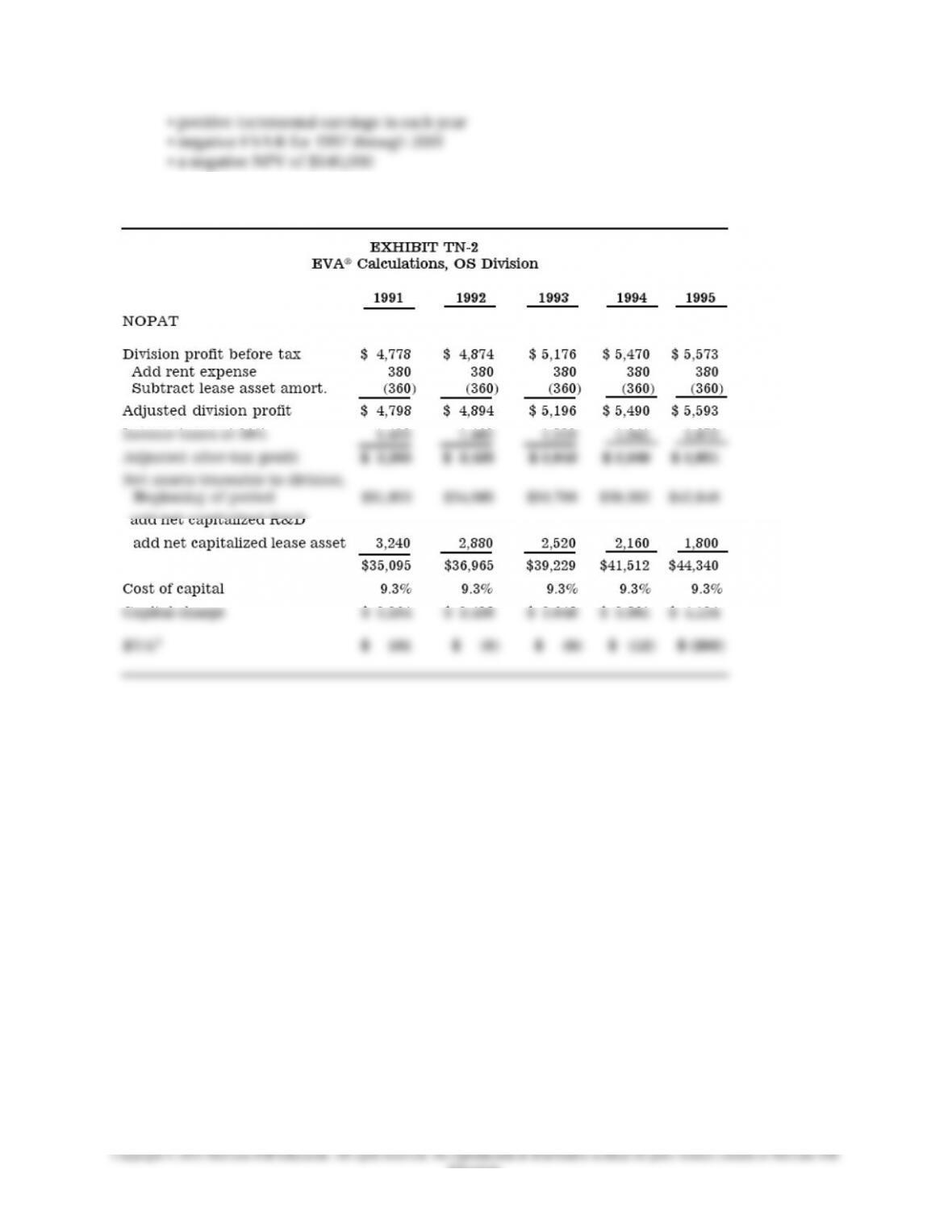
1. EVA® calculations are included in exhibit TN-1 (for Airline Interiors) and exhibit TN-2 (for Office
Solutions).Major points include:
AI division EVA® performance:
• Strong in 1991 and 1992; EVA® is positive, consistent with creating increased shareholder value.
• Very negative during downturn of 1993 and 1994 (consistent with destroying shareholder value)—but
recovery in 1995.
• Over the past five years, the three positive EVA® years have not overcome the two negative EVA®
years. Not surprisingly, EVA® appears to fluctuate with cycles in the industry. To get a picture of AI’s
long-term profitability, one would have to observe a complete business cycle.
OS division EVA® performance:
• Positive in 1991, somewhat negative in 1992–1994 and increasingly negative in 1995.
• Trend suggests that OS division is destroying shareholder value and therefore has not yet met the goal of
stabilizing the cycles experienced by the AI division.
2. EVA® is likely to affect managerial decisions. (See exhibit TN-4 for elaboration and summary of
results from Wallace [1997], a study on firms’ adoption of EVA®-like incentive plans.)
2a. Other things equal, management should find that fewer projects are viewed as acceptable since each
project must now earn greater than the overall, after-tax, weighted cost of capital. (With profits as a
performance measure, any project that earns more than the imbedded cost of debt increases earnings.)
Profitable projects (such as the E-chair proposal) will be rejected if they are not predicted to cover the
cost of capital. Exhibit TN-3A includes a traditional discounted expected cash flow analysis and exhibit
TN-3B presents a discounted expected EVA® analysis of the E-chair proposal using the assumption that
the necessary capital investment is $4 million. Note that, given the same set of assumptions (discussed
next), both approaches arrive at the same NPV. Exhibits TN-3C and 3D repeat the calculations using the
assumption that the necessary capital investment is $4.5 million.
Assumptions (not made explicit in the case) include:
• The single year of cash flows provided in exhibit 4 is representative of all years of the project’s
life. This suggests that there is no learning curve and no decay in performance throughout the
against “real” [vs. nominal] cash flows in exhibit 4. This is not precisely correct because, for
example, tax savings related to depreciation deductions are nominal cash flows.)
Given the above assumptions, the quantitative attractiveness of the E-chair proposal hinges on the size of
the initial investment in depreciable assets.
At $4 million (provided in exhibits TN-3A and 3B), the project has:
• a payback of 7 years
19-9
Education.
Chapter 19 – Strategic Performance Measurement: Investment Centers
19-10
Education.