Chapter 15 – Operational Performance Measurement: Indirect-Cost Variances and Resource-Capacity Management
15-45 Four-Variance Analysis; Journal Entries (60-75 Minutes)
1.
Standard Factory Overhead Rates
Variable factory OH $3,600,000 600,000 DLHs = $ 6.00per DLH
Fixed factory OH $3,000,000 600,000 DLHs = $ 5.00 per DLH
Total $11.00 per DLH
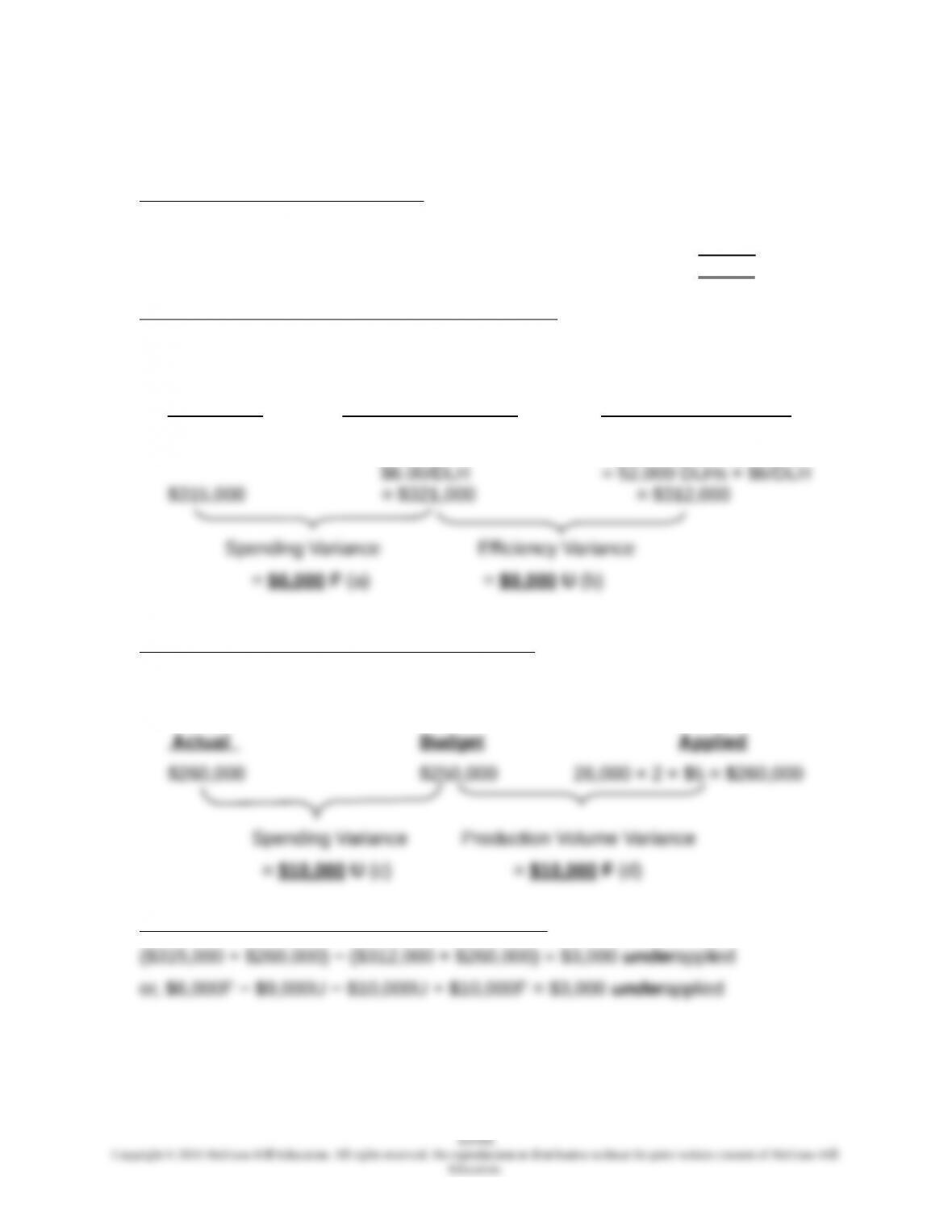
a. & b. Variable manufacturing overhead variances
FB for Variable Overhead FB for Variable Overhead
based on Inputs based on Outputs (i.e., on
(i.e., Actual Hours allowed hours for Units
Actual Cost Worked) = (SP × AQ) produced) = (SP × SQ)
53,500 DLHs × 26,000 units × 2 DLH/unit
c. & d. Fixed manufacturing overhead variances
Budgeted fixed manufacturing overhead per month:
$3,000,000 12 months = $250,000
e. Under- or overapplied manufacturing overhead
Chapter 15 – Operational Performance Measurement: Indirect-Cost Variances and Resource-Capacity Management
15-45 (Continued-1)
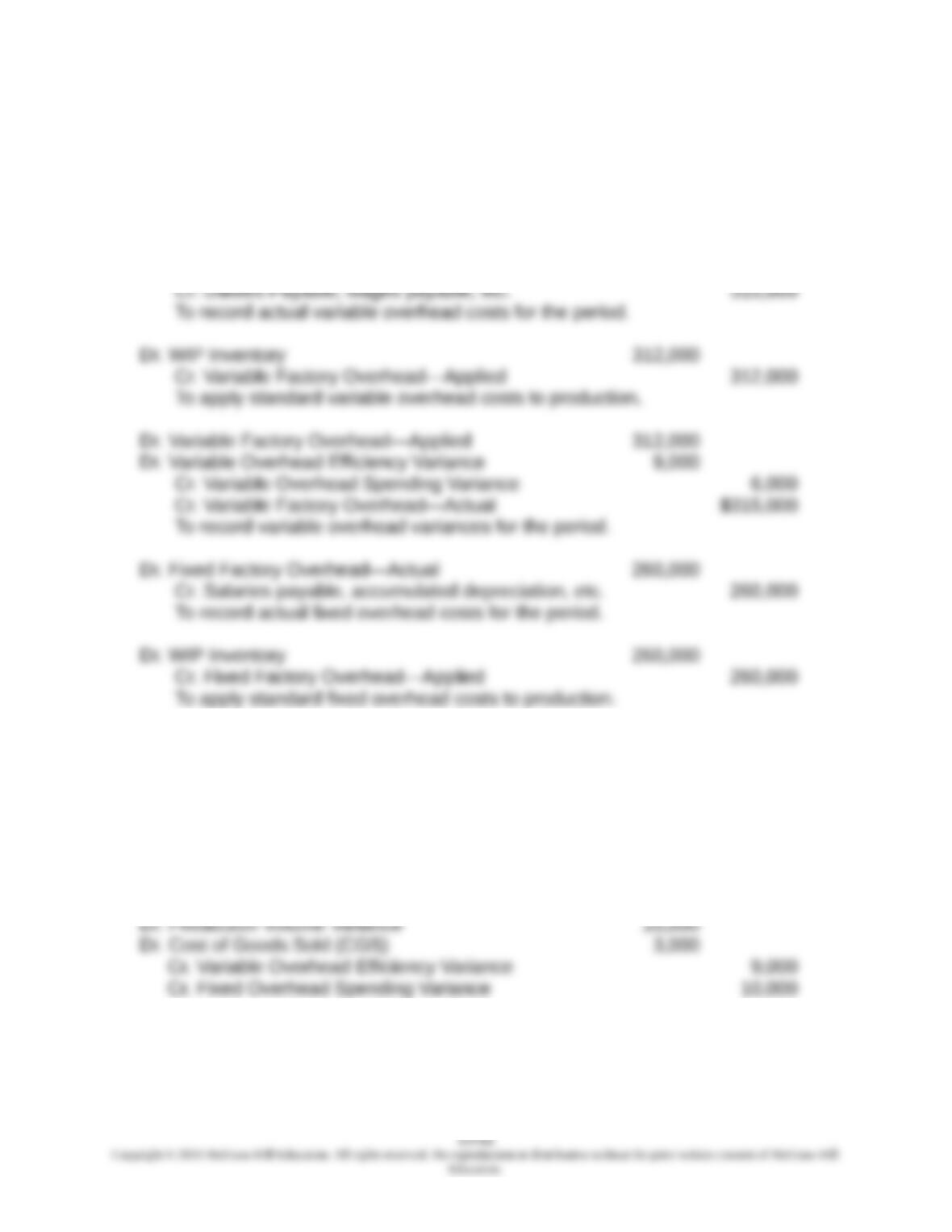
2. Summary Journal Entries (this solution assumes that the company uses an actual
and an applied account for variable overhead and an actual and an applied account
for fixed overhead costs):
Dr. Variable Factory Overhead—Actual 315,000
Dr. Fixed Factory Overhead—Applied 260,000
Dr. Fixed Factory Overhead Spending Variance 10,000
Cr. Production Volume Variance 10,000
Cr. Fixed Factory Overhead—Actual 260,000
To record fixed overhead variances for the period.
3. Closing Journal Entry:
Dr. Variable Overhead Spending Variance 6,000
4. Generally accepted accounting principles (GAAP) (viz., FASB ASC 330-10-30-3 to -7,
previously SFAS151—“Inventory Costs: An Amendment of ARB No. 43, Chapter 4,”
and available at www.fasb.org) reaffirms (and brings U.S. reporting standards more in
line with International Accounting Standards in the area) that abnormal amounts of
Chapter 15 – Operational Performance Measurement: Indirect-Cost Variances and Resource-Capacity Management
15-45 (Continued-2)
idle facility expense (as well as abnormal amounts of freight, handling costs, and
spoilage) be written off as a period expense (i.e., as a current-period charge).
Further, GAAP specifies that “normal capacity” be used for establishing fixed
overhead allocation rates and that any unallocated overhead be recognized as an
expense of the period (rather than be prorated to inventories and CGS). While not
5. The point of this question is to impress upon students the fact that under absorption
costing, reported operating income can be affected by the method used to dispose
of any production volume variance associated with fixed overhead. In other words,
the variance-disposition method can be used to “manage earnings” under absorption
costing.
inventory can be intensified or reduced based on how the production volume
variance is disposed of at the end of the period. Specifically, this ability to affect
reported income is confined to the situation where the production volume variance is
written off entirely to cost of goods sold (CGS), as follows:
If inventory is increasing, choosing a lower denominator-volume level will
resulting production volume variance is accounted for that provides management an
opportunity to manage earnings under absorption costing. The above points suggest
that managers can increase short-run operating income by: (1) choosing larger
denominator levels if they expect inventory to decrease, or (2) choosing smaller
denominator levels if they expect inventory to increase. Note, however, that if the
Education.
Chapter 15 – Operational Performance Measurement: Indirect-Cost Variances and Resource-Capacity Management
15-46 Research Assignment: Control of Overhead Costs; Strategy (45-60 Minutes)
This assignment is based on the following article: K. P. Coyne, S. T. Coyne, and E. J.
Coyne, Jr., “When You’ve Got to Cut Costs Now: A Practical Guide to Reducing
Overhead by 10%, 20%, or (wince) 30%,” Harvard Business Review (May 2010), pp.
74-82.
1. In general, how does this article relate to the material covered in Chapter 15?
Chapter 15 deals with the accounting for and the management of indirect costs—
principally, indirect manufacturing costs (i.e., manufacturing overhead). The
discussion in Chapter 15 extends the discussion from Chapter 14 and as such uses
standard costs and flexible budgets at the end of an accounting period to generate
maker/manager, are not in a position to advocate a change in strategy or large-scale
investments in technology (either of which might produce long-term cost savings).
Thus, you have been asked to focus on ways to secure specified short-term
administrative cost savings.
2. The authors state (p. 75) that “administrative cost-reduction opportunities follow
similar patterns virtually everywhere.” What two major conclusions do the authors
offer, based on the accumulated experience in implementing successful cost-cutting
programs?
One, organizations typically are not able to meet their cost-cutting goals with a single
idea or plan. In fact, as a rule-of-thumb, the authors suggest that typically a
combination of 10 or more actions will be needed.
Two, the type of cost-cutting plans or ideas implemented should be directly related to
15-64
Education.
15-46 (Continued-1)
3. The authors of this article also state (p. 75) that cost-reduction goals typically require
“ten or more actions.” For each of the three classifications of cost-reduction goals
discussed in the article provide examples of specific actions that managers can
pursue in an attempt to meet the stated cost-reduction goal.
10% Cost-Reduction Goal (“Incremental Ideas”)
1. Consolidate incidentals (e.g., combining training days or celebrations into a single
event; cross-scheduling the use of external resources, such as facilities or
trainers)
enhancing suggestions that were rejected; check the most recent three budget
cycles for such investment opportunities that may now be viable)
20% Cost-Reduction Goal (“Redesign Ideas”)—can the demands on your
department be reduced so that resource savings can accrue?
1. Talk to your counterparties (to reveal cost-saving opportunities in terms of
demands on resources made available by your department)
consequence events be reduced? (For example, is it necessary to check 100% of
data 100% of the time?)
30% Cost-Reduction Goal (Cross-Department and Program-Elimination Ideas;
How well does the work of your department fit within the work performed by
other departments?)
1. Coordinate parallel activities (e.g., purchasing of supplies, travel
4. Eliminate low-value meetings and forums (to free employees to do more
15-65
Chapter 15 – Operational Performance Measurement: Indirect-Cost Variances and Resource-Capacity Management
creative/productive tasks)
15-46 (Continued-2)
5. Eliminate certain tasks performed by or programs conducted by your department
4. Provide a concise summary of the authors’ recommended approach for determining
the “right level of overhead.”
The authors’ thoughts in this regard are presented at the top of pages 78 and 79.
From management’s perspective, the underlying issue is “are we cutting enough—or
too much?”
In attempting to answer this question, the authors suggest that overhead spending
15-66
Education.
Chapter 15 – Operational Performance Measurement: Indirect-Cost Variances and Resource-Capacity Management
15-47 ABC Data, Resource-Capacity Planning, Non-Financial Performance Indicators
(45 Minutes)
1. Allocated costs: Cost-driver rates based on budgeted capacity usage
2. Allocated costs: Cost-driver rates based on practical capacity
15-67
Chapter 15 – Operational Performance Measurement: Indirect-Cost Variances and Resource-Capacity Management
15-47 (Continued)
3. For each activity, we calculate in (2) an estimated cost of “unused capacity.” The
company should monitor these amounts (or variances) over time and evaluate
4. Customer Service activities can be viewed as part of the larger “Customer
Management” process. Conceptually, the company should establish one or more key
objectives regarding “customer service.” Each of these specified objectives would
include one or more performance measures (metrics). Below are some
plausible objectives and associated non-financial performance metrics that the
company might monitor:
Respond Quickly to Customer Feedback and Complaints:
15-68
Education.
Chapter 15 – Operational Performance Measurement: Indirect-Cost Variances and Resource-Capacity Management
15-48 Managing Resource Capacity through Activity-Based Costing (ABC) (60
Minutes)
1. “Variable” and “fixed” costs represent descriptions of how a given cost changes in
response to one or more specified activities or “cost drivers.” (Mathematically, we
would say that “cost” is the dependent variable and the cost drivers represent
independent variables. A mathematical equation, in linear or non-linear form, can be
used to depict the underlying “behavior” of a given cost.)
We say a given cost is “variable” if, in the short run, that cost changes in response to
one or more cost drivers. In other words, such costs change, in total, as related
Fixed costs are those that, in the short run, are related to the amount of capacity
supplied. That is, these costs are independent of actual activity levels—they relate
more to the ability to produce, rather than the actual level of production. (Of course,
in the long-run, these costs can be managed—increased or decreased—by
managerial action.) Resource expenditures for these items are therefore independent
of how much of the resource is used in a given period. Examples include things such
as engineering salaries, production scheduling, sales and marketing managers, and
depreciation expense (or most rental expenses).
For many organizations today, their support costs are significant in amount and
largely short-term fixed. That is, many (if not most) support costs, including
approximate cost of acquired, but unused, capacity.
2. In implementing an ABC system, management has several options at its disposal in
terms of how the ABC cost-allocation rates are determined. For example, the
denominator in each calculation can be either actual or budgeted activity. The former
is deficient in that its use would produce a backward-looking figure. The latter is also
Chapter 15 – Operational Performance Measurement: Indirect-Cost Variances and Resource-Capacity Management
15-48 (Continued-1)
prices, and order acceptance, the company may set an increased price to offset the
To provide forward-looking data and to avoid the so-called death-spiral effect, it is
recommended that the denominator in the calculation of ABC rates be defined as
practical capacity, which over short planning horizons would be fixed. Conceptually,
we might define “practical capacity” as the amount of work (or activity) that can be
3. Determination of Activity-Cost Rate for “Handling Customer Orders” Activity
Budgeted Resource Spending (i.e., the numerator) = $720,000
No. of Orders @ Practical Capacity (i.e., the denominator) = 10,000
Support Cost Rate: Per Order Handled = $72.00
Cost of Resources Supplied = $720,000
strategy. Thus, managing resource spending in support areas (e.g., manufacturing
support, customer support) is strategically important. Further, the dollar amount of
such costs are likely to be large and therefore worthy of special attention (monitoring
and control).
4. The point of this question is to demonstrate that the ABC data, based on practical
capacity, can be used to reveal the increased efficiencies associated with the TQM
initiative (in terms of the impact of that initiative on the customer-handling process).