Chapter 12 – Strategy and the Analysis of Capital Investments
CHAPTER 12: STRATEGY AND THE ANALYSIS OF CAPITAL
INVESTMENTS
QUESTIONS
12-1 Capital-budgeting decisions: (a) are long-term in nature (i.e., they affect profitability
and cash flows for many years into the future), and (b) involve substantial amounts
discounted after-tax flows are needed for investment-analysis purposes.
12-2 As members of managerial decision-making teams, accountants can add value to
the capital budgeting process in at least four ways: (1) ensuring linkage between the
capital budgeting process and the organization’s master budget; (2) ensuring linkage
to the strategic plans of the organization (e.g., integrating capital budgeting into an
12-3 The analytic hierarchy process (AHP) is one of several multi-criteria decision-making
techniques, that is, decision models that include more than a single decision
criterion. As such, the model can incorporate both financial and nonfinancial
(strategic) decision criteria, weighted according to managerial preferences.
to numerous decision contexts.
12-4 Income-tax effects represent changes (i.e., increases or decreases) to the income-
tax liability of the firm. Tax effects of a decision to acquire new factory equipment
may include:
Decreases in income taxes because of the deductibility of depreciation
expenses of the factory equipment.
Increases in tax payments for taxable gains (or decreases in tax payments for
12-5 Among the limitations of the payback period decision model are its failure to
12-1
Education.
Chapter 12 – Strategy and the Analysis of Capital Investments
consider a project’s total profitability over its useful life and failure to incorporate the
time value of money. The present value payback period model considers the time
12-6 The book (accounting) rate of return of an investment is not likely to yield a true
measure of the rate of return on the investment because it does not consider the
time value of money and because it includes in its computation accrual-based
accounting numbers (rather than after-tax cash flows). In contrast, the internal rate
of return (IRR) of a project, because it focuses on discounted cash flows, represents
an estimate of the true (i.e., economic) rate of return on a proposed investment. For
12-7 The decision criterion for the NPV method is the amount and direction of the net
present value. A proposed investment with a positive NPV should be accepted.
Furthermore, a higher NPV signals a better capital investment, from the standpoint
of the goal of maximizing shareholder value.
The IRR method uses a different decision criterion for evaluating capital
12-8 Among important behavioral factors that might affect capital investment decisions
are:
Desires of managers to grow through acquisitions and new investments
12-9 The NPV method weighs early cash flows more heavily than cash flows in the
12-2
Education.

Chapter 12 – Strategy and the Analysis of Capital Investments
distant future in at least two ways. First, amounts of discount applied to early cash
flows are less than those of later cash flows. Thus, one dollar to be received in the
12-10 Depreciation expense per se has no effect on cash flows. However, depreciation
deductions do affect capital investment decisions in two indirect ways:
economic life, which in turn affects the tax liability of the firm in the year of
asset disposal.
12-11 a. The firm can expect to earn a higher return than the cost of funds needed for the
investment; thus, using the IRR decision model, this project should be accepted. It
promises to fully recover the initial investment in the project plus provide an
firm a present-value return of $148,000 above the required 10% rate of return.
12-12 The internal rate of return (IRR) of a project assumes that the cash inflows from the
project are reinvested at the project’s IRR. The modified internal rate of return
(MIRR) assumes, by contrast, that these cash flows are reinvested at the firm’s
discount rate (i.e., its WACC). Some individuals believe that MIRR more accurately
reflects the profitability of a project.
For example, assume a two-year project with an initial outlay of $195, a cost of
capital of 12%, a return of $121 in the first year and a return of $131 in the second
12-3

Chapter 12 – Strategy and the Analysis of Capital Investments
NPV = 17.47 when MIRR = 12%
The following function in Excel can be used to estimate a project’s MIRR:
MIRR(values,finance_rate,reinvest_rate)
where values is an array or a reference to cells that contain numbers. These
numbers represent a series of payments (negative values) and cash inflows (positive
12-13 (Appendix B): With unlimited funds available at a 10 percent cost of capital, the firm
needs to ensure that all investments will earn an economic return of at least 10
percent. As explained in the appendix, if the firm operates under a capital constraint,
12-14 (Appendix B): The NPV model and the IRR model may yield conflicting results when
two investment projects are being compared and these projects differ in:
12-15 (Appendix B): Because of the scaling process, the size of initial investment has no
effect on the rate of return as determined using the IRR model. However, a project
with a larger initial investment will likely have a higher NPV than a project with a
smaller initial investment (simply because it is bigger) and often becomes the
preferred investment when using a NPV method to analyzing capital investments. An
12-4
Education.
Chapter 12 – Strategy and the Analysis of Capital Investments
BRIEF EXERCISES
12-16 Calculating After-tax Cash Flows
Given a marginal income-tax rate of 34%:
a) The after-tax cash effect of a $1,000 increase in cash contribution margin =
= $500 × (1 – 0.34) = $330.00 decrease
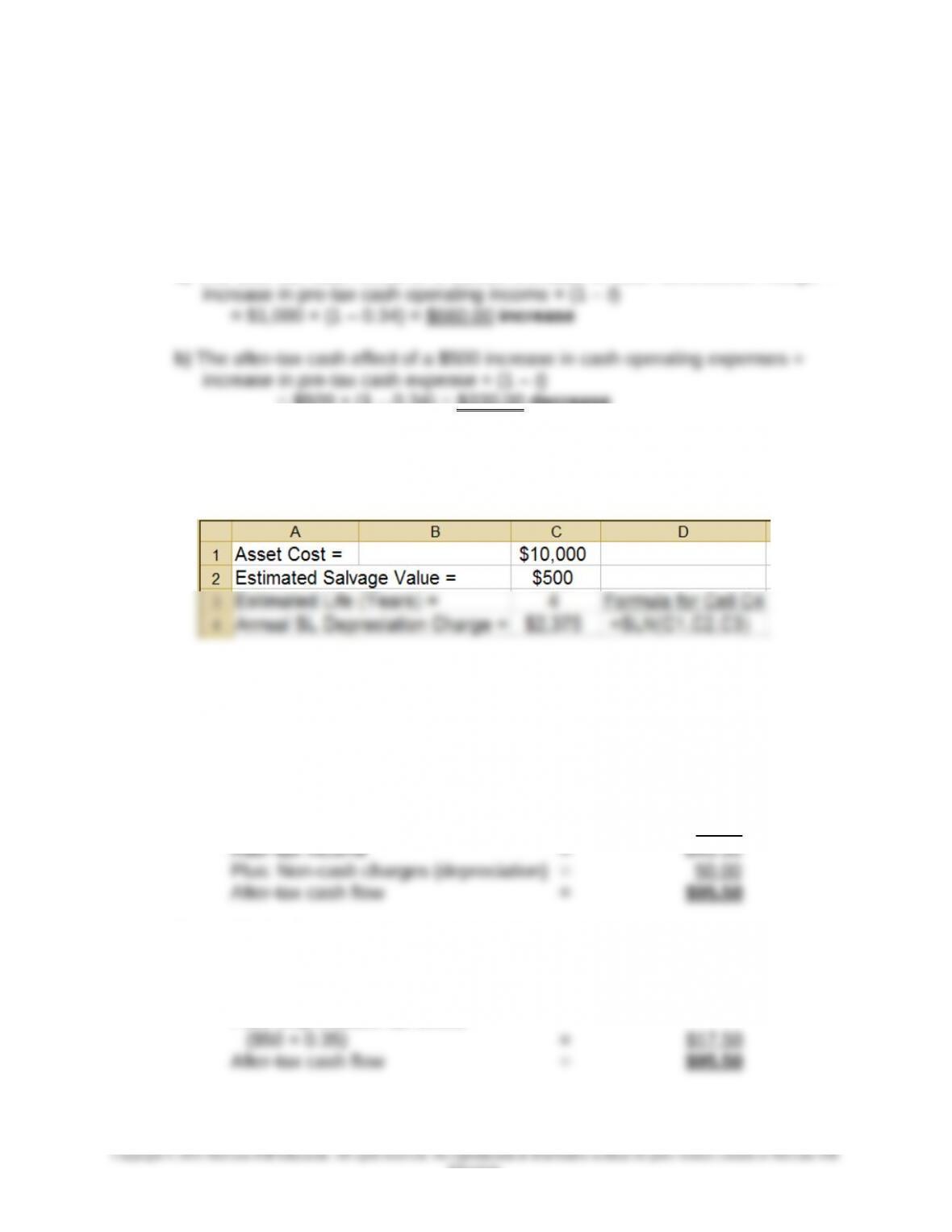
12-17 SL Depreciation Calculation Using Excel
12-18 Calculating Net After-tax Cash Flows:
Indirect Method:
Pre-tax Income ($260 – $140 – $50) = $70.00
Less: Income-tax Expense = 24.50
Direct Method:
After-tax cash operating income
($260 – $140) × (1 – 0.35) = $78.00
Plus: Depreciation tax shield
12-5
Education.

Chapter 12 – Strategy and the Analysis of Capital Investments
12-19 MACRS Depreciation Calculations
3-year property, cost = $10,000:
Year 1 = $10,000 × 33.33% = $3,333
12-20 Present Value of MACRS Depreciation Deductions
Net present value of depreciation tax deductions, given an after-tax discount rate of
12.00%, MACRS 3-year property, and an asset-acquisition cost of $10,000 = $3,217,
as follows (note: the PV factors are taken from Table1, Appendix C; Present Value
amounts are rounded):
(rounded)
12-21 After-tax Proceeds, Asset Disposals
Given an NBV of $25,000 and a marginal income-tax rate of 34%:
a) If sales price = $35,000 (i.e., gain situation):
After-tax proceeds = net selling price – tax on gain
12-6
Education.
Asset Cost = $10,000
After-tax Discount Rate = 12.00%
Marginal Income-Tax Rate = 40.00%
MACRS Depreciation Tax PV Present
Year % Deduction Savings Factor Values

Chapter 12 – Strategy and the Analysis of Capital Investments
b) If sales price = $15,000 (i.e., loss situation):
= $15,000 + $3,400 = $18,400
12-22 Present Value of a Single Amount
Present value of $1,000 to be received two years from now (note that the difference
in answers below is attributable to rounding):
1) Using PV table (Chapter 12, Appendix C, Table 1):
2) Using Excel:
12-23 Present Value of an
Annuity
Given a 5-year stream of cash flows, $500 per year, at 14%:
a) Using the annuity table (Chapter 12, Appendix C, Table 2):
b) Using the built-in PV function in Excel:
12-7
Education.
Chapter 12 – Strategy and the Analysis of Capital Investments
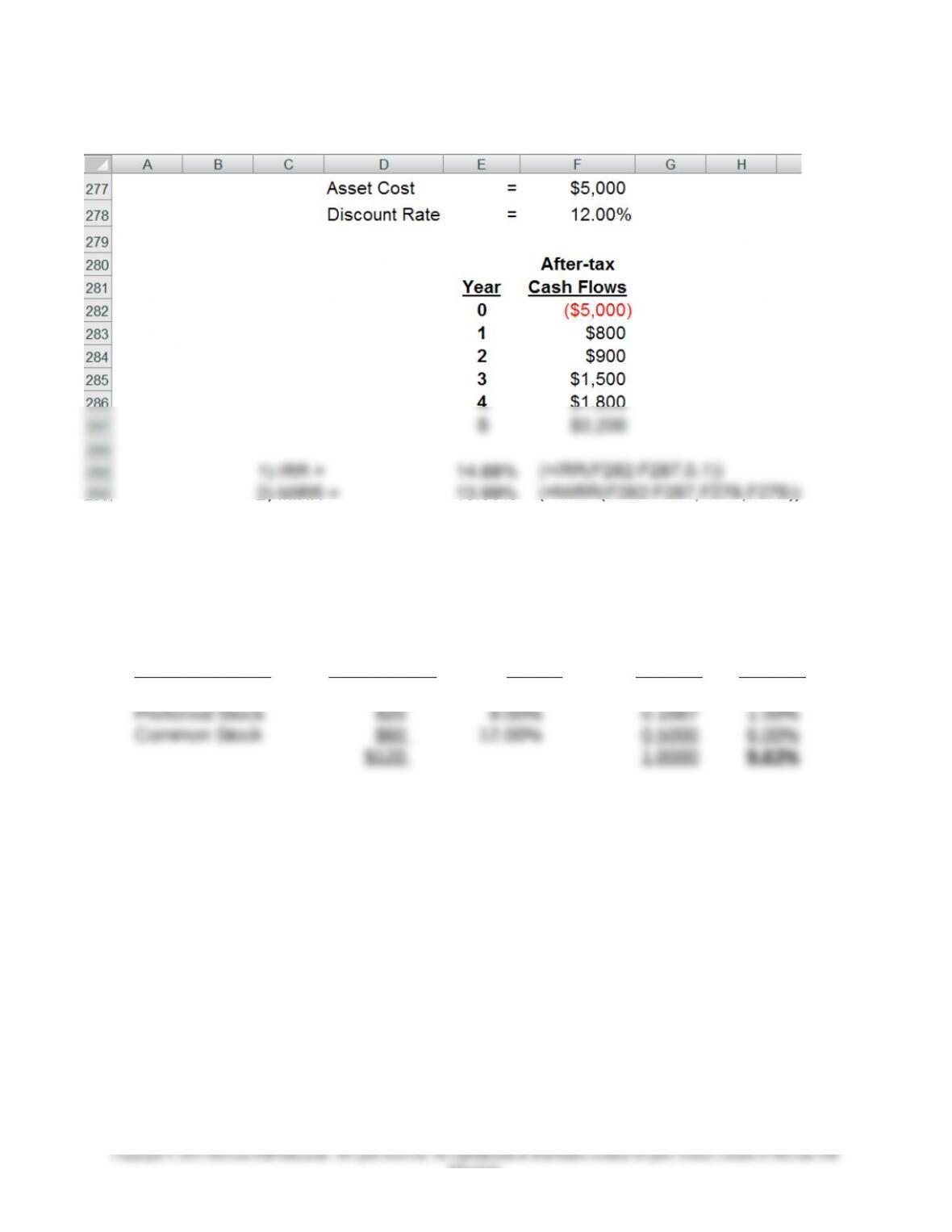
12-24 IRR vs. MIRR
These two measures of investment profitability make different assumptions as to the
rate of return on cash inflows from the investment: the IRR assumes that these cash
inflows are reinvested at the IRR; the MIRR, on the other hand, assumes that these
cash inflows are reinvested at the WACC (discount rate). As such, the MIRR is a
more conservative estimate of a project‘s rate of profitability.
12-25 Estimating Weighted-Average Cost of Capital (WACC)
The weighted-average cost of capital (WACC) = 9.83%, as follows:
(1) (2)
Source of Funds Market Value
Required Rate of
Return Weights (1) × (2)
Long-term Debt $40 7.00% 0.3333 2.33%
12-8
Education.
Chapter 12 – Strategy and the Analysis of Capital Investments
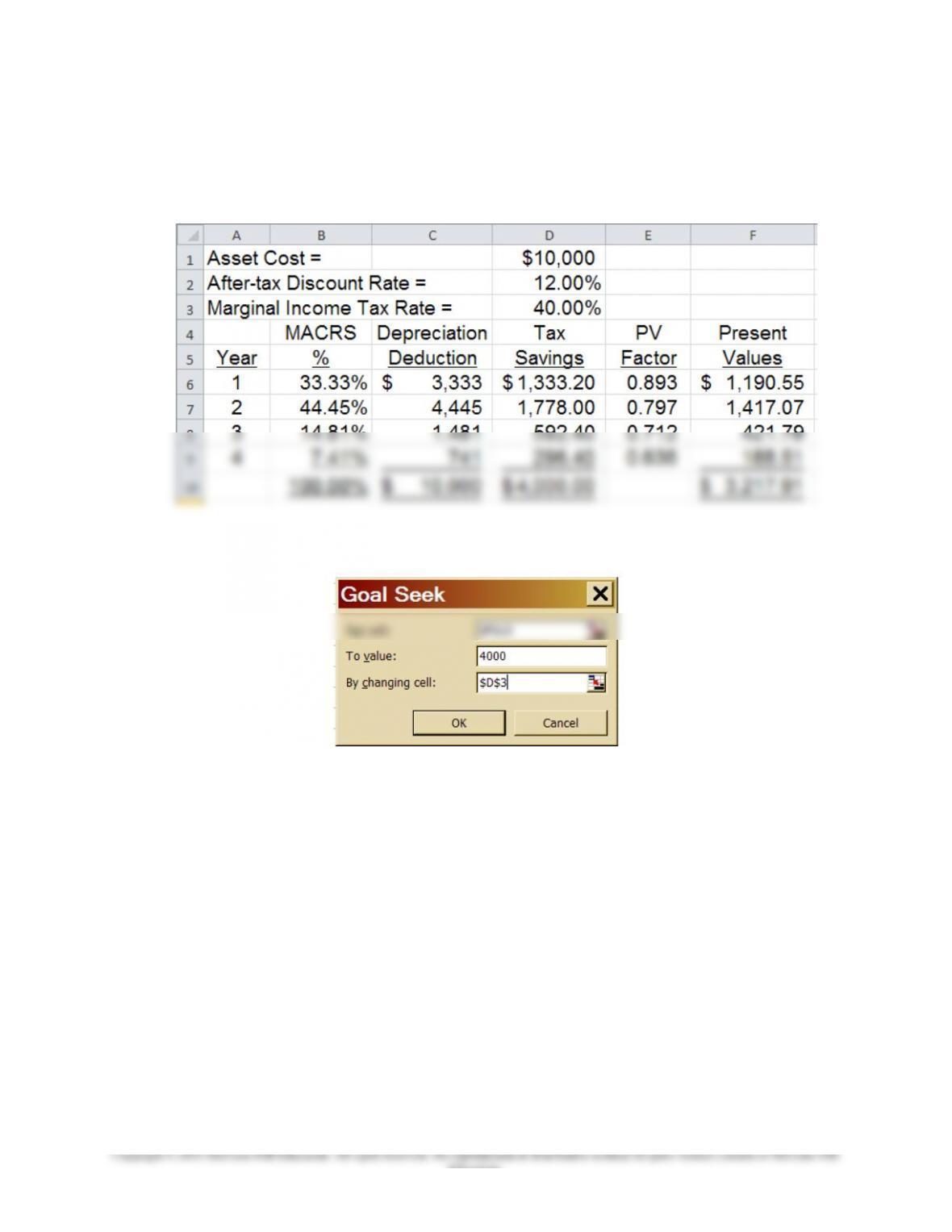
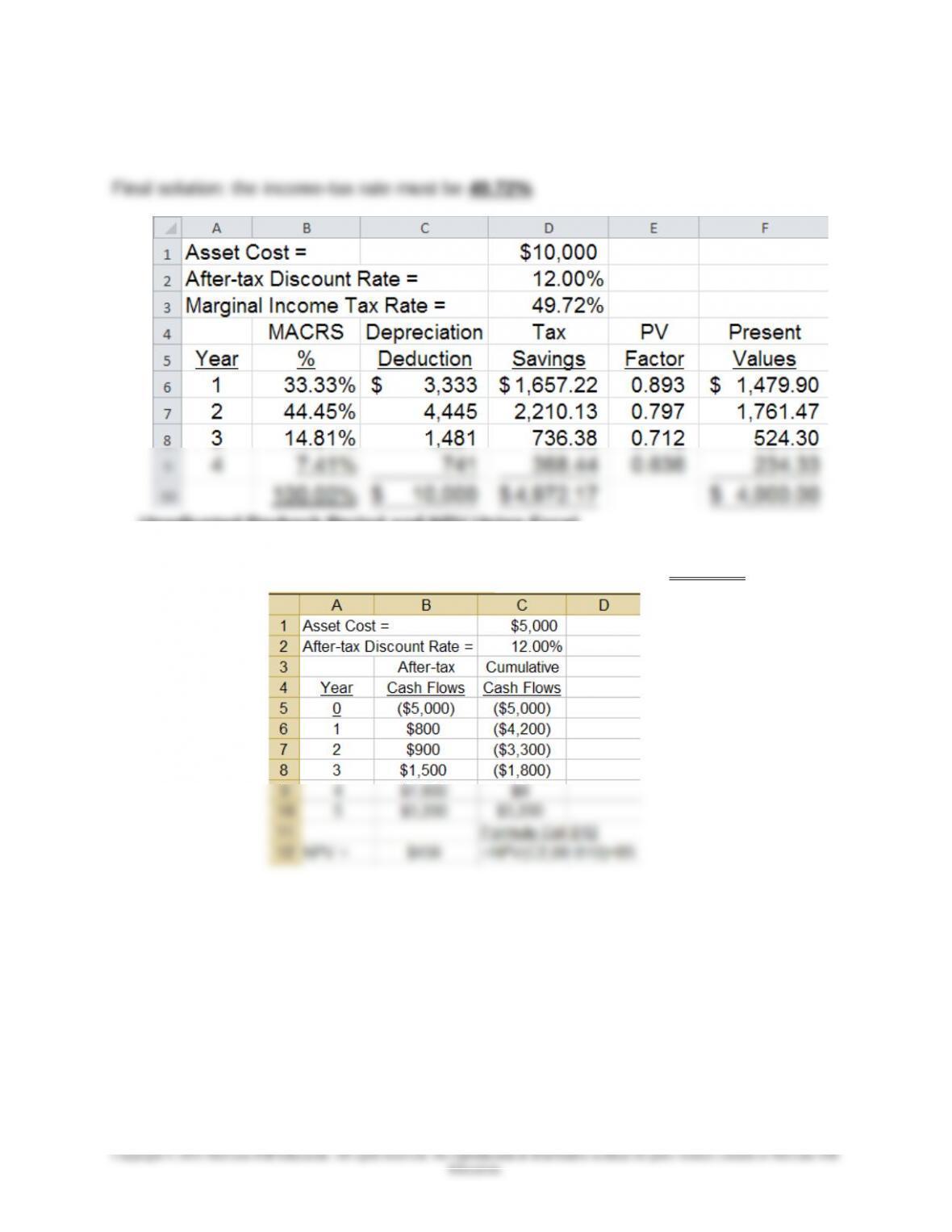
12-26 Sensitivity Analysis: Use of “Goal Seek” Function in Excel
Starting point = solution to Brief Exercise 12-20, as follows (note: the PV factors
below are entered from Appendix C, Table 1):
Then, use the following Goal Seek commands in Excel:
12-9
Education.
Chapter 12 – Strategy and the Analysis of Capital Investments
12-27
Unadjusted Payback Period and NPV Using Excel
The project’s NPV = $459 and the unadjusted payback period = 4.0 years
12-10