Chapter 09 – Audit Sampling: An Application to Substantive Tests of Account Balances
CHAPTER 9
AUDIT SAMPLING: AN APPLICATION TO
SUBSTANTIVE TESTS OF ACCOUNT BALANCES
Answers to Review Questions
9-1 The steps in a statistical sampling application for substantive testing include (by phases):
Planning
1. Determine the test objectives.
2. Define the population characteristics:
o Define the population.
o Population size.
Performance
4. Select sample items.
5. Perform the audit procedures:
Evaluation
6. Calculate the projected misstatement and the upper limit on misstatement.
7. Draw final conclusions.
9-2 When monetary-unit sampling (MUS) is used, the sampling unit is defined as an
individual monetary unit (e.g., a dollar or other forms of currency). When classical
9-3 The following table shows how the desired confidence level, tolerable misstatement, and
expected misstatement are related to sample size:
Factor
Relationship to Sample Size
Desired confidence level
Direct
Tolerable misstatement
Inverse
Expected misstatement
Direct

Chapter 09 – Audit Sampling: An Application to Substantive Tests of Account Balances
9-2
Chapter 09 – Audit Sampling: An Application to Substantive Tests of Account Balances
9-3
9-4 The advantages and disadvantages of MUS are:
Advantages:
• When the auditor expects no misstatements, MUS will normally result in a smaller
sample size than classical variables sampling.
• The calculation of sample size and the evaluation of the sample results are not based on
Disadvantages:
• Selection of a zero or negative balance generally requires special design consideration.
9-5 Probability-proportional-to-size sample selection gives each individual dollar or monetary
unit in the population an equal chance of being selected. Each selected dollar represents a
group of dollars (referred to as the sampling interval). The sampling interval is
9-6 The decision rule for determining the acceptability of sample results when MUS is used
compares the tolerable misstatement (TM) to the upper misstatement limit (UML). If
UML is less than TM, the evidence supports the fair presentation of the account. If UML
9-7 Variation in the population, the risk of incorrect acceptance, and tolerable and expected
misstatement affect sample size in the following way:
• Desired confidence level: Direct-as the desired confidence level increases, the required
sample size increases.
• Risk of material misstatement: Direct-as the risk of material misstatement increases, the
• Expected misstatement: Direct-an increase in expected misstatement results in an
increase in sample size.

Chapter 09 – Audit Sampling: An Application to Substantive Tests of Account Balances
9-4
9-5
9-8 The AICPA’s audit guide describes two acceptable methods of projecting the amount of
misstatement found in a nonstatistical sample, ratio projection and difference projection.
Ratio projection determines the amount of misstatement by dividing the amount of
misstatement by the percentage of the dollars of the population included in the sample.
the population, difference projection should be used.
9-9 The advantages and disadvantages of classical variables sampling are:
Advantages:
• When the auditor expects a relatively large number of differences between book and
audited values, classical variables sampling will normally result in a smaller sample
size than MUS.
• Classical variables sampling techniques are effective for both overstatements and
Disadvantages:
• When using the approach to evaluate likely misstatements in an account or population,
some classical variables sampling techniques (e.g., difference estimation) do not work
9-10 The decision that the evidence supports or does not support the account balance using
classical variables sampling is made by determining whether the upper and lower limits
are within tolerable misstatement. If both limits are within the bounds of tolerable

Chapter 09 – Audit Sampling: An Application to Substantive Tests of Account Balances
9-6
Chapter 09 – Audit Sampling: An Application to Substantive Tests of Account Balances
Answers to Multiple-Choice Questions
Chapter 09 – Audit Sampling: An Application to Substantive Tests of Account Balances
9-8
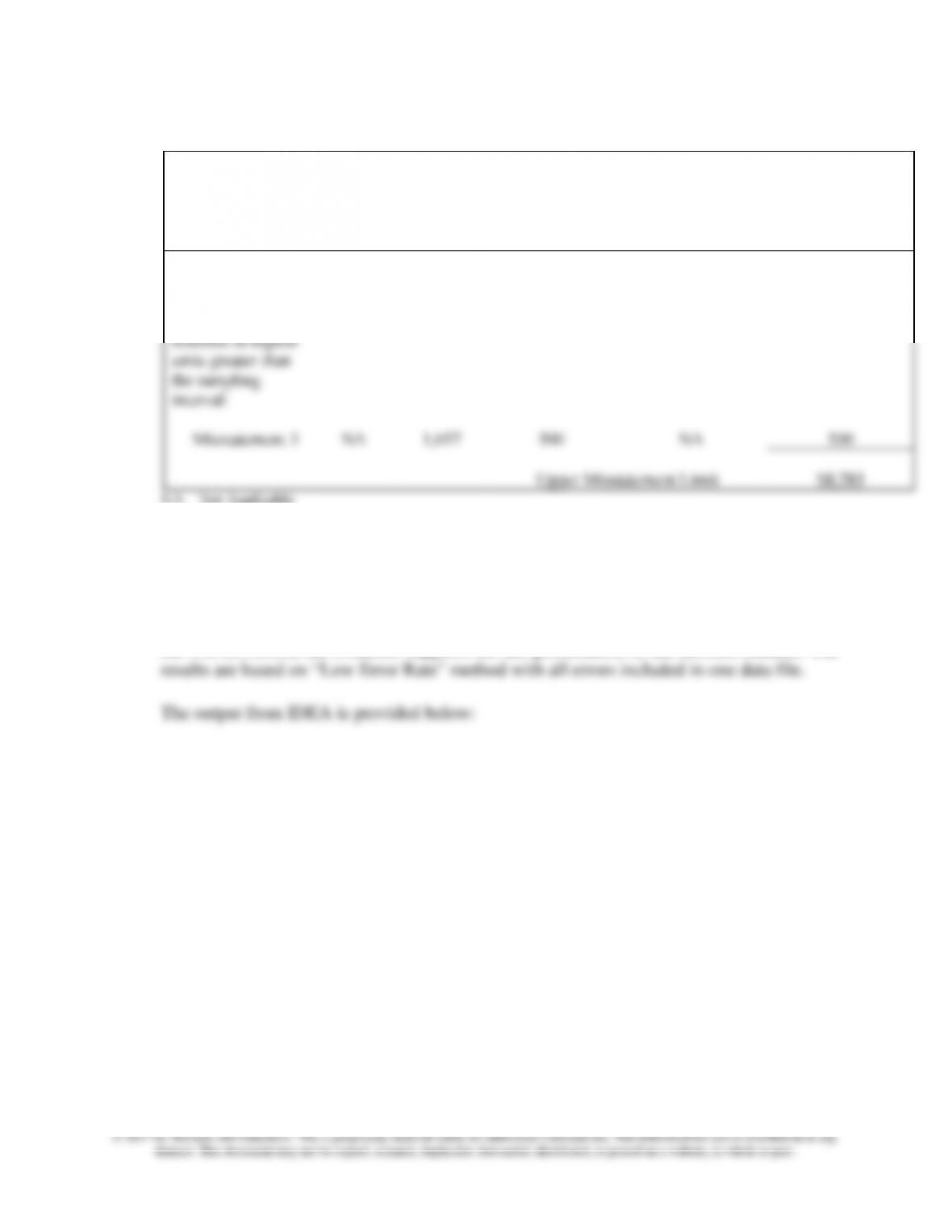
c. The total projected misstatement for the three misstatements identified is calculated
by first computing the tainting factor as follows:
Misstatement
Number
Book
Value
Audit
Value
Tainting
Factor
1
$400
$320
.20
2
500
0
1.00
3
3,000
2,500
Not applicable, since book value
exceeds sampling interval.
Chapter 09 – Audit Sampling: An Application to Substantive Tests of Account Balances
9-9
The upper misstatement limit is calculated as follows:
Misstatement
Number
Tainting
Factor
Sampling
Interval
Projected
Misstatement
(column 2 x 3)
95%
Misstatement
Factor or
Increment (from
Table 9-3)
Upper
Misstatement
Limit
(column 2 x 3 x 5)
Basic Precision
1.0
$1,657
NA
3.0
$4,971
2
1.0
1,657
1,657
1.7 (4.7 – 3.0)
2,817
1
.20
1,657
331
1.5 (6.2 – 4.7)
497
Add misstatements
detected in logical
units greater than
the sampling
interval:
Misstatement 3
NA
1,657
500
NA
500
Upper Misstatement Limit
$8,785
NA—Not Applicable
Since the UML ($8,785) is less than the TM ($15,000), the evidence supports the fair
presentation of the account balance.
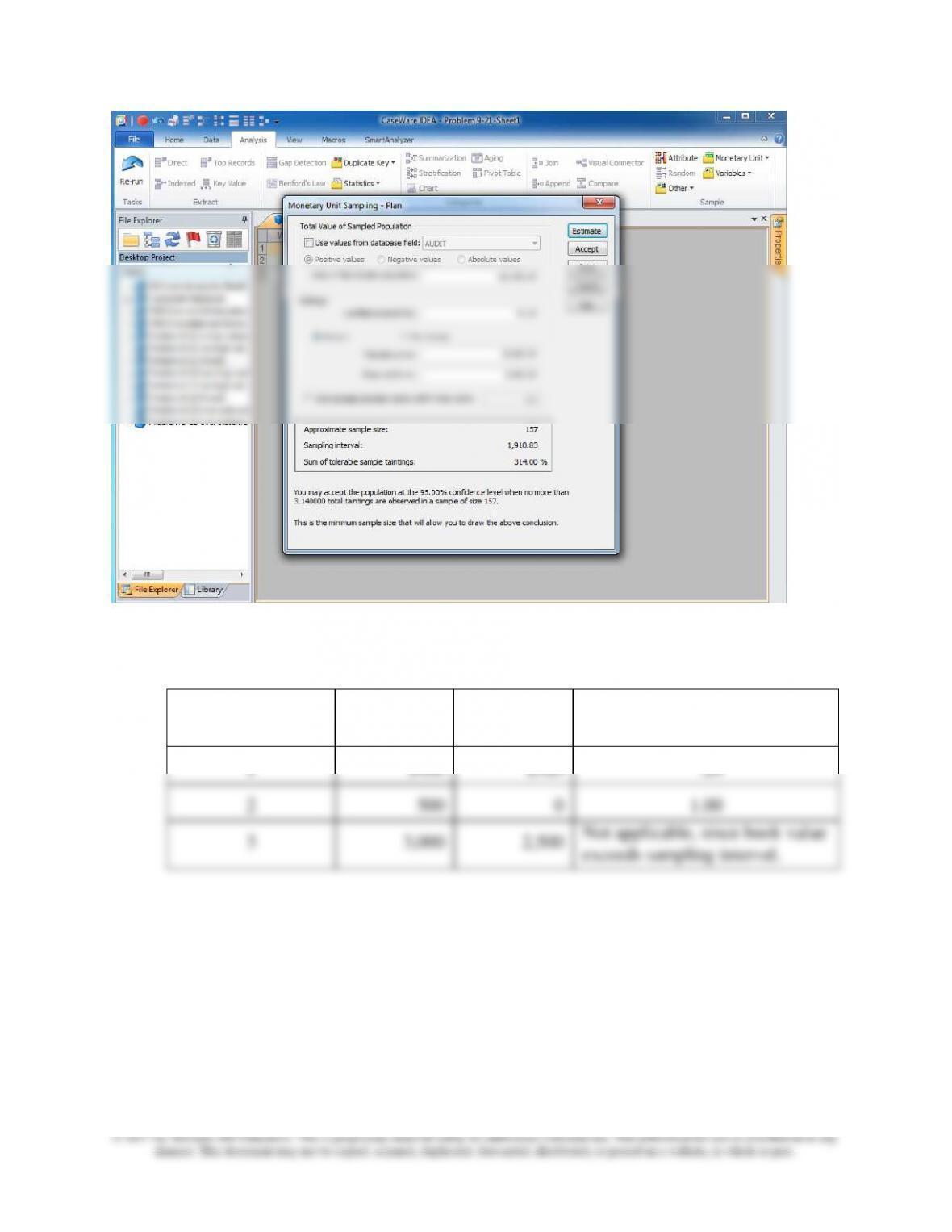
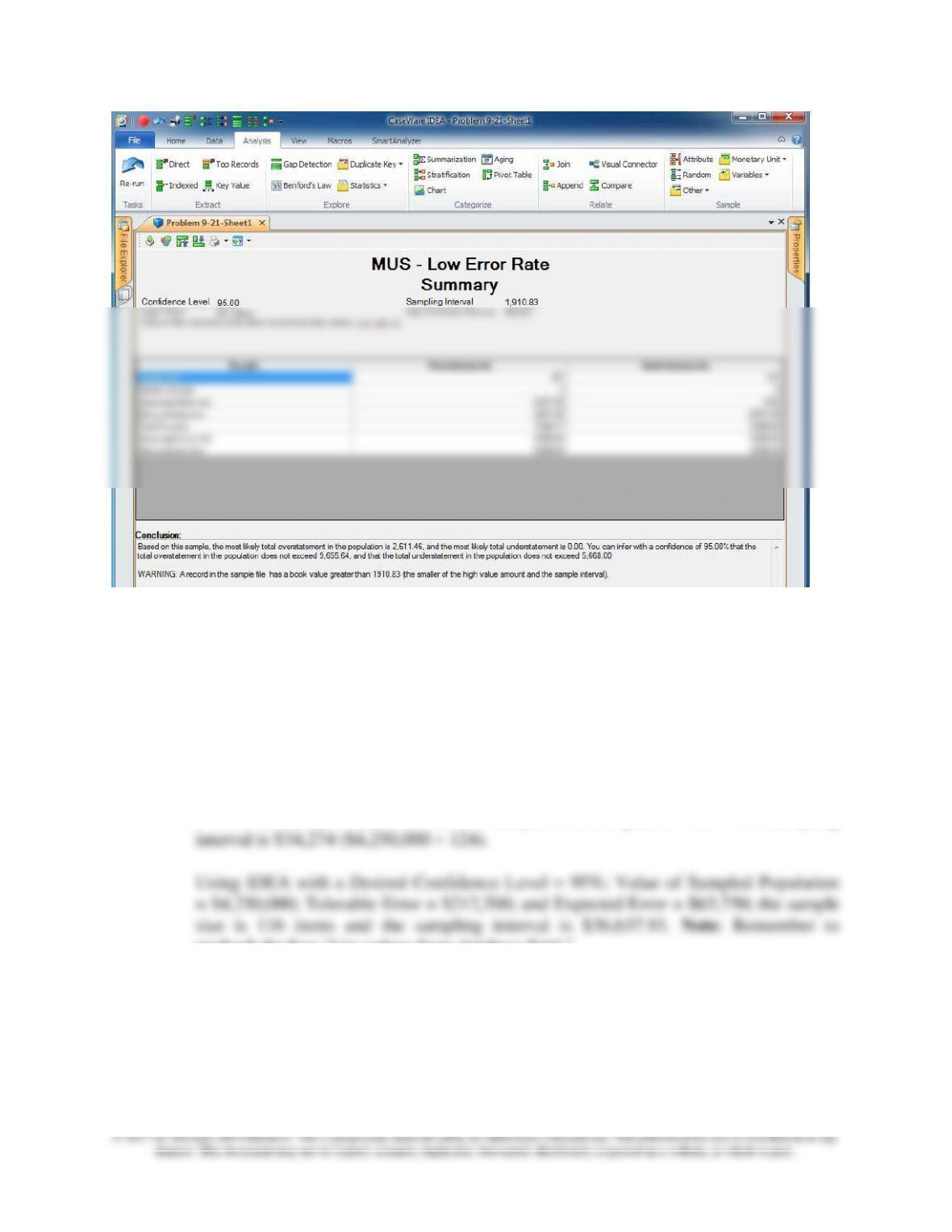
Using IDEA and the IDEA sample size calculated by in part (b), the Upper Error Limit is
$9,655.64 and the Most Likely Error is $2,611.46. Since the Upper Error Limit is less than
the TM ($15,000), the evidence supports the fair presentation of the account balance. The
Chapter 09 – Audit Sampling: An Application to Substantive Tests of Account Balances
9-10
The warning at the bottom of the screen refers to the way “High Value” items are handled
in the evaluation. For very large items that can be selected multiple times when using the
sampling interval and systematic selection, IDEA’s technical literature provides
alternative approaches to handle such situations. Additional examples of applying IDEA
in MUS evaluation are included in the Chapter 9 IDEA problems found in Connect.
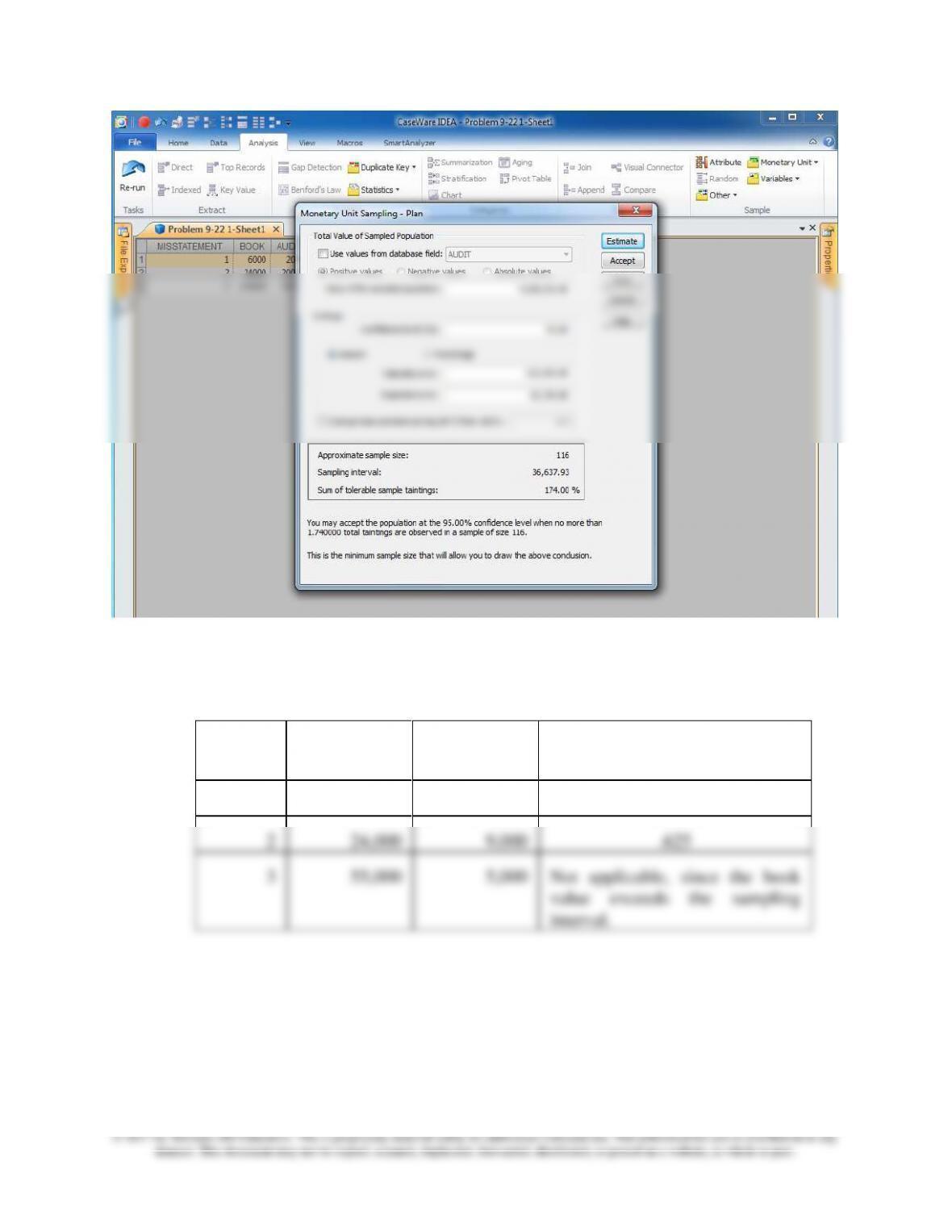
9-22 a. Using Table 8-5 with a desired confidence level = 95% (risk of incorrect acceptance
= 5%); tolerable misstatement = 5% ($212,500 $4,250,000); expected misstatement
= 1.5% ($63,750 $4,250,000); the sample size is equal to 124. The sampling
uncheck the box “Use values from database field.”
The output from IDEA is provided below:
Chapter 09 – Audit Sampling: An Application to Substantive Tests of Account Balances
9-11
b. The upper misstatement limit is calculated as follows:
Overstatement Errors
Error
Number
Book Value
Audit Value
Tainting Factor
1
6,000
1,000
.883
2
24,000
9,000
.625
3
55,000
5,000
Not applicable, since the book
value exceeds the sampling
interval.
Chapter 09 – Audit Sampling: An Application to Substantive Tests of Account Balances
9-12
Error Number
Tainting
Factor
Sampling
Interval
Projected
Misstatement
(column 2 x 3)
95%
Misstatement
Factor or
Increment (from
Table 9-3)
Upper
Misstatement
Limit
(column 2 x 3
x 5)
Basic Precision
1.0
$34,274
NA
3.0
$102,822
1
.883
34,274
28,550
1.7 (4.7 – 3.0)
48,535
2
.625
34,274
21,421
1.5 (6.2 – 4.7)
32,132
Add misstatements
detected in logical
units greater than
the sampling
interval:
Error 3
NA
34,274
50,000
NA
50,000
Upper Misstatement Limit
$233,489
NA—Not Applicable
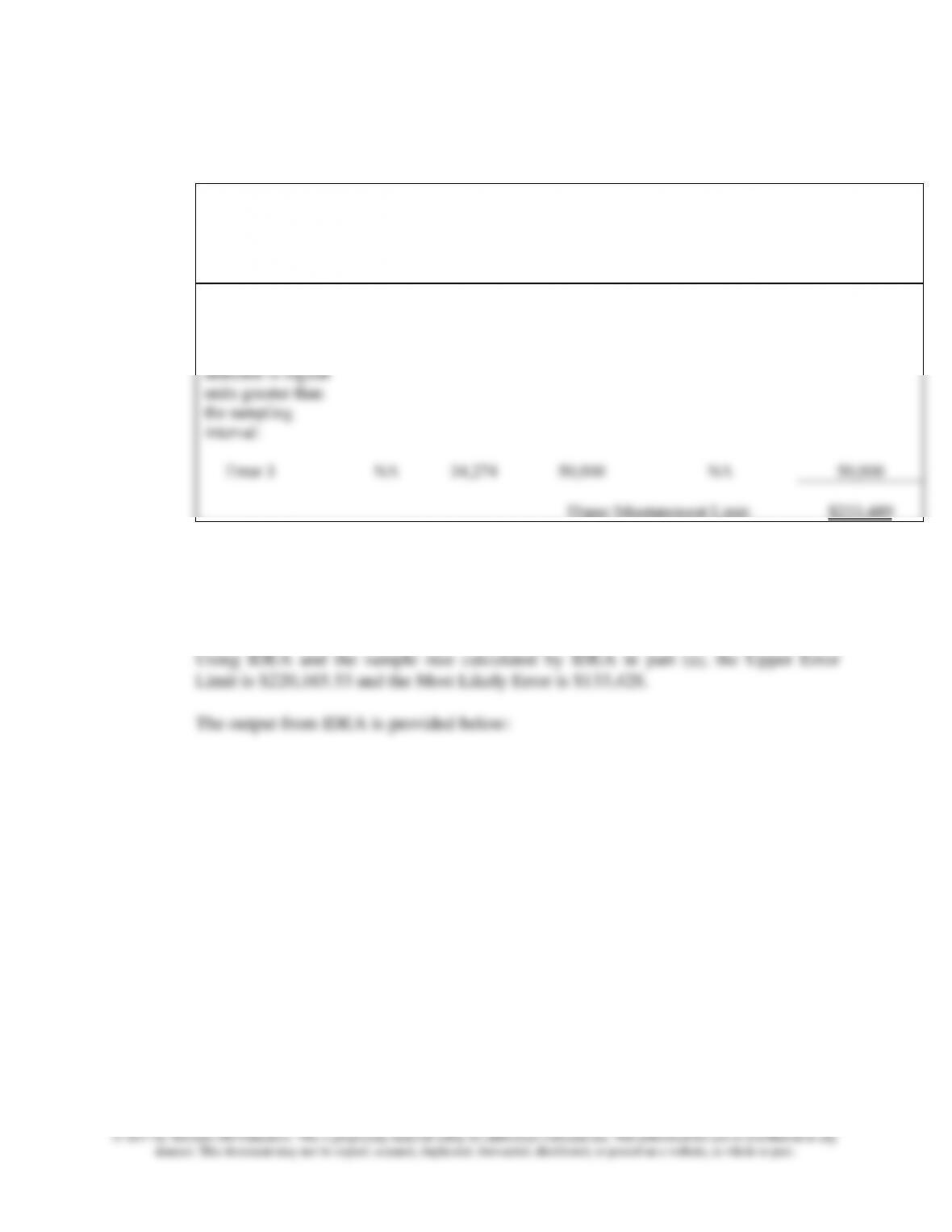
Since the UML ($233,489) is more than the TM ($212,500), Zhu cannot accept the
inventory account as being fairly stated since there is more than a 5 percent risk that
the account contains a misstatement greater than $212,500.