Chapter 07 – Auditing Internal Control over Financial Reporting
7-10
NOTE: In answering Problems 7-35 and 7-36, you should refer to the Audit Policy of Willis &
Adams LLP on Evaluating Control Deficiencies. A copy of the policy can be downloaded from
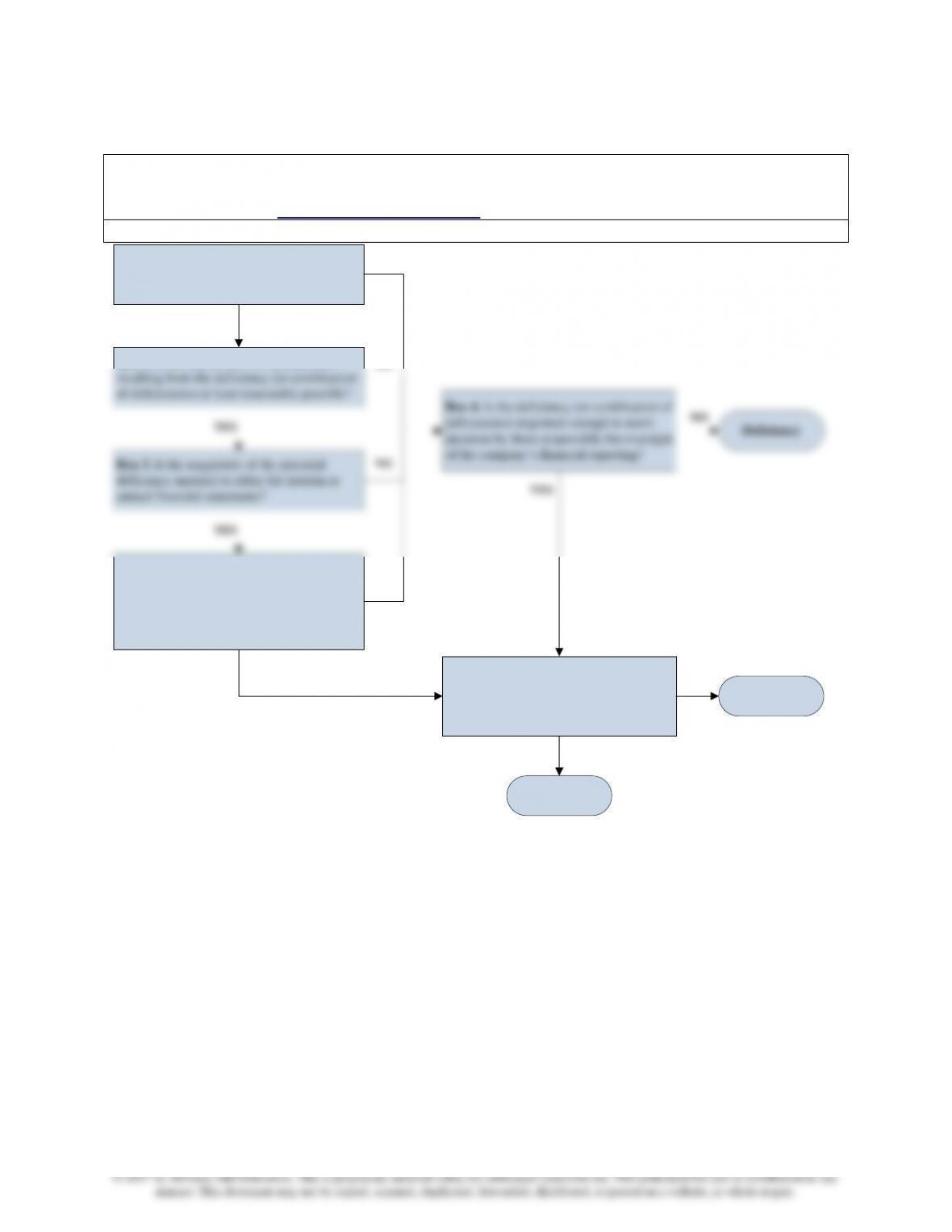
the firm’s web site at (www.mhhe.com/messier9e). The decision chart is included here.
Box 1. Does the deficiency relate directly to
the achievement of one or more financial
statement assertions?
Box 2. Is the likelihood of a misstatement
resulting from the deficiency (or combination
of deficiencies) at least reasonably possible?
YES
Box 3. Is the magnitude of the potential
deficiency material to either the interim or
annual financial statements?
Box 4. Is the deficiency (or combination of
deficiencies) important enough to merit
attention by those responsible for oversight
of the company’s financial reporting?
NO
NO
NO
Box 5. Do compensating controls exist and
operate effectively at a level of precision
sufficient to prevent or detect a misstatement
that could be material to interim or annual
financial statements?
YES
Deficiency
NO
Box 6. Would a well-informed, competent
and objective individual (i.e., prudent
official) conclude the deficiency is a
material weakness?
NO
YES
Significant
Deficiency
YES
YES
NO
YES
Chapter 07 – Auditing Internal Control over Financial Reporting
7-11
7-35
a. Based only on these facts, this deficiency represents a significant deficiency for the
following reasons: First, the deficiency satisfies Box 1 – it relates to a financial
statement assertion. Second, the controls do not effectively address the detection of
misstatements as evidenced by situations in which transactions that were not material
were improperly recorded. Therefore, there is a reasonable possibility that a
that there is a compensating detective controls that operates monthly and at the end of
each financial reporting period that should reduce the likelihood of a material misstatement
going undetected. However, the compensating detective controls are only designed to
detect material misstatements.
b. Based only on these facts, this deficiency represents a material weakness for the
following reasons: First, the deficiency satisfies Box 1 – it relates to a financial
statement assertion. Second, the controls do not effectively address the detection of
misstatements as evidenced by improper revenue recognition that has occurred.
Therefore, the likelihood of material misstatements occurring is probable. Thus, the
answer to Box 2 is “yes.” The answer to Box 3 is “yes” since the magnitude of a
Chapter 07 – Auditing Internal Control over Financial Reporting
7-12
c. Based on only these facts, this deficiency represents a material weakness for the
following reasons: First, the deficiency satisfies Box 1 – it relates to a financial
statement assertion. Second, the likelihood of material misstatement of the financial
statements resulting from this internal control deficiency is reasonably possible (even
assuming that the amounts were fully reserved for in the company’s allowance for
“yes”).
7-36
a. Based only on these facts, the combination of these significant deficiencies represents a
material weakness for the following reasons: First, the deficiency satisfies Box 1 – it
relates to a financial statement assertion. Second, the combination of these deficiencies
was evaluated as representing a reasonably possible likelihood that a misstatement
with the combined effect of the deficiencies described, results in a reasonably possible
likelihood that a material misstatement of the allowance for credit losses or interest income
could occur. Thus, Box 3 is answered “yes.” Fourth, there are no effective compensating
controls (Box 5 is answered “no”). Finally, it is likely that a prudent official would
conclude that these deficiencies represent a material weakness (answer to Box 6 is “yes”).
Chapter 07 – Auditing Internal Control over Financial Reporting
7-13
7-37 (Note that these cases were taken from disclosures made by companies subject to
SOX 404.)
a. Case 1 would be deemed a material weakness because the company did not have
proper controls over the accounting for and disclosure of derivatives that were
associated with warrants. The company’s management acknowledged that it did not
have the expertise within the company to properly evaluate the analysis of the
warrants under ASC 815. The inability to perform such analysis by entity personnel
c. Case 3 is a material weakness for a number of reasons. First, there was a
computational error in the update of the calculation of the allowance for loan losses.
Second, the monitoring controls for reviewing the calculation did not identify the
error in a timely manner. Finally, an error did occur and the allowance for loan losses
account for a bank would be highly material.
7-38
a. The auditor must determine whether the restatements are significant or material
deficiencies. If material, an adverse opinion will probably be issued, otherwise an
unqualified report may be given. If the misstatement resulted in a restatement of the
monitoring, an adverse opinion would most likely be considered appropriate.
e. The significance of financial fraud by the CFO is a material weakness and an adverse
opinion should be issued.
Chapter 07 – Auditing Internal Control over Financial Reporting
7-14
f. Depending on the amount of risk of material misstatement due to the ineffective
control environment, the auditor will issue an adverse opinion or an unqualified
7-39
a. The auditor would most likely issue an unqualified opinion on the effectiveness of
internal control. Significant deficiencies do not necessitate an adverse opinion. In this
case, the likelihood is extremely low that the deficiencies taken individually or
together will result in a material misstatement, meaning that there is no material
management an opportunity to remediate weaknesses and avoid an adverse opinion so
long as enough time is left for management to reassess and for the auditor to retest
controls and obtain sufficient competent evidence that controls were effective as of
the report date.
d. An adverse opinion with respect to effectiveness of ICFR. The presence of a material
weakness as of the report date necessitates an adverse opinion with respect to internal
control.
e. The auditor would most likely issue a disclaimer on the effectiveness of internal
control due to a scope limitation. The auditor’s inability to collect sufficient data to
assess the operating effectiveness of the control constitutes a scope limitation, and the
Chapter 07 – Auditing Internal Control over Financial Reporting
7-15
f. Adverse opinion on the effectiveness of internal control. Because the significant
deficiencies identified, taken together, produce a “moderately low” risk of material
7-40
a. As long as the auditor agrees with company’s assessment of controls, an unqualified
report can be issued. However, AS5 indicates that controls must operate for a
sufficient time period to accommodate management and auditor testing. This does not
appear to be possible in the scenario when the changes were made after
effectiveness of internal controls could be issued.
7-41 The audit report should include the proper title; introductory, scope, definition,
limitations, opinion, and explanatory paragraphs; and should describe the reason for the
7-42 The audit report should include the proper title; introductory, scope, definition,
limitations, and opinion paragraphs; and should describe the reason for the material
7-43 The auditors’ report contains the following deficiencies:
Introductory Paragraph
• This paragraph needs to state why the company’s internal control did not maintain
effective control by including a brief description of the material weakness.
• This paragraph should not indicate that it is the auditor’s responsibility to report on
Chapter 07 – Auditing Internal Control over Financial Reporting
7-16
Scope Paragraph
• The audit for public companies is conducted according to “the standards of the Public
Company Accounting Oversight Board” not according to “generally accepted
auditing standards.”
• The audit only provides reasonable assurance about whether effective internal control
Explanatory Paragraph
• Should be located before the opinion paragraph.
• Must contain the definition of a material weakness as stated in AS5.
• Must contain a description of the specific material misstatement identified at the
entity.
Opinion Paragraph
• “Maintained ineffective internal control” is not correct wording. The paragraph
should read, “did not maintain effective internal control...”The auditor is no longer
The dates of the auditor’s reports on financial statements and on ICFR should be the
same. The opinion paragraph uses February 15, 2013 as the date of the financial
statement opinion.
7-44 a. 2
7-17
7-45 The substantive auditing procedures Brown may consider performing include the
following:
Using the perpetual inventory file:
• Recalculate the beginning and ending balances (prices x quantities), foot, and print out
a report to be used to reconcile the totals with the general ledger (or agree beginning
balance with the prior year’s working papers).
• Calculate the quantity balances as of the physical inventory date for comparison to the
physical inventory file. (Alternatively, update the physical inventory file for purchases
2013.)
• Recalculate the ending inventory (or selected items) by taking the beginning balances
plus purchases, less sales (quantities and/or amounts), and print out the differences.
• Recalculate the cost of sales for selected items sold during the year.
Using the physical inventory and test count files:
• Account for all inventory tag numbers used and print out a report of missing or
duplicate numbers for follow-up.
• Search for tag numbers noted during the physical inventory observation as being
voided or not used.
Chapter 07 – Auditing Internal Control over Financial Reporting
7-18
• Calculate the quantities and dollar amounts of the book-to-physical adjustments for
each item and the total adjustment. Print out a report to reconcile the total adjustment
INTERNET ASSIGNMENTS
7-46 The opinion paragraph of the audit report will indicate whether the report is for both audits.
Note that even separate reports on each of the audits (of financial statements and controls)
will refer to the conclusion reached on the other audit. In a combined report, the
7-47 The opinion paragraph of an integrated audit will indicate the auditor’s opinion with
respect to the effectiveness of internal control. The explanatory paragraph will offer the