Chapter 05 – Evidence and Documentation
5-1
CHAPTER 5
EVIDENCE AND DOCUMENTATION
Answers to Review Questions
5-1 Auditors typically divide the financial statements into components or segments in order
to make the audit more manageable. A component can be a financial statement account or
a business (transaction cycle) process. This approach allows the auditor to gather
initiated by the entity until its final recording in the financial statement accounts.
5-2 The financial statements contain management’s assertions about the various financial
statement components. The auditor tests management’s assertions by conducting audit
5-3
Assertions about classes of transactions and events for the period under audit:
Assertion
Definition
Occurrence
Transactions and events that have been recorded have
occurred and pertain to the entity (sometime referred to as
validity).
Completeness
All transactions and events that should have been recorded
have been recorded.
Authorization
All transactions and events have been properly authorized.
Accuracy
Amounts and other data relating to recorded transactions and
events have been recorded appropriately.
Cutoff
Transactions and events have been recorded in the correct
accounting period.
Classification
Transactions and events have been recorded in the proper
accounts.
5-2
5-4
Assertions about account balances at the period end:
Assertion
Definition
Existence
Assets, liabilities, and equity interests exist.
Rights and
Obligations
The entity holds or controls the rights to assets, and liabilities
are the obligations of the entity.
Completeness
All assets, liabilities, and equity interests that should have
been recorded have been recorded.
Valuation and
Allocation
Assets, liabilities, and equity interests are included in the
financial statements at appropriate amounts and any resulting
valuation or allocation adjustments are recorded
appropriately.
5-5 Audit evidence is the information used by the auditor in arriving at the conclusions on
which the audit opinion is based, and includes the information contained in the
accounting records underlying the financial statements and other information. Accounting
records include the records of initial entries and supporting records, such as checks and
records of electronic fund transfers; invoices; journal entries, and other adjustments to the
financial statements that are not reflected in formal journal entries; and records such as
the auditor to reach conclusions through valid reasoning.
5-6 Audit evidence is usually persuasive rather than convincing for two reasons. First, since
an audit must be completed in a reasonable amount of time and at a reasonable cost, the
auditor examines only a sample of the transactions that compose the class of transactions
Chapter 05 – Evidence and Documentation
5-3
5-7 The types of audit procedures and their definitions are: (1) Inspection of records or
documents consists of examining internal and external records or documents that are in
paper form, electronic form, or other media. (2) Inspection of tangible assets consists of
physical examination of tangible assets. (3) Observation consists of watching a process
or procedure being performed by others. (4) Inquiry consists of seeking information of
of financial information through analysis of plausible relationships among both financial
and nonfinancial data. (9) Scanning is the review of accounting data to identify
significant or unusual items.
5-8 Vouching refers to first selecting an item for testing from the accounting journals or
ledgers and then examining the underlying source document. Thus, the direction of
testing is from the journals or ledgers back to the source documents. Vouching provides
are recorded (completeness) in the accounting records.
5-9 Corroborating evidence is obtained for inquiry and for observation because these audit
procedures typically are not from independent sources and therefore are not considered to
5-10 Inspection of tangible assets, reperformance, and recalculation are generally considered
of high reliability because the auditor has direct knowledge about them. Inspection of
records and documents, confirmation, analytical procedures, and scanning are generally
considered to be of medium reliability. The reliability of inspection of records and
documents depends primarily on whether a document is internal or external. Scanning
Chapter 05 – Evidence and Documentation
5-4
It should be understood, however, that levels of reliability for the types of evidence
should be considered as general guidelines. The reliability of the types of evidence may
vary considerably across entities, and it is subject to a number of exceptions.
5-11 The “audit testing hierarchy” starts with tests of controls and substantive analytical
procedures because those tests are generally both more effective and more efficient than
5-12 Some of the buckets are larger than others because certain assertions will be more
important or present bigger risks for some accounts than for others. For instance,
existence (or validity) is typically more important for accounts receivable than it is for
5-13 It is important that the audit documentation or working papers be organized or indexed in
such a way that members of the audit team or firm can find relevant audit evidence.
When the auditor performs audit work on one working paper and supporting information
5-14 The quality of an expectation is referred to as the precision of the expectation. Precision
is a measure of the potential effectiveness of an analytical procedure; it represents the
degree of reliance that can be placed on the procedure. Precision is a measure of how
closely the expectation approximates the unknown “correct” amount. The degree of
Chapter 05 – Evidence and Documentation
5-5
The second step in the substantive analytical procedures decision process is to define or
calculate a tolerable difference. Since the expectation developed by the auditor will rarely
be identical to the client’s recorded amount, the auditor must decide the amount of
5-15 Explanations for significant differences observed for substantive analytical procedures
must be followed up and resolved through quantification, corroboration, and evaluation.
Quantification: Quantification involves determining whether the explanation or error
can explain the observed difference. This may require the recalculation of the expectation
after considering the additional information. For example, a client may offer the
explanation that the inventory account increased by a certain percentage as compared to
the prior year due to a 12 percent increase in raw materials prices. The auditor should
compute the effects of the raw materials price increase and determine the extent to which
procedures to conclude whether the desired level of assurance has been achieved. If the
auditor obtains evidence that a misstatement exists and can be sufficiently quantified, the
auditor makes note of his or her proposed adjustment to the client’s financial statements.
5-16 There are four categories of financial ratios discussed in the text: short-term liquidity
ratios, activity ratios, profitability ratios, and coverage ratios. Short-term liquidity ratios
are indicators of the entity’s ability to meet its current obligations when they become due.
Chapter 05 – Evidence and Documentation
5-6
Answers to Multiple-Choice Questions
5-17
b
5-24
b
5-18
c
5-25
c
5-19
b
5-26
d
5-20
b
5-27
a
5-21
a
5-28
c
5-22
b
5-29
c
5-23
b
Solutions to Problems
5-30 a. 4
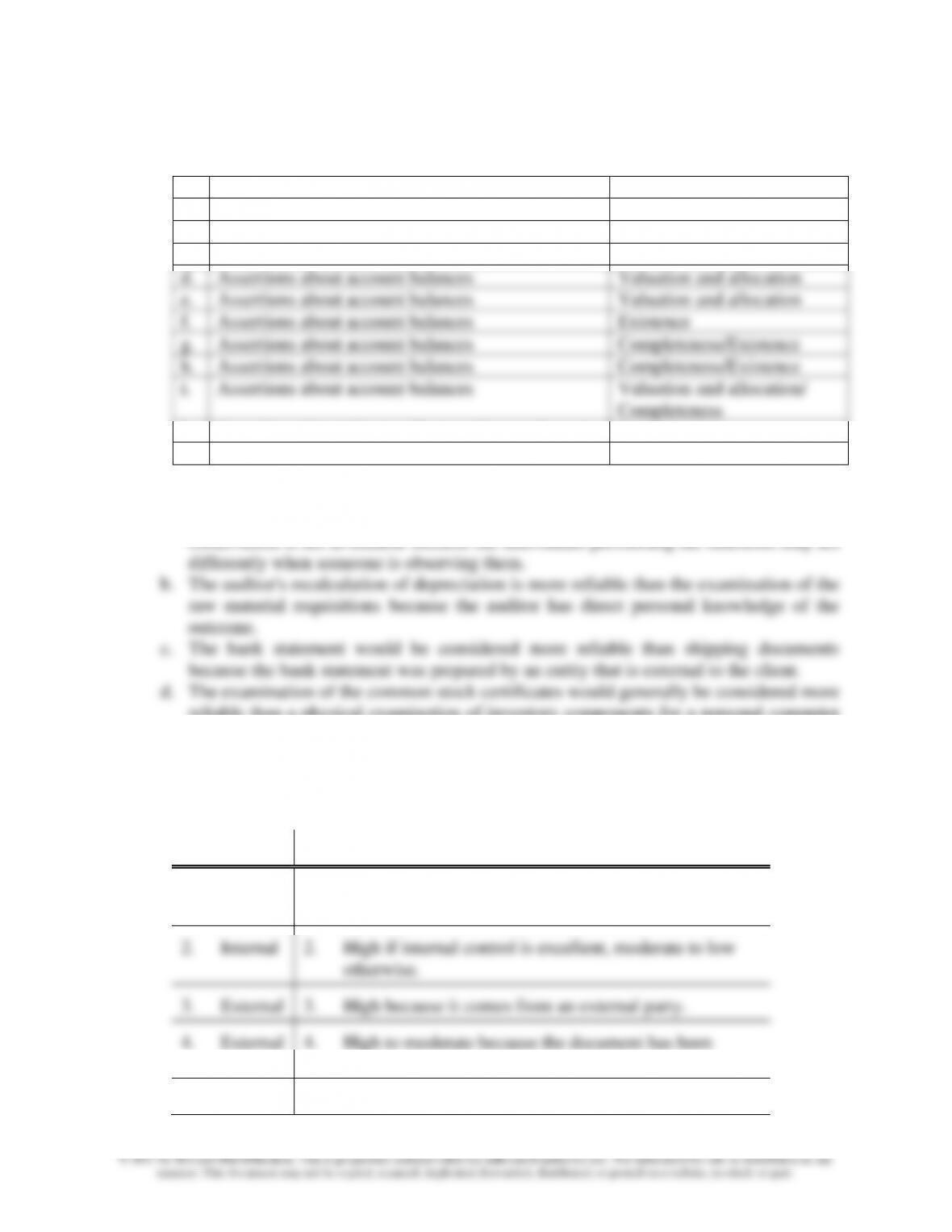
5-31
a.
Fictitious revenue.
Revenue recorded, goods not shipped, or services not performed.
b.
Goods shipped or services performed, revenue not recorded.
c.
Goods shipped or services performed for a customer who is a bad credit risk.
Shipments made or services performed at unauthorized prices or on
unauthorized terms.
d.
Revenue transaction recorded at an incorrect dollar amount.
Revenue transactions not posted correctly to the sales journal or customers’
accounts in accounts receivable subsidiary ledger.
Amounts from sales journal not posted correctly to general ledger.
e.
Revenue transactions recorded in the wrong period.
f.
Revenue transaction not properly classified as revenue (i.e. improperly recorded
as other income or as an offset to expenses).
5-32
a.
5
g.
3
b.
1
h.
7
c.
1/7
i.
5
d.
4
j.
1/7
e.
8
k.
9
f.
2
Chapter 05 – Evidence and Documentation
5-7
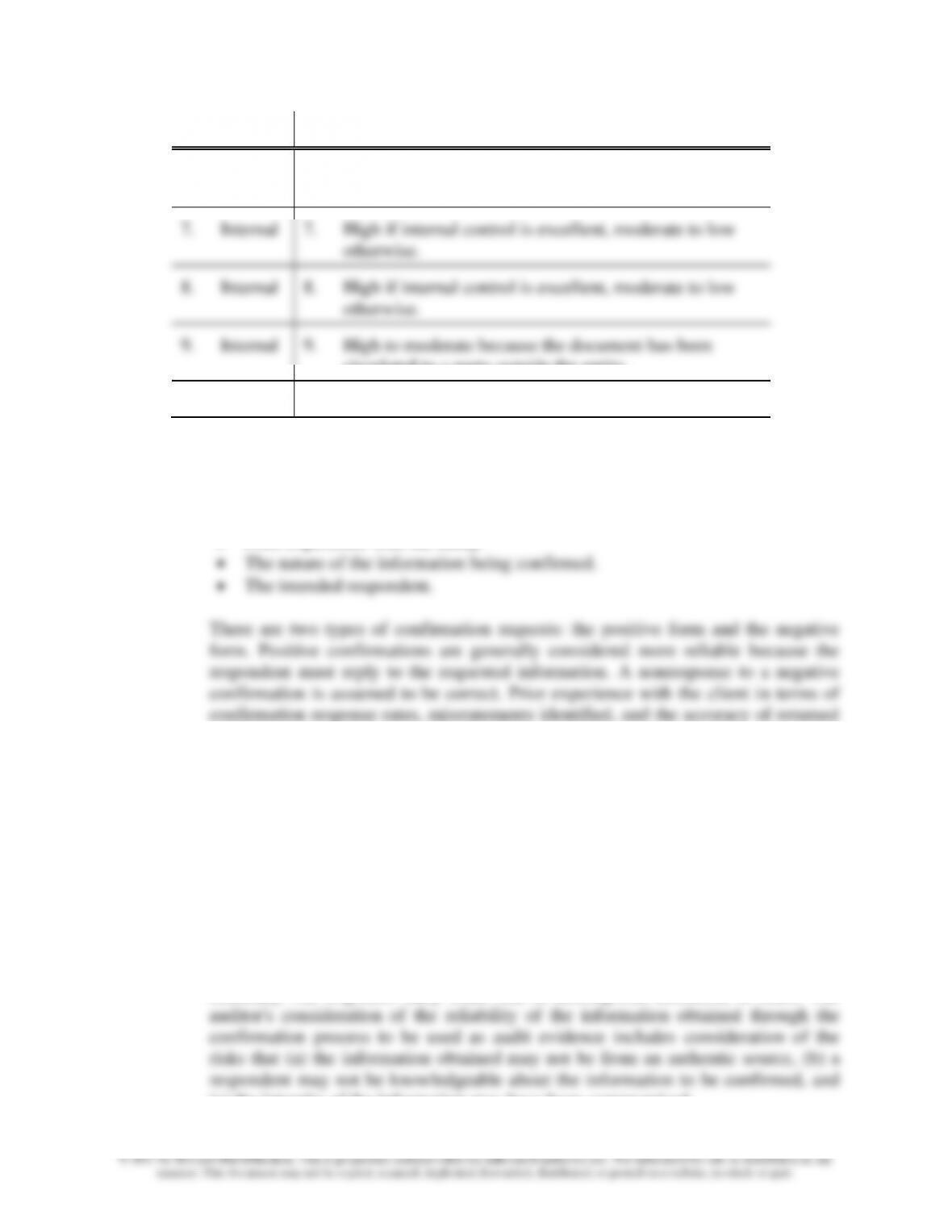
5-33
Category of Assertion
Assertion
a.
Assertions about account balances
Existence
b.
Assertions about classes of transactions and events
Cutoff
c.
Assertions about account balances
Completeness
d.
Assertions about account balances
Valuation and allocation
e.
Assertions about account balances
Valuation and allocation
f.
Assertions about account balances
Existence
g.
Assertions about account balances
Completeness/Existence
h.
Assertions about account balances
Completeness/Existence
i.
Assertions about account balances
Valuation and allocation/
Completeness
j.
Assertions about classes of transactions and events
Accuracy
k.
Assertions about account balances
Valuation and allocation
5-34 a. The bank confirmation would be considered more reliable than the observation of
segregation of duties because an independent external party provided the information.
Observation is not as reliable because the individuals performing the functions may act
reliable than a physical examination of inventory components for a personal computer
because the stock certificates are prepared by an entity external to the client.
Additionally, the auditor may not be able to easily determine the quality or value of
the computer components.
5-35
a. Type
b. Reliability
1. Internal
1. High if internal control is excellent, moderate to low
otherwise.
2. Internal
2. High if internal control is excellent, moderate to low
otherwise.
3. External
3. High because it comes from an external party.
4. External
4. High to moderate because the document has been
circulated to a party outside the entity.
5. External
5. High because it comes from an external party.
Chapter 05 – Evidence and Documentation
5-8
a. Type
b. Reliability
6. Internal
6. High if internal control is excellent, moderate to low
otherwise.
7. Internal
7. High if internal control is excellent, moderate to low
otherwise.
8. Internal
8. High if internal control is excellent, moderate to low
otherwise.
9. Internal
9. High to moderate because the document has been
circulated to a party outside the entity.
10. External
10. High because it comes from an external party.
5-36 a. The reliability of evidence obtained through confirmations is directly affected by
factors such as:
• The form of the confirmation.
• Prior experience with the entity.
confirmations should be considered when assessing the reliability of confirmations.
If response rates were low in prior audits, the auditor might consider obtaining
evidence using alternative procedures. The nature and availability of the
information being confirmed may directly affect the competence of the evidence
obtained. The intended respondent to confirmations may vary from individuals with
little accounting knowledge to highly qualified accounting personnel in large
corporations. The auditor should consider the respondent’s competence, knowledge,
ability, and objectivity when assessing the reliability of confirmation requests.
b. This is a difficult question, but one that is worth discussing with the students, at
least preliminarily. AU 500 indicates that even when audit evidence is obtained
from sources external to the entity, circumstances may exist that affect its
reliability. All responses carry some risk of interception, alteration, or fraud. The
(c) the integrity of the information may have been compromised.
Chapter 05 – Evidence and Documentation
5-9
One of the most important steps is to ensure that the confirmation process is
adequately controlled. The auditor is required by AU 500 to determine whether to
modify or add procedures to resolve doubts over the reliability of information to be
used as audit evidence. The auditor may choose to verify the source and contents of
a response to a confirmation request by contacting the confirming party.
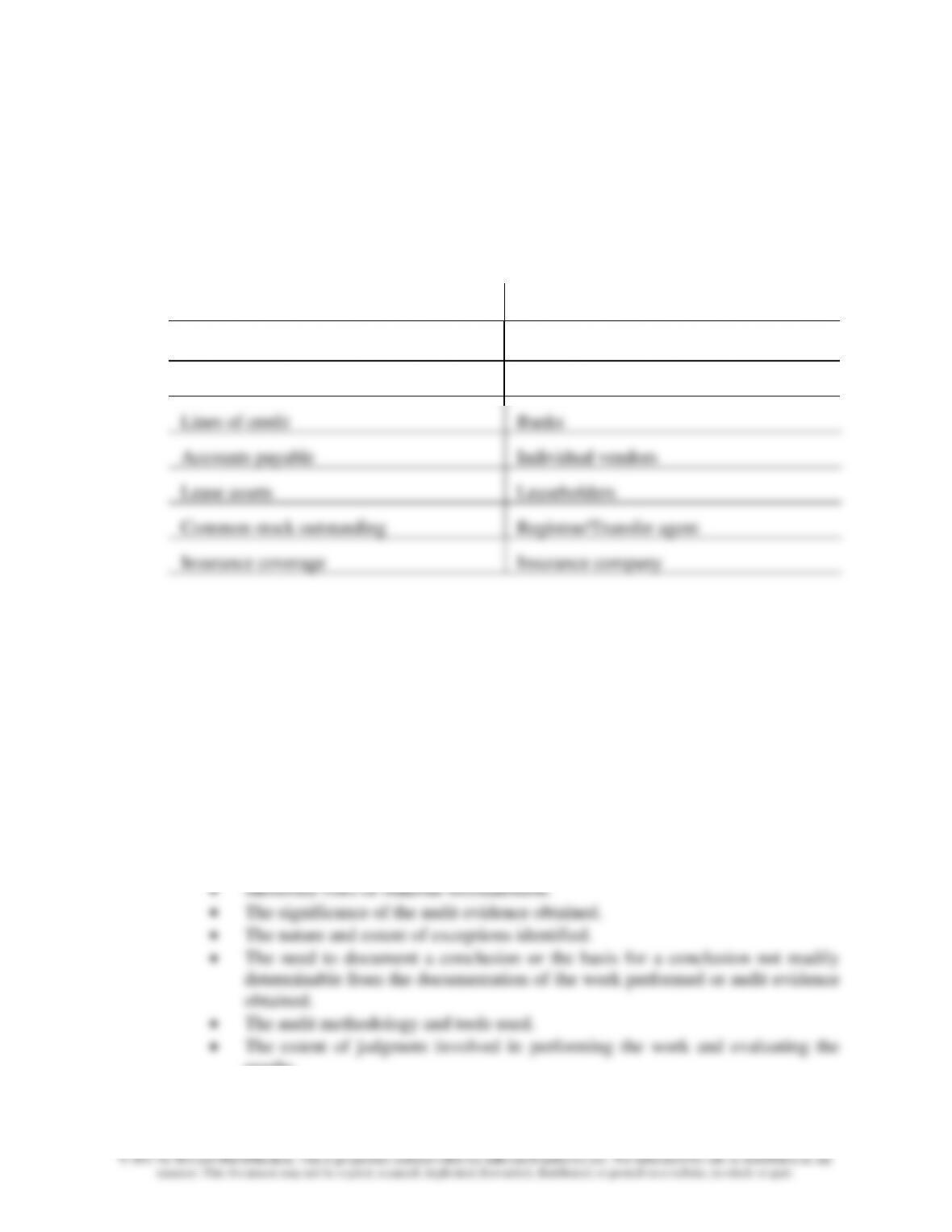
c. The following amounts or information included in EarthWear’s financial statements
could be confirmed. The source of the confirmation is also included.
Amounts or Information Confirmed
Source of Confirmation
Cash balances
Banks
Accounts receivable
Individual customers
Lines of credit
Banks
Accounts payable
Individual vendors
Lease assets
Leaseholders
Common stock outstanding
Registrar/Transfer agent
Insurance coverage
Insurance company
5-37 a. Auditing standards stipulate that working papers have two functions: (1) to provide
principal support for the representation in the auditor’s report that the audit was
conducted in accordance with GAAS and (2) to aid in the planning, performance,
and supervision of the audit.
b. The more common types of working papers include the audit plan and programs,
working trial balance, adjusting and reclassification entries, account analysis and
listings, and audit memoranda.
c. The auditor should consider the following factors when determining the form and
extent of the documentation for a particular audit area or auditing procedure:
• The size and complexity of the entity.
• The nature of the audit procedures to be performed.
results.