Chapter 04 – Risk Assessment
4-1
CHAPTER 4
RISK ASSESSMENT
Answers to Review Questions
4-1 Audit risk is the risk that the auditor expresses an inappropriate audit opinion when the
financial statements are materially misstated. Engagement risk is the risk that the auditor
is exposed to financial loss or damage to his or her professional reputation from
litigation, adverse publicity, or other events arising in connection with financial
4-2 Inherent risk and control risk differ from detection risk in that inherent risk and control
risk exist independent of the audit; that is, the levels of inherent risk and control risk are
functions of the client and its environment. The auditor has little control over these risks.
4-3 Sampling risk refers to the fact that, in many instances, the auditor does not examine 100
percent of the class of transactions or account balance. Since only a subset of the
population is examined, it is possible that the sample drawn is not representative of the
4-4 Standard setters developed the audit risk model as a planning and evaluation tool.
Therefore, the model is only as good as the judgments and assessments used as inputs.
Following are some limitations. First, since the auditor assesses inherent risk and control
4-5 In understanding the entity and its environment, the auditor gathers knowledge about: (1)
Chapter 04 – Risk Assessment
4-2
4-6 Some examples of conditions and events that may indicate the existence of business risks
are:
• Significant changes in the entity such as large acquisitions, reorganizations, or other
• High degree of complex regulation.
4-7 A company that operates in the coal mining industry faces numerous business risks. The
following are selected business risks disclosed by Arch Coal, Inc. – the second largest
coal producer in the United States.
General Risks:
• Coal prices are subject to change and a substantial or extended decline in prices could
materially and adversely affect our profitability and the value of our coal reserves.
• Disruptions in the quantities of coal produced by our contract mine operators or
purchased from other third parties could temporarily impair our ability to fill
customer orders or increase our operating costs.
• Our profitability depends upon the long-term coal supply agreements we have with
our customers. Changes in purchasing patterns in the coal industry could make it
difficult for us to extend our existing long-term coal supply agreements or to enter
into new agreements in the future.
Chapter 04 – Risk Assessment
4-3
Risks Related to Environmental, Other Regulations and Legislation:
• Extensive environmental regulations, including existing and potential future
regulatory requirements relating to air emissions, affect our customers and could
reduce the demand for coal as a fuel source and cause coal prices and sales of our
• Extensive environmental regulations impose significant costs on our mining
operations, and future regulations could materially increase those costs or limit our
ability to produce and sell coal.
4-8 There are three types of misstatements:
• Factual Misstatements. These are misstatements about which there is no doubt. For
example, an auditor may test a sales invoice and determine that the prices applied to
populations, involving the projection of misstatements identified in an audit sample to
the entire population from which the sample was drawn.
4-9 Misstatements can result from errors or fraud. The term errors refers to unintentional
misstatements of amounts or disclosures in financial statements. The term fraud refers to
an intentional act by one or more among management, those charged with governance,
employees, or third parties, involving the use of deception to obtain an unjust or illegal
advantage. Thus, the primary distinction between errors and fraud is whether the
Examples of misstatements due to errors or fraud include:
• An inaccuracy in gathering or processing data from which financial statements are
prepared.
Chapter 04 – Risk Assessment
4-4
• An incorrect accounting estimate arising from overlooking or clear misinterpretation
4-10 The auditor performs the following steps to identify the risks of material misstatement
due to fraud:
• Discussion among the audit team members regarding the risks of material
end adjustments.
• Identification and assessment of fraud risk factors.
4-11 There are numerous risk factors that can cause an individual to misappropriate assets,
such as cash (see Table 4-5). By requiring that an individual take a vacation, another
individual will perform that person’s duties. If some type of misappropriation is taking
responsible for the asset.
4-12 If Jackal determines that a number of the risks of material misstatements are pervasive to
the overall financial statement, he should reconsider the overall audit approach and
respond to such pervasive risks by:
• Assign more experienced personnel or those with specialized knowledge to assess the
• Incorporate an element of unpredictability in the selection of the nature, timing, and
extent of audit procedures.
Answers to Multiple-Choice Questions
4-13
d
4-18
c
4-14
a
4-19
b
4-15
c
4-20
a
4-16
a
4-21
c
4-17
c
4-22
a
Chapter 04 – Risk Assessment
4-5
Solutions to Problems
4-23
a. Audit risk is the risk that the auditor expresses an inappropriate audit opinion when
the financial statements are materially misstated.
b. Inherent risk is the susceptibility of an assertion in an account or disclosure to a
misstatement due to error or fraud that could be material, either individually or when
aggregated with other misstatements, before consideration of any related controls.
Control risk is the risk that a misstatement that could occur in an assertion about an
has an inverse relationship to inherent and control risk.
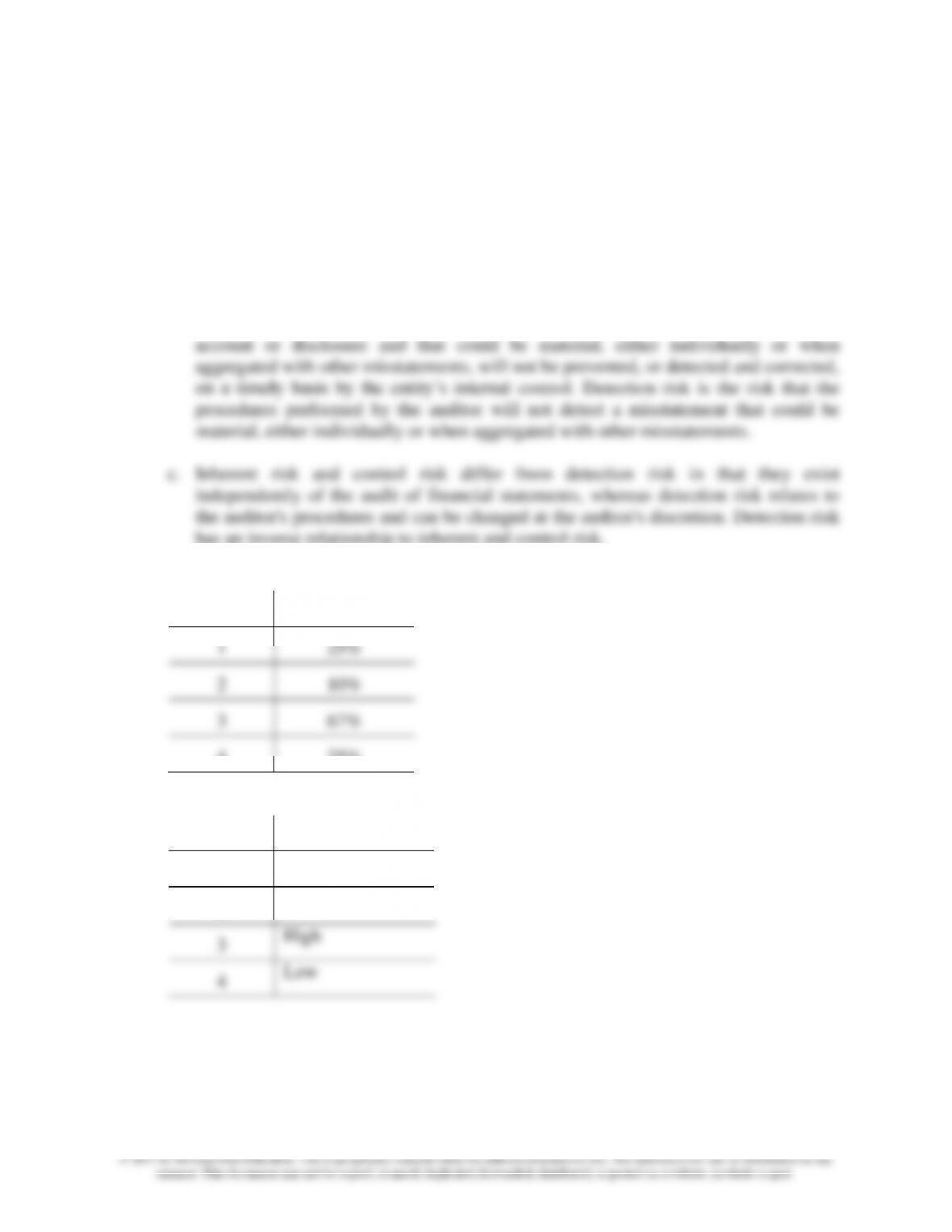
4-24
Client No.
Detection Risk
1
25%
2
10%
3
67%
4
25%
4-25
Client No.
Detection Risk
1
Moderate
2
Low
3
High
4
Low
4-26 a. A public offering would increase the auditor’s exposure to third party litigation and
would, therefore, reduce acceptable audit risk relative to a private company audit.
Chapter 04 – Risk Assessment
4-7
4-29 In developing an understanding of the entity and its environment, the auditor obtains
information from numerous sources (internal or external) of information about the entity
and its environment, including the following:
• Cumulative knowledge and experience obtained from prior audits.
• Procedures performed in client acceptance and continuance process.
• Knowledge obtained from performing interim procedures.
• Industry or trade journals.
• Client press releases, publications, and brochures.
• Internal audit reports.
4-30 a. The entity’s market conditions and competition can be significant sources of
business risks. For example, decreasing demand for the entity’s products can affect
revenues and the value of inventory. Competition in an industry has a similar affect
on prices, and therefore revenues.
b. An industry that is cyclical or seasonal can affect the demand for the entity’s product
and the size of its workforce. It can also cause problems with purchasing raw
materials or product components. For example, EarthWear’s sales are much higher
d. The availability of raw materials or product components and their price can
significantly affect an entity. If an entity is unable to obtain raw materials or their
Chapter 04 – Risk Assessment
4-8
these effects in entities that buy and sell commodities (e.g., oil, precious metals,
agricultural products).
4-31 a. An auditor is responsible for obtaining reasonable assurance that the financial
statements as a whole are free from material misstatements, whether caused by error
or fraud.
b. Three conditions are generally present when material misstatements due to fraud
occur:
1. Management or other employees have an incentive or are under pressure that
to knowingly and intentionally commit a dishonest act.
c. The objectives of the brainstorming meeting are to:
• Share insights about the entity and its environment and the entity’s business risks.
• Provide an opportunity for the team members to discuss how and where the entity
d. The documentation should include:
• The risks identified, an evaluation of management’s response to such risks, and
the auditor’s assessment of the risk of error or fraud after considering the entity’s
response.
• The nature, timing, and extent of the procedures performed in response to the
Chapter 04 – Risk Assessment
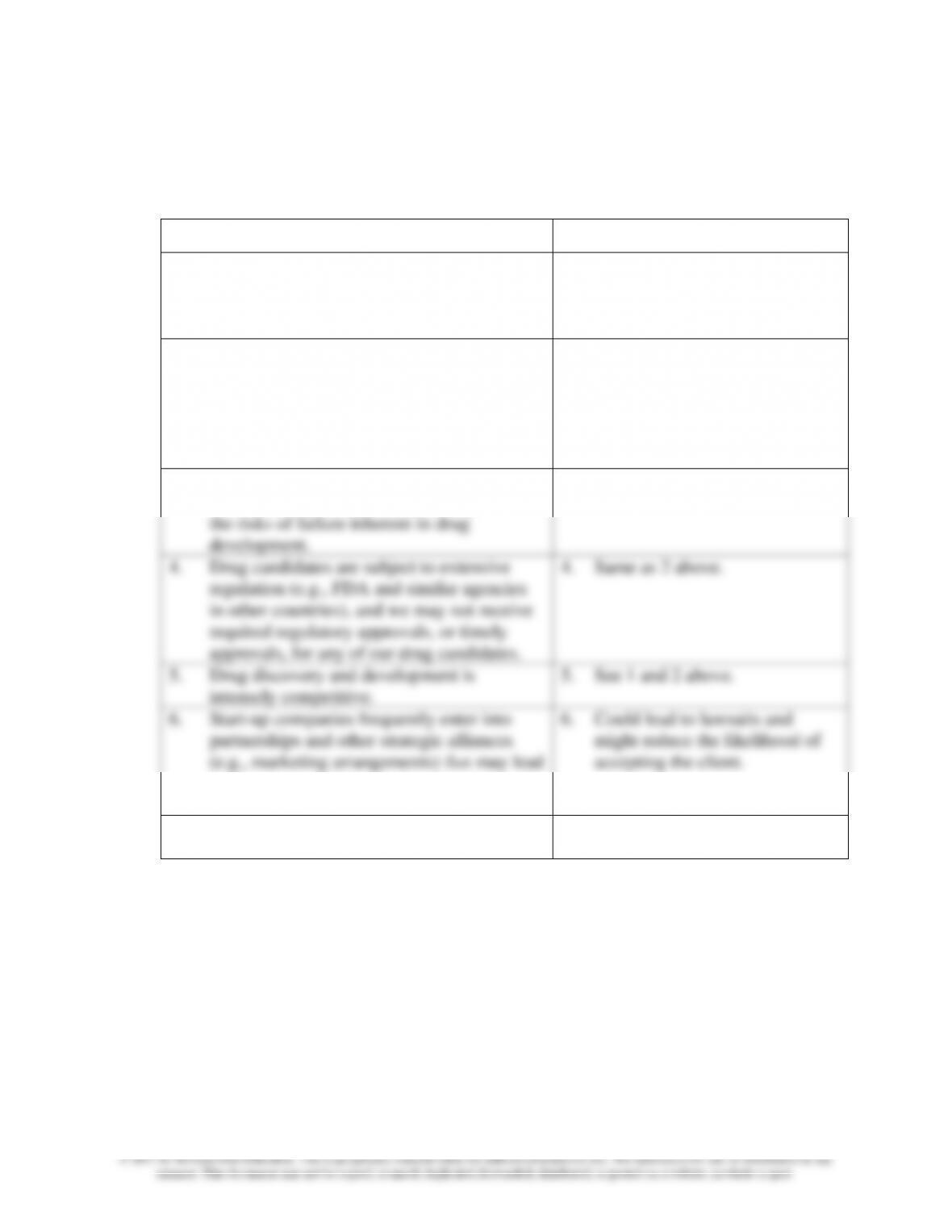
4-32 The following are a sample of the possible business risks that a publicly traded, start-up
biotech might have. You might consider having the class examine Item 1A – Risk Factors
in a company’s 10–K.
a. Business Risks
b. Effect on Acceptance Decision
1. Start-up companies usually have large,
accumulated deficits and they usually
require large capital infusions until they
have a viable product.
1. Presents a potential going
concern problem and might
reduce the likelihood of
accepting the client.
2. Drug development programs are very
expensive, time consuming, and difficult to
design and implement.
2. Potentially affects the long-term
(and ultimate) success of the
company. The probability of
success of the drug(s) would
likely affect the auditor’s
decision to accept the client.
3. Drug candidates are in various stages of
research and development and are prone to
the risks of failure inherent in drug
development.
3. Same as 2 above.
4. Drug candidates are subject to extensive
regulation (e.g., FDA and similar agencies
in other countries), and we may not receive
required regulatory approvals, or timely
approvals, for any of our drug candidates.
4. Same as 2 above.
5. Drug discovery and development is
intensely competitive.
5. See 1 and 2 above.
6. Start-up companies frequently enter into
partnerships and other strategic alliances
(e.g., marketing arrangements) that may lead
to disputes and delays in drug development
and commercialization.
6. Could lead to lawsuits and
might reduce the likelihood of
accepting the client.
7. May incur substantial liabilities from any
product liability claims.
7. Same as 1 above.
Chapter 04 – Risk Assessment
4-10
Solution to Discussion Case
4-33 Koss Case.
1. This question can be can answered by looking at the tables (Tables 4-5) that contain
the fraud risk factors the incentives/pressures, opportunity, and
attitudes/rationalizations to misappropriate assets.
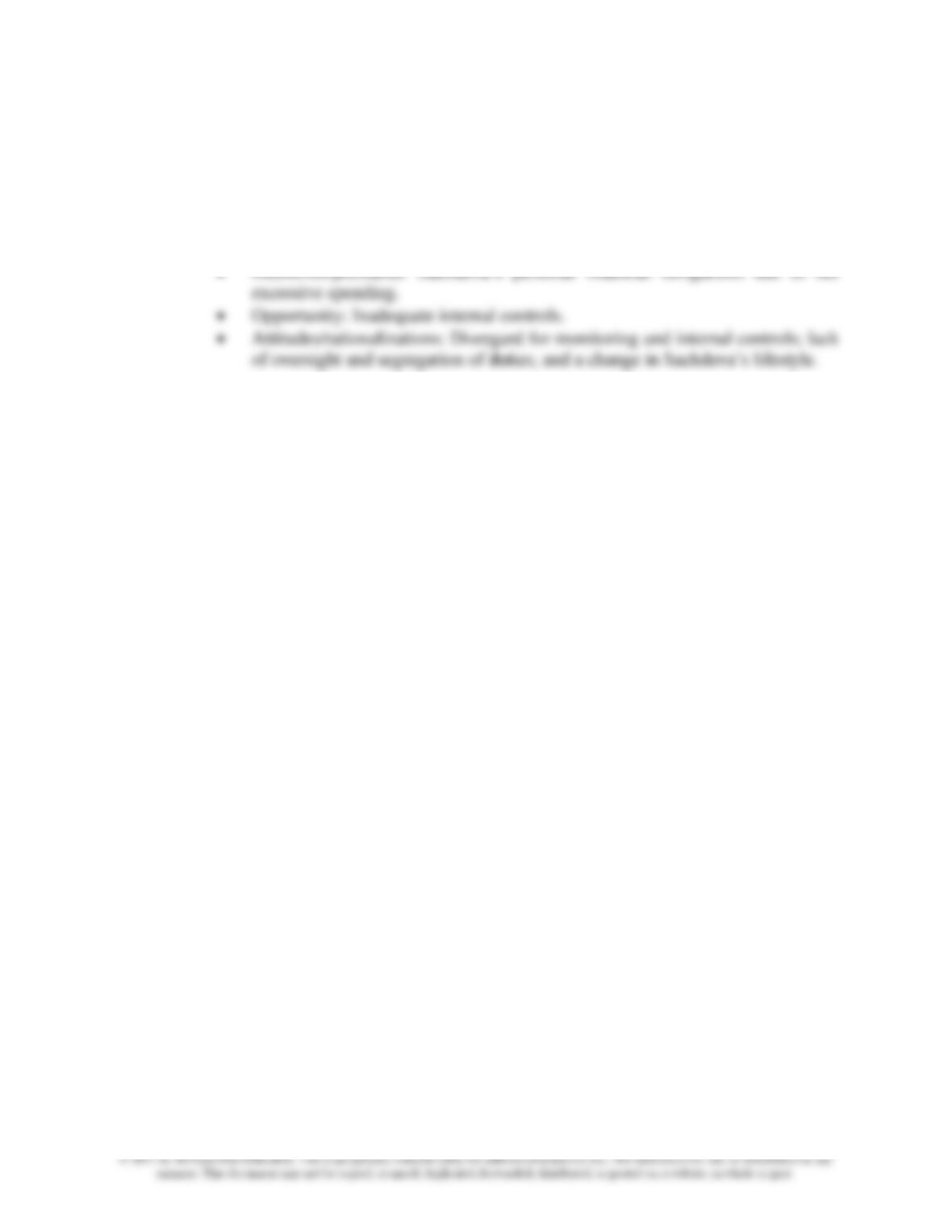
• Incentives/pressures: Sachdeva’s personal financial obligations due to her
2. It is not appropriate for one individual, in this case, Michael Koss to hold 5 C-Level
positions. Even in a smaller public company like Koss Corporation, the demands
for each job would be such that none of them would be performed adequately.
Solutions to Internet Assignments
4-34 The answers to this Internet assignment will be a function of the company assigned by
the instructor. However, the responses to the questions will be found in the sources cited
in the problem and will be similar to those in the questionnaire provided by your
instructor or downloaded from the book’s website.
See (Messier, W. F., Jr. 2014. An approach to learning risk-based auditing. Journal of
Accounting Education 32: 276-287) for a discussion of the use of this case. If you would
like more information about the use of this questionnaire, please contact Professor
Messier (bill.messier@unlv.edu).