Chapter 03 – Audit Planning, Types of Audit Tests, and Materiality
3-1
CHAPTER 3
AUDIT PLANNING, TYPES OF AUDIT TESTS,
AND MATERIALITY
Answers to Review Questions
3-1 The auditor should inquire of the prospective client’s bankers and attorneys, credit
3-2 The successor auditor is responsible for initiating the communication with the
predecessor auditor. However, the successor auditor should request permission of the
prospective client before contacting the predecessor auditor. The successor auditor’s
communication with the predecessor auditor should include questions related to the
3-3 An engagement letter is used to formalize the arrangement reached between the auditor
and client. It serves as a contract that outlines the responsibilities of both parties and is
intended to prevent misunderstandings between the two parties. The letter states the
responsibilities of the auditor and management, that the audit will be conducted in
accordance with auditing standards, that certain types of audit procedures will be
• Arrangements regarding other services (e.g., assurance, tax, or consulting services).
3-4 The following factors can be used to judge the objectivity of the internal audit function:
• Whether the organizational status of the IAF, including the function’s authority and
accountability, supports the ability of the function to be free from bias, conflict of
Chapter 03 – Audit Planning, Types of Audit Tests, and Materiality
3-2
operational duties or responsibilities that are outside of the IAF).
• Whether audit committee oversees employment decisions related to the IAF.
The competence of internal audit function can be determined by assessing the following
factors:
• Whether the IAF is adequately and appropriately resourced relative to the size of the
entity and the nature of its operations.
statements.
• Whether the internal auditors are members of relevant professional bodies that oblige
them to comply with the relevant professional standards, including continuing
professional development requirements.
3-5 An audit committee is a subcommittee of the board of directors composed of independent
members. The audit committee is responsible for the financial reporting and disclosure
process. The committee should encourage fair reporting from the perspective of the
3-6 The auditor should be guided by the results of the client acceptance/continuance process,
procedures performed to gain the understanding of the entity, and preliminary engagement
activities. Additional steps that should be performed include the following:
• Assess business risks.
• Establish materiality.
• Document the overall audit strategy, audit plan, and prepare audit programs.
3-3
3-7 The first type of illegal acts includes violations of laws and regulations, such as tax laws,
that are generally recognized as having a direct and material effect on the determination of
financial statement amounts. Other illegal acts are violations of laws or regulations such as
the Securities Acts, the Occupational Safety and Health Act, Food and Drug
Administration regulations, environmental protection laws, equal employment statutes,
and price fixing or other antitrust violations that may have a material but indirect effect on
the financial statements.
Circumstances that may indicate a possible illegal act include the following:
• Unauthorized transactions, improperly recorded transactions, or transactions not
recorded in a complete or timely manner.
• Failure to file tax returns or pay government duties.
3-8 Sources of information that may be used to identify related parties include (see AS18,
Appendix A):
• Inquires of management.
• Contracts and other agreements representing significant unusual transactions.
3-9 The engagement partner has the overall responsibility for the engagement and its
performance and should supervise the audit engagement team so that the work is
performed as directed and supports the conclusions reached. The engagement partner and
other engagement team members performing supervisory activities should
• Inform engagement team members of their responsibilities, including:
o the objectives of the procedures that they are to perform;
determine appropriate actions.
• Review the work of engagement team members to evaluate whether:
o the work was performed and documented;
Chapter 03 – Audit Planning, Types of Audit Tests, and Materiality
3-4
3-10 The three general types of audit tests are risk assessment procedures, tests of controls, and
substantive tests.
Risk assessment procedures are used to obtain an understanding of the entity and its
environment, including internal control. Examples include inquiries of management and
others, analytical procedures, and observation and inspection.
financial statements. Examples of substantive procedures are (1) tests of details (i.e.,
substantive tests of transactions and test of details of account balances) and (2)
substantive analytical procedures.
3-11 Professional standards provide very little specific guidance on how to assess what is
material to a reasonable user. As a result, auditing firms should develop policies and
procedures to assist their auditors in establishing materiality judgments for clients in
3-12 The three major steps in applying materiality are:
Step 1: Determine overall materiality (planning materiality). The auditor should
establish a materiality level for the financial statements taken as a whole. This will be
referred to as overall materiality. Overall materiality is the maximum amount by which
Step 3: Evaluate audit findings. Based on the results of the audit procedures conducted,
the auditor aggregates misstatements from each account or class of transactions. When
the aggregated misstatements are less than the overall materiality, the auditor can
conclude that the financial statements are fairly presented. Conversely, when the
Chapter 03 – Audit Planning, Types of Audit Tests, and Materiality
3-5
3-13 Total assets or total revenues may be better bases for entities in certain industries. For
example, in a not-for-profit entity, total revenues or total expenses might be more
3-14 Qualitative factors that may affect the establishment of the overall materiality (step 1)
include:
• Material misstatements in prior years;
3-15 Factors that would cause the auditor to use a lower percentage for tolerable misstatement:
• High risk of misstatement within the account balance, class of transaction, or
• High turnover of senior management or key financial reporting personnel.
Answers to Multiple-Choice Questions
3-16
d
3-21
b
3-17
d
3-22
a
3-18
a
3-23
d
3-19
c
3-24
d
3-20
d
3-25
b
Solutions to Problems
3-26 a. Prior to acceptance of the engagement, Tish & Field should obtain the following
information from the predecessor auditor:
• Information that might bear on the integrity of management.
Chapter 03 – Audit Planning, Types of Audit Tests, and Materiality
3-6
significant deficiencies and material weaknesses in internal control.
• The predecessor auditor’s understanding about the reasons for the change in
auditors.
b. The additional procedures Tish & Field should perform before accepting the
engagement include the following:
• Obtain and review available financial information (annual reports, interim
financial statements, income tax returns, etc.).
• Inquire of third parties about any information concerning the integrity of the
industry to complete the engagement.
• Determine if acceptance of the client would violate any applicable regulatory
agency requirements or the Code of Professional Conduct.
3-27 The preliminary engagement and planning activities that Parker needs to complete are:
• Reading the current year’s interim financial statements.
• Discussing the scope of the examination with management of the client.
• Establishing the timing of the audit work.
• Making a preliminary assessment about control risk.
• Updating the prior year‘s written audit program and possibly developing new
procedures as warranted by changes in the business.
3-28 a. In addition to the items shown in the EarthWear engagement letter (Exhibit 3-1), the
letter generally may include the following items:
• Arrangements involving the use of specialists or internal auditors.
Chapter 03 – Audit Planning, Types of Audit Tests, and Materiality
3-7
• Any limitation of the liability of the auditor or client, such as indemnification to
the auditor for liability arising from knowing misrepresentations to the auditor by
services).
b. The benefits of preparing an engagement letter include the avoidance of possible
problems between the CPA and the client concerning (1) the scope of the work, (2) the
service to be rendered, and (3) the audit fee. In addition, the “in-charge” auditor
conducting the examination can avoid misunderstanding the nature and scope of the
engagement if the engagement letter is included in the permanent section of the audit
assumed. For example, if scope limitations prevent the auditor from performing
normal audit procedures, the auditor cannot be legally responsible if a fraud is not
detected when clearly it would have been detected if such procedures were performed.
The engagement letter is also useful as a reference document when preparing for
future engagements.
3-29 a. An audit committee is a subcommittee of the board of directors that is responsible for
the financial reporting and disclosure process. Audit committees are required for
b. Audit committees are formed to satisfy the shareholders’ need for assurance that
directors are exercising due care in the performance of their duties. For public
companies they are required. They may also be formed so that a private company can
c. The functions of an audit committee may include the following:
• Selection of the independent auditor, discussion of audit fee with the auditor, and
Chapter 03 – Audit Planning, Types of Audit Tests, and Materiality
3-8
• Review of the annual financial statements before submission to the full board of
directors for approval.
• Review of the results of the auditor’s examination including experiences,
approves them.
• Review of company policies concerning political contributions, conflicts of interest,
and compliance with federal, state, and local laws and regulations, and
investigation of compliance with those policies.
• Review of financial statements that are part of prospectuses or offering circulars;
• Review and discussion of the independent auditor’s management letter.
3-30 To determine overall materiality based on the information provided, the auditor would
make the following calculation for the full year income before taxes:
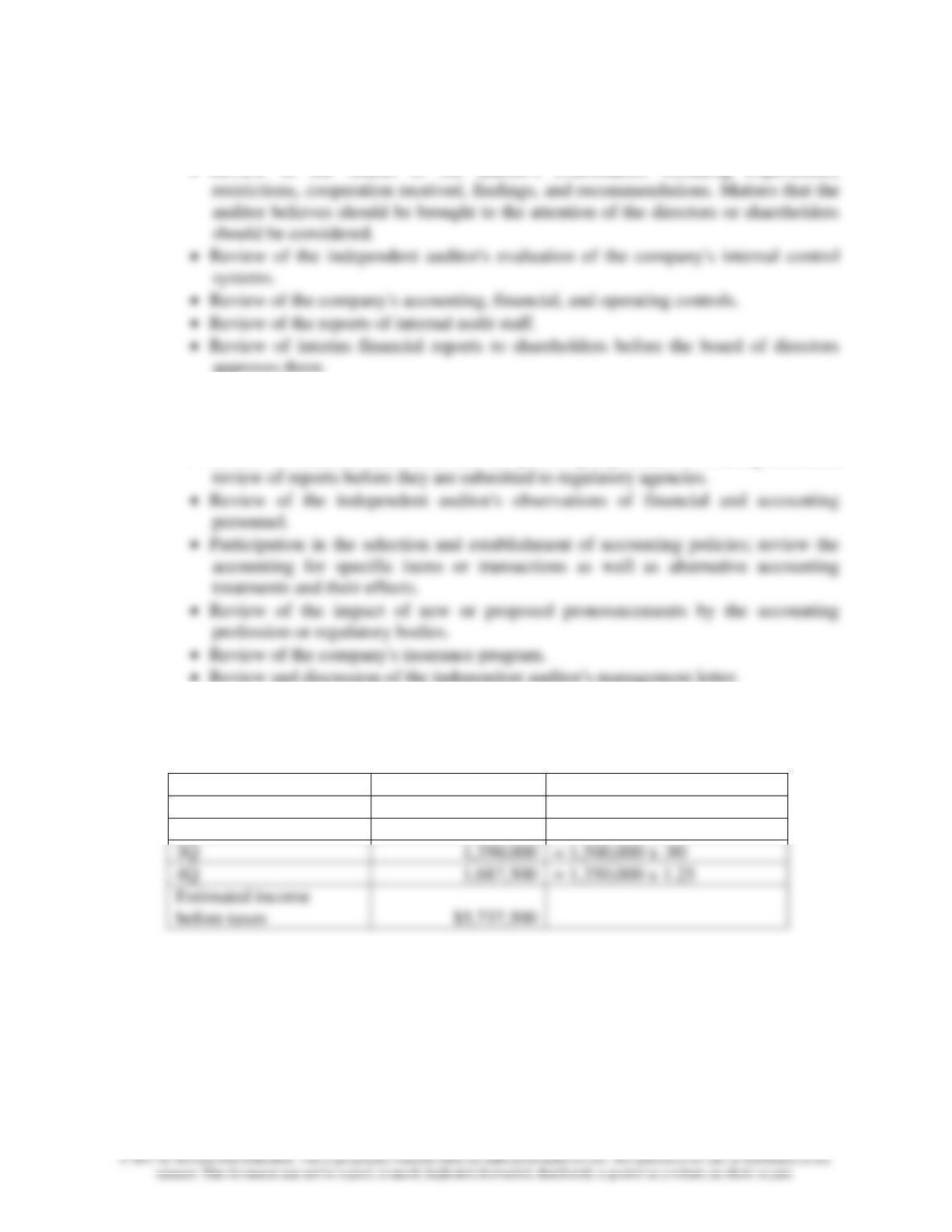
Quarters
Income before taxes
1Q
$1,200,000
2Q
1,500,000
3Q
1,350,000
= 1,500,000 x .90
4Q
1,687,500
= 1,350,000 x 1.25
Estimated income
before taxes
$5,737,500
Using 5% as a benchmark, overall materiality based on the estimated income before taxes
would be $ 287,000 (rounded).
Chapter 03 – Audit Planning, Types of Audit Tests, and Materiality
3-9
3-31 Scenario 1:
a. Because Murphy & Johnson is a profit-oriented entity, income before taxes is likely
to be the most appropriate benchmark for determining overall materiality. Murphy &
Johnson’s auditor could use 3 – 5% of income before operations for determining
b. In this case, the two detected misstatements exceed overall materiality ($1.25 million
versus $1.05 million). Thus, the auditor needs to propose an adjustment to the
financial statements. If both of the misstatements are factual (known) misstatements,
the auditor should request the client to book both misstatements. If the misstatements
are judgmental or projected misstatements, the auditor will have to determine whether
material weaknesses in controls.
Scenario 2:
a. Delta Investments is in the mutual fund industry and total assets would likely be the
most appropriate benchmark for determining overall materiality. Delta’s auditor could
misstatement will be set 50% of overall materiality or $10.75 million.
b. The two detected misstatements are less than both tolerable misstatement and overall
materiality so no adjustment to the financial statements would be necessary.
However, the auditor should understand the cause of the misstatement and determine
the impact of the misstatements on the auditor’s assessment of fraud and control risk.
Chapter 03 – Audit Planning, Types of Audit Tests, and Materiality
3-10
Scenario 3:
a. Swell Computers is a profit-oriented entity and income before taxes would normally
be the most appropriate benchmark for determining overall materiality. However,
Swell’s profit ($500,000 income on $7 billion of revenue) is close to breakeven. In
this case, Swell’s auditor can use total assets (.25 – 2%) or total revenues (.5 – 5%) for
b. The detected misstatement is less than both tolerable misstatement and overall
materiality. However, in this instance the adjustment of $1.5 million turns a profit
into a loss. This is one of the qualitative factors that SAB No. 99 requires the auditor
to consider (see Chapter 17), so an adjustment to the financial statements would be
3-32 a. Because of the significant drop in income in 2015, the auditor should use some type
of “normalized” earnings. One approach would be to use the average of 2012 – 2014
(584,000,000 + 520,000,000 + 453,000,000 = 1,557,000,000 / 3 = $519,000,000).
While the firm allows the use of 3 – 10% for the range of percentages, the loss in the
tolerable misstatement would then be $8 million to $13 million.
An alternative way for making these calculations would be to add back the write-
down to the 2015 income ($105 + 465 = $570) and then use a three-year average of
2013 – 2014.
b. The auditor could use the amounts for 2015 total assets and total revenues for the
calculations. Thus, overall materiality using total assets would be: ($23,422,000,000
x .0025 = $59 million) and ($23,422,000,000 x .02 = $468 million). Using 50% as the
multiplier, tolerable misstatement would be $26 million and $203 million,
Chapter 03 – Audit Planning, Types of Audit Tests, and Materiality
3-11
respectively.
c. If we use overall materiality for comparison purposes, the $50 million in detected
misstatements that were “waived,” would be material using the income measures in
part a., but not material using total assets or total revenues. The instructor might
consider discussing the fact that the $50 million in misstatements is greater than the
tolerable misstatement when the lower percentage is applied to total assets and total
revenues.
Solutions to Discussion Cases
3-33 a. The current-year audit discovered that Forestcrest Woolen Mills had not completed
any construction work on the water treatment facility that must be built to comply with
the consent decree from the North Carolina EPA. Failure to complete this facility on
time can result in fines and possible plant closure under the consent decree. This
situation represents a material uncertainty that is likely to be remote at this point in
time. However, the auditor should determine if the client will continue work on the
opinion on the company. The auditor might require the client to provide more detailed
disclosure of the issue in the footnotes to the financial statements.
b. If these facts were noted at the end of the seventh year of the consent decree, the
auditor would again need information on the possible timely completion of the facility.
If the facility can be completed, the auditor would most likely issue a standard
Solutions to Internet Assignments
3-34 A search of any of these sites should allow the student to identify a company that has
recently changed auditors. Once the company has been identified, the student can check
the investor relations section on the relevant company’s website. This web page will
contain the 8K filed by the company with the SEC. Alternatively, the student can search
3-12
3-35 The Institute of Internal Auditors (IIA) home page (www.theiia.org) contains detailed
information about various activities of the IIA. This includes information on the
3-36 A search of the Internet identified a number of potential sources for information on the
mail order industry:
• The National Mail Order Association (www.nmoa.com) is one site where small to
medium-sized organizations can go to get information on education, ideas, resources,
• Lastly, a number of the major public accounting firms have industry specialization in
retail. The sites of the firms may contain information on the retail industry.