Chapter 11 Auditing the Purchasing Process
11-1
CHAPTER 11
AUDITING THE PURCHASING PROCESS
Answers to Review Questions
11-1 Expenses can be classified into three categories:
1. Product costs are expenses that can be matched directly with specific transactions or
events and are recognized upon recognition of the revenues. An example of a product
and equipment is an example of such an expense.
11-2 The three types of transactions that are processed through the purchasing process are:
The more common accounts affected by each major type of transaction are:
Purchase transaction:
• Accounts payable
• Inventory
Purchase return transaction:
• Purchase returns
• Purchase allowances
Chapter 11 Auditing the Purchasing Process
11-2
11-3 A purchase requisition is a request for goods and services by an authorized individual or
department within the entity. A purchase order contains the description, quality, quantity,
and other information on the goods and services being purchased. A receiving report is
documents and information more easily.
11-4 The key segregation of duties and the errors or fraud that can occur if such duties are not
segregated are:
Segregation of Duties
Possible Errors or Fraud Resulting
from Conflicts of Duties
The purchasing function should be
segregated from the requisitioning and
receiving functions.
Theft of goods and possible payment for
unauthorized purchases.
The invoice-processing function should
be segregated from the accounts payable
function.
Overpayment for goods and services or
theft of cash.
The disbursement function should be
segregated from the accounts payable
function.
Theft of cash.
The accounts payable function should
be segregated from the general ledger
function.
A defalcation that would normally be
detected by reconciling subsidiary records
with the general ledger control account.
11-5 Two inherent risk factors that directly affect the purchasing process are (1) industry–
related factors, and (2) misstatements detected in prior audits.
If the entity deals with a large number of vendors and prices tend to be relatively stable,
there is less risk that the entity’s operations will be affected by raw-material shortages or
that production costs will be difficult to control. However, if an entity is dependent on a
11-3
11-6 The following controls and related tests are utilized to ensure that the occurrence,
authorization, and completeness assertions are met for purchase transactions:
Assertion
Control Activity
Tests of Controls
Occurrence
Segregation of duties
Purchase not recorded
without approved
purchase order and
receiving report
Accounting for numerical
sequences of receiving
reports and vouchers
Cancellation of documents
Observe and evaluate proper
segregation of duties.
Test of a sample of vouchers for
the presence of an authorized
purchase order and receiving
report; if IT application, examine
application controls.
Review and test entity procedures
for accounting for numerical
sequence of receiving reports and
vouchers; if IT application,
examine application controls.
Examine paid vouchers and
supporting documents for
indication of cancellation.
Authorization
Approval of acquisitions
consistent with the entity’s
authorization dollar limits
Approved purchase
requisition and purchase
order
Competitive bidding
procedures followed
Review entity’s dollar limits
authorization for acquisitions.
Examine purchase requisitions or
purchase orders for proper
approval; if IT is used for
automatic ordering, examination of
application controls.
Review entity’s competitive
bidding procedures.
Completeness
Accounting for numerical
sequences of purchase
orders, receiving reports,
and vouchers
to vendor invoices and
entered in purchases
journal
Review and test entity’s procedures
for accounting for numerical
sequence of purchase orders,
receiving report, and vouchers; if
IT application, examine
application controls.
to their respective vendor invoices
and vouchers.
Trace a sample of vouchers to the
purchases journal.
Chapter 11 Auditing the Purchasing Process
11-4
11-7 CAATs can be used to test numerous controls in the purchasing process. For example, a
generalized audit software package can be used to account for the numerical sequence of
purchase orders, receiving reports, and vouchers. Another example involves the use of a
11-8 The analytical procedures that can be used to test accounts payable and accrued expenses
and the possible misstatements that can be detected by each analytical procedure are:
Substantive Analytical Procedure
Possible Misstatement Detected
Compare payable turnover and days
outstanding in accounts payable with
previous years’ and industry data.
Compare current-year balances in accounts
payable and accruals with prior years’
balances.
Compare amounts owed to individual vendors
in the current year’s accounts payable
listing to amounts owed in prior years.
Compare purchase returns and allowances as a
percentage of revenue or cost of sales to
prior years’ and industry data.
Under- or overstatement of
liabilities and expenses
Under- or overstatement of
liabilities and expenses
Under- or overstatement of
liabilities and expenses
Under- or overstatement of
purchase returns
11-9 The following audit procedures may be used as part of the search for unrecorded
liabilities:
• Ask management about control activities used to identify unrecorded liabilities and
accruals at the end of an accounting period.
• Examine the files of unmatched purchase orders, receiving reports, and vendor
invoices for any unrecorded liabilities.
11-5
11-10 The following are examples of disclosures for the purchasing process and related
accounts:
• Payables by type (trade, officers, employee, affiliate, etc.).
• Costs by reportable segment of the business.
11-11 Accounts payable confirmations are generally used less frequently than accounts
receivable confirmations because the auditor can test accounts payable by examining
vendor invoices and monthly vendor statements. Since these documents originate from
Both positive and negative confirmations are used for accounts receivable. Lastly,
accounts payable confirmations are generally mailed at year-end rather than at an interim
date because of the auditor’s concerns about unrecorded liabilities. Accounts receivable
confirmations are sent at both dates.
11-12 Some of the typical procedures that might be applied to the audit of the tax provision by
the auditors and/or tax specialist include:
• Compare the size and trend in the tax provision and related balance sheet accounts
over time.
• Perform walkthroughs and test the design and operating effectiveness of internal
appropriate disclosure and accounting under ASC 740.
• Consider the realizability of net deferred tax assets and adequacy of related valuation
allowances.
• Test the reconciliation of income taxes payable, deferred income tax assets/liabilities
(including any related valuation allowances), and tax liabilities to supporting
Chapter 11 Auditing the Purchasing Process
11-6
documentation, including the general ledger, financial statements, and related footnote
disclosure.
• Ensure proper documentation in the audit working papers to allow for reperformance
of the audit procedures applied to the tax accounts.
Answers to Multiple-Choice Questions
11-13
c
11-19
c
11-14
c
11-20
d
11-15
b
11-21
c
11-16
d
11-22
c
11-17
b
11-23
a
11-18
b
Solutions to Problems
11-24 This is a relatively straightforward analytical procedures problem. Here are some of the
concerns the auditor might have about potential misstatements in both accounts:
• Both inventory and accounts payable have increased significantly in absolute dollar
terms from 2014 to 2015.
value and (2) there are unrecorded accounts payable. Other misstatements are
possible.
11-25 The internal control activities that most likely would provide reasonable assurance that
specific control objectives for management assertions regarding purchases and accounts
payable will be achieved are:
• The purchasing, receiving, and accounts payable functions are segregated.
Requisitioning Department:
Chapter 11 Auditing the Purchasing Process
11-7
• The adequacy of each vendor’s past record as a supplier is verified.
Receiving Department:
Accounts Payable Department:
• Requisitions, purchase orders, and receiving reports are matched with vendor invoices
as to quantity and price.
treasurer.
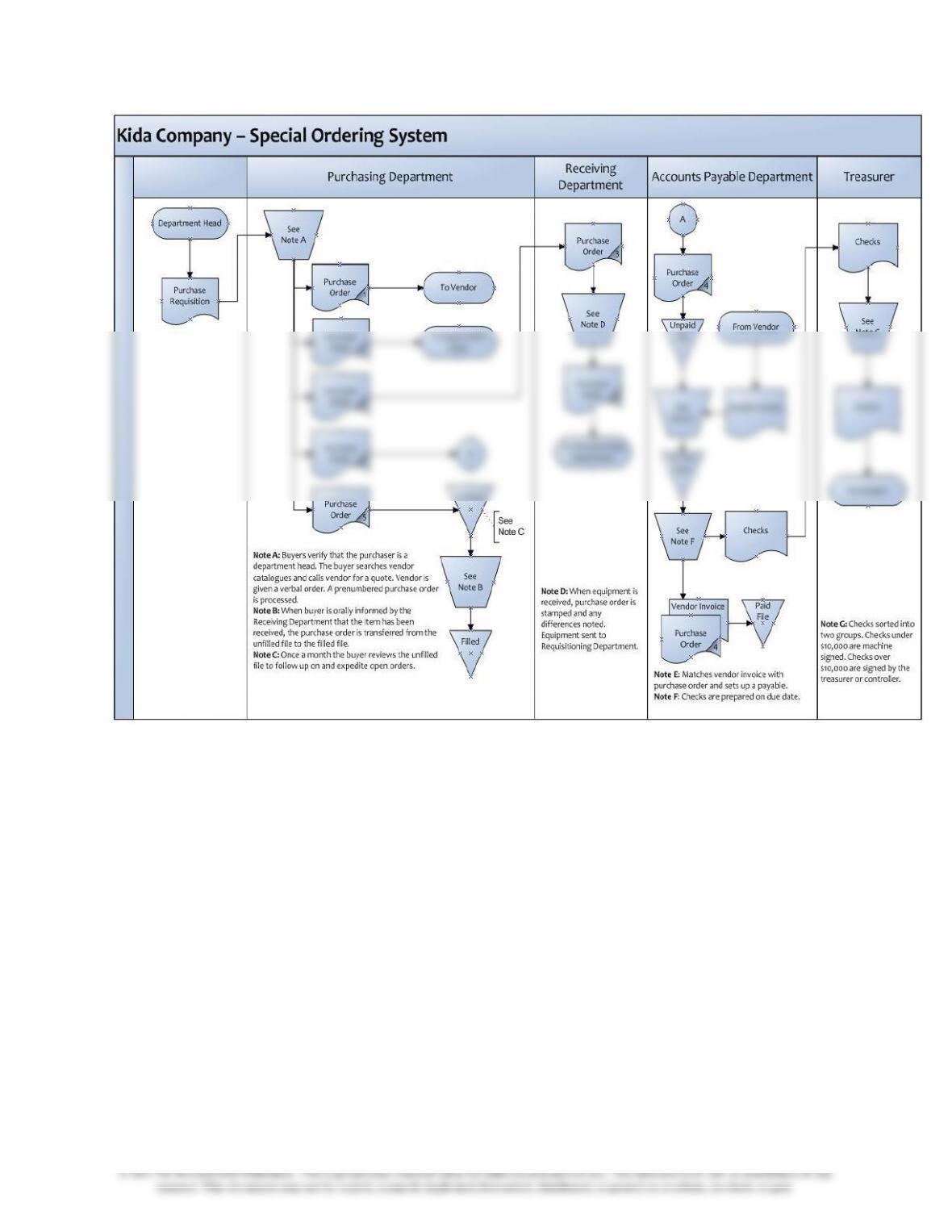
11-26 a. The flowchart for Kida Company is shown below:
Chapter 11 Auditing the Purchasing Process
11-8
Chapter 11 Auditing the Purchasing Process
11-9
b. Kida Company’s major internal control weaknesses are:
Purchasing:
• The buyer does not verify that the department head’s request is within budget
limitations.
Receiving:
• Receiving clerk does not make blind counts for all special equipment or at least for
large-dollar items.
department is not obtained before the payable is recorded.
• No alphabetic file of vendors from which purchases are made is maintained.
Treasurer:
• Documentation supporting the checks is not sent by the accounts payable
department to the cashier in order for the cashier or treasurer to be assured that the
check is for properly authorized and received equipment.
• The controller is authorized to sign checks.
11-27 1. Test of details of transactions (substantive test of transactions).
2. Tests of details of transactions (cutoff test).
11–10
11-28 The substantive audit procedures Coltrane should apply to Jang’s trade accounts payable
balances include the following:
• Foot the schedule of the trade accounts payable.
• Agree the total of the schedule to the general ledger trial balance.
payables.
• Perform cutoff tests.
• Perform analytical procedures.
Confirm or verify recorded accounts payable balances by:
• Reviewing the voucher register or subsidiary accounts payable ledger and consider
• Testing a sample of unconfirmed balances by examining the related vouchers,
invoices, purchase orders, and receiving reports.
Perform a search for unrecorded liabilities by:
• Examining files of receiving reports unmatched with vendors’ invoices and searching
• Inquiring of key employees about additional sources of unprocessed invoices or
other trade payables.
11-29 a. 3
Chapter 11 Auditing the Purchasing Process
11-30
a.
No adjustment is needed. The goods were received before December 31, 2015
and recorded in the Purchases Journal in December.
b.
An adjustment is required. The $45,000 payment covers a 3-month period
starting on December 1, 2015. The total amount was charged to consulting
expenses, while only 1 month of services was used by year-end. The entry to
correct is:
Prepaid Consulting Expenses 30,000
Consulting Expenses 30,000
c.
No adjustment is needed. The goods were received before December 31, 2015
and recorded in the Purchases Journal in December.
d.
No adjustment is needed. The truck was received in 2016 as evidenced by RR#
49746 and recorded in the Purchases Journal in January.
e.
An adjustment is required. The paper products were received in December
2015 as evidenced by the RR# 49743 (RR #49745 is the last receiving report in
December). Thus, these goods should have been recorded in December 2015. The
entry to correct is:
Supplies 42,000
Accounts Payable 42,000
f.
An adjustment is required. The telephone bill applies to December 2015 and the
$32,450 should be an accrued expense. The entry to correct is:
Telephone expense 32,450
Accrued Expenses 32,450
Solution to Discussion Case
11-31 a. The accounts payable audit procedures should be directed toward searching for
proper inclusion of all accounts payable and ascertaining that recorded amounts are
reasonably stated because the primary audit purpose is to reveal any possible
material understatements.
The principal objectives of the accounts payable examination are:
1. To determine adequacy of internal control for processing and payment of
Chapter 11 Auditing the Purchasing Process
11–12
b. Mincin is not required to use accounts payable confirmation procedures. The auditor,
with three exceptions, is required to obtain direct confirmation of accounts
receivable, since the primary audit test is for possible material overstatements and
generally the entity has available only internal documents such as sales invoices. For
accounts payable, however, the auditor can examine external evidence such as
vendor invoices and vendor statements that substantiate the accounts payable
balance. Although not required, the accounts payable confirmation is often used. The
auditor might consider such use when:
1. Internal controls are weak.
7. Change in personnel or management behavior related to payables.
c. A selection technique using the large dollar balances of accounts is generally used
when the primary audit objective is to test for overstatements (e.g., accounts
receivable audit work). Accounts with zero balances or relatively small balances
would not be subjected to selection under such an approach. When auditing accounts
payable, the auditor is primarily concerned with the possibility of unrecorded
payables or understatement of recorded payables. Selection of accounts with
relatively small or no balances for confirmation is the more efficient direction of
testing, since understatements are more likely to be detected when examining such
accounts.
When selecting accounts payable for confirmation, the following procedures
could be followed:
1. Analyze the accounts payable population and stratify it into accounts with large
balances, accounts with small balances, accounts with zero balances, etc.
2. Use a sampling technique that selects items based on criteria other than the dollar
8. Select accounts secured by pledged assets.
Chapter 11 Auditing the Purchasing Process
11–13
© 2017 by McGraw-Hill Education. This is proprietary material solely for authorized instructor use. Not authorized for sale or distribution in any
manner. This document may not be copied, scanned, duplicated, forwarded, distributed, or posted on a website, in whole or part.
Solution to Internet Assignments
11-32 It may be difficult to get information directly on some of EarthWear’s competitors.
Lands’ End and Timberland are publicly traded companies. Eddie Bauer, L.L. Bean and
11-33 A search of the SEC’s website should identify a recent company that has been cited by