Chapter 10 – Auditing the Revenue Process
10-1
CHAPTER 10
AUDITING THE REVENUE PROCESS
Answers to Review Questions
10-1 FASB Statement of Financial Accounting Concepts No. 5, “Recognition and
Measurement in Financial Statements of Business Enterprises” (CON5), requires that
before revenue is recognized (recorded) it must be realized or realizable and earned.
Revenues are realized when the products or services are exchanged for cash, a promise to
10-2 The credit function has the responsibility for monitoring customer payments. An aged
trial balance of accounts receivable should be prepared and reviewed by the credit
function. Payment should be requested from customers who are delinquent in making
10-3 When the entity does not have adequate segregation of duties or if collusion is suspected,
the possibility of a defalcation is increased. An employee who has access to both the cash
receipts and the accounts receivable records has the ability to steal cash and manipulate
the accounting records to hide the misstatement. This is sometimes referred to as
10-4 Industry-related factors such as the profitability and health of the industry in which the
entity operates, the level of competition within the industry, and the industry’s rate of
technological change affect the potential for misstatements in the revenue process. The
level of governmental regulation (e.g., by the Food and Drug Administration) within the
Chapter 10 – Auditing the Revenue Process
10-2
10-5 The auditor needs to obtain the following knowledge for each major class of transactions
in the revenue process when performing a walkthrough:
• How sales, cash receipts, and sales returns and allowances transactions are initiated.
• The accounting records, supporting documents, and accounts that are involved in
10-6 Two important controls for processing of credit memoranda for sales returns and
allowances transactions are: (1) each credit memorandum should be approved by
someone other than the individual who initiated it and (2) a credit for returned goods
10-7 The analytical procedures that can be used to test revenue-related accounts and the
possible misstatements that can be detected by each analytical procedure are (also see
Table 10-9):
Analytical Procedure
Possible Misstatement Detected
Revenue:
Comparison of gross profit percentage by
product line with previous years’ and/or
industry data.
Comparison of reported revenue to budgeted
revenue.
Unrecorded (understated) revenue
Fictitious (overstated) revenue
Changes in pricing policies
Product-pricing problems
Accounts Receivable, Allowance for
Uncollectible Accounts, and Bad-Debt
Expense:
Comparison of receivables turnover and days
outstanding in accounts receivable to
previous years’ and/or industry data.
Comparison of aging categories on aged trial
balance of accounts receivable to previous
years.
Under- or overstatement of
allowance for uncollectible
accounts and bad-debt
expense
Chapter 10 – Auditing the Revenue Process
Comparison of bad-debt expense as a percentage
of revenue to previous years’ and/or industry
data.
Comparison of the allowance for uncollectible
accounts as a percentage of accounts
receivable or credit sales to previous years’
and/or industry data.
Examination of large customer accounts
individually and comparison to previous
year.
Sales Returns and Allowances and Sales
Commissions:
Comparison of sales returns as a percentage of
revenue to previous years’ and/or industry
data.
Comparison of sales discounts as a percentage of
revenue to previous years’ and/or industry
data.
Estimation of sales commissions expense by
multiplication of net revenue by the average
commission rate and comparison to recorded
sales commission expense.
Under- or overstatement of sales
returns
Under- or overstatement of sales
discounts
Under- or overstatement of sales
commission expense and
related accrual
10-8 The auditor verifies the accuracy of the aged trial balance using the following steps. First,
a copy of the aged trial balance of accounts receivable is obtained from the entity and the
total balance is compared to the accounts receivable general ledger balance. Second, a
sample of customer accounts is selected from the aged trial balance. For each selected
customer account, the auditor traces the customer’s balance back to the subsidiary ledger
Chapter 10 – Auditing the Revenue Process
10-4
10-9 Three factors that affect the reliability of accounts receivable confirmations are:
The types of confirmations include positive and negative confirmations. Positive
confirmations are considered more reliable because the recipient is required to respond to
the auditor regardless of whether a misstatement exists or not. Prior experience with the
entity in terms of confirmation response rates, misstatements identified, and the accuracy
of returned confirmations should be considered when assessing the reliability of accounts
receivable confirmations. For example, if response rates were low in prior audits, the
10-10 A positive accounts receivable confirmation requests that the customer indicate whether
or not it is in agreement with the amount due to the entity stated in the confirmation.
Thus, a response is required regardless of whether the customer believes that the amount
confirmation requests are used when there are a large number of accounts with small
balances, control risk is assessed to be low, and the auditor believes that the customers
will devote adequate attention to the confirmation.
10-11 Other types of receivables that the auditor should examine include:
The auditor would confirm and evaluate each type of receivable for collectibility. The
transactions that result in receivables from related parties are examined to determine if
Chapter 10 – Auditing the Revenue Process
Answers to Multiple-Choice Questions
10-25 The following weaknesses were identified by Smith in the existing control system over
cash admission fees along with the related recommendation for improvement:
Weakness
Recommendation
1. There is no segregation of
duties between persons
responsible for collecting
admission fees and persons
responsible for authorizing
admission.
1. One clerk (the collection clerk) should
collect admission fees and issue
prenumbered tickets. The other clerk (the
admission clerk) should authorize
admission upon receipt of the ticket or
proof of membership.
2. An independent count of
paying patrons is not made.
2. The admission clerk should retain a portion
of the prenumbered admission ticket
(admission ticket stub).
3. There is no proof of accuracy
of amounts collected by the
clerks.
3. Admission ticket stubs should be reconciled
with cash collected by the treasurer each
day.
4. Cash receipts records are not
promptly prepared.
4. The cash collections should be recorded by
the collection clerk daily on a permanent
record that will serve as the first record of
accountability.
5. Cash receipts are not promptly
deposited. Cash should not be
left undeposited for a week.
5. Cash should be deposited at least once each
day.
6. There is no proof of accuracy
of the amounts deposited.
6. Authenticated deposit slips should be
compared with daily cash collection
records. Discrepancies should be promptly
investigated and resolved. In addition, the
treasurer should establish a policy that
includes an analytical review of cash
collections.
7. There is no record of the
internal accountability for
cash.
7. The treasurer should issue a signed receipt
for all proceeds received from the
collection clerk. These receipts should be
maintained and periodically checked
against cash collection and deposit records.
10-26 a. 1
Chapter 10 – Auditing the Revenue Process
10-7
10-27 a. In addition to sending second requests, Signoff-On can perform the following audit
procedures:
• Examination of subsequent cash receipts.
provides strong evidence that the receivable was valid.
10-28 The working paper contains the following deficiencies:
• The working paper was not initialed and dated by the audit assistant.
• Negative confirmations not returned cannot be considered to be accounts “confirmed
without exception.”
• The two positive confirmations that were sent but were unanswered are not accounted
• There is no reference to second requests.
• Cross-referencing is incomplete, such as the eighteen “Differences reported and
resolved, no adjustment” and “Confirmation Requests” to the confirmation control
schedule.
Chapter 10 – Auditing the Revenue Process
10-8
10-29 In order to determine whether lapping exists, Stanley would test the aging of accounts
receivable and then:
• Mail positive accounts receivable confirmation requests directly to all customers with
old balances.
• Investigate all exceptions noted on confirmations.
control account.
• Compare information in copies of monthly customers’ statements with information in
customers’ ledger accounts.
10-30 In evaluating proper sales cutoff, three points should be noted: (1) The book–to-physical
adjustment has already been made by the client, (2) all sales are made FOB shipping (title
passes to the customer at the time the goods are shipped), and (3) goods on hand on
January 31 are included in the physical inventory.
a. Since the goods were shipped on December 31, they were included in the physical
inventory at the end of the fiscal year. Since the sale should be recognized in the
current fiscal year, the following adjustment is necessary:
following adjusting entry should be made:
Sales 4,000
Accounts receivable 4,000
Chapter 10 – Auditing the Revenue Process
10-9
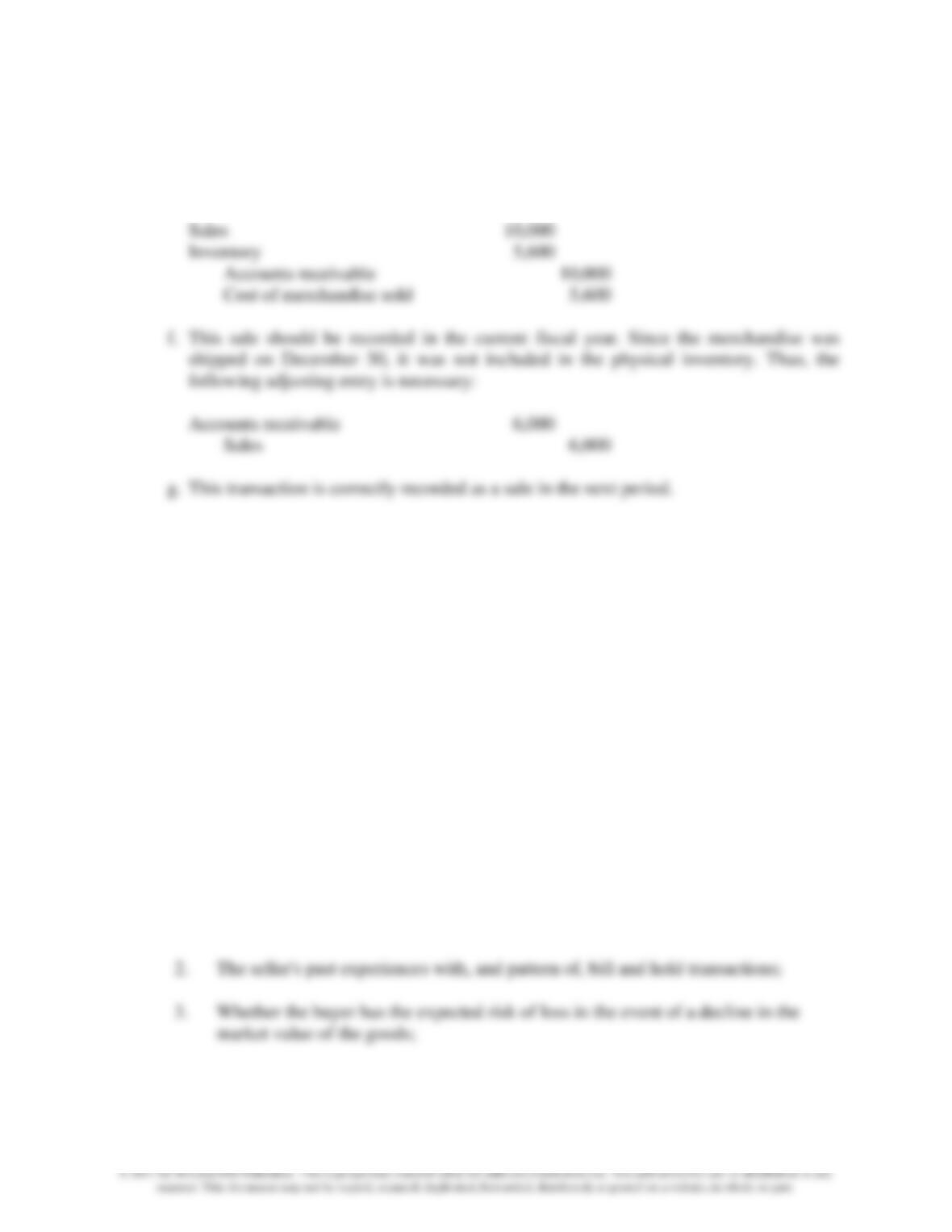
e. Since this transaction is a shipment of merchandise to a consignee, no sale should be
recognized. Since the goods were not on hand on December 31, the following entry is
necessary:
Sales 10,000
h. Since the merchandise was shipped on December 31, it should be recorded as a sale in
the current fiscal year. It was also included in the physical inventory because it was on
hand on that date. Thus, the following adjusting entry is necessary:
Accounts receivable 8,000
Cost of merchandise sold 5,500
Sales 8,000
Inventory 5,500
Solutions to Discussion Cases
10-31 The listed conditions are the important conceptual criteria that should be used in
evaluating any purported bill and hold sale. In some circumstances, a transaction may
meet all the factors listed above but not meet the requirements for revenue recognition. In
applying the above criteria to a purported bill and hold sale, the auditor should also
consider the following factors and evidence related to each factor:
1. The date by which the seller expects payment, and whether it has modified its
normal billing and credit terms for this buyer;
Chapter 10 – Auditing the Revenue Process
10–10
4. Whether the seller’s custodial risks are insurable and insured;
the buyer’s commitment.
10-32 a. Friendly Furniture carried insurance coverage for property loss at replacement value
and business interruption insurance for lost production. Because the property loss is
covered at replacement value, which exceeds carrying value, the recognition of both a
reimbursement for costs incurred and a gain contingency should be considered.
Before deciding on when to recognize proceeds from insurance coverage, it is
necessary to consider whether the amount of proceeds is a gain contingency, which
generally cannot be recognized under GAAP. The gain must be realized before
recognition is permitted. FASB ASC Topic 450, “Contingencies,” reaffirms the
principle on the recognition of gain contingencies.
from the destruction of fixed assets and inventory as well as from lost production.
There are a number of points in time when the insurance proceeds may be
recognized. The most conservative approach—the one likely to be least favored by the
company and the least likely to be a gain contingency—would be when the proceeds
are received. This would result in a cash basis of accounting and would not be
supported by SFAC No. 6, “Elements of Financial Statements.” The other extreme
would be recognition of the insurance proceeds before verification of coverage or
admission of liability by the insurance carrier. This is the most aggressive approach
and the most likely to result in recognition of a gain contingency.
Chapter 10 – Auditing the Revenue Process
10–11
One possible answer is to recognize insurance proceeds (a receivable from the
insurance company) in Friendly Furniture’s financial statements at June 30 in the
following manner: credit a portion of business interruption insurance to cost of sales
and recognize in other income a gain that consists of the estimated minimum amount
that the replacement cost insurance proceeds exceed the net book value of equipment
and inventory destroyed and unallocated proceeds from business interruption
insurance.
b. The auditor can perform the following procedures to support the amount recorded for
the receivable:
• Examine the inventory records, including the perpetual and physical inventory, to
• Examine the entity’s and insurance company’s calculation of the amount of income
to be recognized as a result of the business interruption.
Solution to Internet Assignments
10-33 It is difficult to get information directly on some of EarthWear’s competitors. Lands’
End is now part of Sears. Eddie Bauer is part of The Spiegel Group. The Spiegel
Group’s annual report states that revenue from catalog and e-commerce sales is
10-34 A search of the SEC’s website should identify a recent company that has been cited by
the SEC for revenue recognition issues.