Exercise 22-11 (20 minutes)
(1)
Investment center
Operating
income Average assets*
Return on
investment
Beverage….….…….…..... $349 $2,628 13.28%
(2)
Investment center
Operating
income Sales Profit margin
Beverage….….…….…..... $349 $2,681 13.02%
(3)
Investment center Sales Average assets*
Investment
turnover
Beverage….….…….…..... $2,681 $2,628 1.02
*Beginning plus ending invested assets, divided by 2. Rounded to the nearest dollar.
Exercise 22-12 (10 minutes)
($ millions) Beverage Cheese
Operating income…...... $349 $634
Target net income
$2,628* x 7%…….….….
(184)
*Average invested assets. Computed as beginning plus ending invested assets, divided by two,
and rounded to nearest dollar.
Exercise 22-13 (15 minutes)
Investment center
Operating
income Sales Profit margin
Americas….….…….…..... $22,817 $62,739 36.4%
Exercise 22-14 (20 minutes)
1. Return on investment = $1,000,000/$12,500,000 = 8%
2. Profit margin = $1,000,000/$5,000,000 = 20%
4. Predicted 2016 investment turnover = $6,000,000/$12,500,000 = 0.48
Exercise 22-15 (20 minutes)
1. F 8. P
2. C 9. C
Exercise 22-16 (15 minutes)
Part 1
Process time…………………………………………………..…….…….….. 6.0 days
Inspection time……………….………………………………………….…… 0.8 days
Part 2
Manufacturing cycle efficiency (6.0 days/ 15.0 days)…......... 0.40
Part 3
If move time is reduced by 1.2 days and wait time is reduced by 2.8 days,
cycle efficiency will be 0.545, computed as 6.0 days divided by 11.0 days.
Exercise 22-17 (15 minutes)
Part 1
Process time…………………………………………………..…….…….…..16.0 hours
Inspection time……………….………………………………………….…… 3.5 hours
Exercise 22-17 (continued)
Part 2
Manufacturing cycle efficiency (16.0 hours/ 50.0 hours)...... 0.32
Part 3
To increase the manufacturing cycle efficiency to 0.80 Best Ink needs to
reduce the total manufacturing cycle time to 20 hours without changing the
Exercise 22-18A (15 minutes)
1. If the trailer division is currently operating at full capacity, its manager
will not accept a transfer price below the retail market price of $200 per
2. If the trailer division is currently producing 20,000 trailers and the
assembly division will order 15,000 more trailers, the Trailer division will
have excess capacity. In this case the range of acceptable transfer prices
Exercise 22-18A (continued)
3. The trailer division would prefer a transfer price of $140 per trailer, since
it provides a $60 ($140 – $80) contribution margin per trailer. At a transfer
price of $80 the trailer division reports a contribution margin of $0 per
trailer. Conversely, the assembly division manager prefers a transfer price
Exercise 22-19B (20 minutes)
Preliminary calculations
Land cost …………..……………………..….….….…….…….…..$4,000,000
Lots Quantity Price Total
Canyon…..…………..………………….. 450 $ 55,000 $24,750,000
Allocated cost—value basis of allocation: $7,500,000
Market % of Allocated Average
Value Total Cost Lot Cost
Canyon section…......... $24,750,000 60% $4,500,000 $10,000
Exercise 22-20B (25 minutes)
Preliminary calculations
Lobster cost (2,400 lbs. x $4.50)…..……...........$10,800
Parts Quantity* Price Total
* Quantities are computed as:
52% x 2,400 lbs. = 1,248 lbs.
22% x 2,400 lbs. = 528 lbs.
Allocated cost—value basis allocation: $12,600
Market % of Allocated Cost
Parts Value Total Cost per lb.
Lobster tails……………......$26,208 78.0% $9,828 $7.875
Lobster flakes…….…........ 7,392 22 .0 2,772 5.250
Total……………………..……..$33,600 100 .0 % $12,600
(1) Cost of goods sold
Parts Quantity (given) Cost Total
(2) Cost of ending inventory
Parts Quantity Cost Total
Lobster tails………………….…… 152 lbs.* $7.875 $ 1,197
* 1,248 lbs. – 1,096 lbs. sold = 152 lbs.
** 528 lbs. – 324 lbs. sold = 204 lbs.
Note: Cost of goods sold ($10,332) plus cost of ending inventory
($2,268) equals the total cost of $12,600.
Exercise 22-21 (20 minutes)
(1) Profit margin = Income/Sales
Investment center Income* Sales* Profit margin
Professional products…....... € 552 €2,717 20.32%
Active cosmetics.................. 278 1,386 20.06%
*In € millions
The professional products department has the highest profit margin.
(2) Investment turnover = Sales/Average invested assets
Investment center
Sales*
Avg. assets*
Investment
turnover
Professional products…....... €2,717 €2,570 1.06
Consumer products………..… 9,530 5,745 1.66
*In € millions. Avg. assets = Beginning assets plus ending assets, divided by two.
Note: Profit margin and investment turnover amounts are rounded to two decimal places.
The Active cosmetics department has the highest investment turnover.
PROBLEM SET A
Problem 22-1A (50 minutes)
Part 1
a.
Responsibility Accounting Performance Report
Dept. Manager, Camper Department
For the Year
Budgeted Actual Over (Under)
Amount Amount Budget
Controllable Costs
Raw materials…………………..….……..$195,000 $194,200 $ (800)
Totals………..……………………………..…$392,000 $392,500 $ 500
b.
Responsibility Accounting Performance Report
Dept. Manager, Trailer Department
For the Year
Budgeted Actual Over (Under)
Amount Amount Budget
Controllable Costs
Raw materials……………………..….…. $275,000 $273,200 $(1,800)
Employee wages………………..….….. 205,000 206,400 1,400
Problem 22-1A (Continued)
c.
Responsibility Accounting Performance Report
Plant Manager, Indiana Plant
For the Year
Budgeted Actual Over (Under)
Amount Amount Budget
Controllable Costs
Dept. manager salaries….…..........$ 95,000 $ 97,500 $ 2,500
Utilities……………….……………….…... 9,000 8,300 (700)
Building rent….….…….…….……...... 15,000 14,000 (1,000)
Trailer department…..…….…….…... 695,000 696,200 1,200
Total…………....…….….…….…….…….$1,263,500 $1,261,600 $ (1,900)
Part 2
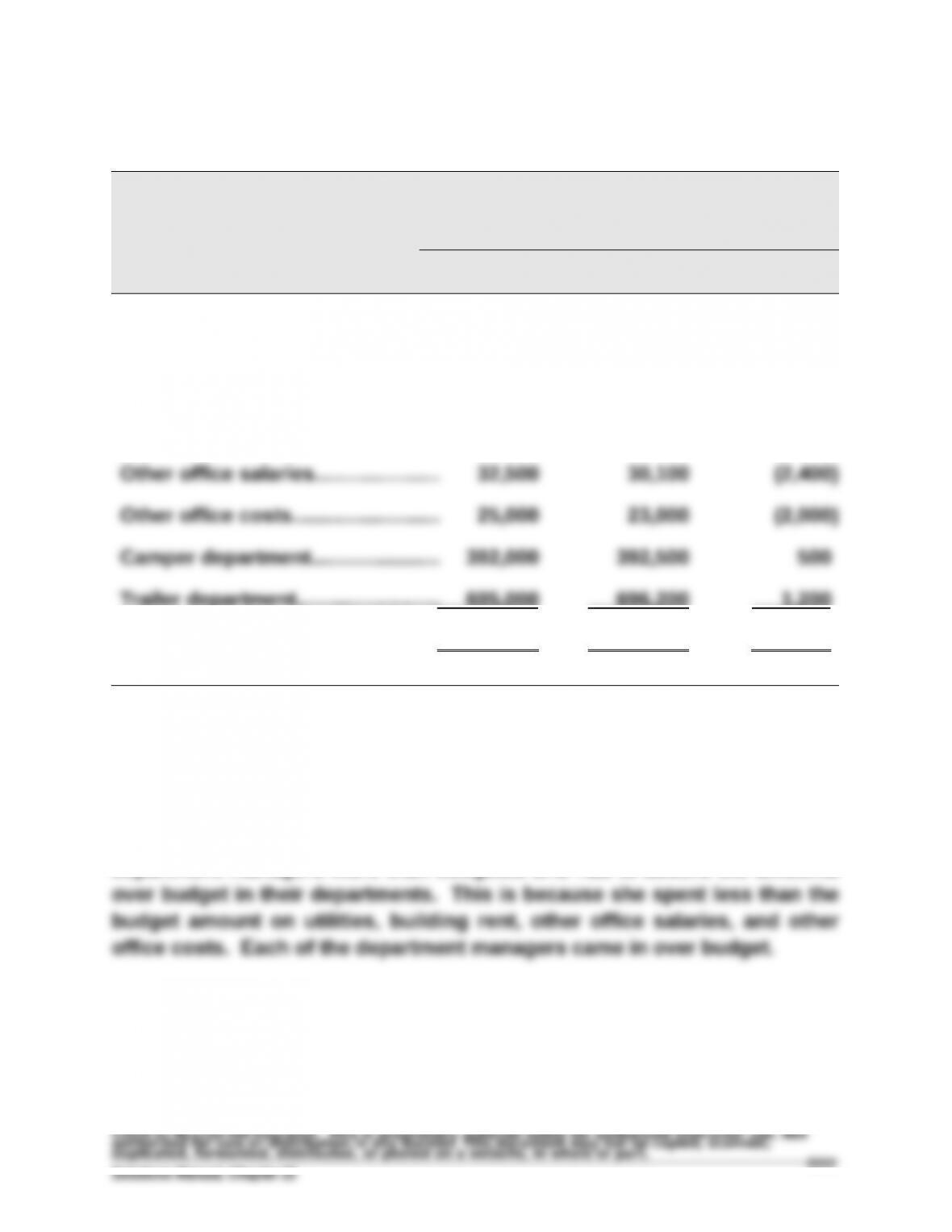
The plant manager did a better job of controlling costs and meeting the
budget. She came in under budget for the plant even though she paid the
department managers more than budgeted and had to absorb the amounts
Problem 22-2A (60 minutes)
Part 1
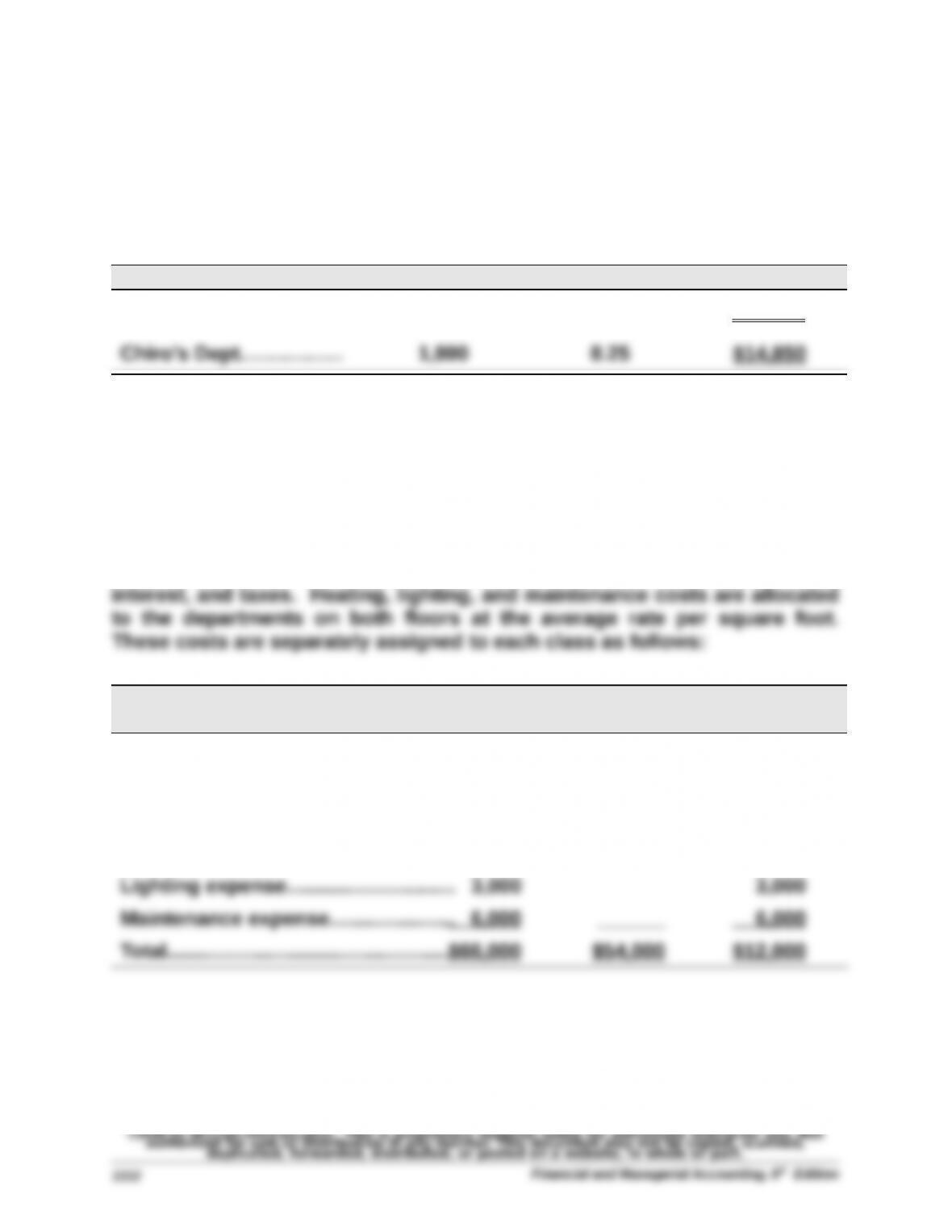
Average occupancy cost = $66,000 / 8,000 sq. ft. = $8.25 per sq. ft.
These costs are assigned to the two departments as follows
Department Square Footage Rate Total
Linder’s Dept................ 1,000 $8.25 $ 8,250
*A total of $23,100 ($8,250 + $14,850) in occupancy costs is allocated to these
departments. The company would follow a similar approach in allocating the remaining
occupancy costs ($42,900, computed as $66,000 – $23,100) to its other departments (not
shown in this problem).
Part 2
Market rates are used to allocate occupancy costs for depreciation,
Total
Costs
Value-Based
Costs
Usage-Based
Costs
Depreciation—Building………………..$18,000 $18,000
Interest—Building mortgage…........ 27,000 27,000
Taxes—Building and land……………. 9,000 9,000
Gas (heating) expense……..….……... 3,000 $ 3,000