Problem 18-5A (65 minutes)
Part 1 Instructor note: Use the equation in Exhibit 18.12
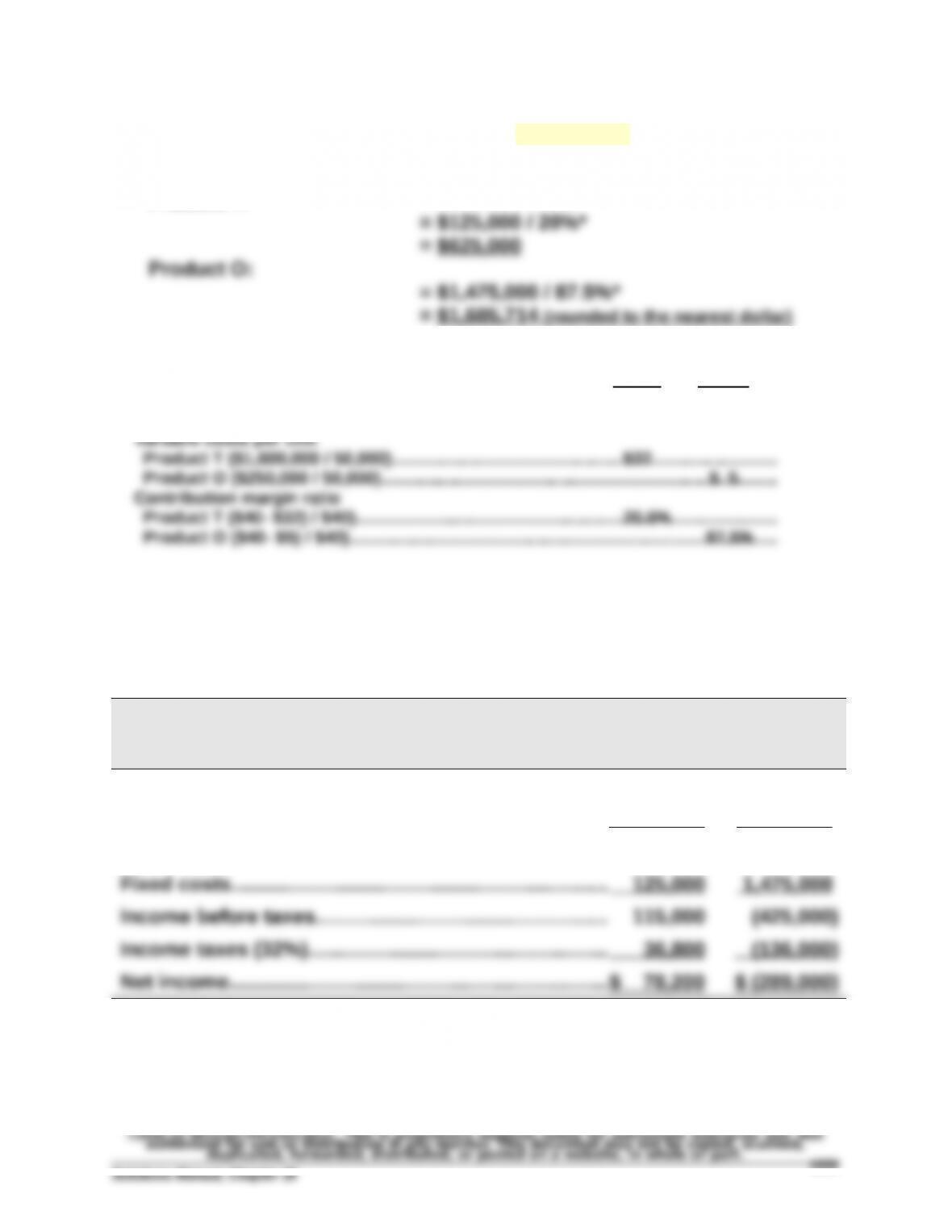
Break-even in dollar sales = Fixed costs / Contribution margin ratio
Product T:
*To compute contribution margin ratio
Sales price per unit
Product T ($2,000,000 / 50,000)……………………………………………………………………..
Product O ($2,000,000 / 50,000)………………………………………………………….….….….
__T__
$40
__O__
$40
Part 2
Forecasted contribution margin income statements for each product
assuming sales declines to 30,000 units with no change in unit sales price
HENNA CO.
Forecasted Contribution Margin Income Statement
Product T Product O
Sales*………………………………………………..……….….…...$1,200,000 $1,200,000
Variable costs**…………………………………………………… 960,000 150,000
Contribution margin…………………………………….…..…. 240,000 1,050,000
Unit sales price and variable costs are computed in Part 1 and used in these computations:
* Product T sales = 30,000 units x $40; Product O sales = 30,000 units x $40.
** Product T variable costs = 30,000 units x $32; Product O variable costs = 30,000 units x $5.
Problem 18-5A (Continued)
Part 3 Forecasted contribution margin income statements for each product
assuming sales increase to 60,000 units with no change in unit sales price
HENNA CO.
Forecasted Contribution Margin Income Statement
Product T Product O
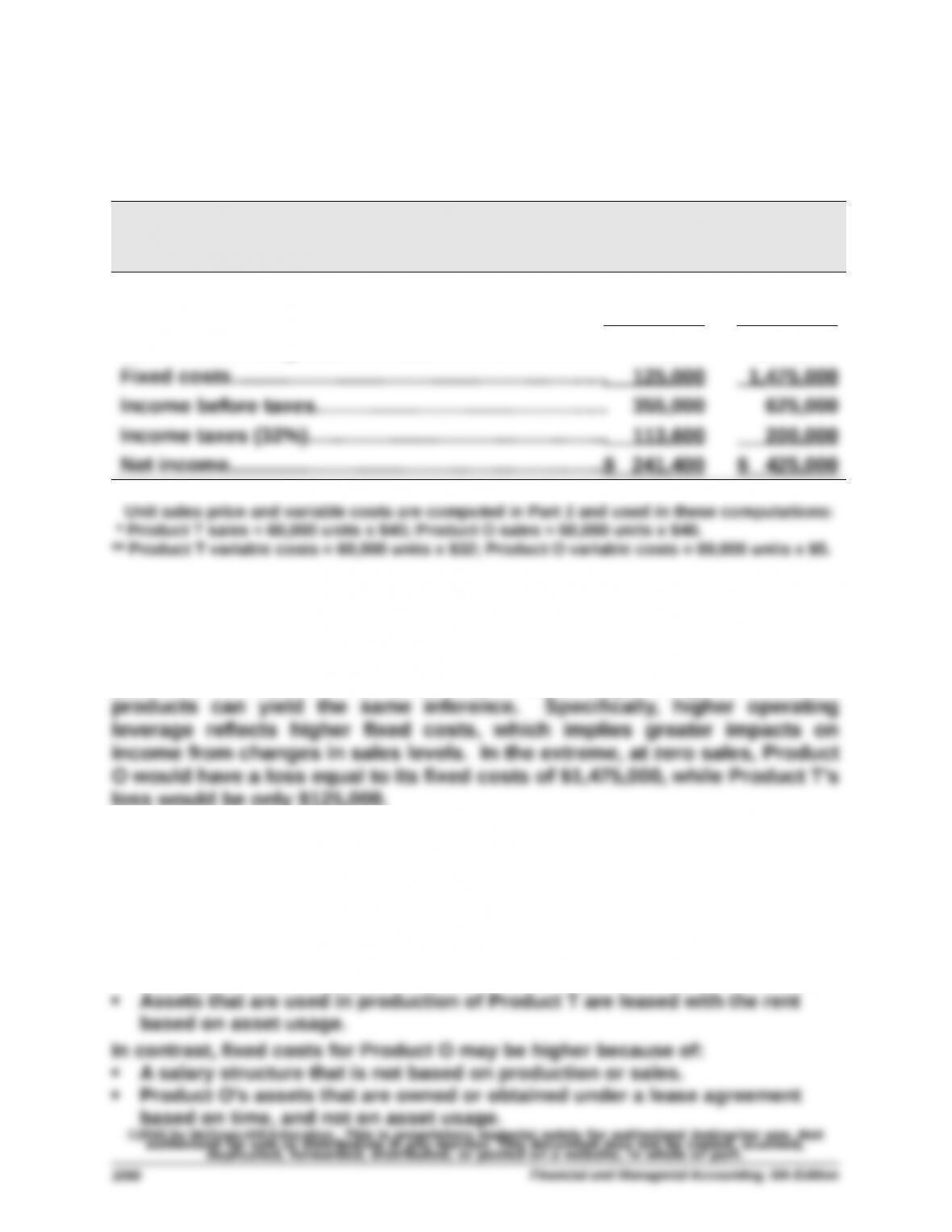
Sales*………………………………………………..……….….…...$2,400,000 $2,400,000
Variable costs**…………………………………………………… 1,920,000 300,000
Contribution margin…………………………………….…..…. 480,000 2,100,000
Part 4
If sales were to greatly decrease, Product O would suffer the greater loss
because it would lose more contribution margin per unit than Product T
($35 for O versus $8 for T). Examining the operating leverage of these two
Part 5
Factors that could cause Product T to have lower fixed costs might include:
Labor arrangement that pays workers for units produced.
Sales representatives that work totally on commission.
Managers that are compensated with a share of profits instead of salaries.
Problem 18-6A (45 minutes)
Part 1 Instructor note: Use the equation in Exhibit 18.12
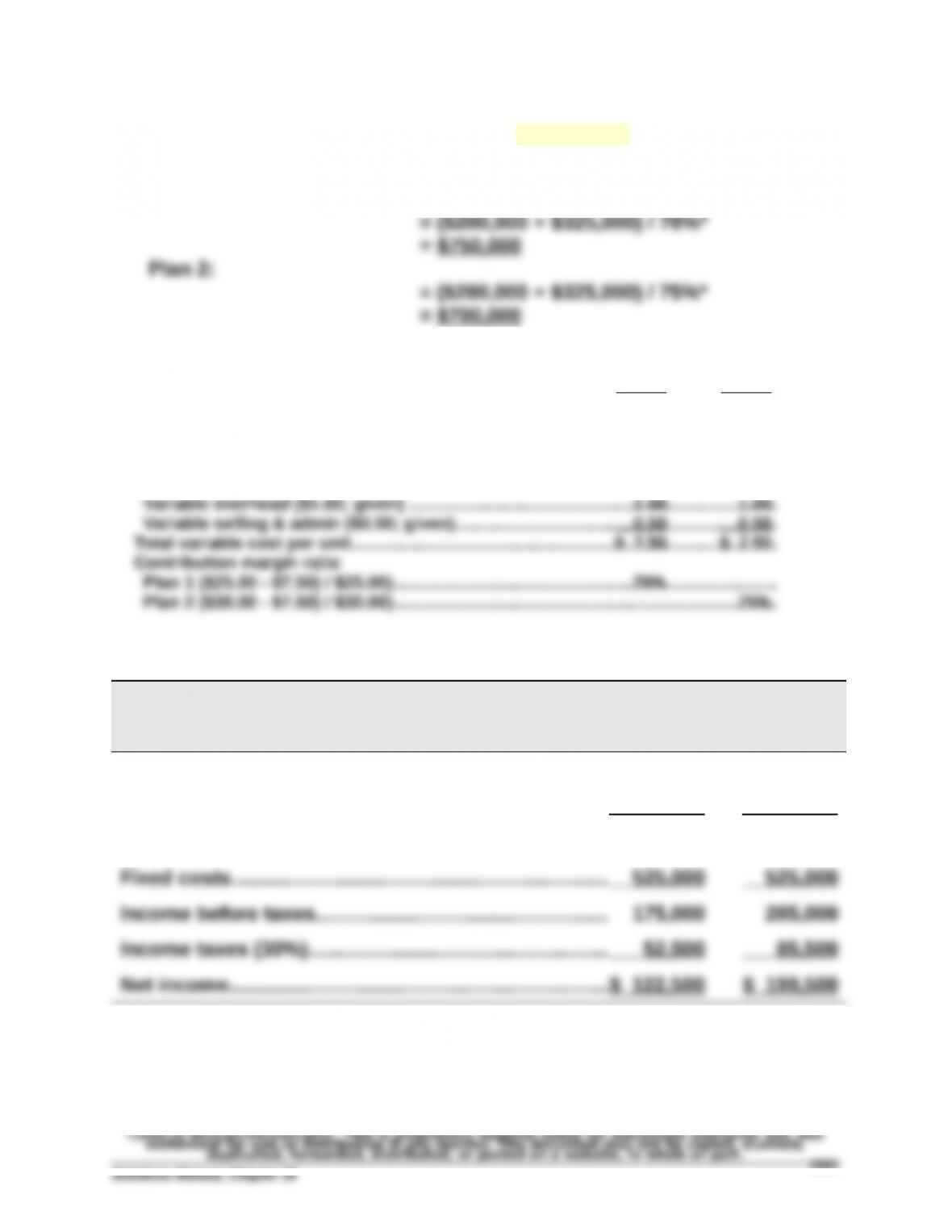
Break-even in dollar sales = Fixed costs / Contribution margin ratio
Plan 1:
*To compute contribution margin ratio
Sales price per unit
Plan 1 (no change)……………………………………………………………………………………….
Plan 2 [$25.00 x (1 + 20%)]…………………………………………………………………..…….…
Plan 1
$25.00
Plan 2
$30.00
Total variable costs per unit (both Plans 1 and 2)
Material [$8.00 x (1 – 50%)]……………………………………………………………..….….…….
Direct labor [$5.00 x (1 – 60%)]……………………………………………………………….…….
$ 4.00
2.00
$ 4.00
2.00
Part 2
BURCHARD CO.
Forecasted Contribution Margin Income Statement
Plan 1 Plan 2
Sales*………………………………………………..……….….…...$1,000,000 $1,080,000
Variable costs**…………………………………………………… 300,000 270,000
Contribution margin…………………………………….…..…. 700,000 810,000
Unit sales price and variable costs are computed in Part 1 and used in these computations:
* Plan 1 sales = 40,000 units x $25; Plan 2 sales = 36,000 units x $30.
** Plan 1 variable costs = 40,000 units x $7.50; Plan 2 variable costs = 36,000 units x $7.50.
Problem 18-7A (50 minutes)
Part 1 BREAK–EVEN ANALYSIS ASSUMING USE OF SAME MATERIALS
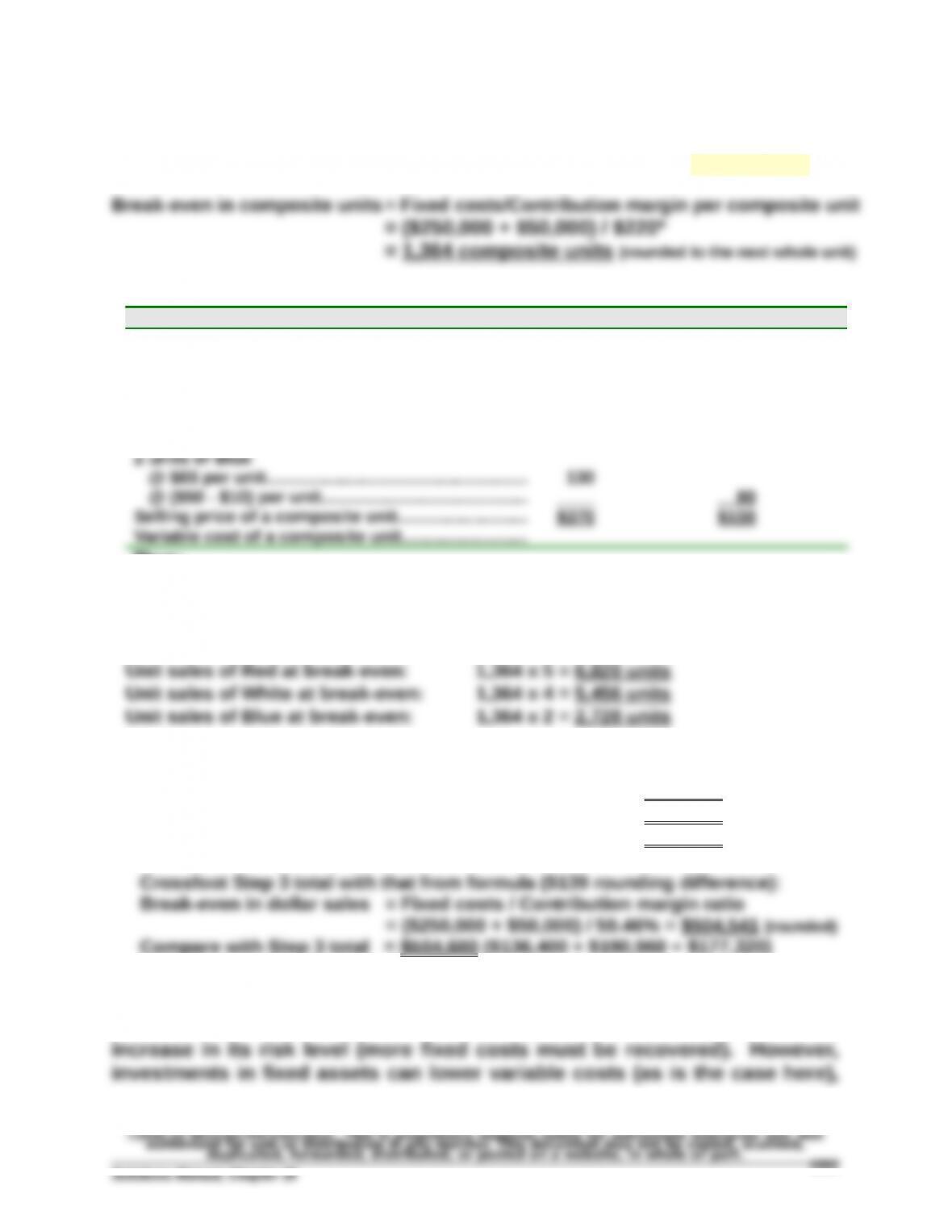
Step 1: Compute break-even in composite units—Use equation in Exhibit 18.29
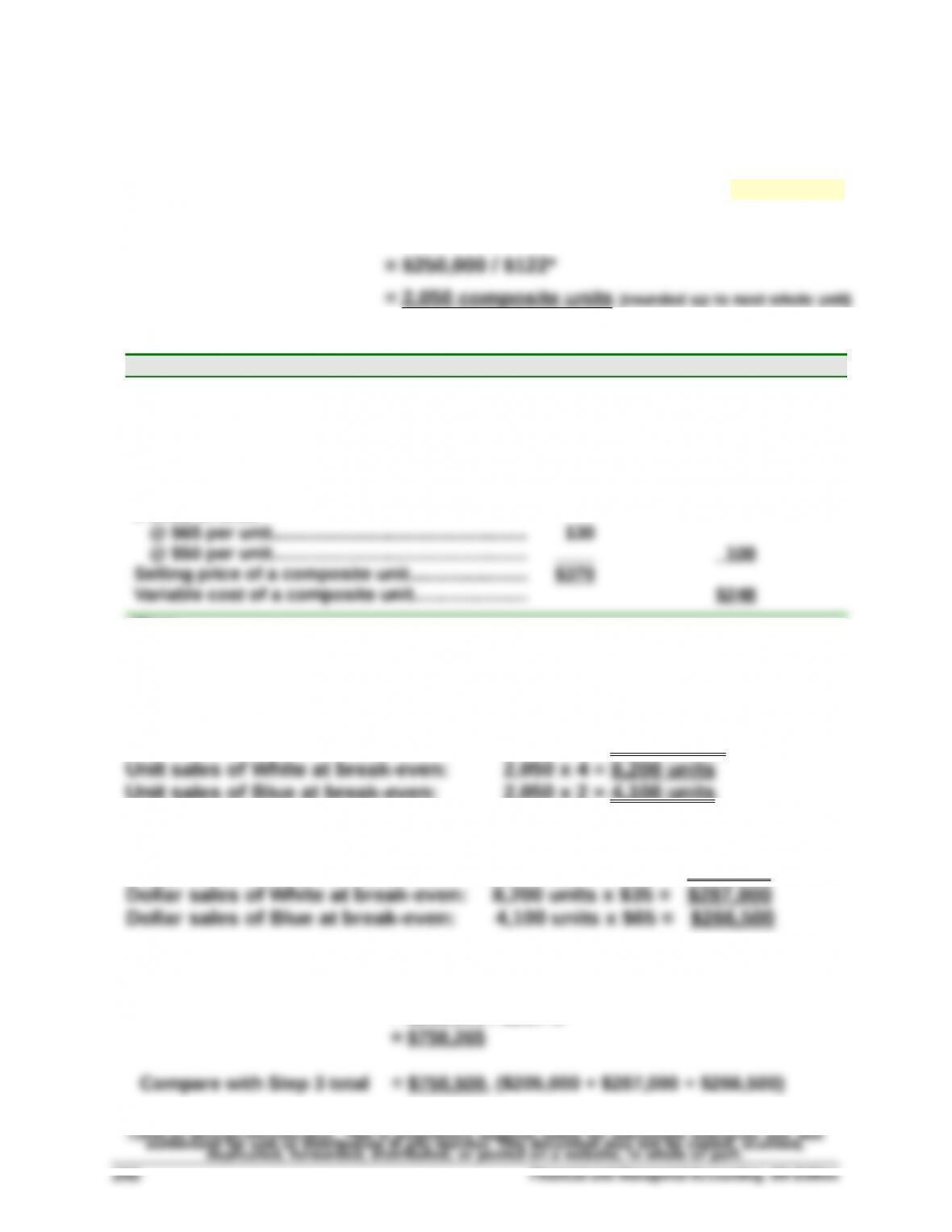
Break-even in composite units = Fixed costs/Contribution margin per composite unit
*To compute the contribution margin per composite unit
Unit Sales Price Unit Variable Costs
5 units of Red
@ $20 per unit………………….…………..…….….….
@ $12 per unit………………….…………..…….….….
$100
$ 60
4 units of White
@ $35 per unit………………….…………..…….….….
@ $22 per unit………………….…………..…….….….
140
88
2 units of Blue
Thus:
Contribution margin per composite unit = $370 – $248 = $122
Contribution margin ratio (rounded) = $122 / $370 = 32.97%
Step 2: Compute break-even in individual product unit sales
Unit sales of Red at break-even: 2,050 x 5 = 10,250 units
Unit sales of Blue at break-even: 2,050 x 2 = 4,100 units
Step 3: Compute break-even in individual product dollar sales
Dollar sales of Red at break-even: 10,250 units x $20 = $205,000
Crossfoot Step 3 total with that from formula ($235 rounding difference):
Break-even in dollar sales = Fixed costs / Contribution margin ratio
= $250,000 / 32.97%
Problem 18-7A (Continued)
Part 2 BREAK–EVEN ANALYSIS ASSUMING USE OF NEW MATERIALS
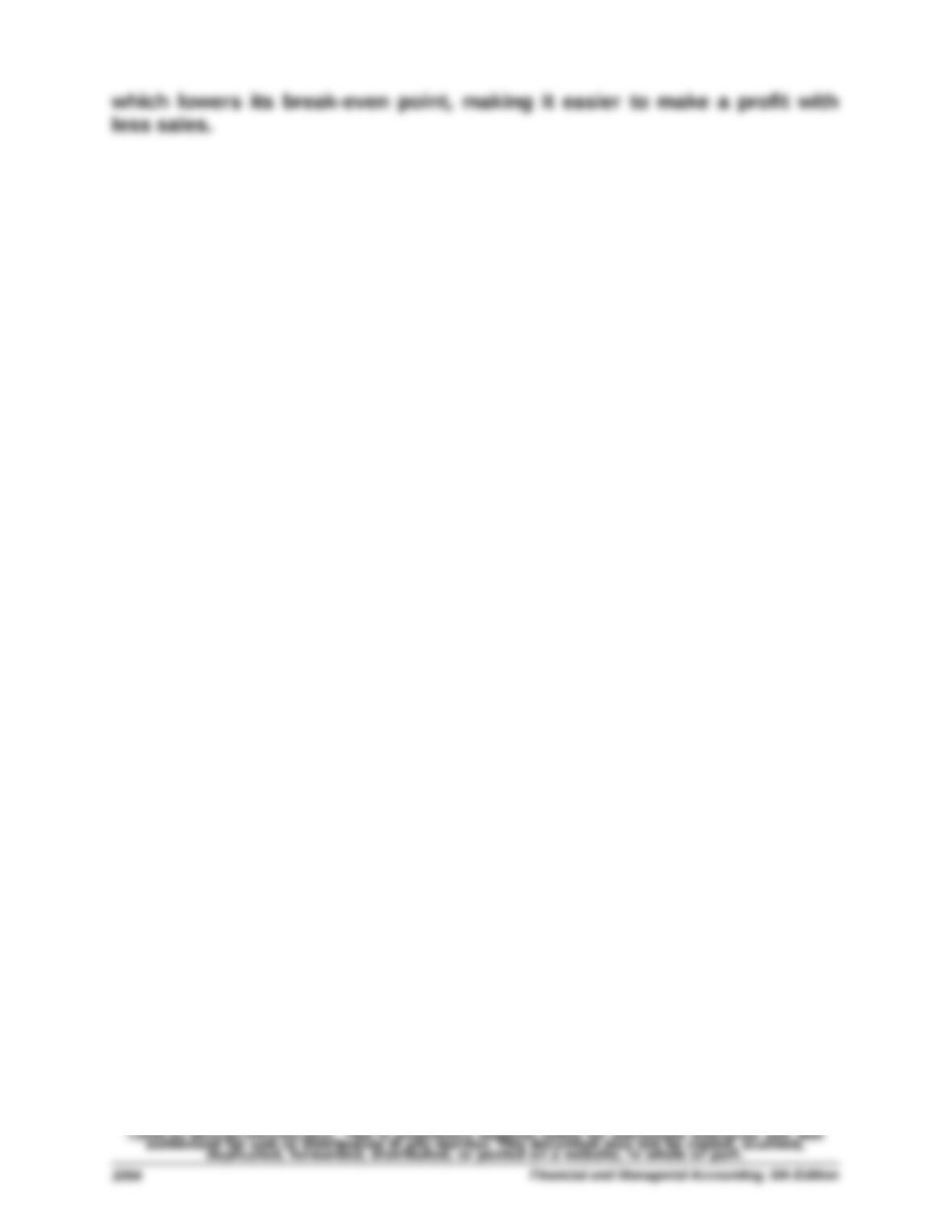
Step 1: Compute break-even in composite units—Use equation in Exhibit 18.29
*To compute the contribution margin per composite unit
Unit Sales Price Unit Variable Costs
5 units of Red
@ $20 per unit……………………………………………...
@ ($12 – $6) per unit……..……...……..…...…..……..
$100
$ 30
4 units of White
@ $35 per unit……………………………………………...
@ ($22 – $12) per unit…………...……..………..……..
140
40
Variable cost of a composite unit….……….………...
Thus:
Contribution margin per composite unit = $370 – $150 = $220
Contribution margin ratio (rounded) = $220/ $370 = 59.46%
Step 2: Compute break-even in individual product unit sales
Step 3: Compute break-even in individual product dollar sales
Dollar sales of Red at break-even: 6,820 units x $20 = $136,400
Dollar sales of White at break-even: 5,456 units x $35 = $190,960
Dollar sales of Blue at break-even: 2,728 units x $65 = $177,320
Part 3
When a business invests in fixed assets, as in this case, there is an
PROBLEM SET B
Problem 18-1B (25 minutes)
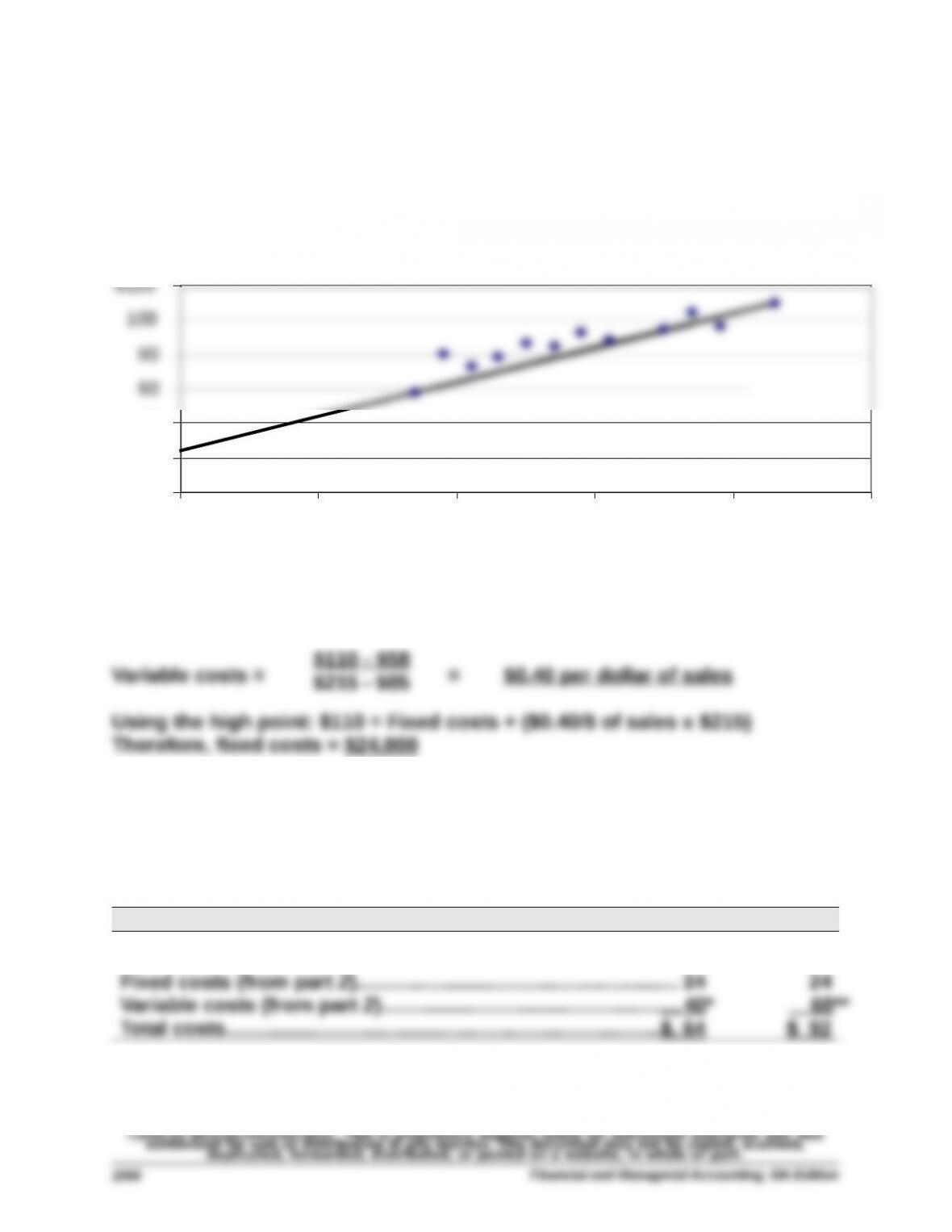
Parts 1 and 2
Gilmore Company
Contribution Margin Income Statement
For Year Ended December 31, 2015
(12,000 units) Per unit % of sales
Sales ($18 x 12,000)……………………….. $216,000 $18.000 100.00%
Variable costs
Plastic for CD sets..………………………$ 1,500 $0.125
Assembly worker wages..……………….30,000 2.500
Factory mach. depreciation……………..20,000
Office equipment lease………….…….….1,050
System staff salaries…………………..…..15,000
Admin. mgmt. salaries……..…….…….…120,000 167,320
The contribution margin per unit is $14.625, and the contribution margin ratio is
81.25%.
Part 3 Analysis Component
Contribution margin shows how much of total sales are available to cover
fixed costs and contribute to operating income. This is why the title for this
Problem 18-2B (45 minutes)
Parts 1 and 2
The scatter diagram and its estimated line of cost behavior appear below.
Sales and cost amounts are in thousands of dollars.
Part 2 Calculation of variable and fixed costs
Part 3
The estimates in Part 2 can be used to predict the total costs that will be
incurred at sales levels of $100 and $170 (both in thousands).
(‘000s) Predictions
Sales (given)…………………………………………………….….…..….…$100 $170
* ($100 sales) x ($0.40 per sales dollar).
** ($170 sales) x ($0.40 per sales dollar).
Sun Company
0
20
40
60
80
100
$120
0 $50 $100 $150 $200 $250
Sales Dollars
Total
Costs
$110 – $58
Problem 18-3B (40 minutes)
Part 1
(a) Instructor note: Use the equation in Exhibit 18.11
Break-even in unit sales = Fixed costs / Contribution margin per unit
(b) Instructor note: Use the equation in Exhibit 18.12
Break-even in dollar sales = Fixed costs / Contribution margin ratio
Problem 18-3B (Continued)
Part 2
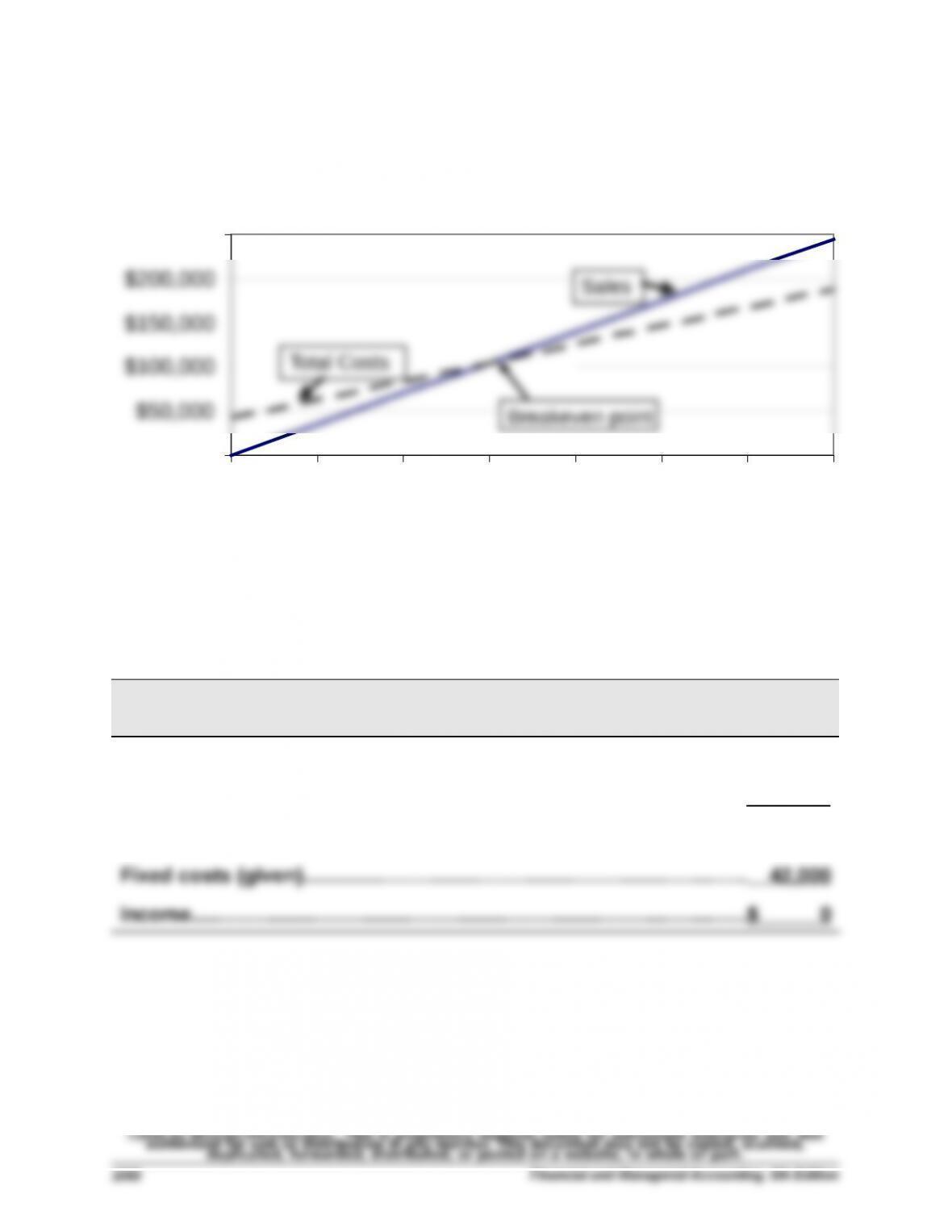
Hip-Hop Company CVP chart
$200,000
$250,000