Problem 10-8BB (Concluded)
Part 4
2015
June 30 Bond Interest Expense……………..…..….….….….….….….7,940
discount amortization.
2015
Dec. 31 Bond Interest Expense……………..…..….….….….….….….7,969
Problem 10-9BB (45 minutes)
Part 1
Ten payments of $14,400……………….…..…$144,000
Par value at maturity…………….……………… 320,000
or:
Ten payments of $14,400……………….…..…$144,000
Part 2
Semiannual
Interest
Period-End
(A)
Cash Interest
Paid
[4.5% x $320,000]
(B)
Bond Interest
Expense
[4% x Prior (E)]
(C)
Premium
Amortization
[(A) – (B)]
(D)
Unamortized
Premium
[Prior (D) – (C)]
(E)
Carrying
Value
[$320,000 + (D)]
1/01/2015 $12,988 $332,988
6/30/2015 $ 14,400 $ 13,320 $ 1,080 11,908 331,908
12/31/2015 14,400 13,276 1,124 10,784 330,784
12/31/2017 14,400 13,085 1,315 5,821 325,821
6/30/2018 14,400 13,033 1,367 4,454 324,454
12/31/2018 14,400 12,978 1,422 3,032 323,032
Problem 10-9BB (Concluded)
Part 3
2015
June 30 Bond Interest Expense……………..…..….….….….….….….13,320
premium amortization.
2015
Dec. 31 Bond Interest Expense……………..…..….….….….….….….13,276
Part 4
As of December 31, 2017
Cash Flow Table Table Value* Amount Present Value
Par value................. B.1 0.8548 $320,000 $273,536
Comparison to Part 2 Table
Except for a small rounding difference, this present value ($325,807) equals
the carrying value of the bonds in column (E) of the amortization table
Problem 10-10BB (70 minutes)
Part 1
2015
Jan. 1 Cash……………………………………………………………………...493,608
Sold bonds on stated issue date.
Part 2
Eight payments of $29,250*….….…...........$ 234,000
Par value at maturity…………….……………… 450,000
Total bond interest expense…..................$ 190,392
*$450,000 x 0.13 x ½ = $29,250
or:
Eight payments of $29,250…………………...$ 234,000
Part 3
Semiannual
Interest
Period-End
(A)
Cash Interest
Paid
[6.5% x $450,000]
(B)
Bond Interest
Expense
[5% x Prior (E)]
(C)
Premium
Amortization
[(A) – (B)]
(D)
Unamortized
Premium
[Prior (D) – (C)]
(E)
Carrying
Value
[$450,000 + (D)]
1/01/2015 $43,608 $493,608
6/30/2015 $29,250 $24,680 $4,570 39,038 489,038
Problem 10-10BB (Concluded)
Part 4
2015
June 30 Bond Interest Expense……………..…..….….….….….….….24,680
Premium on Bonds Payable………………………………..….4,570
2015
Dec. 31 Bond Interest Expense……………..…..….….….….….….….24,452
Part 5
2017
Jan. 1 Bonds Payable …………………..…………….……………………450,000
Premium on Bonds Payable………………………………..….23,912
Part 6
If the market rate on the issue date had been 14% instead of 10%, the bonds
would have sold at a discount because the contract rate of 13% would have been
lower than the market rate.
been issued at a premium.
The statement of cash flows would show a smaller amount of cash received from
borrowing. However, the cash flow statements presented over the life of the
Problem 10-11BD (35 minutes)
Part 1
Present Value of the Lease Payments
Part 2
Leased Asset—Office Equipment…………………………...75,816
To record capital lease of office equipment.
Part 3
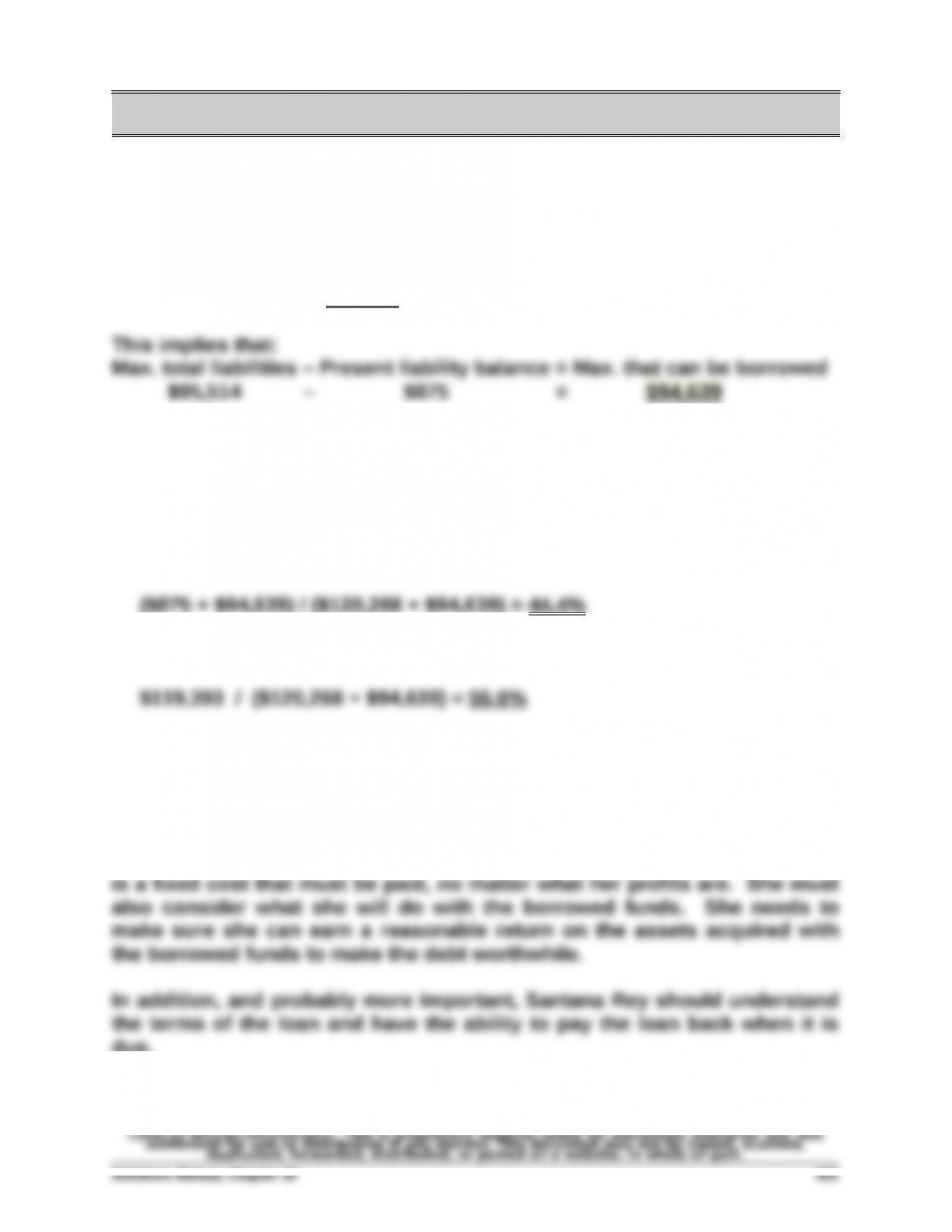
Capital Lease Liability Payment (Amortization) Schedule
Period
Ending
Date
Beginning
Balance of
Lease
Liability
Interest on
Lease
Liability
(10%)
Reduction
of Lease
Liability
Cash
Lease
Payment
Ending
Balance of
Lease
Liability
Year 1 $75,816 $ 7,582* $12,418 $ 20,000 $63,398
Year 5 18,183 1,817 ** 18,183 20,000 0
$24,184 $75,816 $100,000
* Rounded to nearest dollar.
** Adjusted for prior period rounding errors.
Part 4
Depreciation Expense—Leased Asset, Off. Equip….….…........15,163
SERIAL PROBLEM — SP 10
Serial Problem — SP 10, Business Solutions (75 minutes)
Part 1
Total equity = $119,393
Thus, total liabilities can be no more than its total equity x 0.8, or
$119,393 x 0.8 = $95,514
Part 2
Assume the secured loan is taken, then the percent of assets financed by:
a. Debt
b. Equity
Part 3
Santana Rey should understand the risks she is taking by borrowing funds
from the bank. She currently has no interest-bearing debt (per prior chapter
serial problems), but the loan will require her to pay interest. The interest
due.
Reporting in Action — BTN 10-1
1. Apple reported long-term debt of $16,960 million as of September 28,
2013.
2. The interest that Apple must pay on $100 million of 4.25% convertible
3. Assuming that Apple had $100 million carrying value of convertible
bonds that convert into 20,000 shares of stock, the following entry
would be recorded upon conversion:
Instructor note: Apple’s stock is no par stock and therefore there is no
4. Answer depends on the financial statement information obtained.