Problem D-2B (50 minutes)
1.
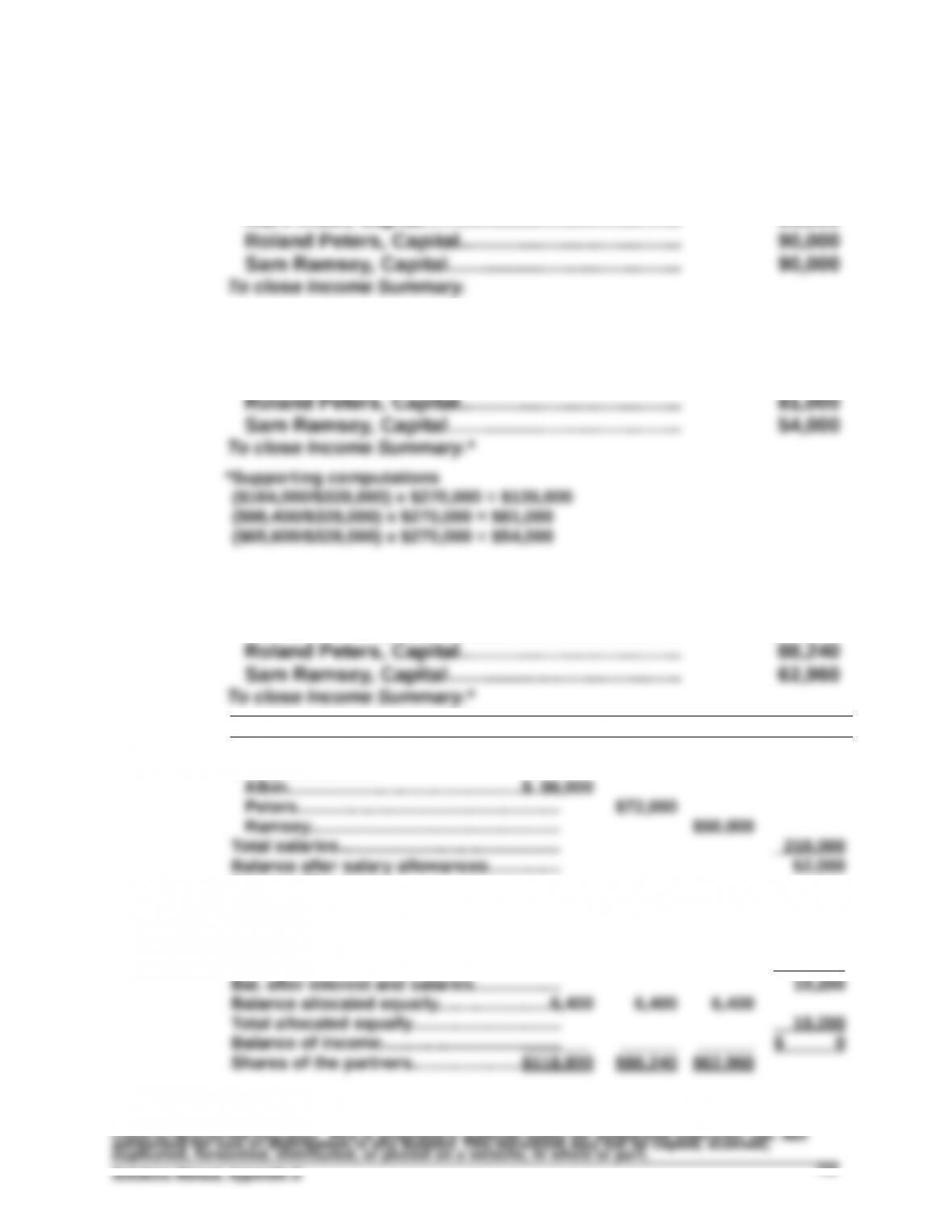
Dec. 31 Income Summary……………..…….….….…….….…….…270,000
Mark Albin, Capital………………..…….…….….……. 90,000
2.
Dec. 31 Income Summary……………..…….….….…….….…….…270,000
Mark Albin, Capital………………..…….…….….……. 135,000
3.
Dec. 31 Income Summary……..……………..….….….…….….…..270,000
Mark Albin, Capital………………..…….…….….……. 118,800
*Supporting calculations Albin Peters Ramsey Total
Net income……………………………………….... $270,000
Salary allowances
Interest allowances
Albin (10% on $164,000)…………..….....…16,400
Peters (10% on $98,400)………..……..…... 9,840
Ramsey (10% on $65,600)………...…....... 6,560
Total interest…..……..……………........…....... 32,800
Problem D-3B (30 minutes)
Part 1
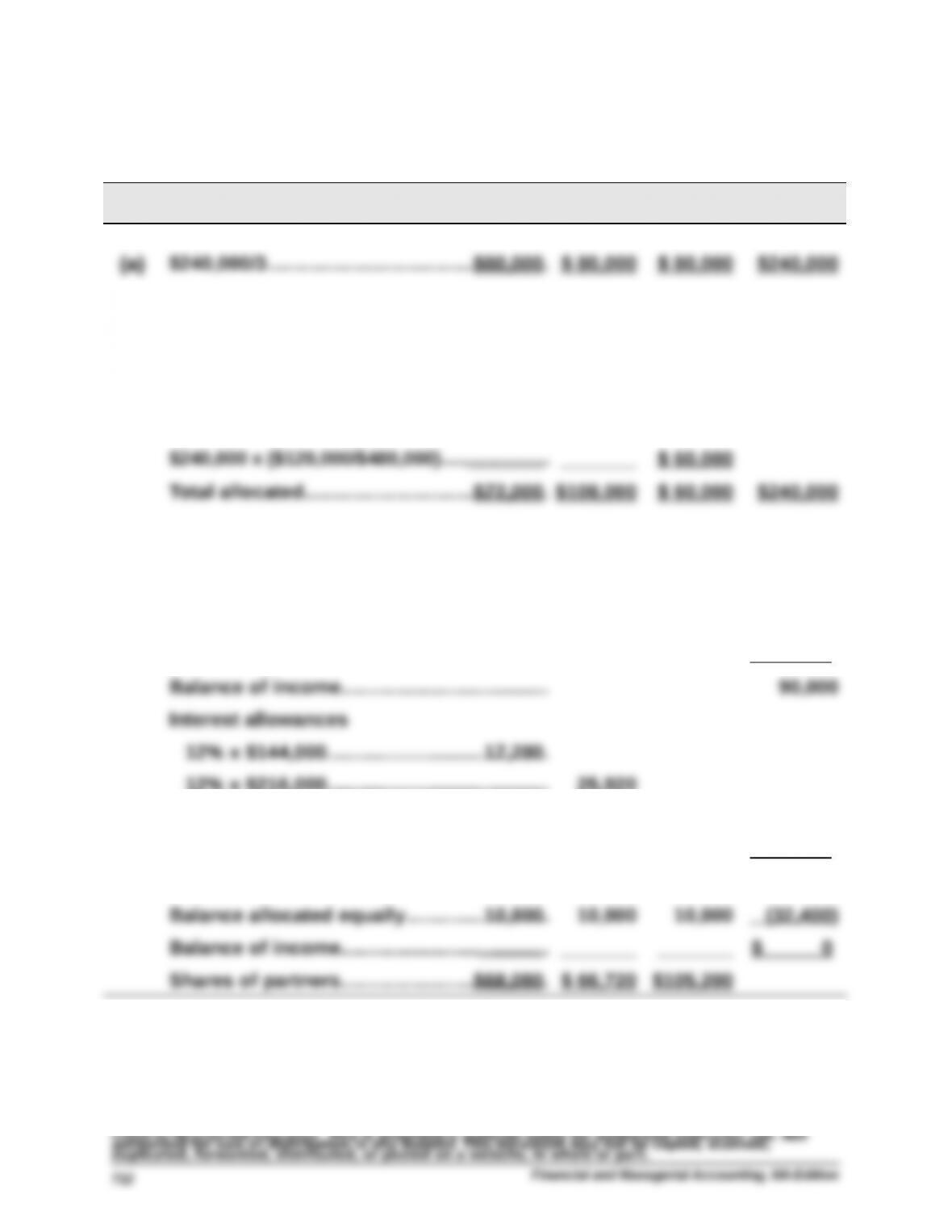
Income (Loss)
Sharing Plan Calculations Cook Xi Schwartz Total
(b) $240,000 x ($144,000/$480,000)………….……..
$72,000
$240,000 x ($216,000/$480,000)………………… $108,000
(c) Net income………………..…….…..…..……….... $240,000
Salary allowances…………………….……….....$40,000 $ 30,000 $ 80,000 (150 ,000 )
12% x $216,000…..…………………………….. 25,920
12% x $120,000…..…………………………….. 14,400
Total interest………….…….…..…..…..…...…... (57 ,600 )
Balance of income……………………....…..….. 32,400
Problem D-3B (Concluded)
Part 2
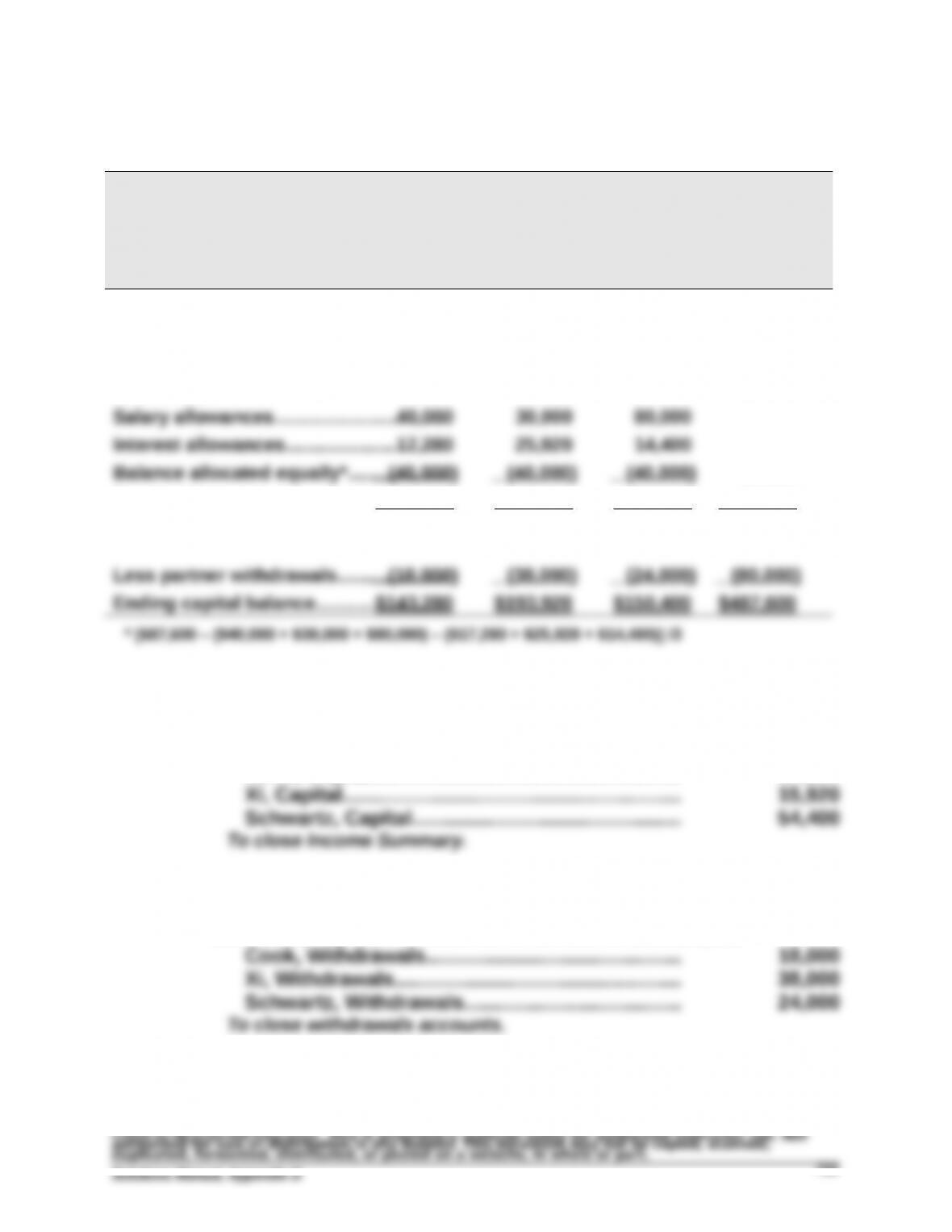
CXS PARTNERSHIP
Statement of Partners’ Equity
For Year Ended December 31
Cook Xi Schwart
z
Total
Beginning capital balances………..…....$ 0 $ 0 $ 0 $ 0
Plus
Investments by owners……..…….…….…144,000 216,000 120,000 480,000
Net income
Total net income……………..…..………….. 17,280 15,920 54,400 87,600
Total………..…….……..…….……..…………….161,280 231,920 174,400 567,600
Part 3
Dec. 31 Income Summary………………………..…….….…….……87,600
Cook, Capital………..…………..……..….…….…….… 17,280
Dec. 31 Cook, Capital…..………………………….…….….…….……18,000
Xi, Capital……….…………………………………..….…….….38,000
Schwartz, Capital………..…………………………………....24,000
Problem D-4B (50 minutes)
Part 1
a)
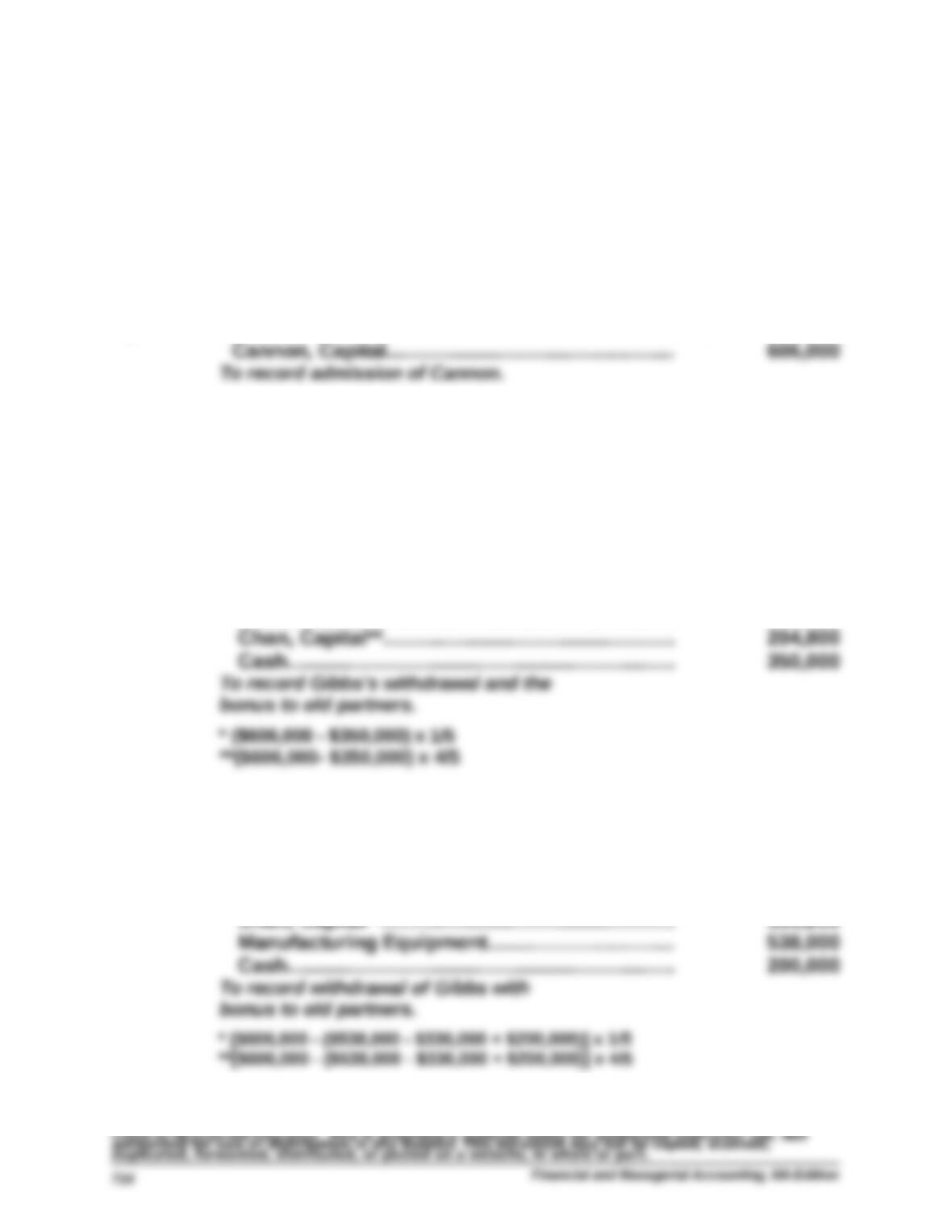
Apr. 30 Gibbs, Capital…………..……………..…..…….…….….…..606,000
Brady, Capital…………………..….……..….…….……. 606,000
To record admission of Brady.
b)
Apr. 30 Gibbs, Capital…………..……………..…..…….…….….…..606,000
c)
Apr. 30 Gibbs, Capital…………..……………..…..…….…….….…..606,000
Cash…………………………………..…………………….… 606,000
To record withdrawal of Gibbs with no bonus.
d)
Apr. 30 Gibbs, Capital…………..……………..…..…….…….….…..606,000
Cook, Capital*………………………………..……………. 51,200
e)
Apr. 30 Gibbs, Capital…………..……………..…..…….…….….…..606,000
Accum. Deprec.—Manufacturing Equipment........336,000
Cook, Capital*………………………….…….….…….…. 40,800
Chan, Capital**……………….…………….…………….. 163,200
Problem D-4B (Concluded)
Part 2
a)
Apr. 30 Cash………………………………………………………………...300,000
Chip, Capital*…………….…………….………….….….. 300,000
To record admission of Chip.
b)
Apr. 30 Cash………………………………………………………………...196,000
Gibbs, Capital ($83,200* x 5/10)………………………….. 41,600
Cook, Capital ($83,200* x 1/10)…………………..……..… 8,320
c)
Apr. 30 Cash………………………………………………………………...426,000
Gibbs, Capital ($100,800* x 5/10)…………………….. 50,400
To record admission of Chip and bonus
to old partners.
* Supporting calculations
Problem D-5B (75 minutes)
Note: All entries in this problem are dated Jan. 18.
1.
(a) Cash……………….………………………………………………..650,000
Equipment……………………………………………..….… 617,200
Gain on Sale of Equipment…………………………… 32,800
(b) Gain on Sale of Equipment………………………………..32,800
(c) Accounts Payable…………….…….….……..…….…….…342,600
Cash……………….…………………..…………………….… 342,600
(d) Lasure, Capital ($300,400 + $13,120)…….….…….…. 313,520
Ramirez, Capital ($195,800 + $6,560)…………….…...202,360
2.
(a) Cash……………….………………………………………………..530,000
Loss on Sale of Equipment…………………….…..…….87,200
Equipment……………………………………………..….… 617,200
(b) Lasure, Capital ($87,200 x 2/5)………….…….….……..34,880
(c) Accounts Payable…………….…….….……..…….…….…342,600
Cash……………….…………………..…………………….… 342,600
(d) Lasure, Capital ($300,400 – $34,880)………..….……..265,520
Problem D-5B (Concluded)
3.
(b) Lasure, Capital ($417,200 x 2/5)………….….….……...166,880
Ramirez, Capital ($417,200 x 1/5)………………….…...83,440
(c) Accounts Payable…………….…….….……..…….…….…342,600
Cash…………………………………..…………………….… 342,600
(d) Lasure, Capital ($300,400 – $166,880)……….….…….133,520
4.
(a) Cash……………….………………………………………………..150,000
Loss on Sale of Equipment…………………….…..…….467,200
Equipment………..…………………………………..….… 617,200
(b) Lasure, Capital ($467,200 x 2/5)………….….….……...186,880
Lasure, Capital ($59,880 x 2/3)…………………..……...39,920
(c) Accounts Payable…………….…….….……..…….…….…342,600
Cash…………………………………..…………………….… 342,600
(d) Lasure, Capital*…………………………………….….……...73,600
Serial Problem — SP D
1. The owner should consider several factors:
a. If the company continues to earn profits, at a 1:1 ownership, she will
have to share profits equally with her new partner. On the other hand,
at a 4:1 ownership, she will only have to share one-fifth of the profits
current owner would absorb less of the loss.
b. At the 1:1 ownership, her partner will have more of a say in how the
less of a voice in the business.
c. If the partner invests in the business equal to their partnership
d. It would likely be easier to attract a partner if there is a lower amount
of investment required by the new partner at the 4:1 level. On the
2a.
Jan. 1 Cash……………………………………………….……………….. 80,360
3.
Jan. 1 Cash……………………………………………….……………….. 20,090
New Partner, Capital……………………..……………... 20,090
To admit a new partner at a 4:1 ownership interest.
4. Total capital before admission of partner………………….…. $ 80,360
Financial and Managerial Accounting, 6th Edition
718
Reporting in Action — BTN D-1
1. The founders of Apple are Steve Wozniak, Steve Jobs and Ron Wayne.
Each Apple I personal computer kit was single-handedly designed and
2. At least two differences would be immediately apparent between
Apple’s corporate income statement and a partnership income
statement.
(i) First, in a general partnership, income flows through to the partners
(ii) Second, a corporate income statement shows earnings per share
figures, whereas a partnership income statement would not report
3. Specifically, the balance sheet for a partnership would not have the
following accounts as reported in the Apple balance sheet reproduced
in Appendix A:
Deferred tax assets