Chapter 19: Convertibles, Warrants, and Derivatives
19-11
19–11. Solution:
Pittsburgh Steel Company (Continued)
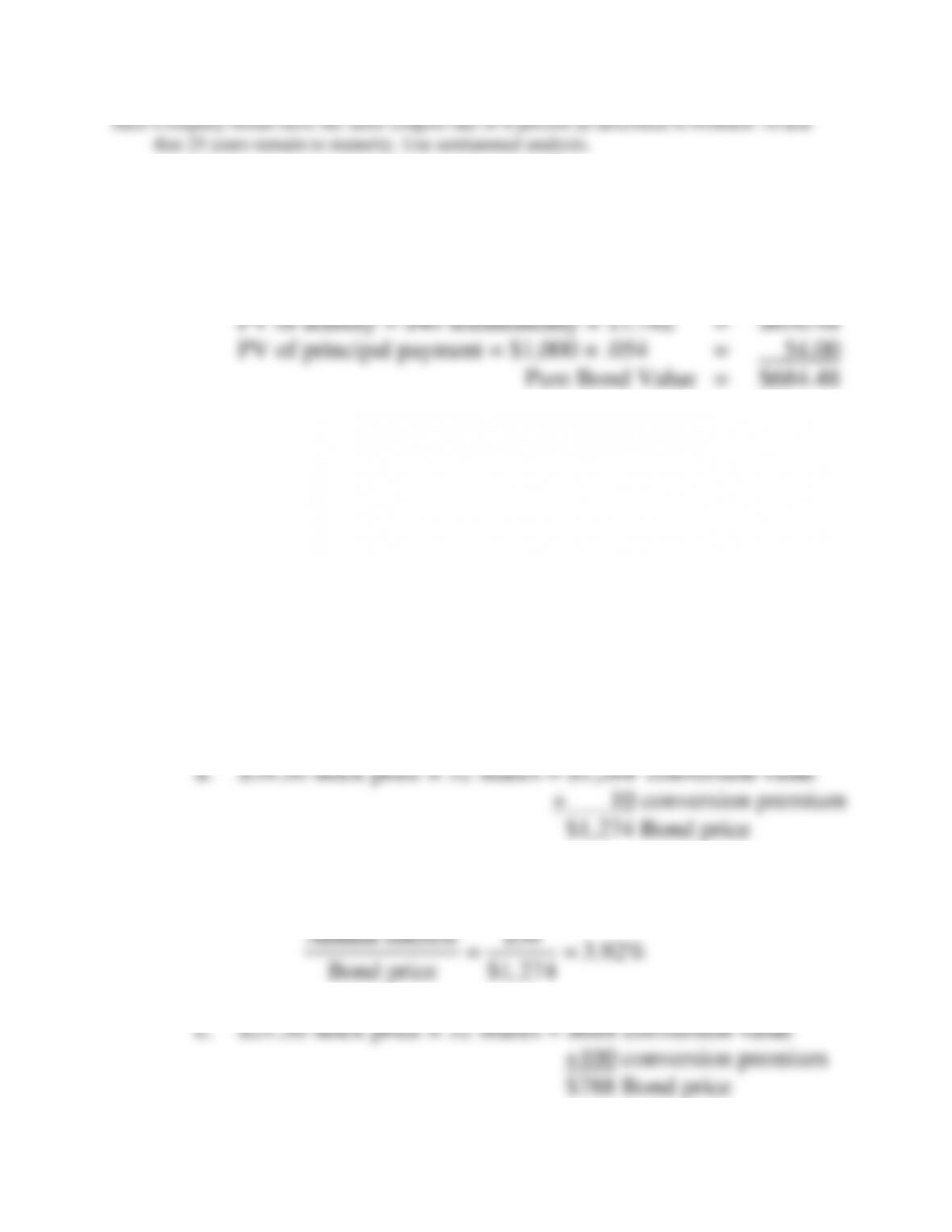
Pure bond value where n = 50, i = 6%
12. Current yield on a convertible bond (LO1) The Olsen Mining Company has been very
successful in the last five years. Its $1,000 par value convertible bonds have a conversion
ratio of 32. The bonds have a quoted interest rate of 5 percent a year. The firm’s common
stock is currently selling for $39.50 per share. The current bond price has a conversion
premium of $10 over the conversion value.
a. What is the current price of the bond?
b. What is the current yield on the bond (annual interest divided by the bond’s market
price)?
c. If the common stock price goes down to $21.50 and the conversion premium goes up
to $100, what will be the new current yield on the bond?
19–12. Solution:
Olsen Mining Company
b. 5% × $1,000 = $50 Annual interest
Annual interest $50 3.92%
Bond price $1,274
==
Chapter 19: Convertibles, Warrants, and Derivatives
19-12
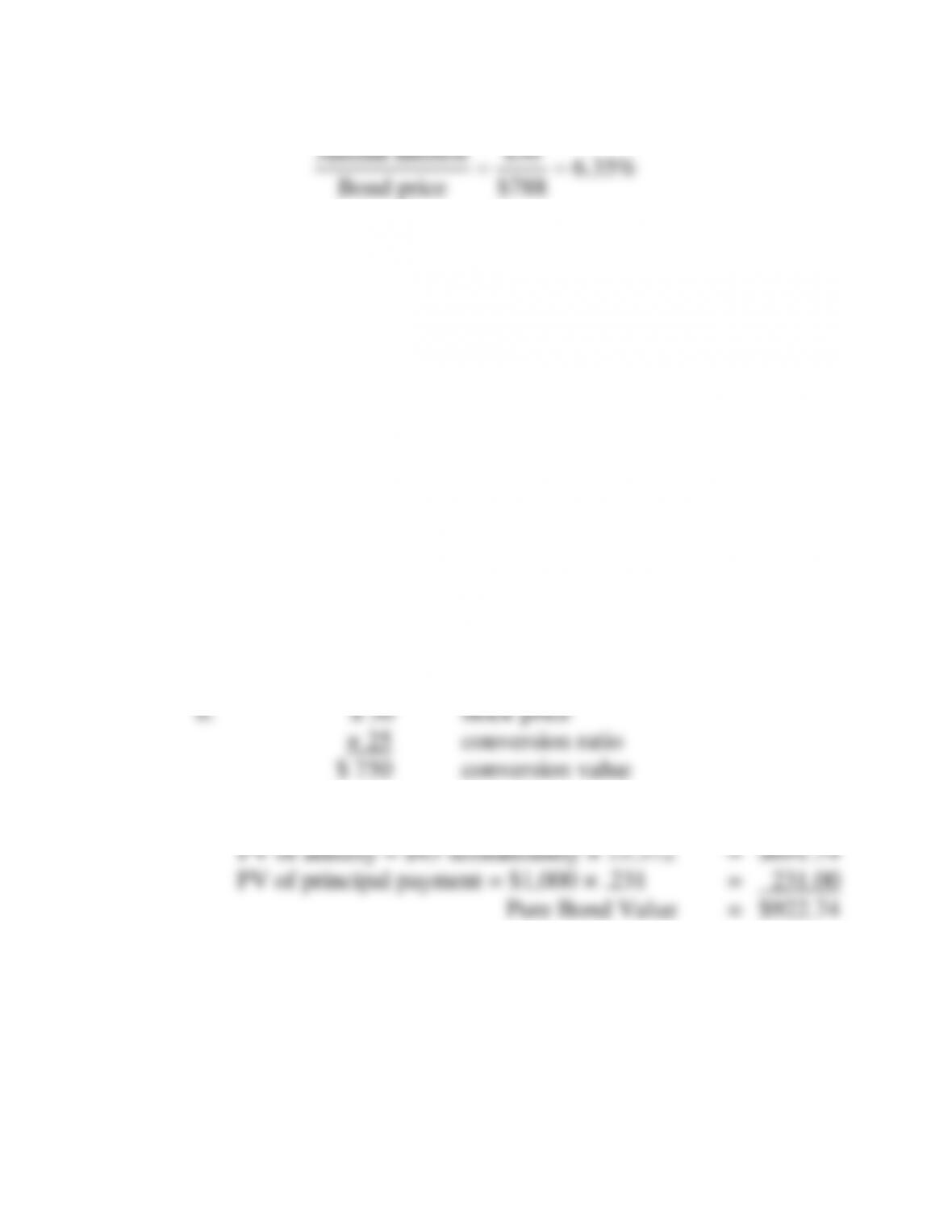
Annual interest $50 6.35%
Bond price $788
==
13. Conversion value versus pure bond value (LO1) Standard Olive Company of California
has a convertible bond outstanding with a coupon rate of 9 percent and a maturity date of
15 years. It is rated Aa, and competitive, nonconvertible bonds of the same risk class carry
a 10 percent return. The conversion ratio is 25. Currently the common stock is selling for
$30 per share on the New York Stock Exchange.
a. What is the conversion price?
b. What is the conversion value?
c. Compute the pure bond value. (Use semiannual analysis.)
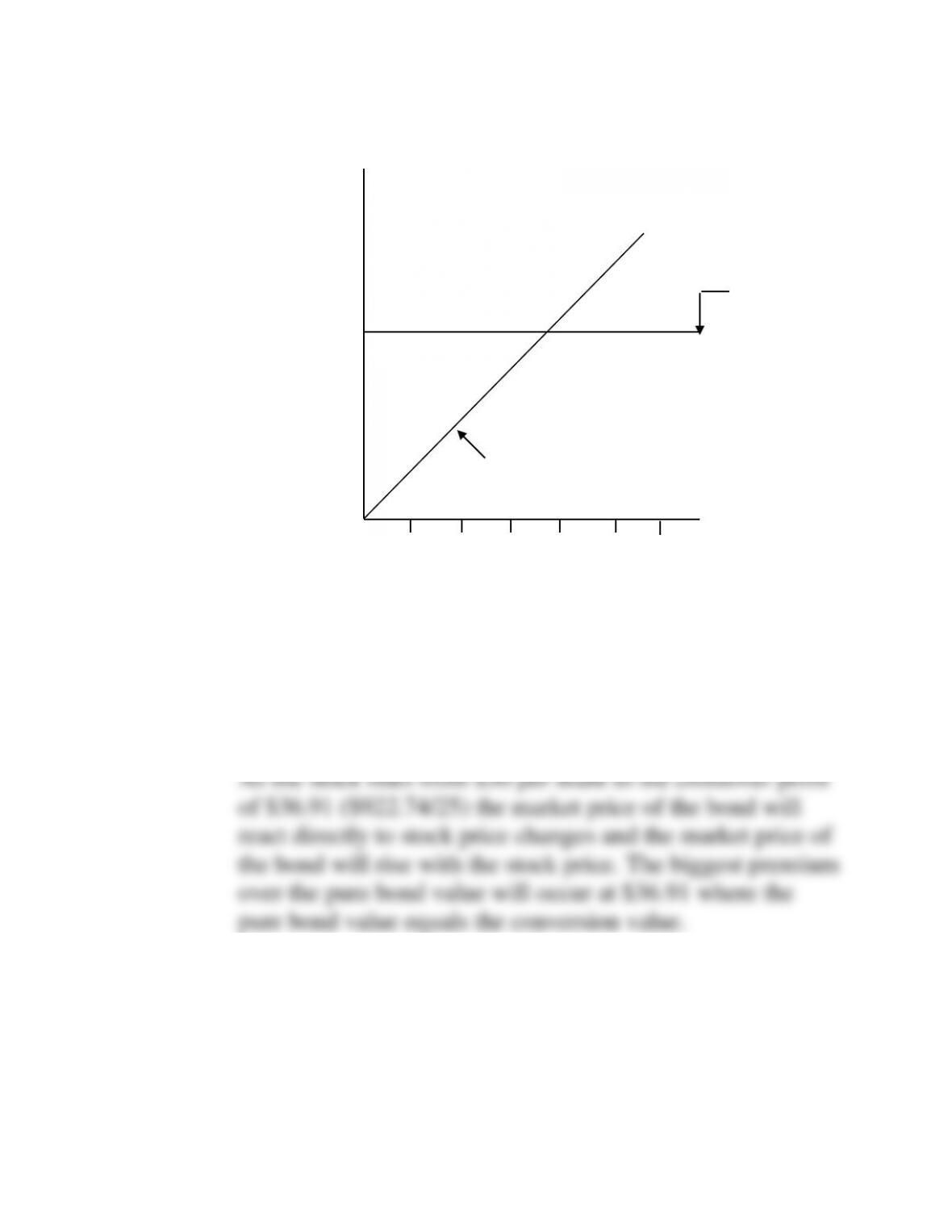
d. Draw a graph that includes the pure bond value and the conversion value but not the
convertible bond price. For the stock price on the horizontal axis, use 10, 20, 30, 40,
50, and 60.
e. Which will influence the bond price more—the pure bond value or the conversion
value?
19–13. Solution:
Standard Olive Company of California
a. $1,000 par/25 conversion ratio = $40 conversion price
c. Pure bond value where n = 30, i = 5%
19–13. (Continued)
d. Bond Values ($)
Chapter 19: Convertibles, Warrants, and Derivatives
19-13
e. At a stock price of $30 per share, the price of the bond will
be influenced more by the pure bond value (floor price) of
$922.74. If interest rates move up the pure bond value will
fall and if they move down, the pure bond value will rise.
14. Call feature with a convertible bond (LO1) Swift Shoe Co. has convertible bonds
outstanding that are callable at $1,080. The bonds are convertible into 22 shares of
common stock. The stock is currently selling for $59.25 per share.
a. If the firm announces it is going to call the bonds at $1,080, what action are
bondholders likely to take, and why?
10 20 30 40 50 60
Price of Common Stock ($)
1,500
1,250
1,000
750
500
250
Conversion value
Pure bond
Value
$922.74
Chapter 19: Convertibles, Warrants, and Derivatives
19-14
b. Assume that instead of the call feature, the firm has the right to drop the conversion
ratio from 22 down to 20 after 5 years and down to 18 after 10 years. If the bonds have
been outstanding for four years and 11 months, what will the price of the bonds be if
the stock price is $60? Assume the bonds carry no conversion premium.
c. Further assume that you anticipate that the common stock price will be up to $63.50 in
two months. Considering the conversion feature, should you convert now or continue to
hold the bond for at least two more months?
19–14. Solution:
Swift Shoe Company
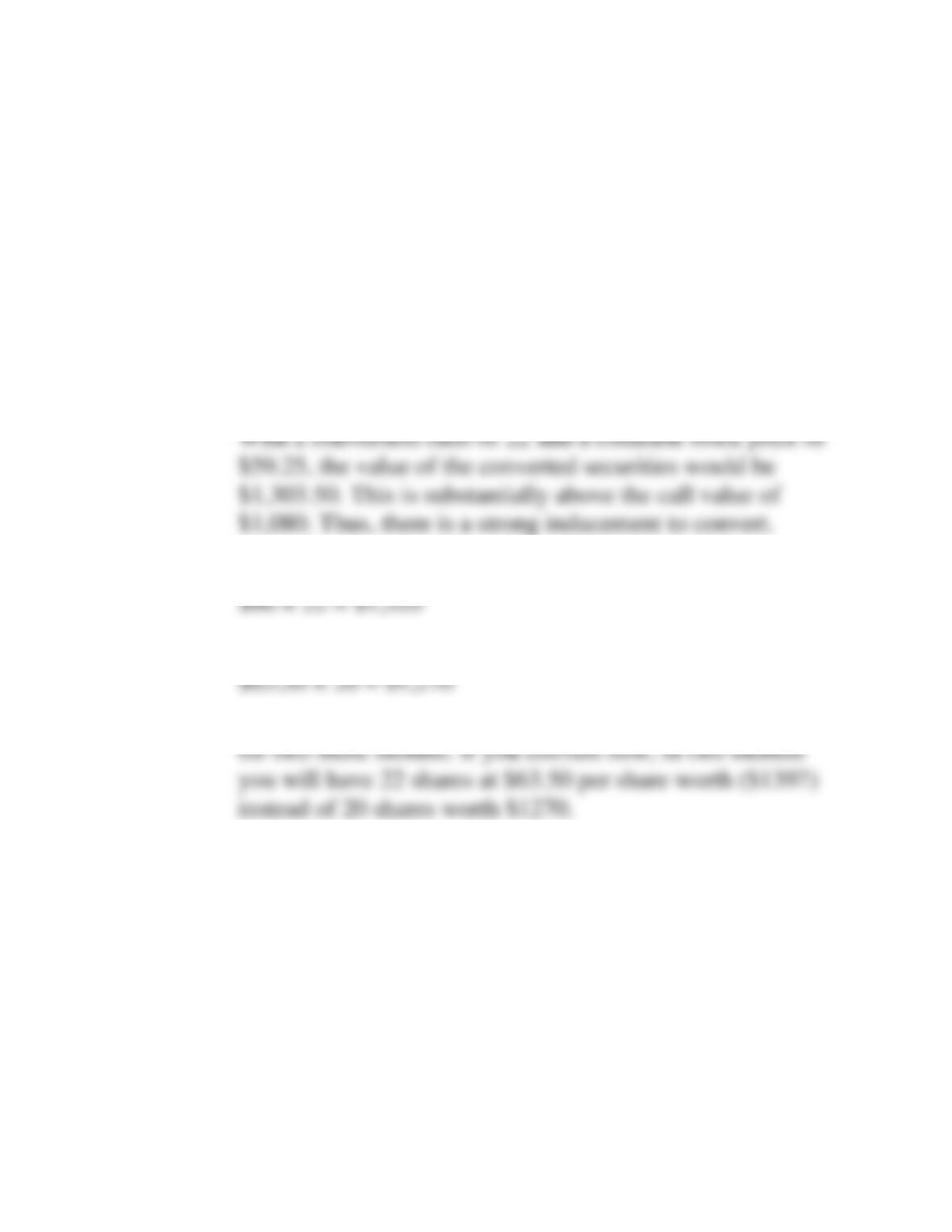
a. They will probably convert the bonds to common stock.
b. Bond price = stock price × conversion ratio
c. Bond price in two months = stock price × conversion ratio
You should convert now rather than hold on to the bonds
15. Convertible bond and rates of return (LO2) Vernon Glass Company has $20 million in
10 percent convertible bonds outstanding. The conversion ratio is 50, the stock price is $19,
and the bond matures in 10 years. The bonds are currently selling at a conversion premium
of $70 over their conversion value.
If the price of the common stock rises to $25 on this date next year, what would your
rate of return be if you bought a convertible bond today and sold it in one year? Assume on
this date next year, the conversion premium has shrunk from $70 to $15.
19-15. Solution:
Chapter 19: Convertibles, Warrants, and Derivatives
19-15
Vernon Glass Company
First, find the price of the convertible bond. The conversion
Next, you find the price of the convertible bond on this day
next year.
conversion value
value of the convertible bond.
Then determine the rate of return.
16. Price appreciation with a warrant (LO4) Assume you can buy a warrant for $5 that gives
you the option to buy one share of common stock at $15 per share. The stock is currently
selling at $18 per share.
a. What is the intrinsic value of the warrant?
b. What is the speculative premium on the warrant?
c. If the stock rises to $27 per share and the warrant sells at its theoretical value without a
premium, what will be the percentage increase in the stock price and the warrant price
if you buy the stock and the warrant at the prices stated above? Explain this
relationship.
19–16. Solution:
warrant = $3 intrinsic value
premium
Chapter 19: Convertibles, Warrants, and Derivatives
c. Percentage change if stock is purchased at $18
$27 $18 $9 50% increase in stock price
$18 $18
−==
Chapter 19: Convertibles, Warrants, and Derivatives
19-17
18. Comparing returns on warrants and common stock (LO4) Assume in Problem 17 that
Cable Corporation common stock was selling for $50 per share when Gifford Investment
Company bought the warrants.
a. What was the intrinsic value of a warrant at that time?
b. What was the speculative premium per warrant when the warrants were purchased?
The purchase price, as indicated above, was $30.
c. What would Gifford’s total dollar profit or loss have been had they invested the $3,000
directly in Cable Corporation’s common stock one year ago at $50 per share? Recall
the current value is $60 per share.
d. What would the percentage rate of return be on this common stock investment?
Compare this to the rate of return on the warrant computed in problem 17b.
19–18. Solution:
Gifford Investment Company (Continued)
a. ($50 stock price – $36 exercise price) × 2 shares = $28
intrinsic value
Chapter 19: Convertibles, Warrants, and Derivatives
19. Return calculations with warrants (LO4) Mr. John Hailey has $1,000 to invest in the
market. He is considering the purchase of 50 shares of Comet Airlines at $20 per share. His
broker suggests that he may wish to consider purchasing warrants instead. The warrants are
selling for $5, and each warrant allows him to purchase one share of Comet Airlines
common stock at $18 per share.
a. How many warrants can Mr. Hailey purchase for the same $1,000?
b. If the price of the stock goes to $30, what would be his total dollar and percentage
return on the stock?
c. At the time the stock goes to $30, the speculative premium on the warrant goes to 0
(though the market value of the warrant goes up). What would be Mr. Hailey’s total
dollar and percentage returns on the warrant?
d. Assuming that the speculative premium remains $3.50 over the intrinsic value, how far
would the price of the stock have to fall from $30 before the warrant has no value?
19–19. Solution:
Comet Airlines
a.
$1,000 200 warrants
$5 =
b. $ 30 new price
Chapter 19: Convertibles, Warrants, and Derivatives
19-19
$ 7 gain
× 200 warrants
$1,400 total dollar gain
$7 $1,400
140% or 140%
$5 $1,000
==
less.
20. Earnings per share with warrants (LO5) Online Network, Inc., has net income of
$600,000 in the current fiscal year. There are 100,000 shares of common stock outstanding
along with convertible bonds, which have a total face value of $1.4 million. The $1.4
million is represented by 1,400 different $1,000 bonds. Each $1,000 bond pays 5 percent
interest. The conversion ratio is 20. The firm is in a 30 percent tax bracket.
a. Calculate basic earnings per share.
b. Calculate diluted earnings per share.
19–20. Solution:
Online Network, Inc.
a. Basic earnings per share
Earnings $600,000 $6.00
Shares 100,000
= = =
b. Diluted earnings per share
Adjusted earnings after taxes
Shares Outstanding + All convertible securities
=