Chapter 10: Valuation and Rates of Return
Tyler Food Corporation
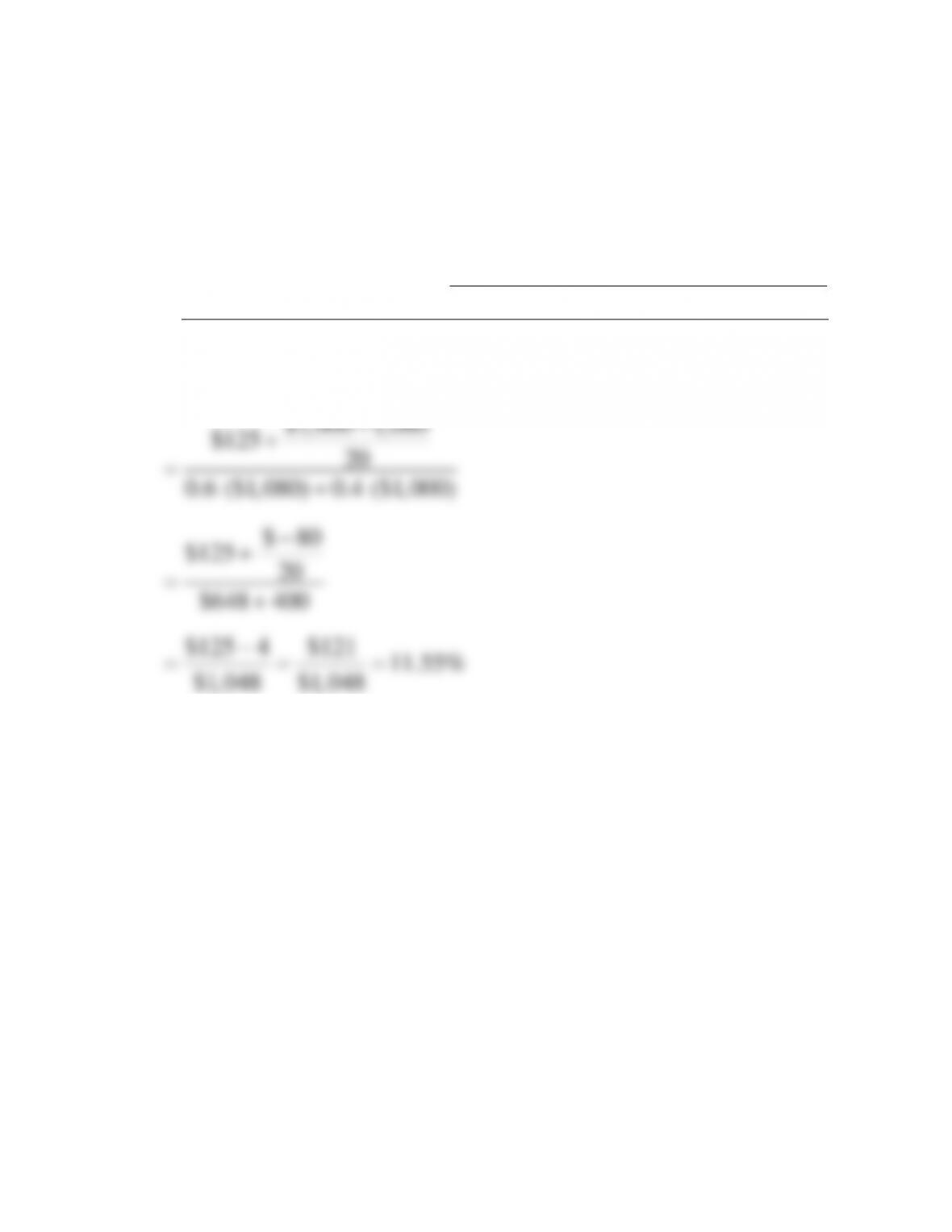
Approximate Yield to Maturity is represented by Y’
Principal payment Price of the bond
Annual interest payment Number of years to maturity
Y’= 0.6 (Price of the bond) 0.4 (Principal payment)
$1,000 1,080
$125 20
0.6 ($1,080) 0.4 ($1,000)
$ 80
$125 20
$648 40
−
+
+
−
+
=
+
−
+
=
+0
$125 4 $121 11.55%
$1,048 $1,048
−
= = =
20. More exact yield to maturity (LO3) Optional––for Problem 19, use the techniques
in Appendix 10A to combine a trial and error approach with interpolation to find a
more exact answer. You may choose to use a handheld calculator instead.
10–20. Solution:
Chapter 10: Valuation and Rates of Return
10-22
Tyler Food Corporation (Continued)
In using the trial and error approach in this instance, we can
reasonably infer the answer is between 11 and 12 percent
based on the information in problem 19. Even if we did not
have this information, we could infer the yield is somewhat
below 12.5 percent because the bonds are trading above the
par value of $1,000. Let‘s begin the trial and error process at
11 percent.
Present Value of Interest Payments
Present Value of Principal Payment at Maturity
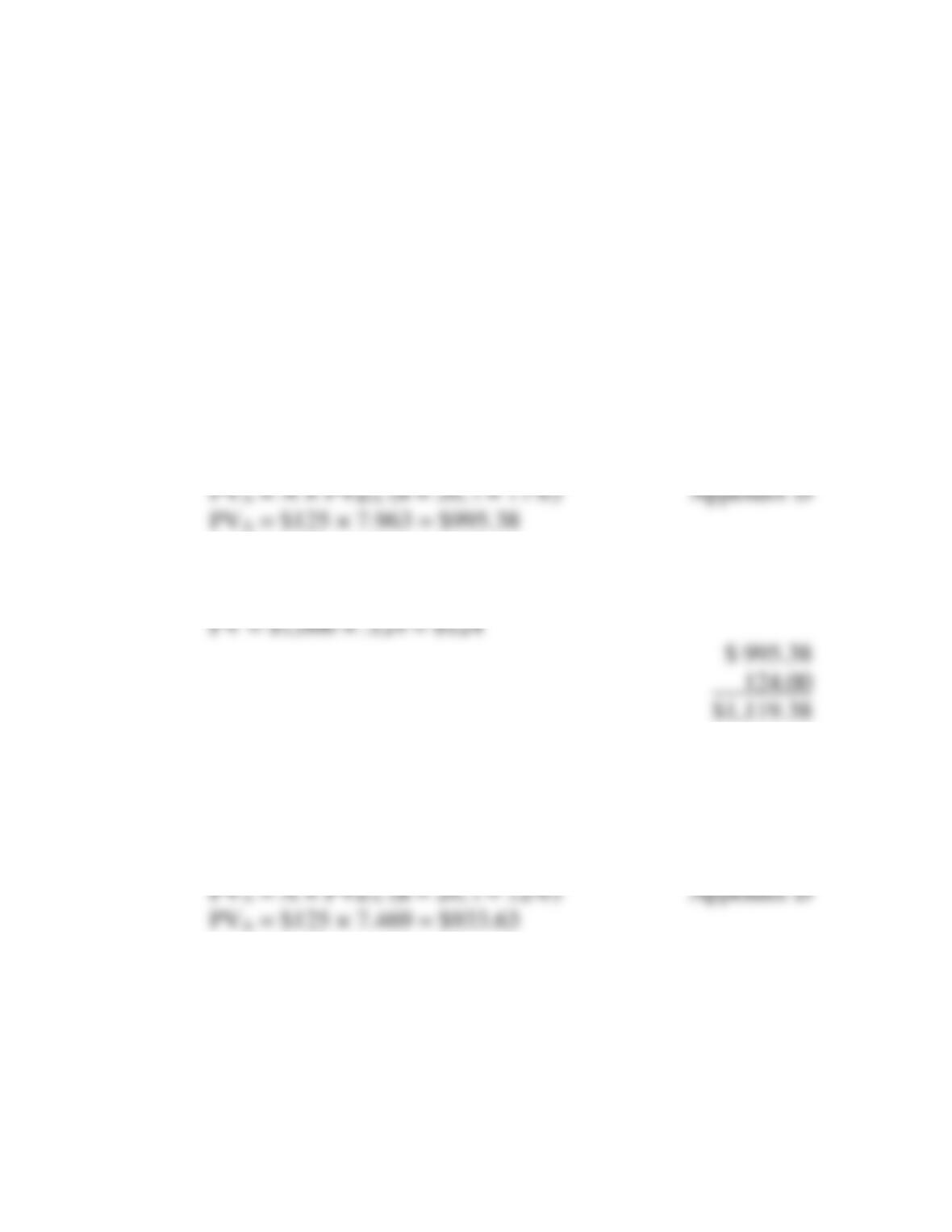
PV = FV × PVIF (n = 20, i = 11%) Appendix B
The discount rate of 11 percent gives us too high a present
value in comparison to the bond price of $1,080. So we next
use a higher rate of 12 percent to reduce the bond price.
Present Value of Interest Payments
Chapter 10: Valuation and Rates of Return
10–20. (Continued)
Present Value of Principal Payment at Maturity
PV = FV × PVIF (n = 20, i = 12%) Appendix B
The discount rate of 12 percent provides too low a value.
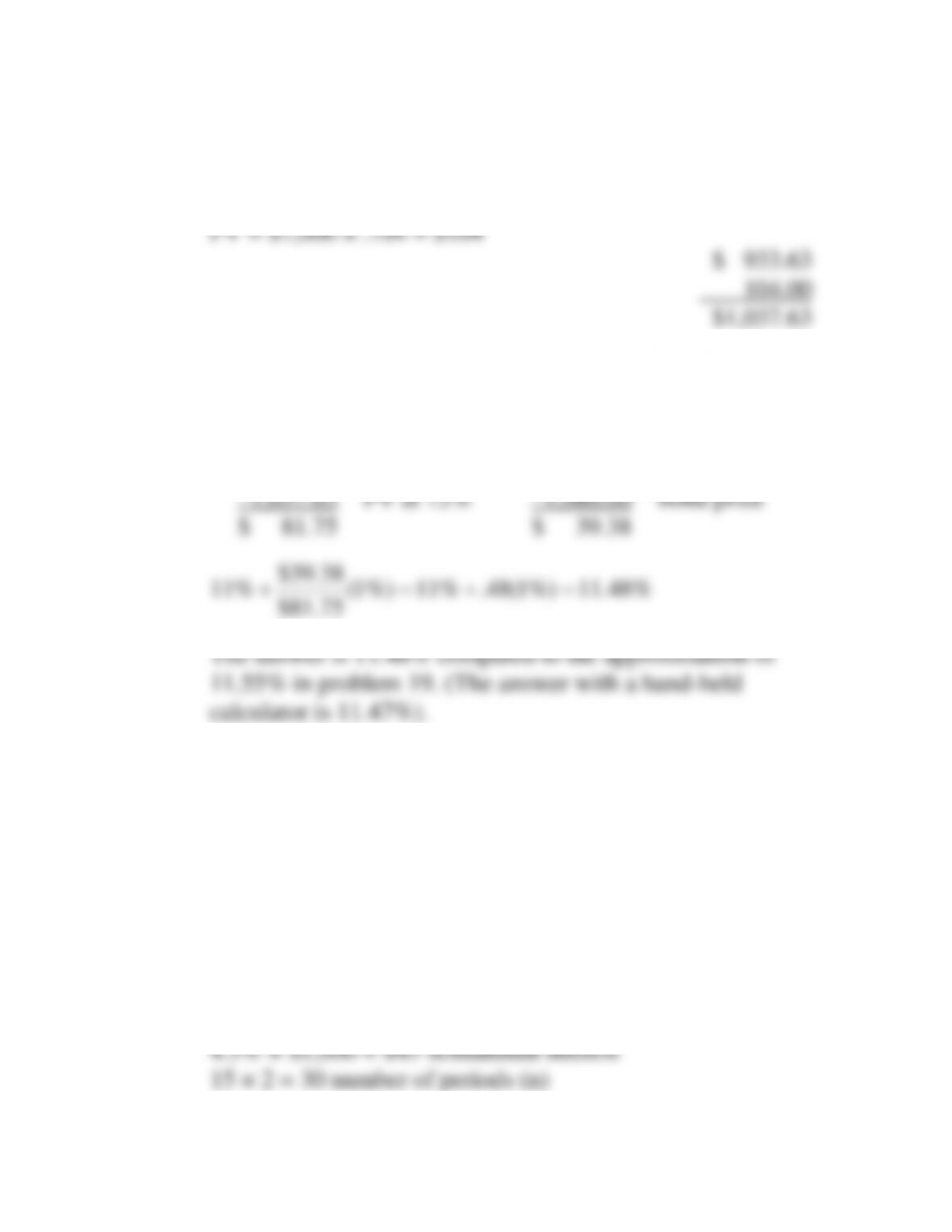
The actual value falls between 11 and 12 percent. Using
interpolation:
$1,119.38 PV at 11% $1,119.38 PV at 11%
Chapter 10: Valuation and Rates of Return
10-24
12%/2 = 6% yield to maturity expressed on a semiannual
basis
Present Value of Interest Payments
Present Value of Principal Payment at Maturity
22. Bond value––semiannual analysis (LO3) You are called in as a financial analyst to
appraise the bonds of Olsen’s Clothing Stores. The $1,000 par value bonds have a
quoted annual interest rate of 13 percent, which is paid semiannually. The yield to
maturity on the bonds is 10 percent annual interest. There are 25 years to maturity.
a. Compute the price of the bonds based on semiannual analysis.
b. With 20 years to maturity, if yield to maturity goes down substantially to
8 percent, what will be the new price of the bonds?
10–22. Solution:
Olsen’s Clothing Stores
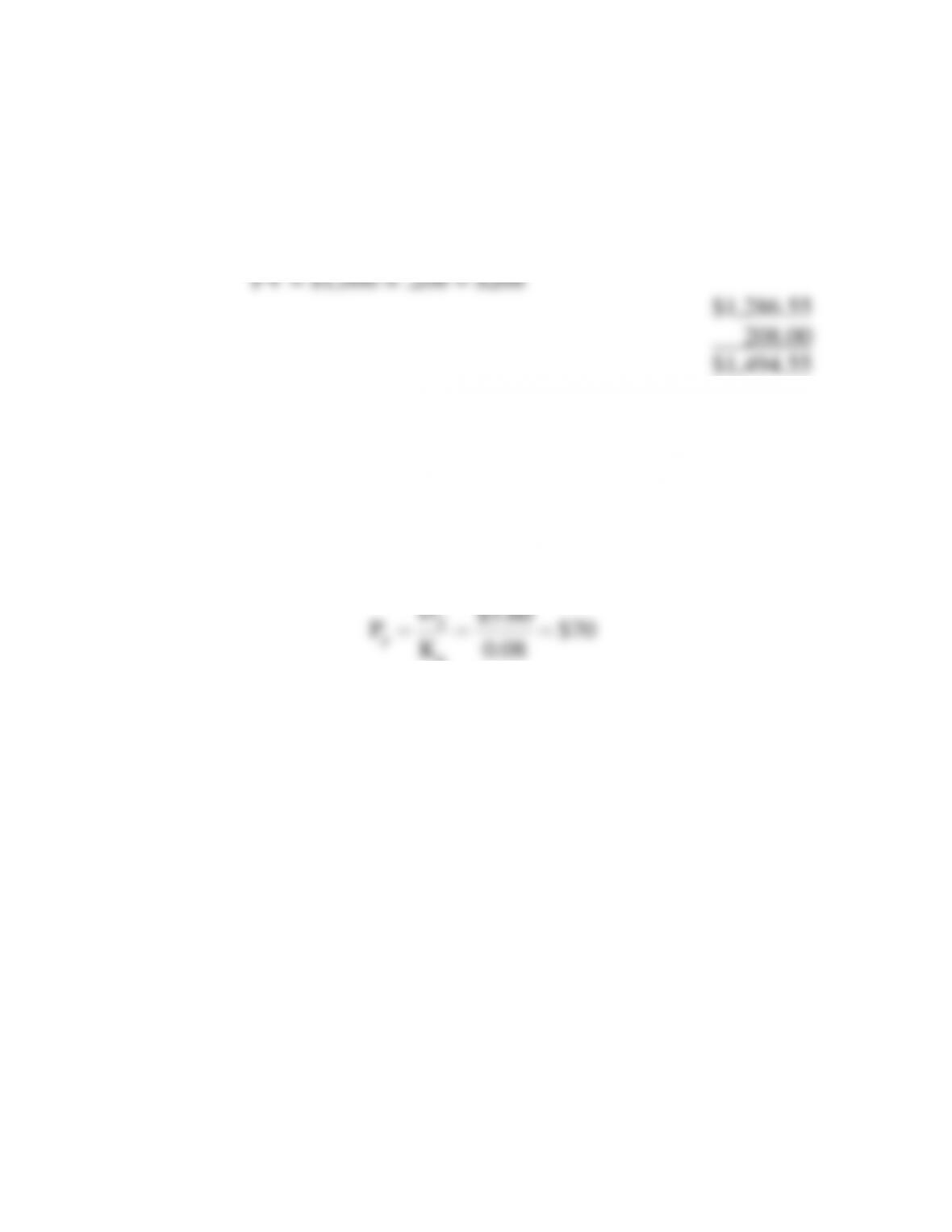
a. Present Value of Interest Payments
Present Value of Principal Payment at Maturity
PV = FV × PVIF (n = 50, i = 5%) Appendix B
Chapter 10: Valuation and Rates of Return
10-25
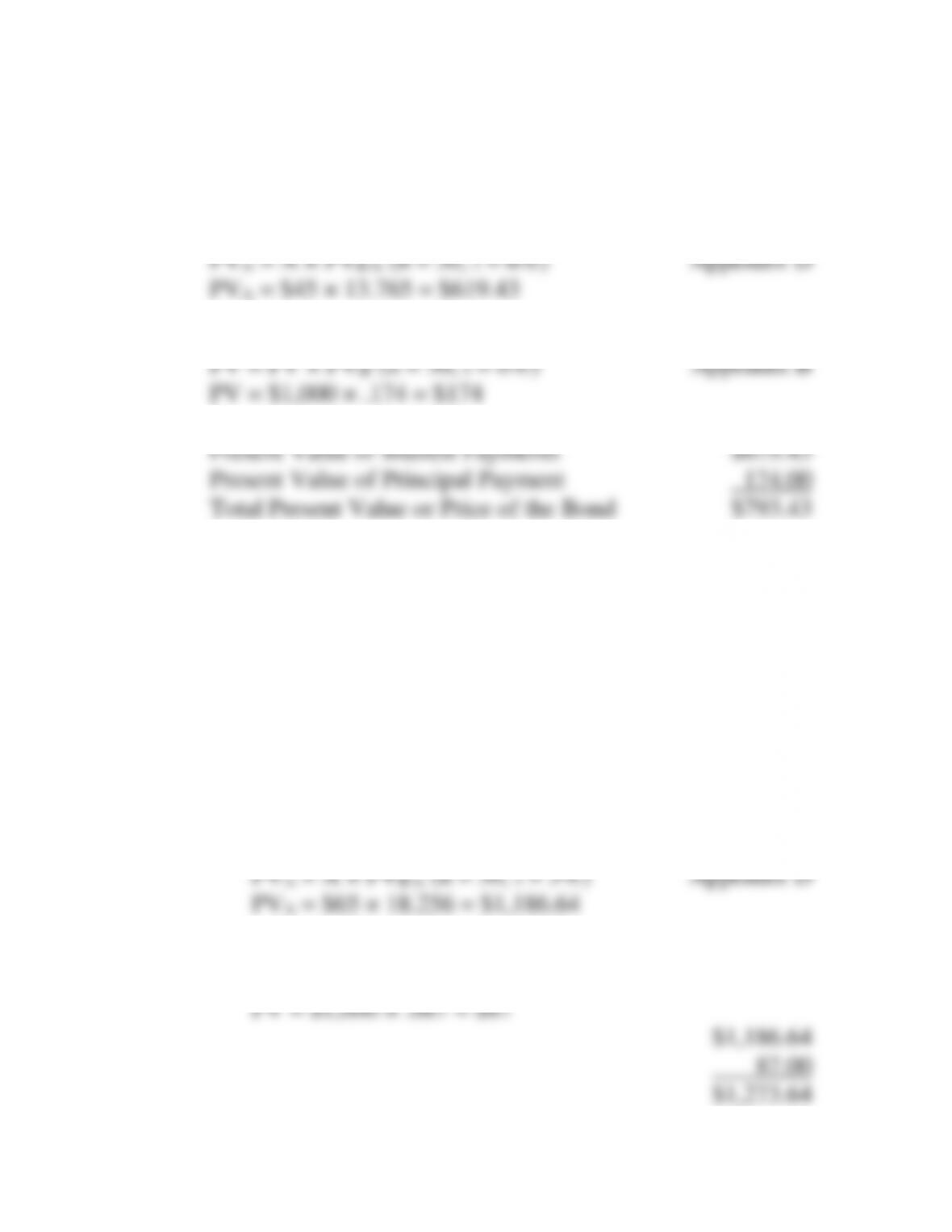
b. PVA = A × PVIFA (n = 40, i = 4%) Appendix D
PVA = $65 × 19.793 = $1,286.55
PV = FV × PVIF (n = 40, i = 4%) Appendix B
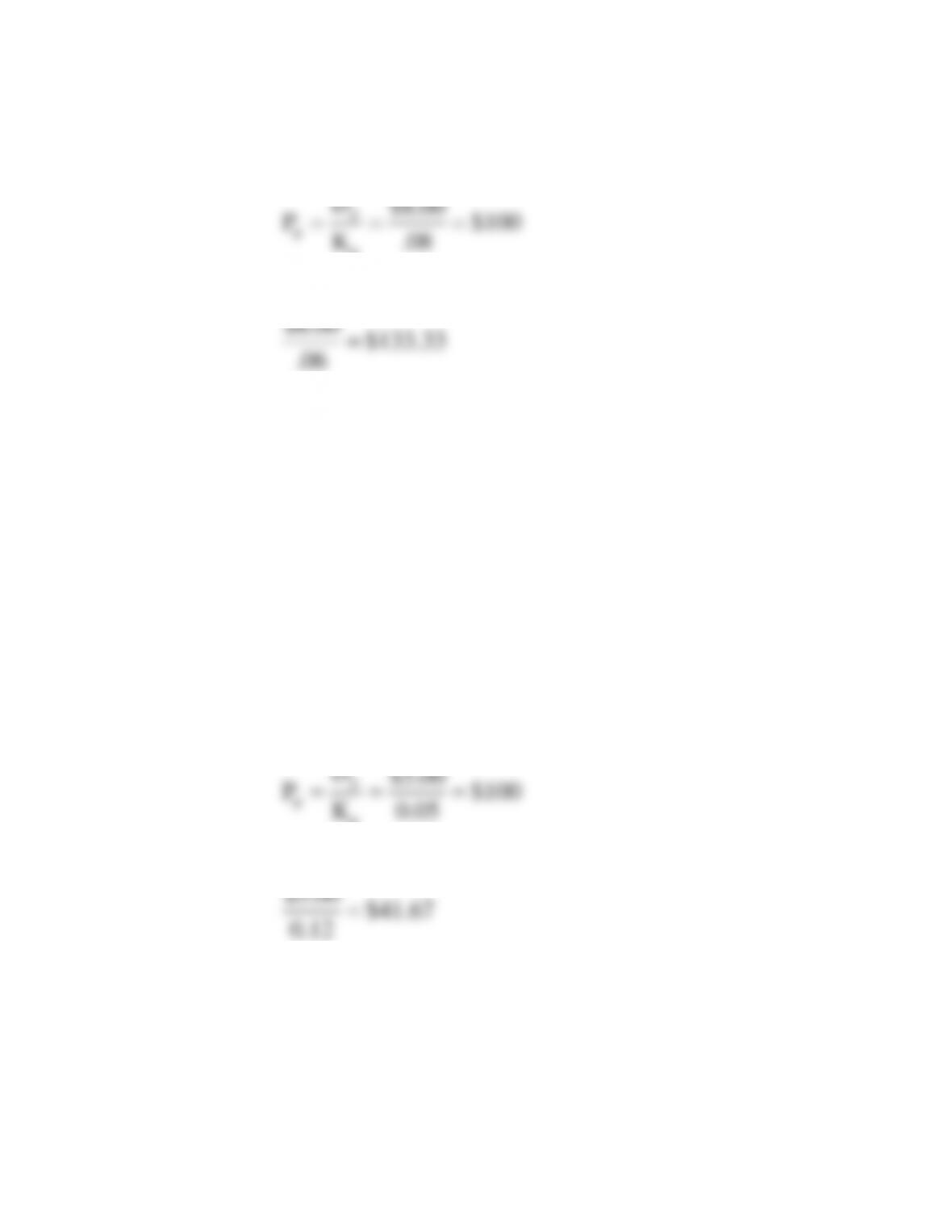
23. Preferred stock value (LO4) The preferred stock of Denver Savings and Loan
pays an annual dividend of $5.60. It has a required rate of return of 8 percent.
Compute the price of the preferred stock.
10–23. Solution:
Denver Savings and Loan
p
p
p
D$5.60
P $70
K 0.08
= = =
24. Preferred stock value (LO4) Bedford Mattress Company issued preferred stock
many years ago. It carries a fixed dividend of $8 per share. With the passage of
time, yields have gone down from the original 8 percent to 6 percent (yield is the
same as required rate of return).
a. What was the original issue price?
b. What is the current value of this preferred stock?
10–24. Solution:
Chapter 10: Valuation and Rates of Return
10-26
Bedford Mattress Company
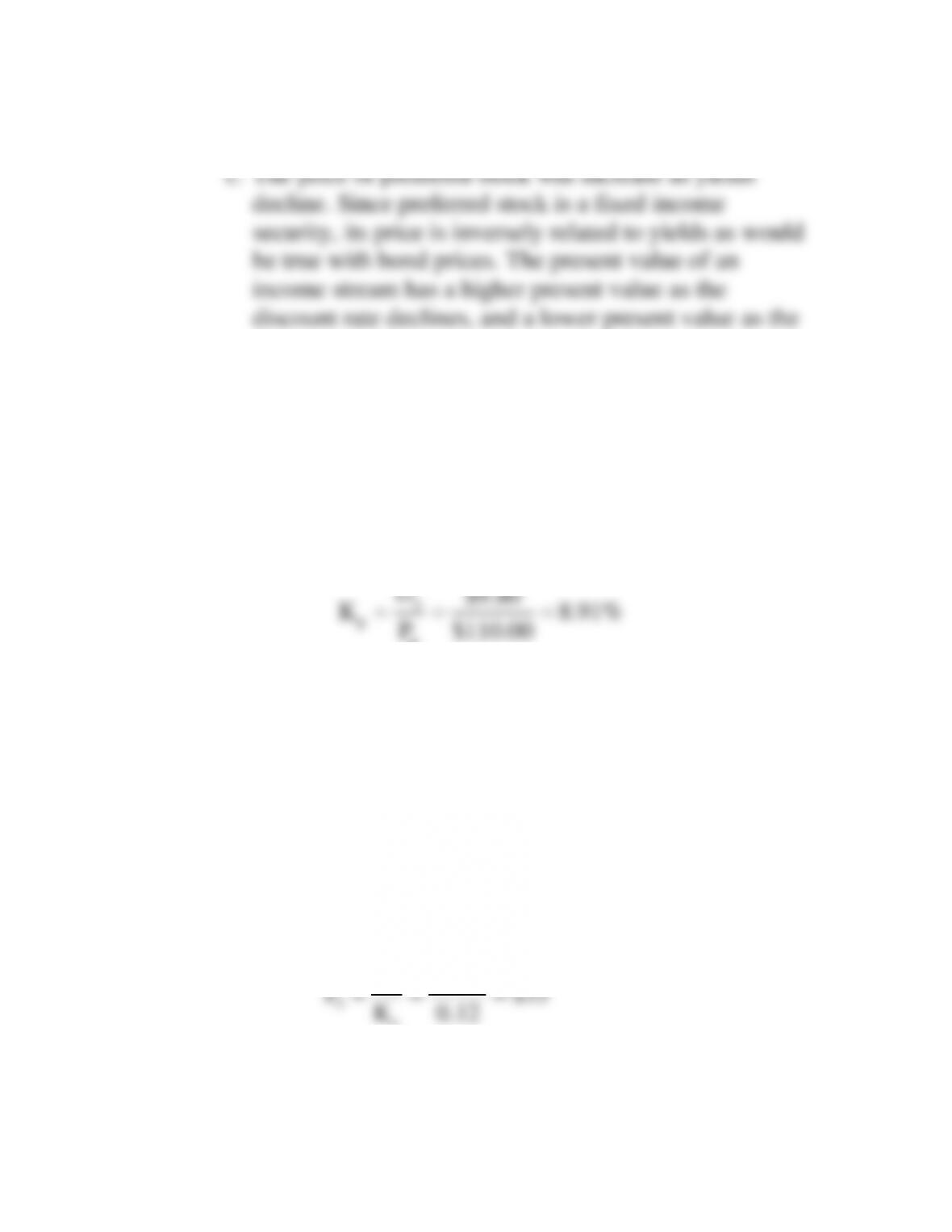
a. Original price
p
p
p
D$8.00
P $100
K .08
= = =
b. Current value
$8.00 $133.33
.06 =
25. Preferred stock value (LO4) X-Tech Company issued preferred stock many years
ago. It carries a fixed dividend of $5.00 per share. With the passage of time, yields
have soared from the original 5 percent to 12 percent (yield is the same as required
rate of return).
a. What was the original issue price?
b. What is the current value of this preferred stock?
c. If the yield on the Standard & Poor’s Preferred Stock Index declines, how will
the price of the preferred stock be affected?
10–25. Solution:
X-Tech Company
a. Original price
p
p
p
D$5.00
P $100
K 0.05
= = =
b. Current value
$5.00 $41.67
0.12 =
Chapter 10: Valuation and Rates of Return
10-27
discount rate increases.
26. Preferred stock rate of return (LO4) Grant Hillside Homes, Inc., has preferred
stock outstanding that pays an annual dividend of $9.80. Its price is $110. What is
the required rate of return (yield) on the preferred stock?
10–26. Solution:
Grant Hillside Homes, Inc.
p
p
p
D$9.80
K 8.91%
P $110.00
= = =
(All of the following problems pertain to the common stock section of the chapter.)
27. Common stock value (LO5) Stagnant Iron and Steel currently pays a $4.20 annual
cash dividend (D0). They plan to maintain the dividend at this level for the
foreseeable future as no future growth is anticipated. If the required rate of return by
common stockholders (Ke) is 12 percent, what is the price of the common stock?
10–27. Solution:
Stagnant Iron & Steel
0
0
e
D$4.20
P $35
K 0.12
= = =

Chapter 10: Valuation and Rates of Return
10-28
28. Common stock value (LO5) Laser Optics will pay a common stock dividend of
$1.60 at the end of the year (D1). The required return on common stock (Ke) is 13
percent. The firm has a constant growth rate (g) of 7 percent. Compute the current
price of the stock (P0).
10–28. Solution:
Laser Optics
1
0
e
D$1.60
P $26.67
K g 0.13 0.07
= = =
−−
29. Common stock value under different market conditions (LO5) Ecology Labs,
Inc., will pay a dividend of $3 per share in the next 12 months (D1). The required
rate of return (Ke) is 10 percent and the constant growth rate is 5 percent.
a. Compute P0.
(For parts b, c, d in this problem, all variables remain the same except the one
specifically changed. Each question is independent of the others.)
b. Assume Ke, the required rate of return, goes up to 12 percent; what will be the
new value of P0?
c. Assume the growth rate (g) goes up to 7 percent; what will be the new value of
P0? Ke goes back to its original value of 10 percent.
d. Assume D1 is $3.50; what will be the new value of P0? Assume Ke is at its
original value of 10 percent and g goes back to its original value of 5 percent.
10–29. Solution:
Ecology Labs, Inc.
1
0
e
D
PKg
=
−
a.
$3.00 $3.00 $60.00
0.10 0.05 0.05
==
−
Chapter 10: Valuation and Rates of Return
10-29
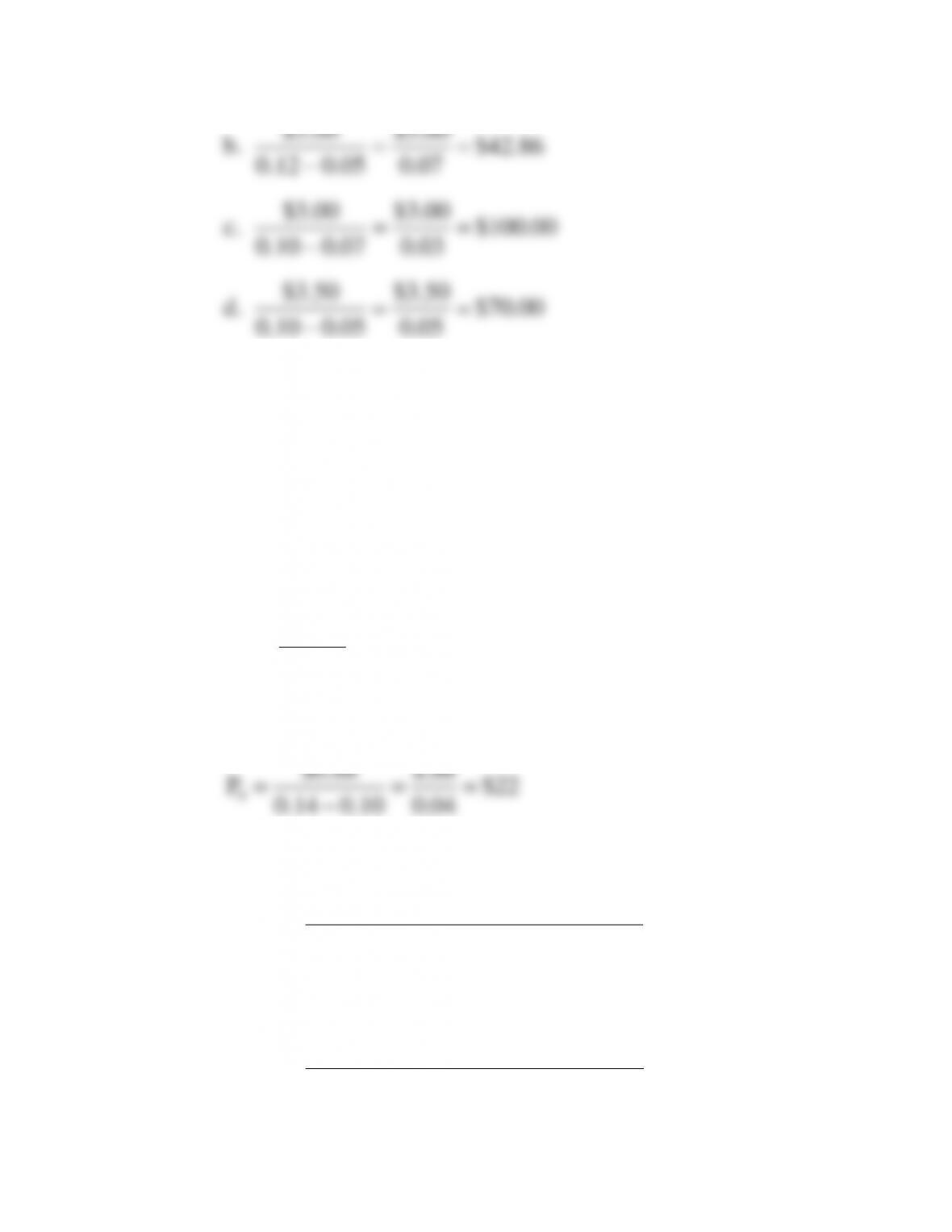
b.
$3.00 $3.00 $42.86
0.12 0.05 0.07
==
−
c.
$3.00 $3.00 $100.00
0.10 0.07 0.03
==
−
d.
$3.50 $3.50 $70.00
0.10 0.05 0.05
==
−
30. Common stock value (LO5) Sterling Corp. paid a dividend of $.80 last year. Over
the next 12 months, the dividend is expected to grow at 10 percent, which is the
constant growth rate for the firm (g). The new dividend after 12 months will
represent D1. The required rate of return (Ke) is 14 percent. Compute the price of
the stock (P0).
10–30. Solution:
Sterling Corp.
1
0
e
D
PKg
=
−
10
D D (1 g) $.80 (1.10) $.88= + = =
0
$0.88 $.88
P $22
0.14 0.10 0.04
= = =
−
31. Common stock value based on determining growth rate (LO5) Justin Cement
Company has had the following pattern of earnings per share over the last five years:
Year Earnings per Share
2006 …………………….. $4.00
2007 …………………….. 4.20
2008 …………………….. 4.41
2009 …………………….. 4.63
2010 …………………….. 4.86
Chapter 10: Valuation and Rates of Return
The earnings per share have grown at a constant rate (on a rounded basis) and will
continue to do so in the future. Dividends represent 40 percent of earnings. Project
earnings and dividends for the next year (2011).
If the required rate of return (Ke) is 13 percent, what is the anticipated stock
price (P0) at the beginning of 2011?
10–31. Solution:
Justin Cement Company
Earnings have been growing at a rate of 5 percent per year.
Base Period
(2007/2006) – 1 = 5% growth ($4.20/$4.00)
The projected EPS for 2011 is $5.10 = ($4.86 × 1.05).
Dividends for 2011 represent 40% of earnings or $2.04