Chapter
I
C) t^tl
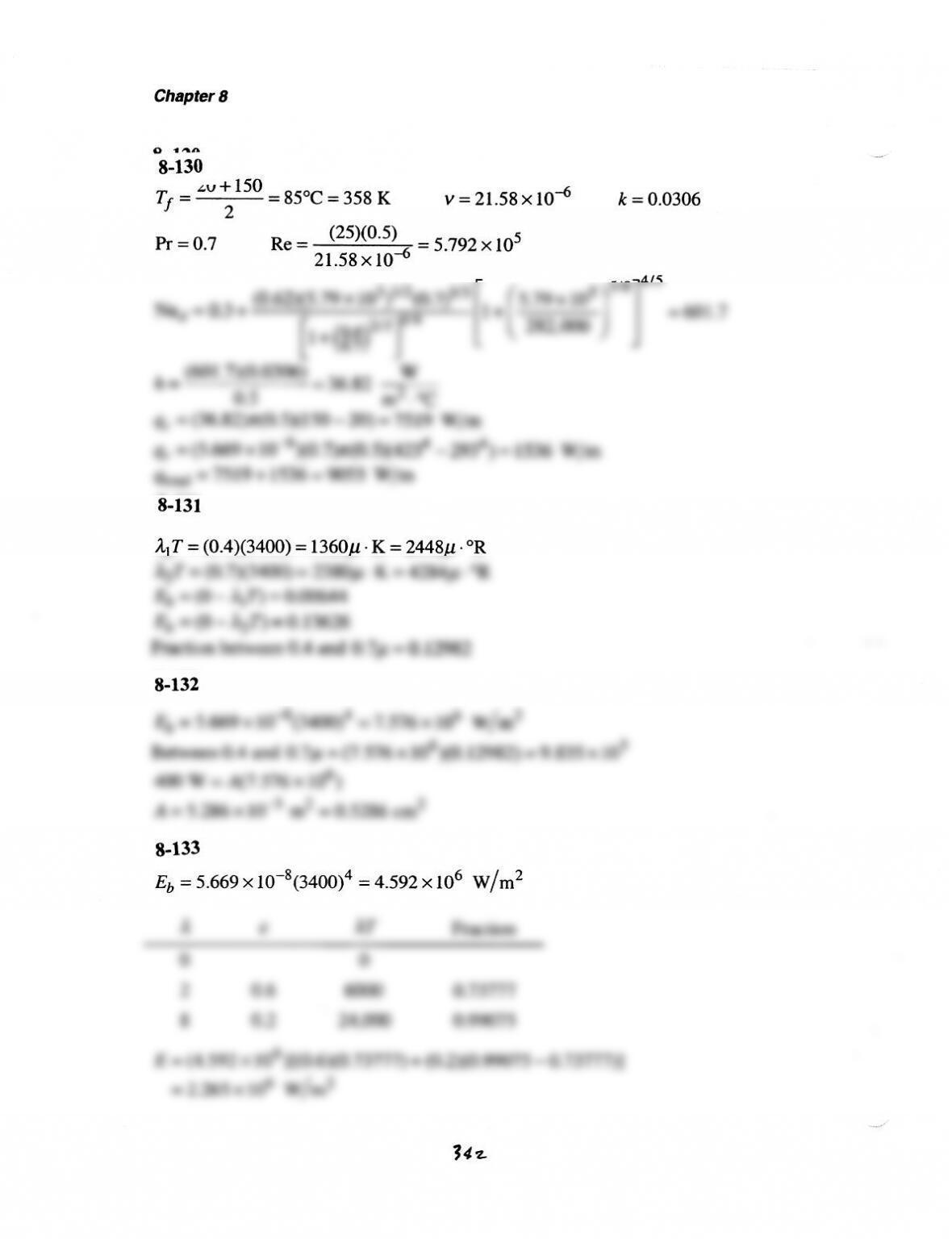
8-130
zv
* 150
Tf= = 85oQ
= 358 K
Pr-0.7 Re= (25X0.5)
21.58
x
10-6
r/
=
2I
58
x
10-6
– 5
.7g2x
105
k
– 0.030b
xto\rtl-{o.t)rt3l,
(
r :,n. rot
)t”l = 60r.7
g-131
L{ =
(0.4X3400)
=
L36O1t.K
=2448p.oR
oR
8-132
– 7 .57
8-133
Eb
=
5.669x 10⁻⁸(:+00)4
=
4.592
xl06 w
I
^’
3lz
Chapter
8
(rrtt-
a^ Il
v
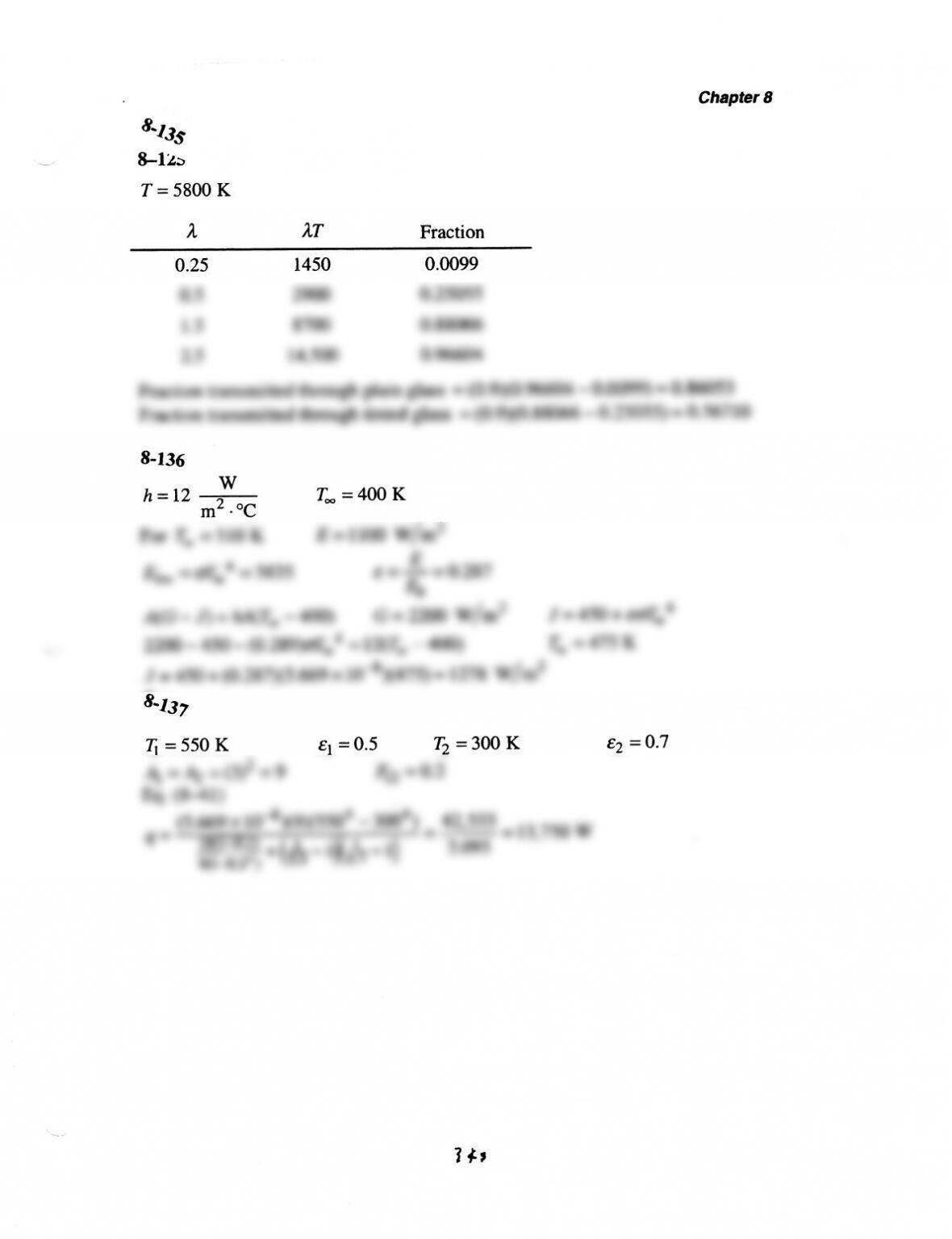
8-12>
T
– 5800
K
)” Lf Fraction
0.25 1450 0.0099
Fraction
transmitted
through
tinted
8-136
h=r2+ L=4ooK
m”.oC
8-{s7
1*t
Chapter
I
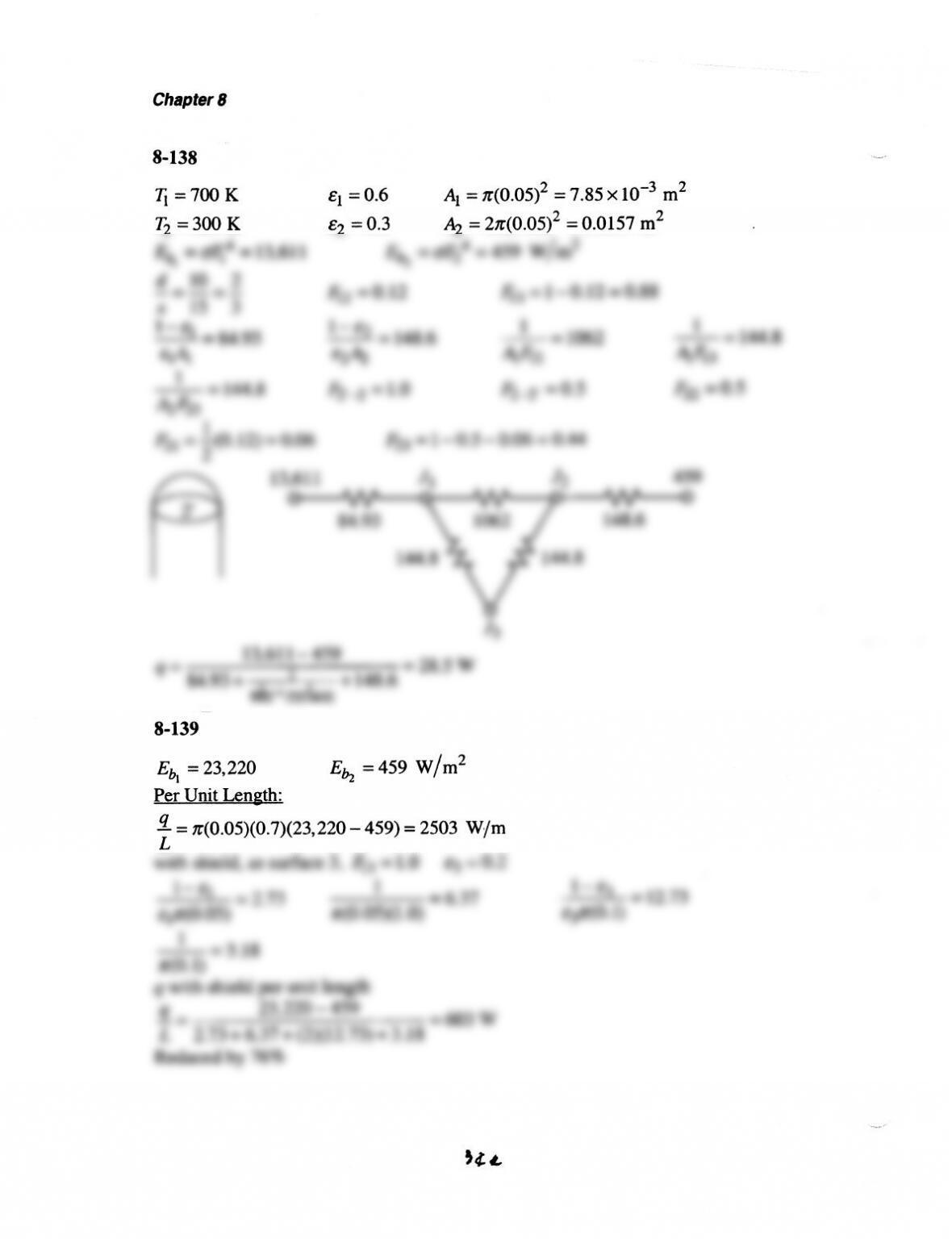
8-l3g
\=7ooK
rz=300K
€l = 0.6 At = n(A-05)2
= J -85
x 10-3 ^2
s2
= 0.3 A2
– 21c(0.05)2
= 0.0
I57
^2
– 459 wl^’
Ek=459
wl^’
1062
8-139
Eh =23’220
Per Unit
Length:
g -zr(0.05X0.7)(23,22A-
459)
= 2503
Wm
L\
e1n(0.05)
1 – 3.18
a(0.1)
q with shield
per
unit length
q _ 23,220-459 =603W
L 2.73
+
6.37
+
(2X12.73)
+
3.18
Reduced
by 76%o
zr(0.05×1.0)
s31r(0.
1)
)&e
Chapter
I
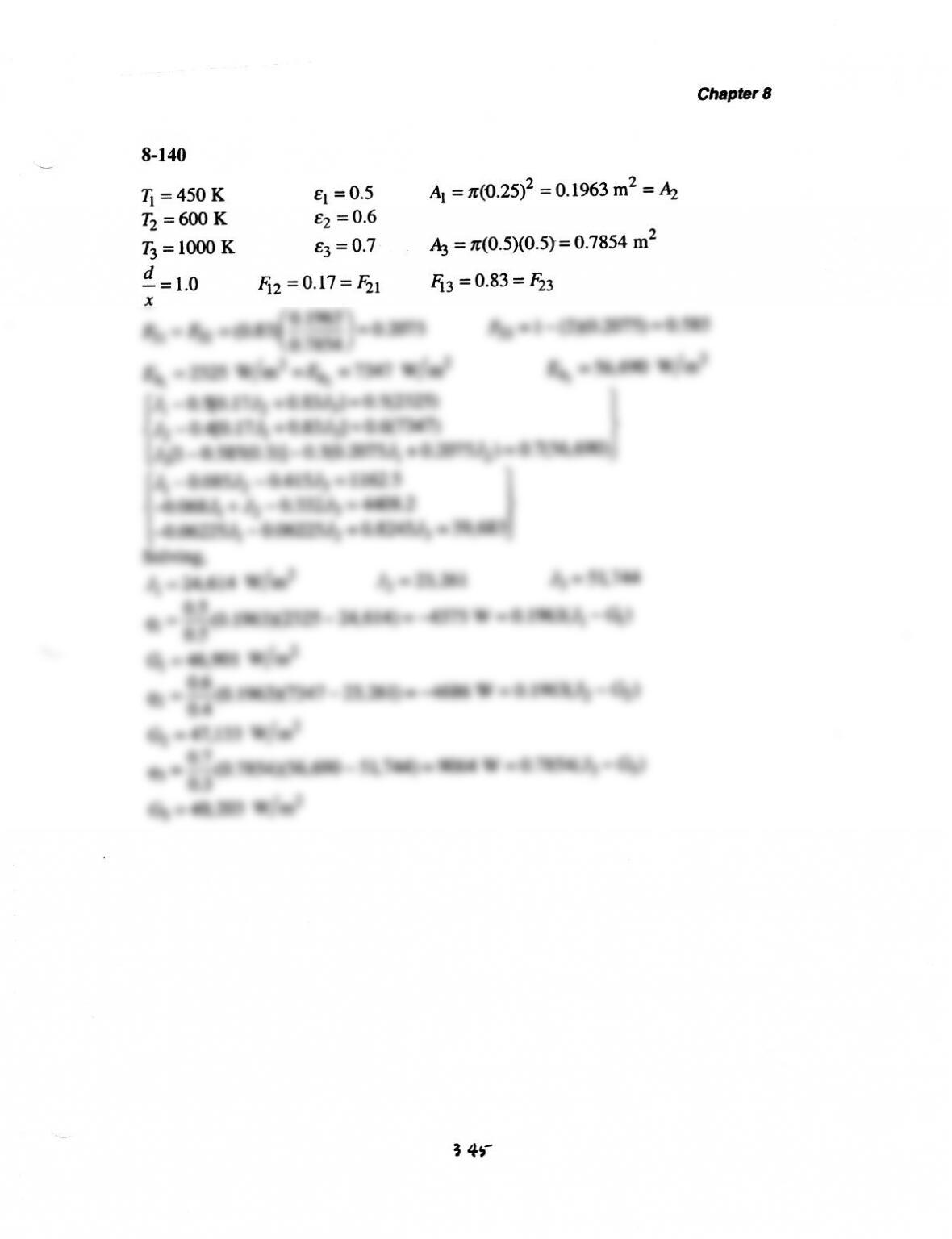
8-140
4 =
450
X €r
=
0.5 At
= nQ’25)2
=
0′
1963
m2
=
b,
Tz=6O0K ez=0.6
7i
=
10fi)
f €l =
0.7 4= x(O’5X0’5)=
A’7854
m2
4 =
1.0 4z
=0.17
= Fzt 4r =
0’83
=
Fzt
x/09) =o.2o75 Ftz=l-(2X0.2075)=g.5s5
=
(0.83\b
74r
Chapter I
g-ur
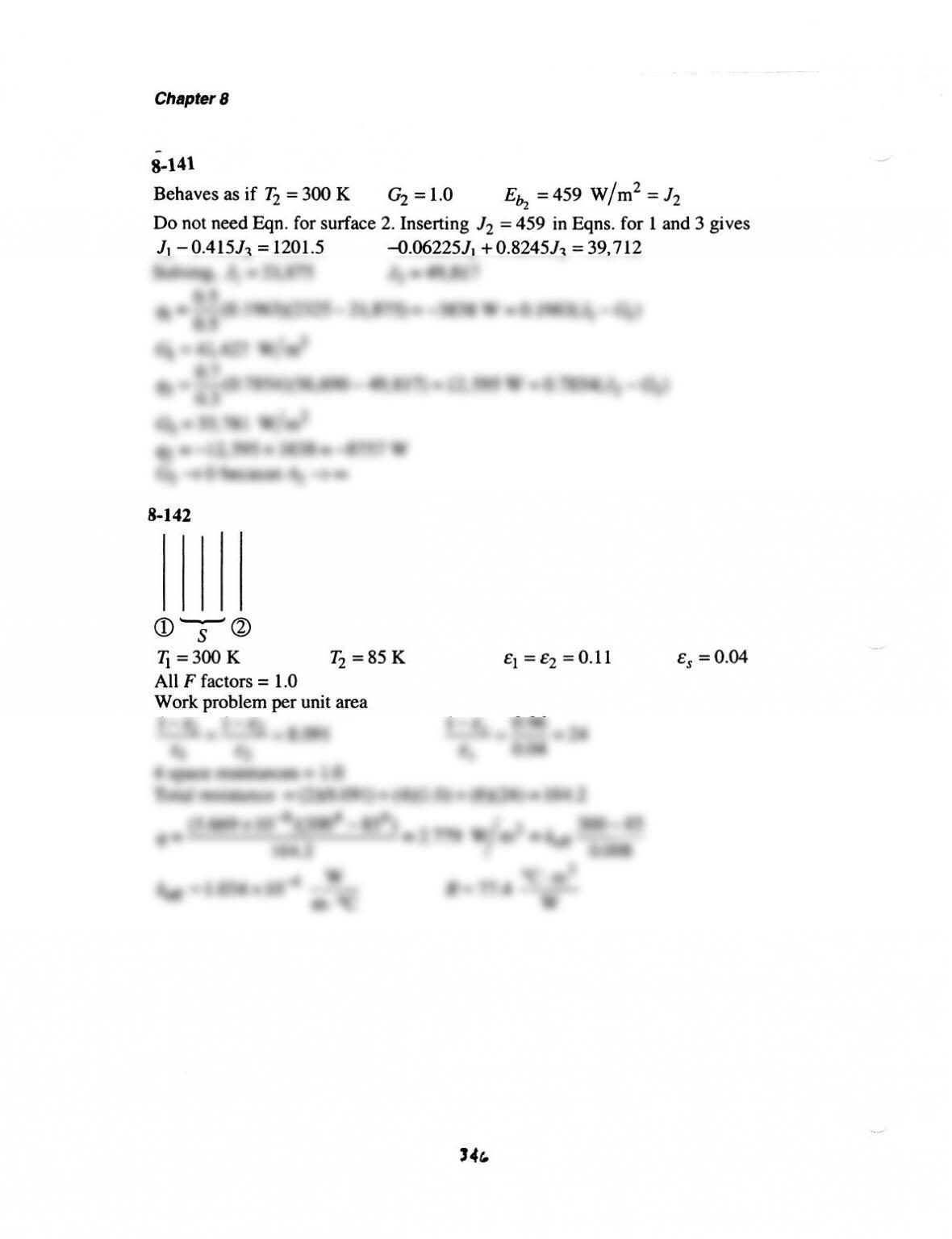
Behaves asif T2=300K Gz=1.0 Eb=459 Wfmz
=J2
Do not need Eqn. for
surface 2. Inserting
Jz = 459
in Eqns.
for I and 3
gives
=
1201.5 4.M225h + 0.8245\
=
39,712
8-r42
cT@
4=300f 4=85t< Er=tz=0.11 €s=0.04
AllFfactors= 1.0
Work problem
per
unit area
\t2
4
space resistances
= tr.0
Total resistance
=
(2)(8.091)
+
(4Xl
.0) +
(6)(24)
– 164.2
(5.66gx10-8X3004-854)
F,F.,.—l
) , 300-85
q=
“*
=)’779
wlm= =fteff
t-t
kett-I.034xloa w R-77.4oc’m2
m.oC W
| lt,
Chapter
I
&143
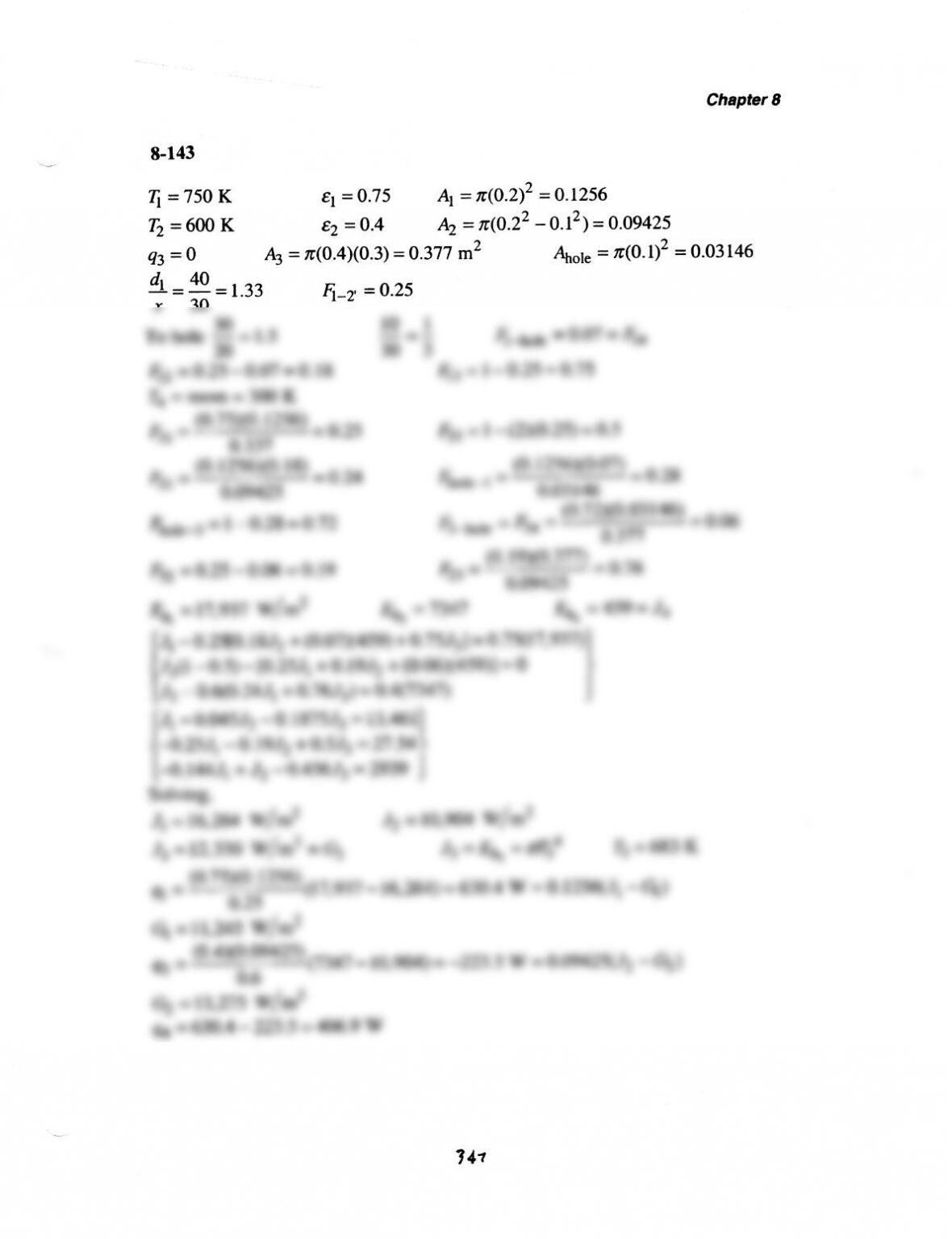
4 = 750 K et
= 0.75 At
= n(O.2)2
=
O.1256
Tz=6f[K tz=0.4 4=n(0.2′-0.t’)-0.09425
qt=0 4=n(0.qx0’3)
=o.377
m2 Arole
= tc(0.1)2
=0’03146
dt
=9= 1.33 4-z
=o.25
74t
X=
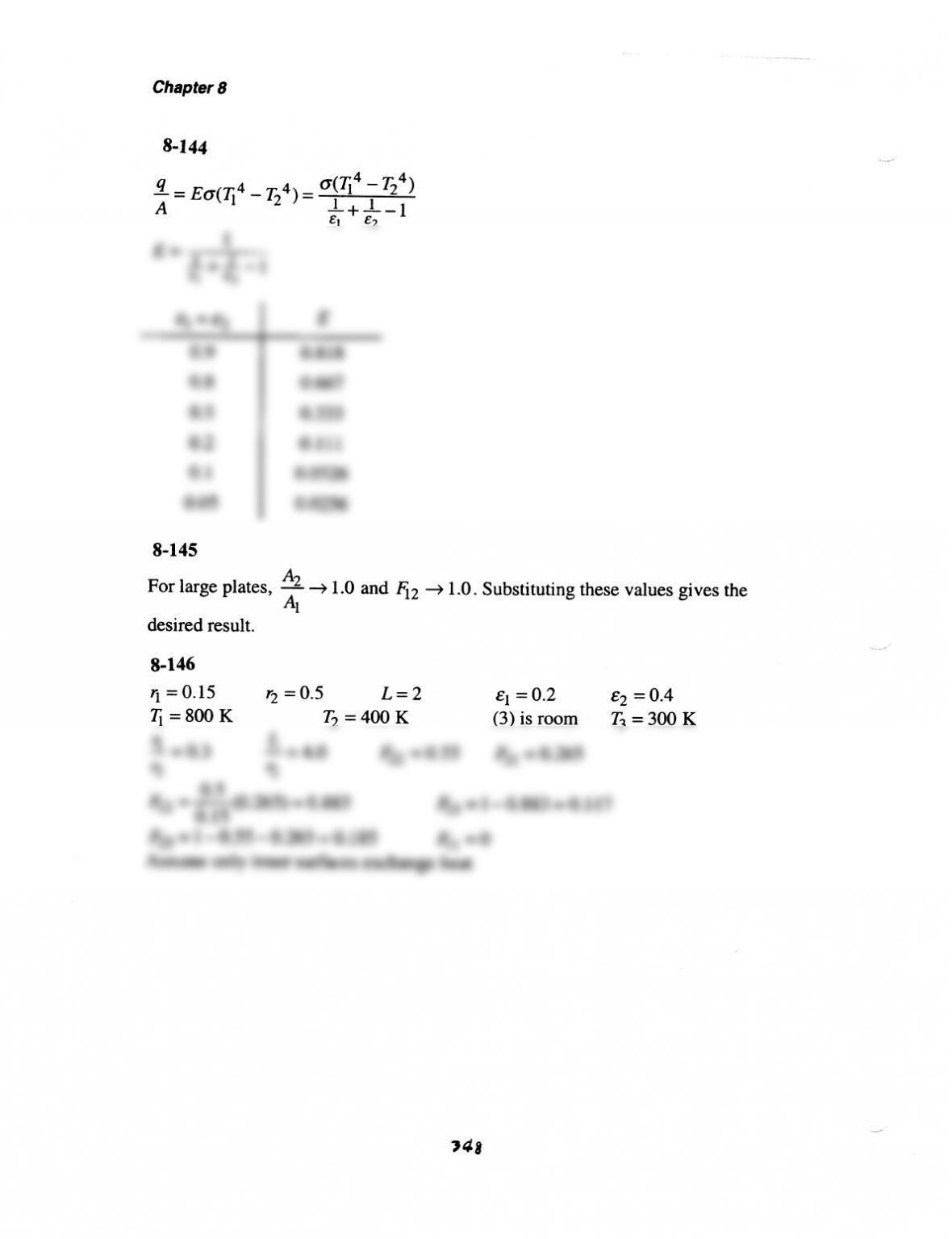
Eo(rf
-h4)-
Chapter
I
g-144
oTf -r24)
l+4-t
t1 t2
8-145
12:0.5 L=2
12=400K \ =0.2 s2
=0.4
(3)
is room T\
= 300 K
For
large
plates,
+ -1.0 and
4z +1.0. substituting
these values
gives
the
A1
desired
result.
8-146
\ =
0.15
q=800K
,4t
Chapter I
Afn
J3 : Ebt
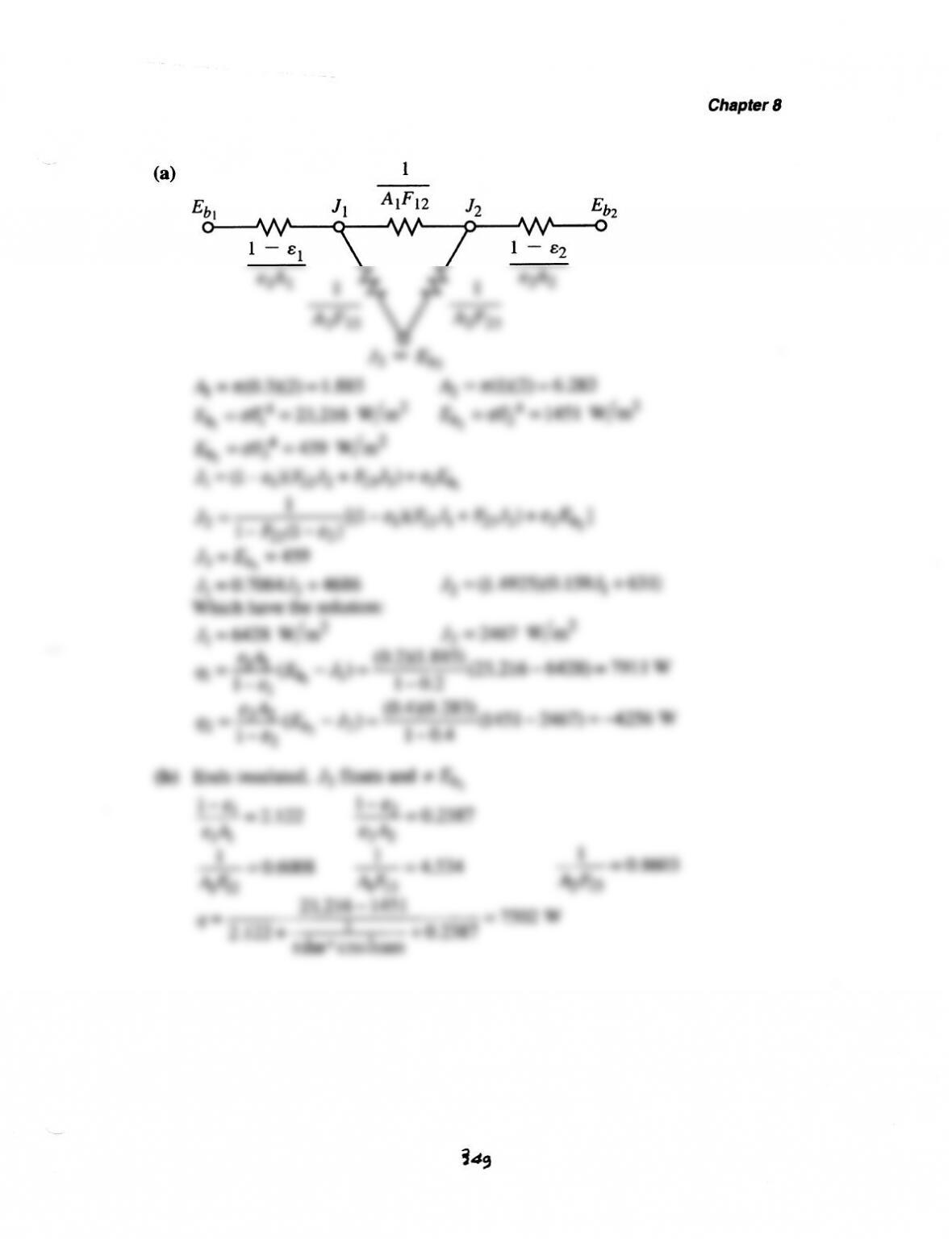
4 =z(0.3)(2)=1.885 Az=rc(l)(2)=6.283
Eh=d\4 -23,216
wl^’ Ear=6Tro
=t+stwf ^2
Eh=6T34
-+ss
wf ^2
.[ =
(1
– e)(\zJz+
4t4) +
e1E4
J”= |
‘ L- rzzo- e)[(1- €1×42
J1+
F7\)+ e2E62l
h=E4=459
4=O.7064J;+4686 J2=(1.4925)(0.1594+631)
Which have
the
solution:
h=6428
wl^’ Jz=2467
wl^’
n,
=
ftrE6,
– J1)=
gffip (23,216
– 6428)=
Tel
l w
etAt
‘- (0’4×6’282(1451
-2467)=4256w
az=fi\Lbz- r2)= l_a4
(b) Ends
insulated, -I3
floats and * E6,
l-et =2.122 l-ez =0.23g7
erA ezb,
=
0.6008 =
{.534 = Q.8603
Ar4z Ar4t
23,216
– 1451 brzt
-7502W
q- 2.122+ +0.2387
ffihr+a’sffi366
A:’.Fn
lag
Chapter
I
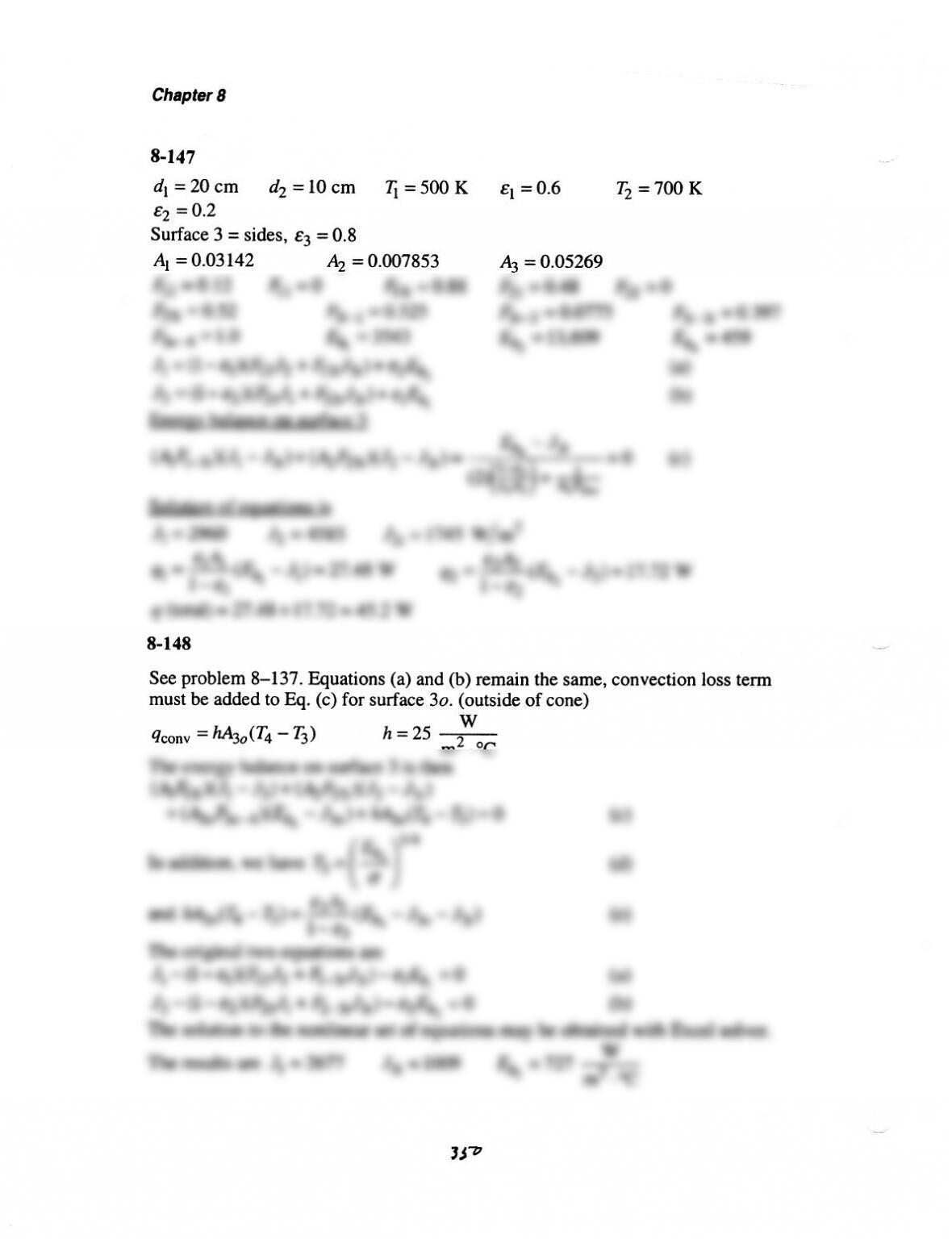
8-t47
dr=20cm dz=lOcm 4
=500
K €r
=0.6 Tz.-700X
€z
=0-2
Surface
3
=
sides,
€t =
0.8
At
=
0.O3142 Az
=
0.007853 Az
=
O.05269
=0 4:i
=0.88 4t=O.48 F)z=Q
8-148
See
problern
8-137. Equations
(a)
and
(b)
remain the same, convection loss
term
must be added
to Eq. (c) for surface
3o. (outside
of cone)
{conv
=
tt4o(r+-rt) h=25
The solution to
the
nonlinear
set
of equations may be obtained
with
Excel solver.
The results
are
J1=2677 ./ri
= 1009 Eb =nl Y
m’ .oC
,t7
Qt
rr I – gt
d (solar)
= 094 4or = 25oC
– 298
K
G
(solar)
= 700 Wl^’
G (so
larl\a (solar)
= oe(Ta – 2984)
(700)(0.94)
=
(5.668
x 10-8X0.2
l)v4 – 2984)
T-501
K-228″C
=337
ez=ft(Eur-
Chapter
I
a (low
temp)
= 0.21
= t
q
(total)
= 59.37
W
As a
check
this
value
must
equal
the energy
lost by convection
and
radiation
from
the outside
of surface
3.
E7Aa,,-
Q3o,
rad
= #@u, – J3u)=
I l’38 W
r-c3
e3o, conv
= h’\o(\ -T+) =
(25X0.05269)(337
– 300)
= 48.74
W
q
(total)
= 60.1
W
Th” diff.t”nce in the
two values for total
heat
transfer
results
from roundoff
in the
solution.
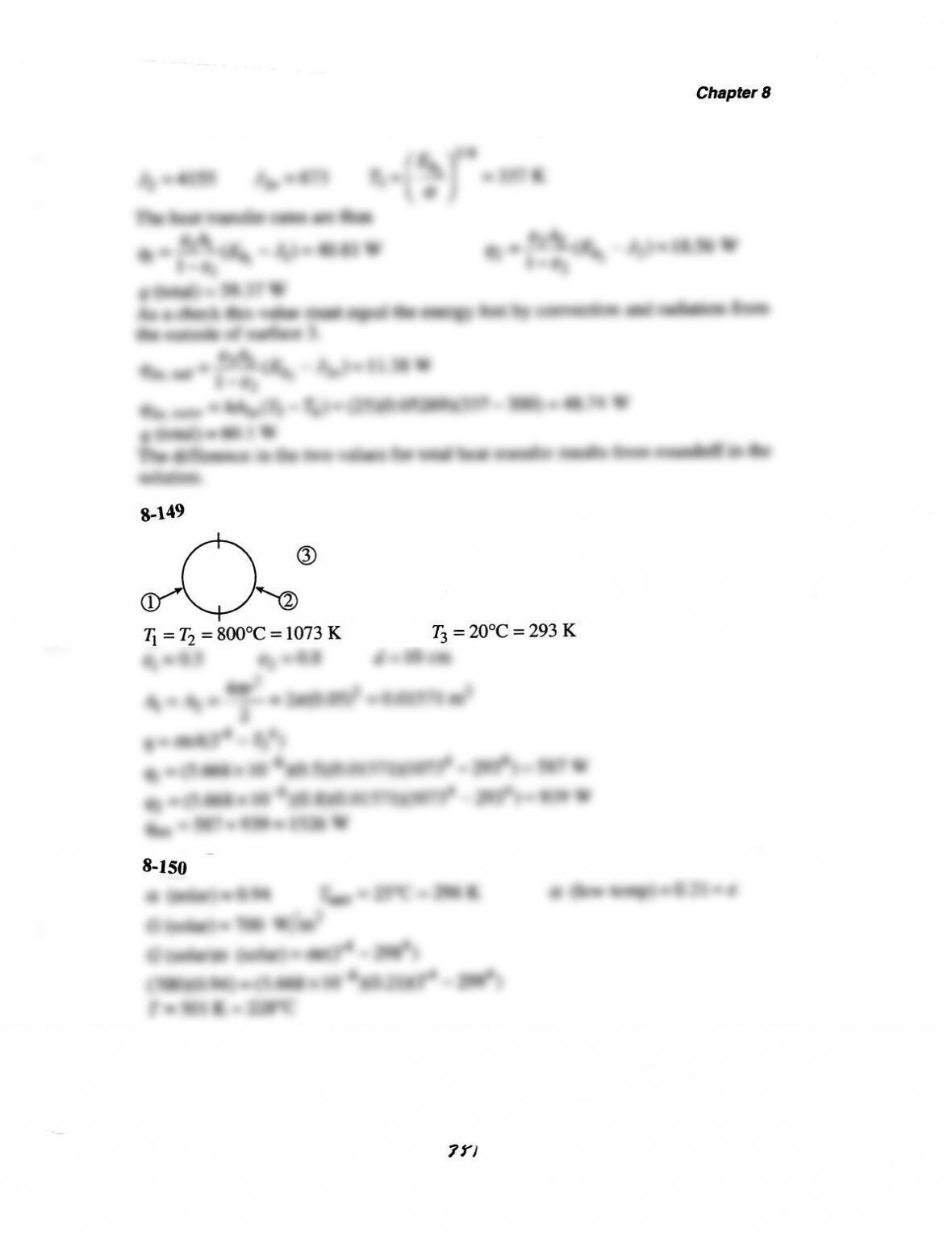
8-149
\ = Tz,
= 800oc
= 1073
KT\
-20″c -293K
eo,t-
8-150
7rt
Chapter 8
8-r5r
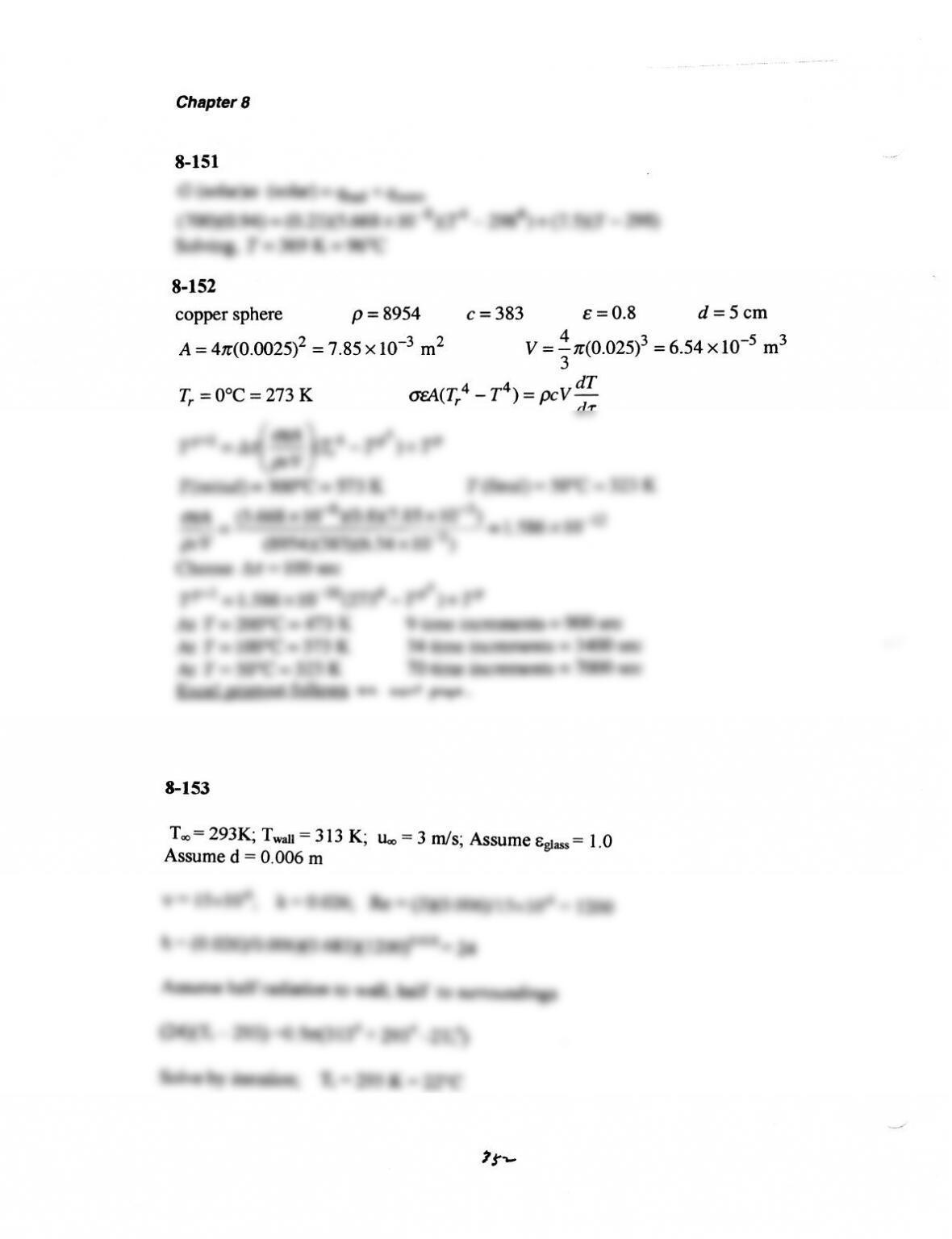
8-152
copper sphere P=8954 c
=383 e=0.8 d=5 cm
A=4n(0.N25)2
=7.85×10⁻³
m2 y =!n@.025)3
=6.54×10⁻⁵
m3
3
T,
= }oC
= 273 K oeA(Zr4
– f\ = prv +
t-153
T- – 293K; T,”au
: 3
t3 K; u* : 3 m/s;
Assume
rgass: I
.0
Assumed-0.006m
?ru
Chapter
I
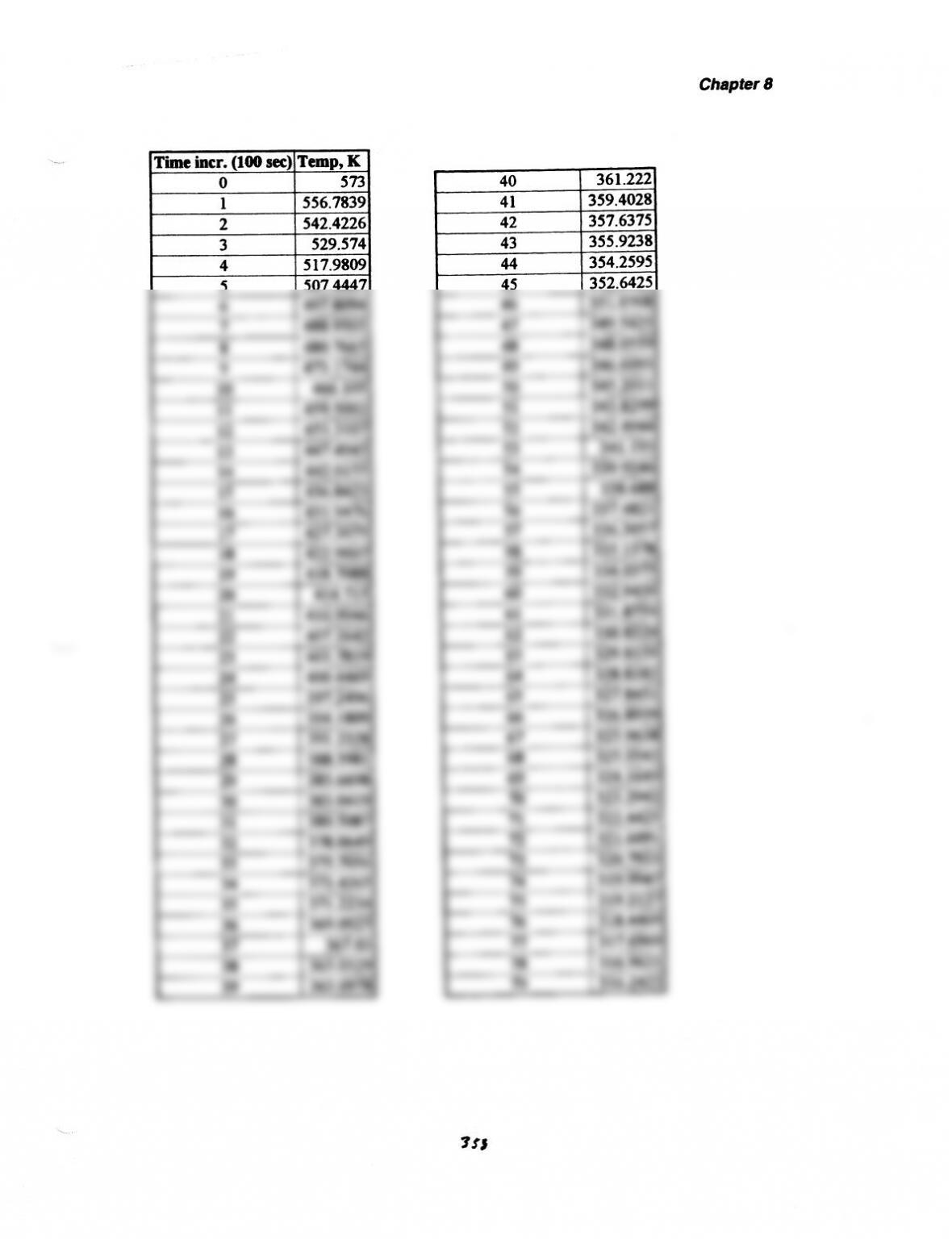
Time
incr.
(100
scc)TemprK
0573
Is56.7839
2542.4226
3529.574
4517.9E09
40 351
.222
4l 359.4028
42 357.6375
43 355.923E
44 354.2595
ts,
Chapter
I
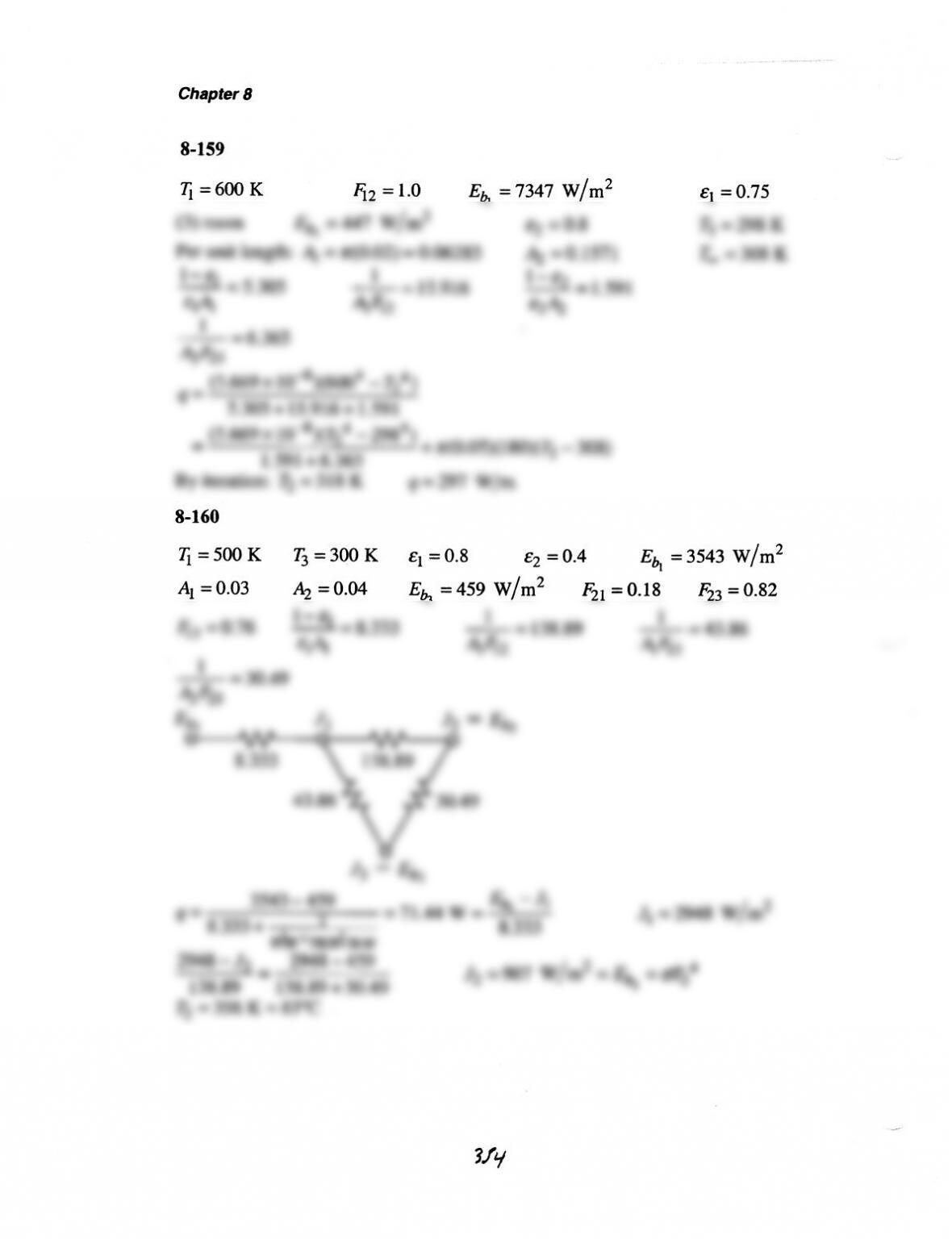
8-159
Tr
=
600
K 4z =
1.0 Eq -7347 Wl^2
8-160
\=500K T\=300K \=0.8 s2=0.4 Er,
At =
o.o3 Az
– 0.04 Er,
= 459
Wl^’ Fn= 0.18
€1
= 0.75
=3543
wl^z
Fzl
=
o’82
I – l3g.g9
h=2s48
wl^’
3543
– 459
q- 8.333 + agha*rm-.ohn-zs
2948-
J2
_ 2948- 459
138.89 138.89
+30.49
fz=356K-83″C
-7L.44w- Eu’-Jt
8.333
wl^’- Ebz
J2 = 907 = dli4
7lv
Chapter
I
8-163
8-157
The
temperature
of the
walls
obviously
depends
on the
wall insulation.
The
radiation
exchange
also
depends
on sunlight
through
the windows
if applicable.
For-comparison
purposes
any
sunlight
load
should-be
neglected.
To st-art
the
8-169
Assume
some convenient
size
of building
wall (5
m high
by
30 m long).
The
concrete
slab
might
be assumed
9ft
ChapF/r
I
8-170
The
open
side
of the
box
should
be
assumed
to be
a
black
surface
with
8-171
while there
will be
temperature
gradients
in the
electronics
package
itself,
there
is
no information
given
to
determinl
these
gradients.
Therefore,
one
should
just
assume
an
outside
temperature
for the
paikage
as
go”c. The
package
wililose
heat
by
both
radiation
and
free
convection
3,C
Chapbr I
E-r72
Designate
the black
panel
as surface
l, the shield as
surface
2, andthe
room as
surface
3. It is reasonable
to assume
| 8-173
Best conditions
can
be
represented
when all the solar
energy
is trapped
inside
the
collector, i.e., no transmission
out through
the glass.
The solar
irradiation may
be
8-r74
Because
of the shadowing
effect
of the fins the assembly
will probably radiate
as
7st
Chapter
I
8-I75
From
the
problem
statement
the
radiatiol-
shape
factor
from
the person
to
each
of
the
walls
is
taken
as
l/6. The
outside
wail tempe*ur”, iint”rior surface
temperature)
will probally u” rather
cold;
about
ro.c. rrtr two
interior
walls
and
floor
should
be
asiumed
it the
room
air
temperature.
8-176
fhe lotal
energy
dissipated
to
the
room
will be
influenced
by
the
free
convection
loss
froni
the
outside
surface
of the
covering.
The
radiant
Ioss
to
the
room
is also
governed
by
the
temperature
of the
surface
lon”r. tvtlnimum
energy
transfer
will
be
obtained
at the
cavity.row
8-179
This problem
obviousry
invorves
the
assumption
that
e
= 1.0
for both
heater
surfaces-
otherwise
the
analysis
is
the
same
as
problem
g
– 16l.
vt8
Chapbr 8
8-r80
The total heat lost
is obviously a strong
function of the strip temperature.
If a
large value
of the
strip temperature
is selected
the
major portion of heat
loss will
be by radiation.
As a start
choose
a rather
high temperature
of 800oC and
a strip
8-l8r
Tm
-25oC
= 298K
tm – 1.0
(a)
w
h:8 —
m’ .oC
T,
=
ooc
-273 K
+l – hLr-
(8x
zs
-zo)
=
4o
A
l.onu
– 7,4)
To=20″C
-293K
wl*’
t
:
?t)
Chapter
I
(d) If emissivity
of man
reduced
to t – 0. I
3
co