Chapter
S
The
Solution:
AB
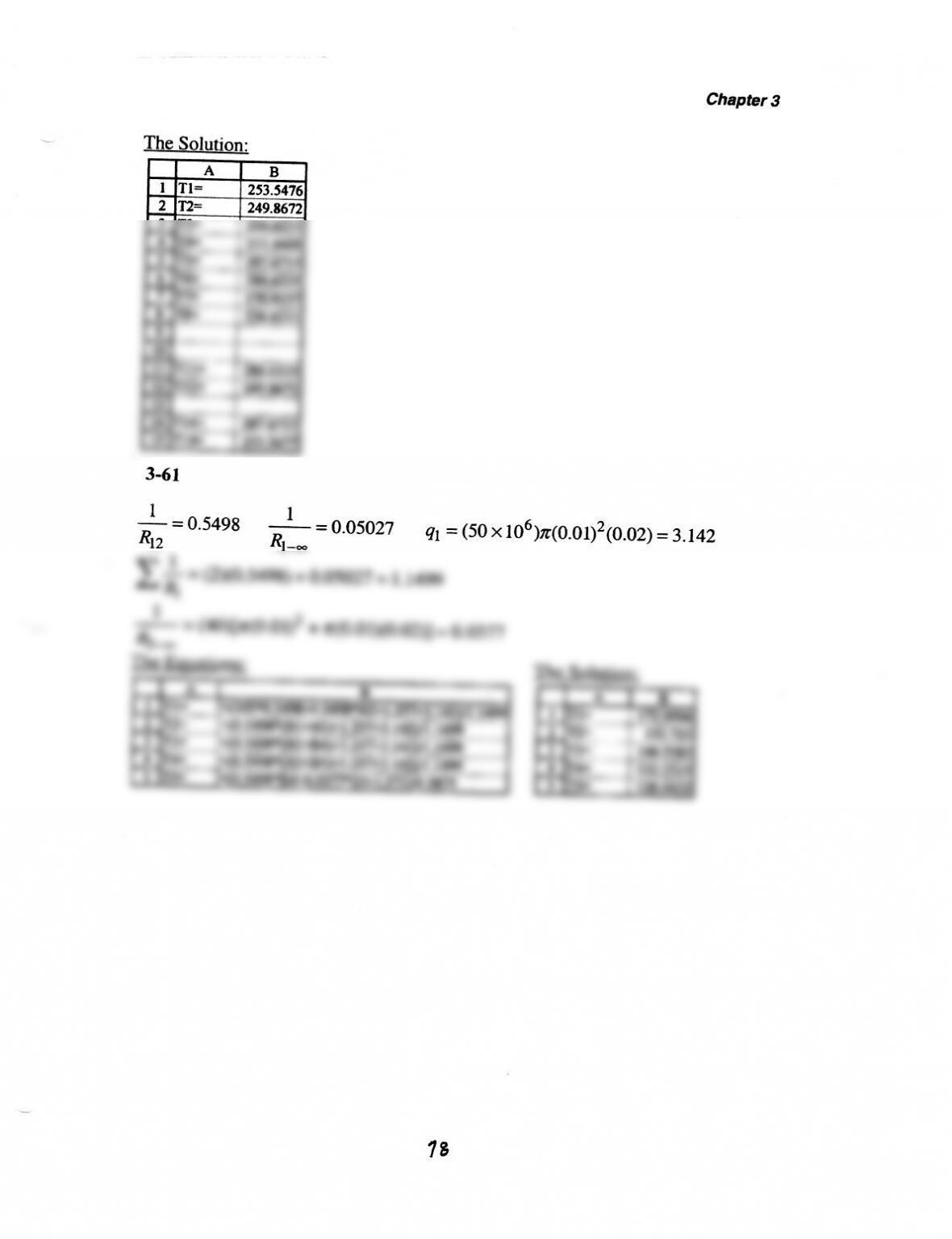
ITI: 253.5476
2T2= 249.9672
3-6t
* =
0.5498
+ =
0.05o27
qr
=
(soxro6;210.0
t)2(o.oz)
=
3.142
Ktz &–
5T5: t29.0432
1s
Chapter
3
3-62
I
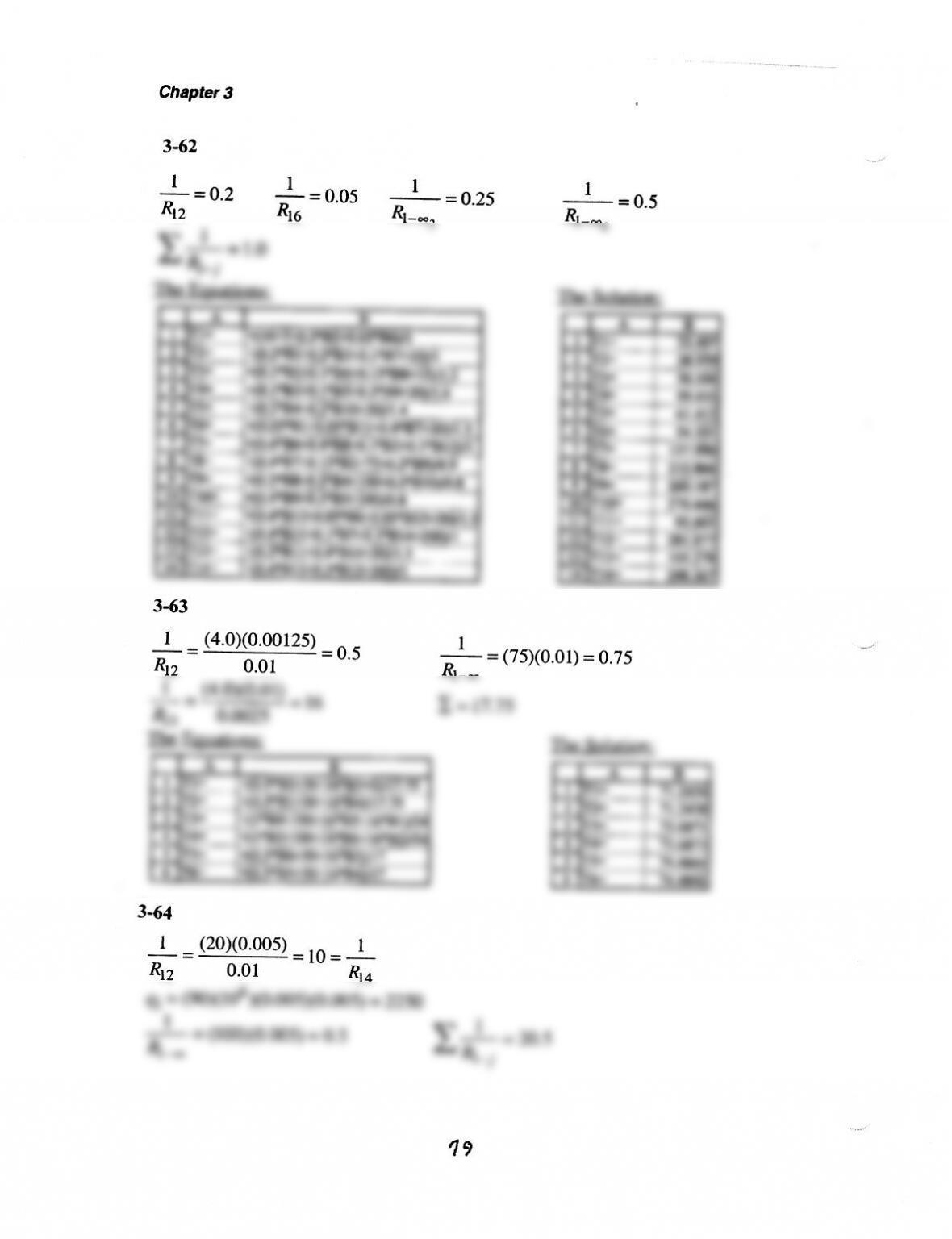
Rtz
I =
0.05
Rro Rt–, =O.25
Rl-“”
=
0.5
Rl-“ou
=
(75)(0.01)
=
0.7
5
3-63
I _(4.0X0.00125)_n
c
&z o.ol J3u’)
3-64
l_ _ (20×0.005)
_,n I
&z o.ol =
lu
– **
et- (90X106X0.005X0.005)
= 2250
l,
Rl-“” \&-;
AB
ITI: { I
0F5+0.
2fB2+0.05
rB6y I
2T2: 10.2t8
I
+0.2rB3{.
I
*B7+
I 0y
I
3T3: :(0.2*82+0.
I
*M+0. I
5*88+
|
SY 1.2
4TF :(0.
I
fB3+0.1fB5t0
.2i89+20y1.4
5T5: {0.2t84+O.2? t
Of2Oyl
.4
6 T6: <0.05*8
l+0.05f8I I
+0.4+p7+21yl
.s
7T7= =(0.4r86+0.4f88+O.
I
rB2+0.
I
*B l}y I
8Tt: <0.4187+0.
I
5
rB3+?5+0.2rB
gyo.g
9T9- <0.2
*88+02*84+
I OO+Q.2rB
I
0y0.
g
t0 Tl0- {0. 4*8$0.2 rB5+
I 00)/0-
g
lt Tl l:
12 T12: <0.4rBl l{{.1t87+0. I
tB l4+2pyl
l3 Tl3: <0.2*B
I I
+0.4+B
I 4+2A)n.5
{0.418
I
3+0.2
rBr
2+200y
I
l4 Tl4:
The
Solution:
AB
ITI: 25.497
2TlL: 3t.g5g
3T3: 50,304
4T4= 59,435
5T5: 61.412
6TF 54.101
7T7: l37.gg0
8T8: 210,966
9TF 2ffi.197
l0 Tl0: 27A.U6
ll Tt l: 93.603
t2 Tr2: zEt.O77
l3 Tl3: 105.379
l4 Tl4: 298.367
6TF 74.4946
‘lg
The
Equations:
AB
ITl= ={
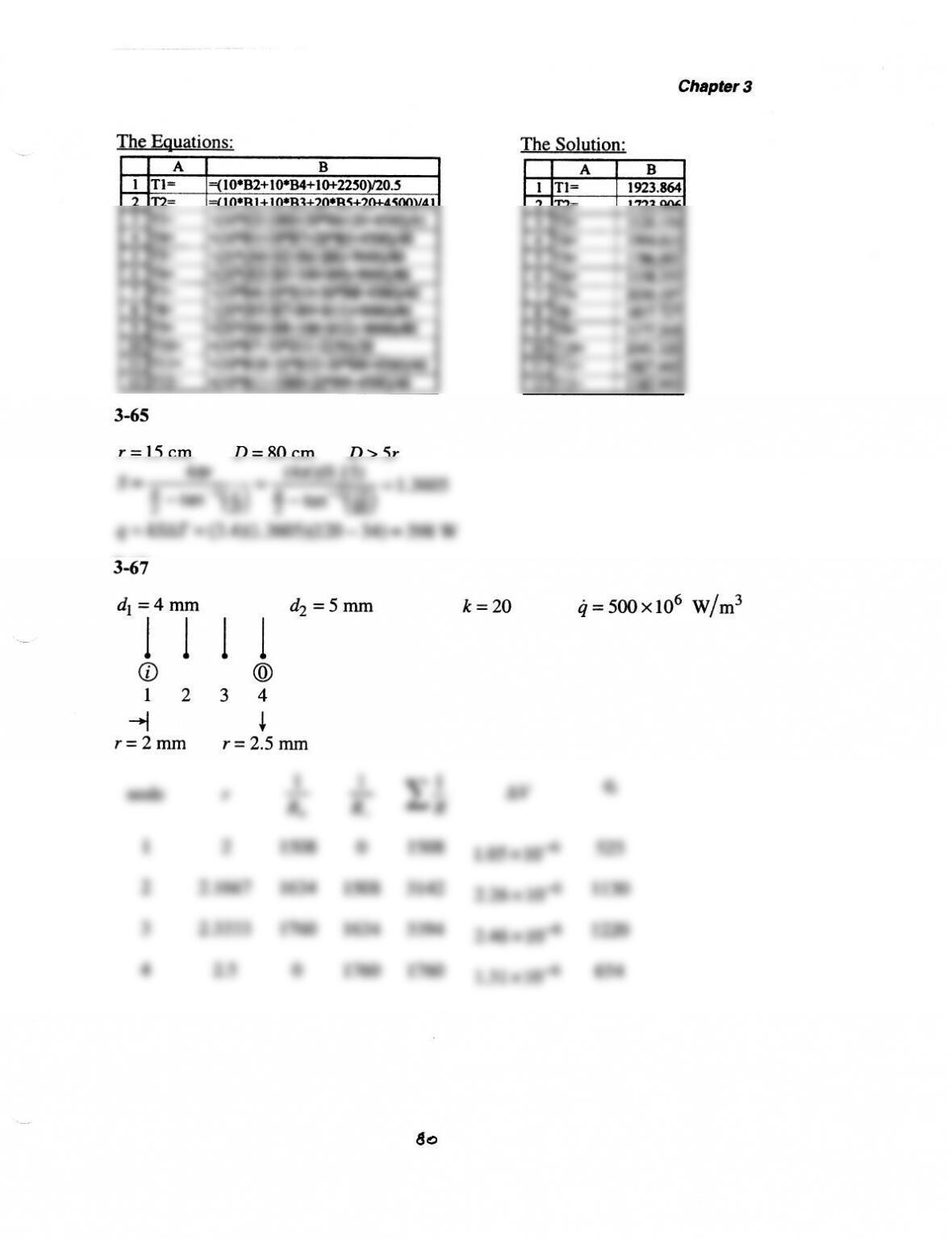
I 0f 82+ I 0tB4+ l0+2250y20.
5
Chapter
3
4=5ooxlo6
wl^3
3-65
3-67
dr- 4
mm d2
– 5 rnm k=20
ltrl
llll
O@
1234
..-|l
r= 2 mm r=2.5
mm
The
Solution:
A B
ITI: 1923.E&
6o
Chapter
3
+
=
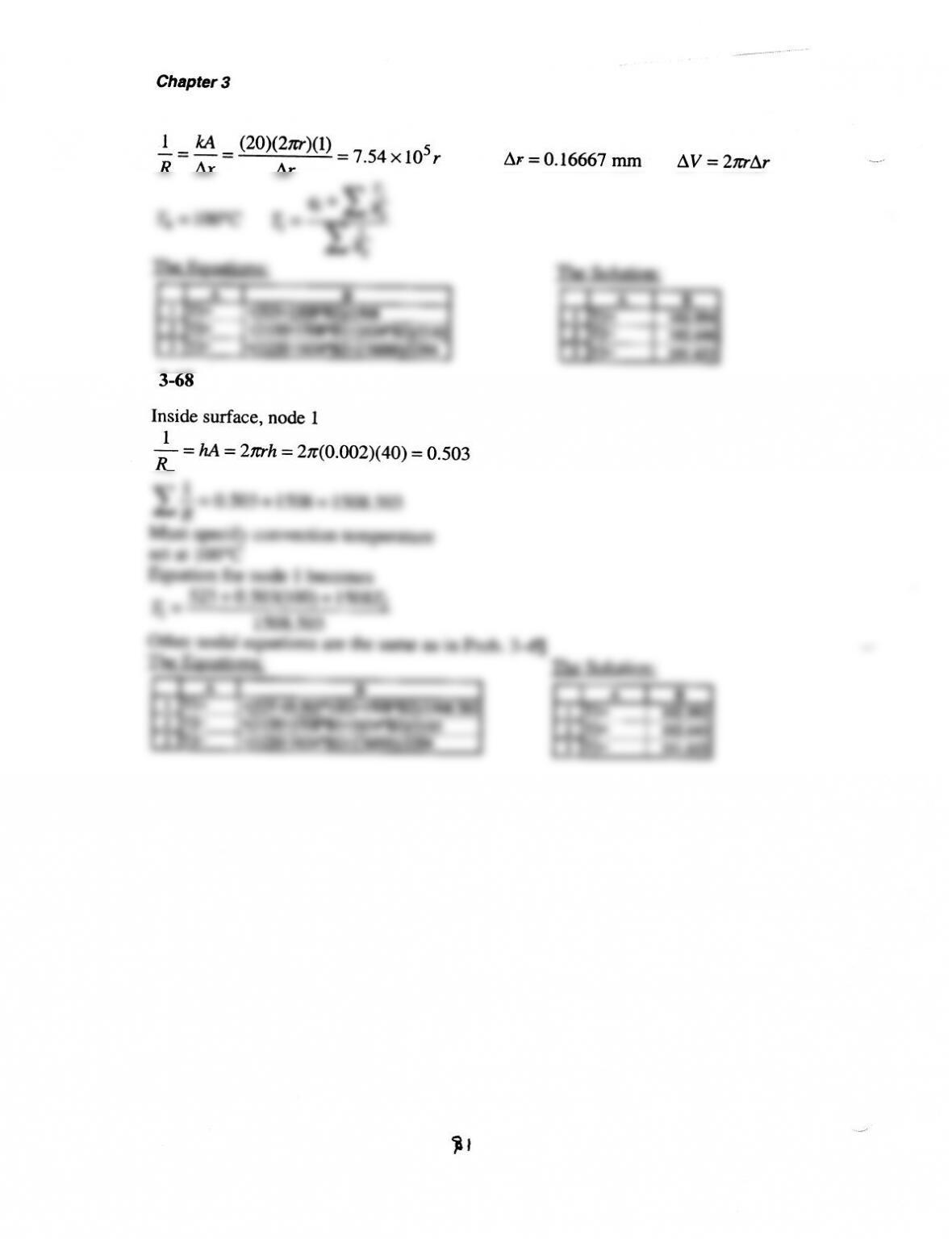
U – Qo)(zr)(r)
– 7
.s4x
to5
r
Lr’=
0.
16667
mm LV
=ZwLr
3-68
Inside
surface,
node
I
I
+ =
ffi=Znrh
-Zrc(0.002X40)
=
e.503
R_
– 1508.503
Ir
Chapter
3
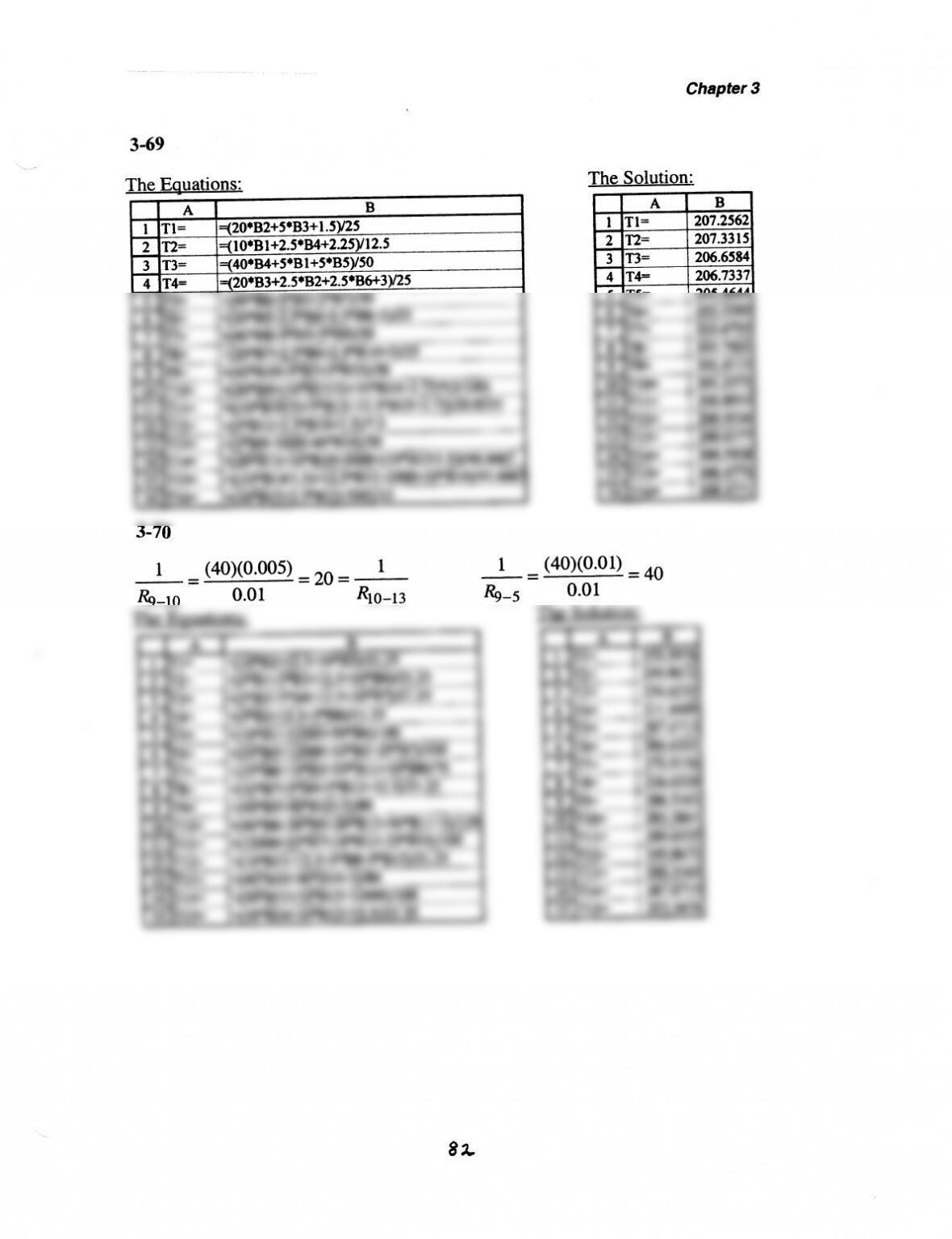
3-69
The
Equations:
AB
ITl= {20182+5183+1.5y25 _.
2T72= <lofBl+2-5rM+2.25L
3T3: <40r84+5rBl+sfB5y!q
4T4= < 20rB
3+2
.
5
rB
2+2
.5]B,6+3y
25
The
Solution:
AB
ITI: 207.2562
2Til: 207.3315
3T3: 206.55E4
4T4: 206.7337
8*
Chapter
3
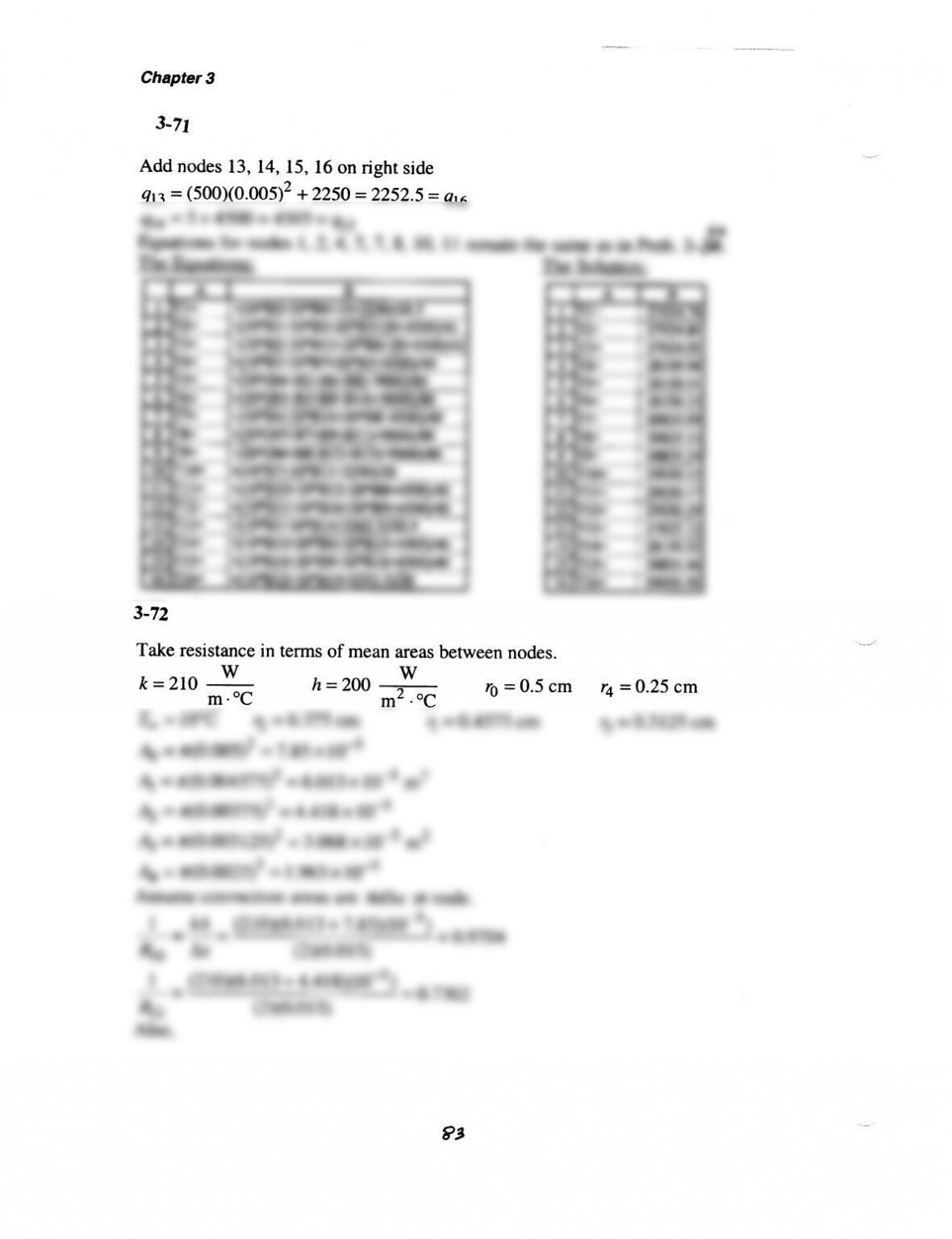
3_71
Add
nodes
13,14,15,
16
on right
side
g13
= (500)(0.0012
+2250
=2252.5
—
qrc
=4505=ets 3.
3-72
Take
resistance
in terms
of mean
areas
between
nodes.
k=210+ h=2OO-L r0=o.5cm
r+=O.Z5cm
m'”C m” ‘oC
=
?e
Chapter
3
Tt
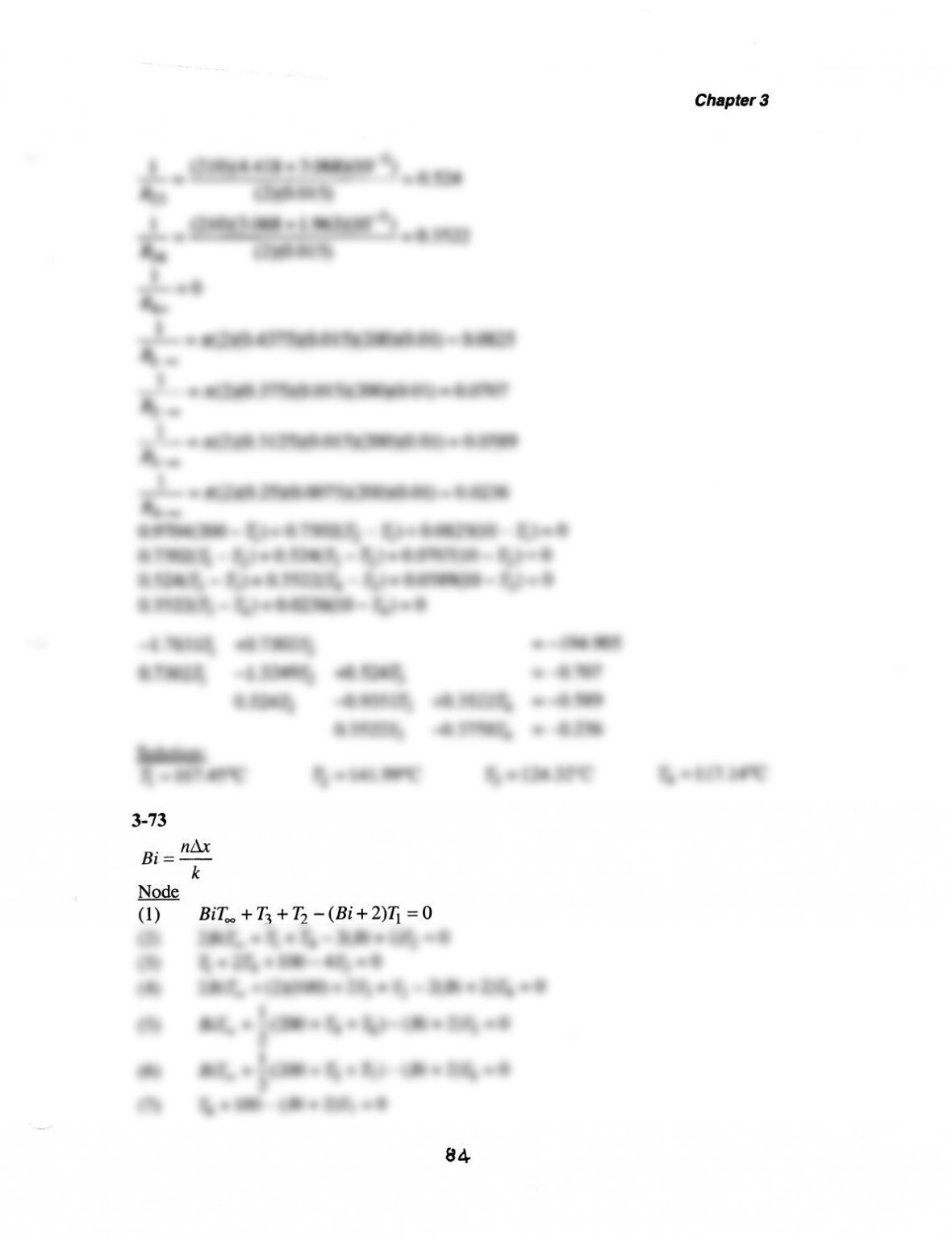
3-73
Bi: nM
k
Node
(l) BiT*+4+fz-@i+2)Tt=g
-z(Bi+l)T2
84
ChaPter
3
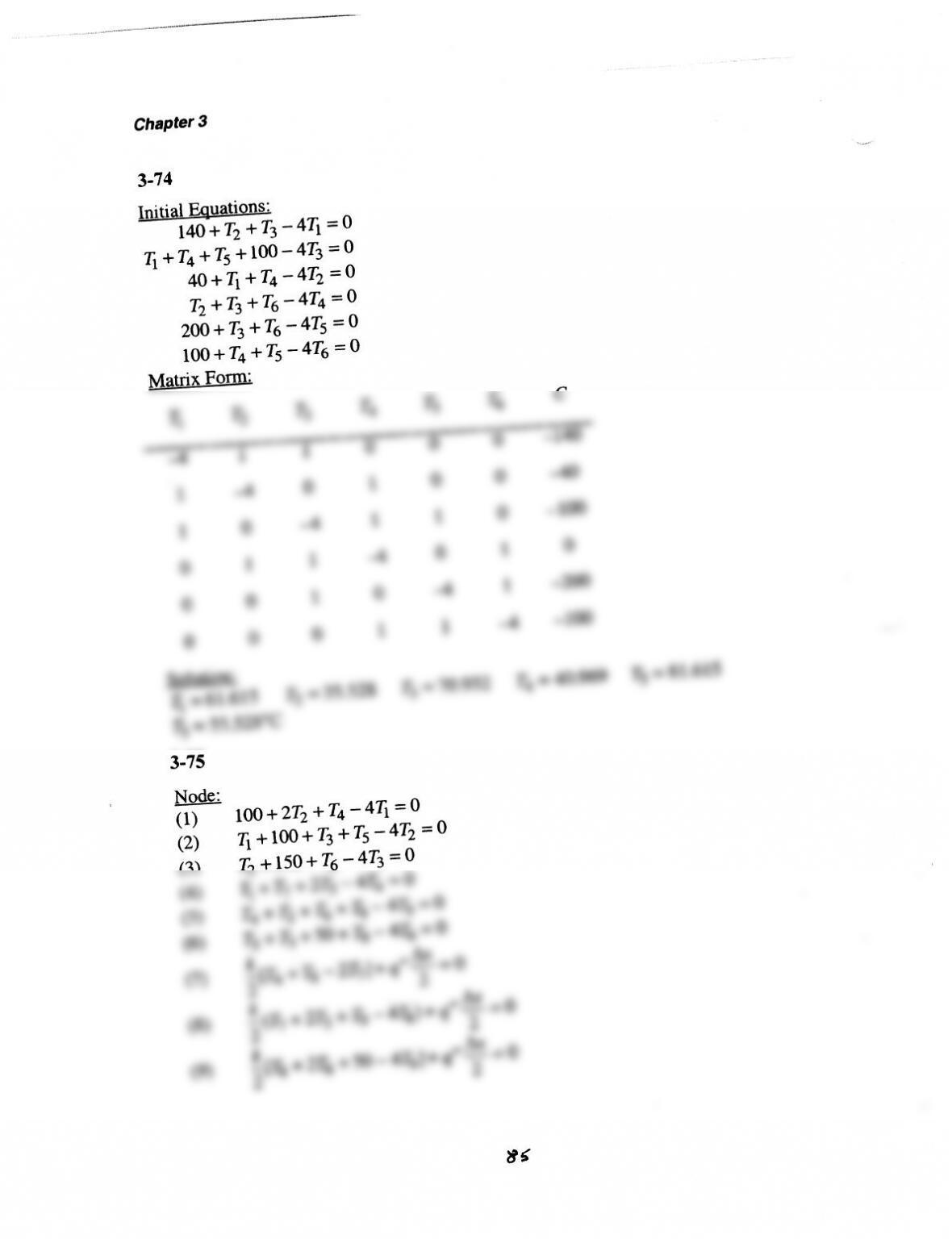
3-74
140
+h+T3- 4Tt=
0
Tt+Tq+Ts+100
-4\-0
40
+-Tt+T4-
4fz
=
0
TZ+TI+76-4Tq-0
200
+Tt +To
– 4TS
– 0
100
+Tq
+Ts
– 4To
– 0
Matrix
Form:
3-75
Node:
(1) 100
+2T2+Tq-
4Tr-
0
(2) 7i
+
1007ft+Ts- 4Tz
=
0
– 0
(4) TI+Tt
+ZTs
– 474
=
0
(5) io*Tz+To+Ts-4Ts-0
(6) rr*rr*50+ Ts-4Te=0
(7) \V^+T3
-zh\+q”+=o^
A
(8) lr’, +2T5+Tg-
4r8)
+
q”
T= o
LA
(e) lVr+276+
5o
– 4Tsl+
q”
+- o
E6
3-16
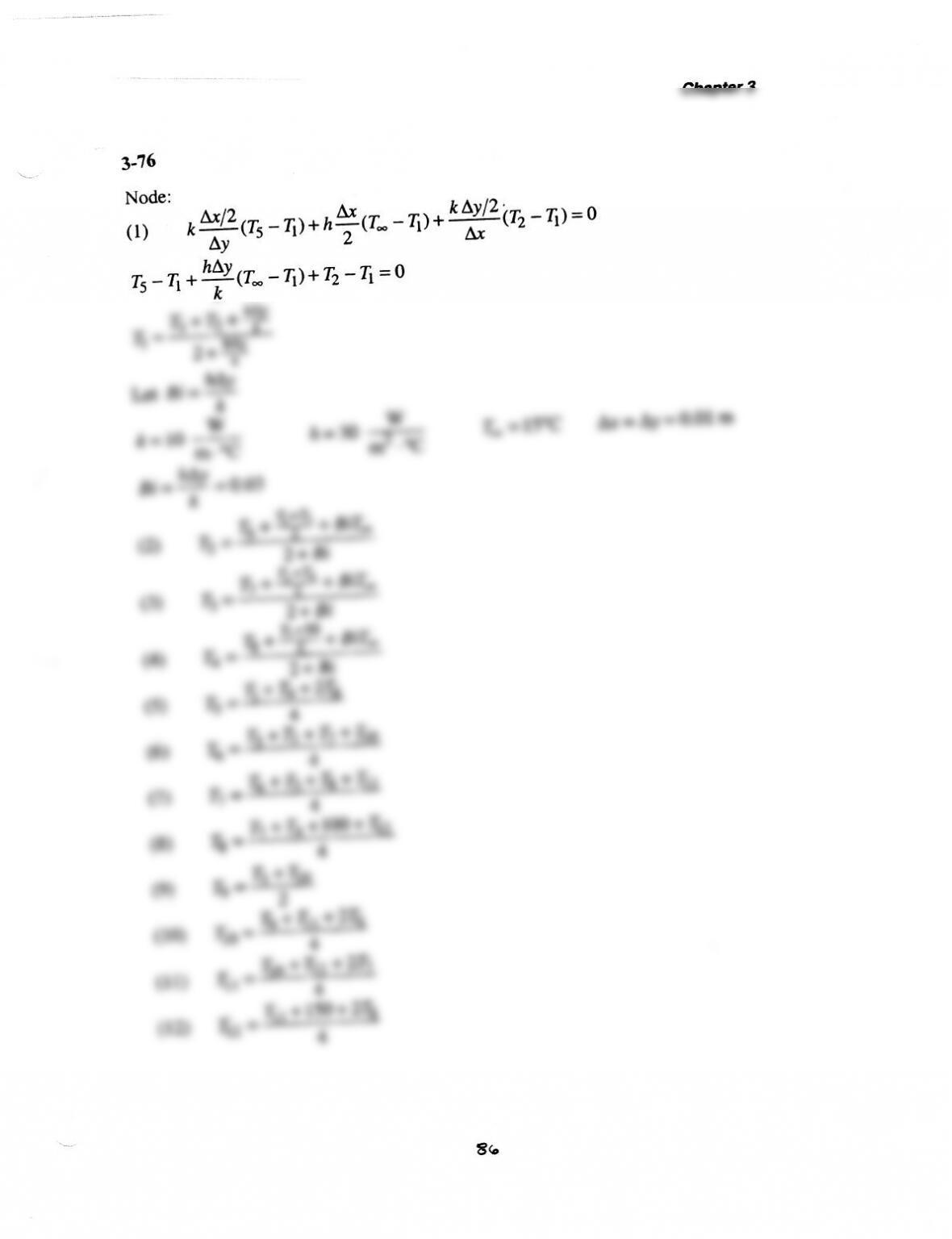
Node:
(r) k+(G
–
7i)
+
h+(r*
-r1)
+
ry(rz -r1) =
0
,1,
T5-?i
+
ry(T*-71)+Tz-71-
0
ChaPter
3
4
(12)
EA
Chapter
3
3-11
,2
+y2
=1oo
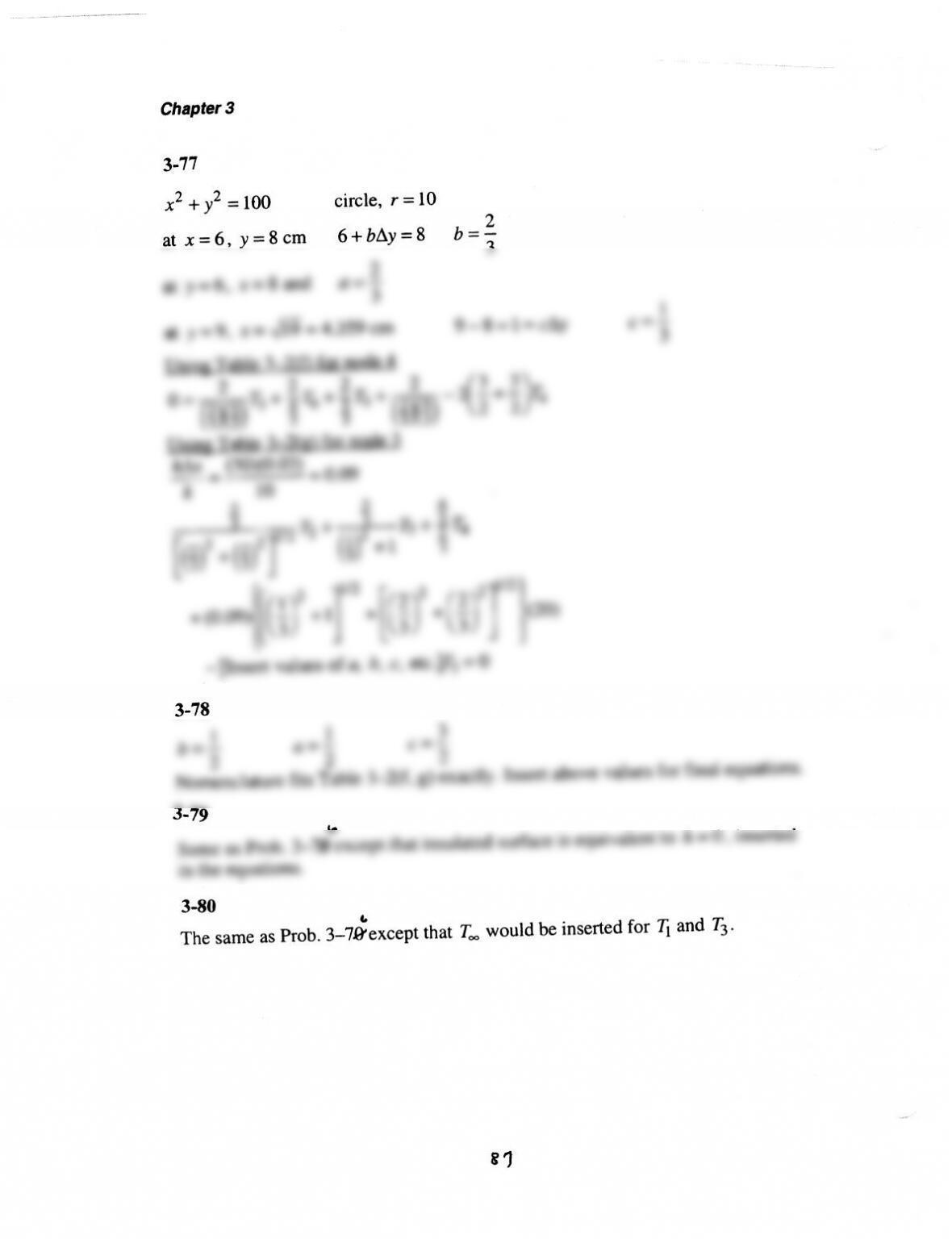
at
x=6,y-8cm 6+bLY-8
circle, r = l0
U=?
– [Insert
values
of a, b, c, etc’]?i
3-78
Nomenclature
fits
Table
3-2(f
,g) exactly.
Insert
above
3-79 ”
prob. 3–li”*””pt that
insulated
surface
is
equivalent
to h = 0
‘ inserted
3-80 b
The
same
as
Prob.
3-1d”*””pt that
L would
be
inserted
for { and
13′
81
ChaPter
3
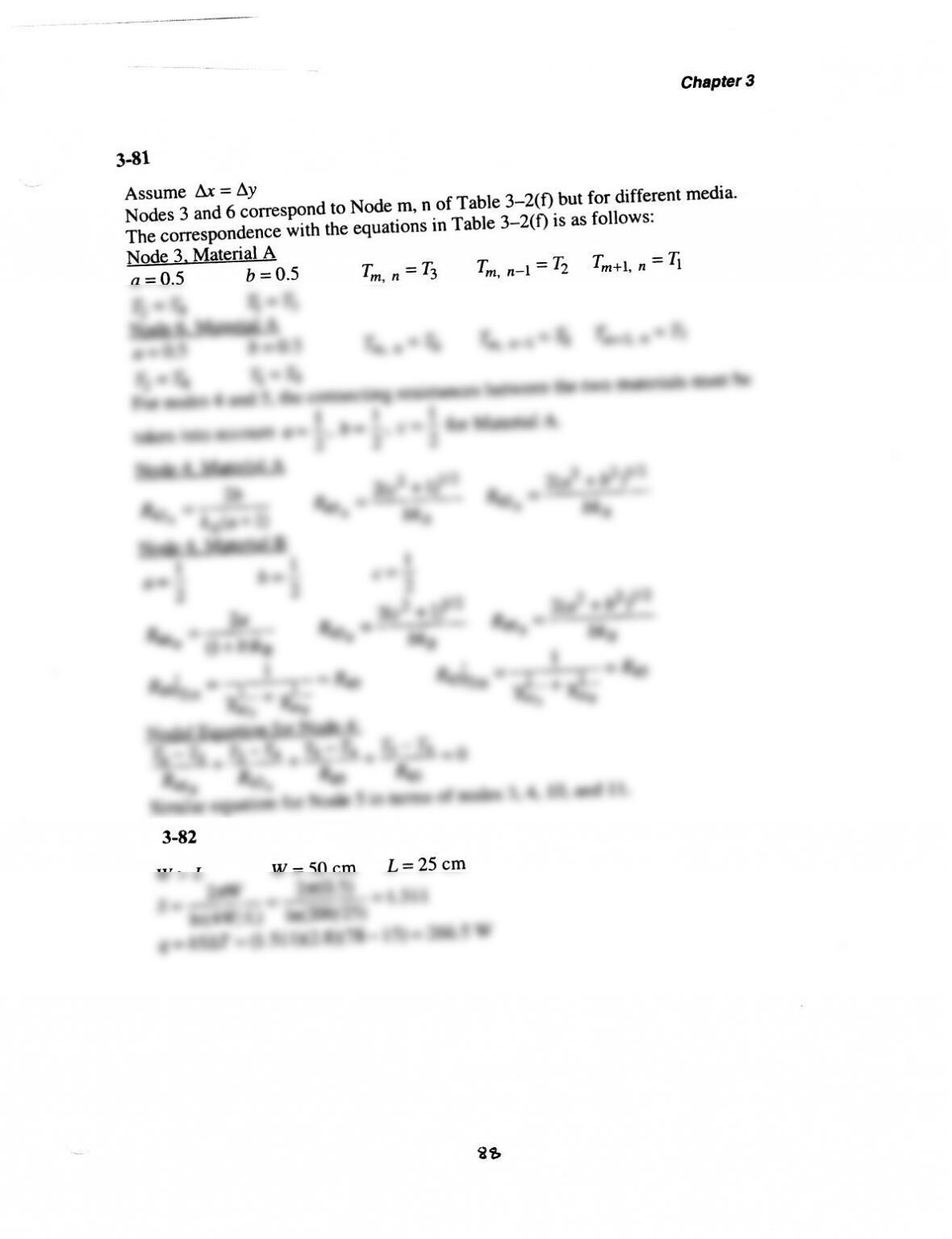
3-81
ft
n:T:ff;t:’*spondloNode.m’n,:f:191″,’;?P,3′”t;T,,-{t:l””tmedia’
ThecorrespondencewitntrreequationsinTable34(f)isasfollows:
Node
3.
Material
A
T^, n = T\ T*, n-l =’ Tz Tm+l’ n = Tl
T*, n — T6 T*, n-l= ?b Tm+\,
n = h
a-0.5 b
– 0.5
resistances
between
the
two
materials
must
be
I2= T4 T1=TS
Node
6.
Material
A
a=0.5 fi=0,5
3-82
W>L W-50cm L-25cm
A ZttW Zq$.s)__
1.511
c-
r – rttt+W
lL) ln(200/25)
q -kSAT
=
(1
’51
1X2’8X78
– 15)
= 266’5
W
r6tL-Tt=4 nh-Tq *Ts-Tq
–
Tt-7o -ri- r+ , 19- L1
—0
Rq6
sR$e, R+q R+s
– -+uB
Similar
equati; for Node
5
in terms
of nodes
3
‘4’ 10,
and
I
1.
8S
Chapter 3
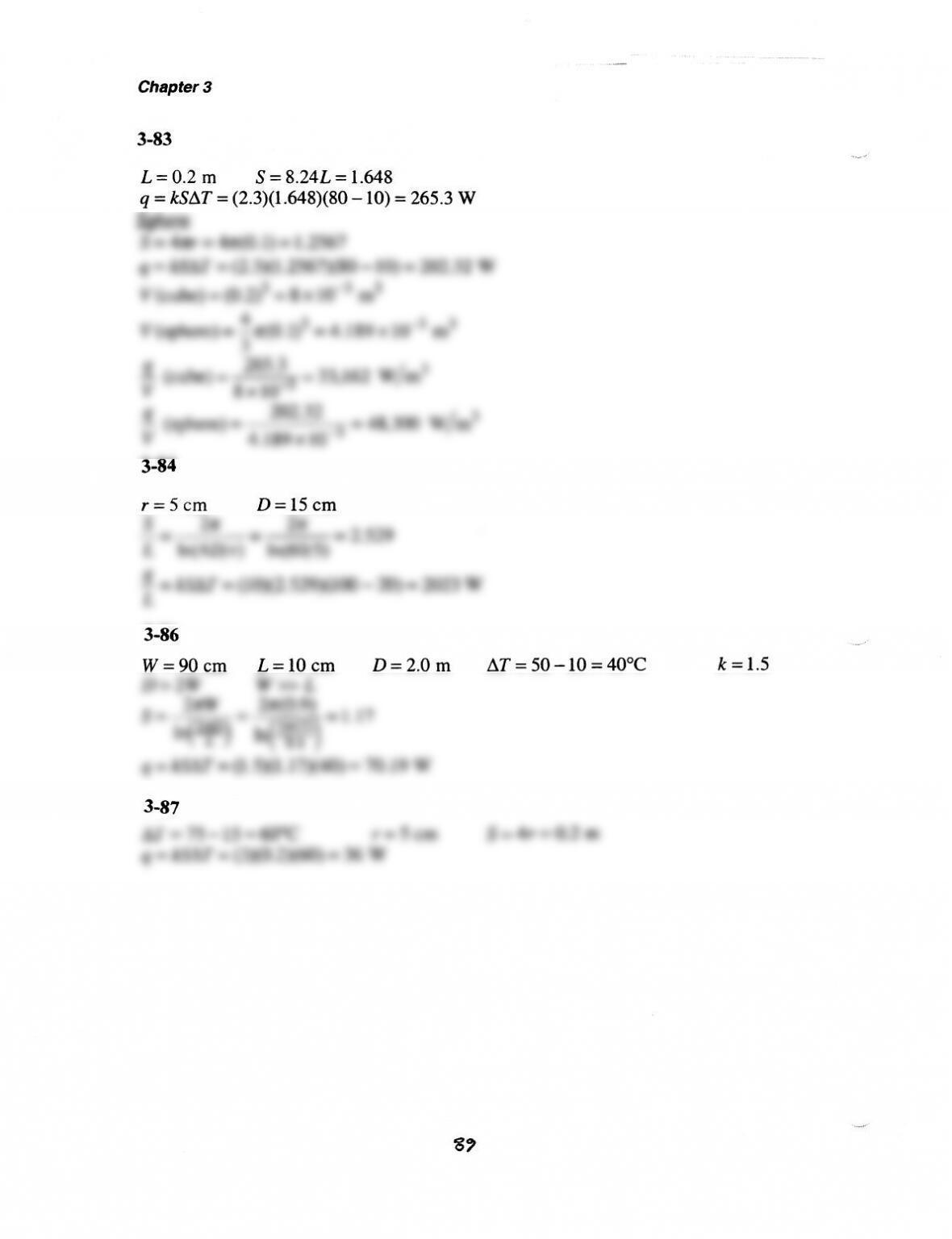
3-83
L=0.2m S=8.24L=1.648
q
= kSLT
– (2.3)(1.648X80
– l0) = 265.3 1U’
3-84
r=5 cm D=15 cm
3-86
W=90cm Z=l0cm D=2.0m AT=50-10=40oC k=1.5
3-87
e= kSLT
67
Chapter
3
3-88
LT=60oC W-L-0’1
-Icw gP =o.zz7
3-89
q
_ksAr
=
(50
x lotrxt 63.2)(200
3-90
q
– kSAf LT = 100
-24
k-0.76
J
m’oC
r–5cm
Aonn
= ZnrLr(z)
q
-(0.76)(1.886X100
– 24)
– 108’9
w
3-gl
A- 27ffi
(conduction)
To
= base
temPerature
(.adjacent
AY
-ZtvLrt
To. —
-r^{^- 9T+ q(Zn)r^Lrt
+
h(2)(2n)r^Lr(r*-T^’)
2o
Chapter
3
3-92
A** =
2vr1 r = 0’25x+
0’01 x =
0 at
top
of
cone
[r
rr(‘ +)+0
‘r],;
-t-r^).[o
rt(‘.+)+o.or]a.r
3-93
To
=
5o
r %
=
o
K ,,
=T= 0.75
cm ‘,
=T= o’85
cm
perunitdepth
Because
outside
surface
is
insulated
a linear
temperature
3-94
S
=8.?-46 L=O-3
q
9t
Chapter
3
3-95
)
q
=kSAf =
(3-4X0.5
734)(50
3-97
Ts
=323K T6=373K
1.5
T*=303K rL=
z
r.7
ry,–
2
– ryXl) Per
m
dePth
t)t
Chapter
3
Numerical
3-99
– T* x1
= r^L0
AT
q=
&verall
&verall = Rinride convection
* R*rn + &utside
3-100
For
this
problem
the
overall
thermal
resistance
will be
the
sum
of the
resistance
of
*,” pif” *Al plus the
resistance
resulting
from
the
shape
factor
for a
buried
pipe’
F;g;l; practical
standpoint
one
might
*-ant
to
use
several
small
pipes operating
in
series
to
minimize
pt”is.re losses
due
to
fluid friction,
but
that
is
not
a
Properties
of plastic
pipe
may
be
taken
as that
of
iepresent
q”
ChaPter
3
3-101
For
this
problem
only
consider
conventional
electric
burners
which
have
spiral
burners
have
different
characteristics’
To
aluminum
layer
for an
initial
3-103
The
analysis
of this
problem
requires.that
the
heat
gained
by
the
building
from
all
fie coofing
iupplied
by
qe reffrgeration
system’
The
heat
thermal
resistances:
that
of the
il;;; the
interiJr
conditions
01+