1
Solutions to end-of–chapter problems
Engineering Economy, 8th edition
Leland Blank and Anthony Tarquin
Chapter 3
Combining Factors and Spreadsheet Functions
Present Worth Calculations
3.1 P = 400,000(P/A,10%,15)(P/F,10%,1)
3.4 P = 12,000(P/A,10%,9)(P/F,10%,1)
3.6 P = 100,000(260)(P/A,10%,8)(P/F,10%,2)
3.7 P = 80(2000)(P/A,18%,3) + 100(2500)(P/A,18%,5)(P/F,18%,3)
3.8 P = 15,000(P/A,8%,18)(P/F,8%,2)
3.10 Present worth before = 73,000(P/A,10%,5)
Annual Worth Calculations
3.11 Find F in year 10 and then convert to A in years 1-10
F = 20,000(F/A,10%,8)
3.12 Find P in year 0 and then convert to A in years 1-5
P = 7000(P/F,10%,2) + 9000(P/F,10%,4) + 15,000(P/F,10%,5)
Copyright © 2018 McGraw–Hill Education. All rights reserved. No reproduction or distribution without the prior written consent
of McGraw–Hill Education.
3
A = 21,245.30(A/P,10%,5)
= 21,245.30(0.26380)
= $5605
Spreadsheet: = PMT(10%,5,PV(10%,2,,7000)+PV(10%,4,,9000)+PV(10%,5,,15000))
3.13 Find F in year 7 and then convert to A in years 1-7
F = 70,000(F/P,10%,7) + 15,000(F/A,10%,5)
= 70,000(1.9487) + 15,000(6.1051)
= 227,986
A = 227,986(A/F,10%,7)
= 227,986(0.10541)
= $24,032
3.14 Find P in year -1 and then convert to A over a 6–year period. In $1000 units,
P-1 = -120(P/F,12%,2) – 50(P/F,12%,3) + 90(P/A,12%,4)(P/F,12%,3)
3.15 Find P and the convert to A
P = 140,000(4000) + 140,000(6000)(P/F,10%,1)
Copyright © 2018 McGraw–Hill Education. All rights reserved. No reproduction or distribution without the prior written consent
of McGraw–Hill Education.
4
3.16 A = 900,000(F/P,8%,1)(A/P,8%,8)
= 900,000(1.08)(0.17401)
= $169,138
3.17 A = 80,000(A/P,10%,5) + 80,000
= 80,000(0.26380) + 80,000
= $101,104
3.18 A = 20,000(A/P,6%,5) + 1,000,000(0.15)(0.75)
[x + 300(P/A,10%,6) + x(P/F,10%,7)](A/P,10%,7) = 300
3.20 Plan 1: A = 700,000(A/P,10%,4)
Future Worth Calculations
3.21 F = 10,000(F/A,10%,21)
3.23 F7 = 15,000(F/A,8%,5)
3.24 A = 500,000(A/F,10%,11)
3.26 First find P in year 0 and then move to year 9
P = 200 + 200(P/A,10%,3) + 300(P/A,10%,3)(P/F,10%,3)
Copyright © 2018 McGraw–Hill Education. All rights reserved. No reproduction or distribution without the prior written consent
of McGraw–Hill Education.
6
= $1257.90
F = 1257.90(F/P,10%,9)
= 1257.90(2.3579)
= $2966
3.27 F = 500(F/A,10%,3)(F/P,10%,6) + 800(F/A,10%,4)(F/P,10%,1)
Random Single Amounts and Uniform Series
3.29 In $1000 units
3.30 Move $85,000 to year 1, subtract $42,000, and find the equivalent over 4 remaining years.
3.31 P = 40 + x(P/F,10%,1) + 40(P/A,10%,2)(P/F,10%,1) + x(P/F,10%,4)
3.32 First find P in year 0, then convert to equivalent A value over 10 years; add the annual
maintenance. In $1 million units,
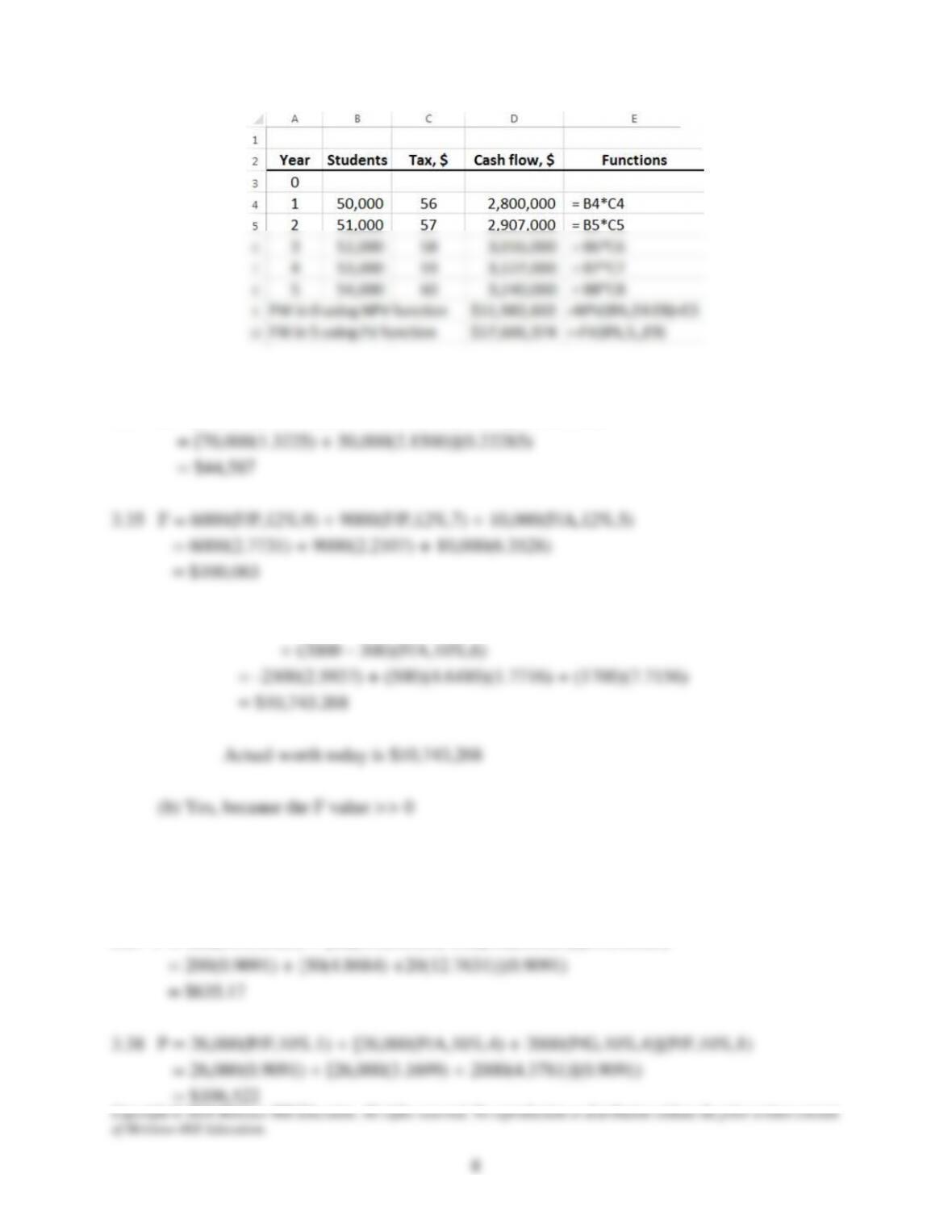
3.33 (a) Using factors, determine the annual cash flow with arithmetic gradient values of Gtax =
$1 for the tax and Gstu = 1000 for students. The resulting cash flows do not form an
arithmetic gradient series.
P = 2,800,000(P/F,8%,1) + 2,907,000(P/F,8%,2) + … + 3,240,000(P/F,8%,5)
F = 11,982,281(F/P,8%,5)
(b) Spreadsheet solution
Year Students Tax, $ Cash flow, $
0
150,000 56 2,800,000
251,000 57 2,907,000
352,000 58 3,016,000
453,000 59 3,127,000
554,000 60 3,240,000
Copyright © 2018 McGraw–Hill Education. All rights reserved. No reproduction or distribution without the prior written consent
of McGraw–Hill Education.
8
3.34 A = [70,000(F/P,15%,2) + 50,000(F/A,15%,2)](A/P,15%,8)
3.36 (a) F = –2500(F/P,10%,10) + (700 – 200)(F/A,10%,4)(F/P,10%,6)
Shifted Gradients
3.37 P = 200(P/F,10%,1) + [50(P/A,10%,7) +20(P/G,10%,7)](P/F,10%,1)
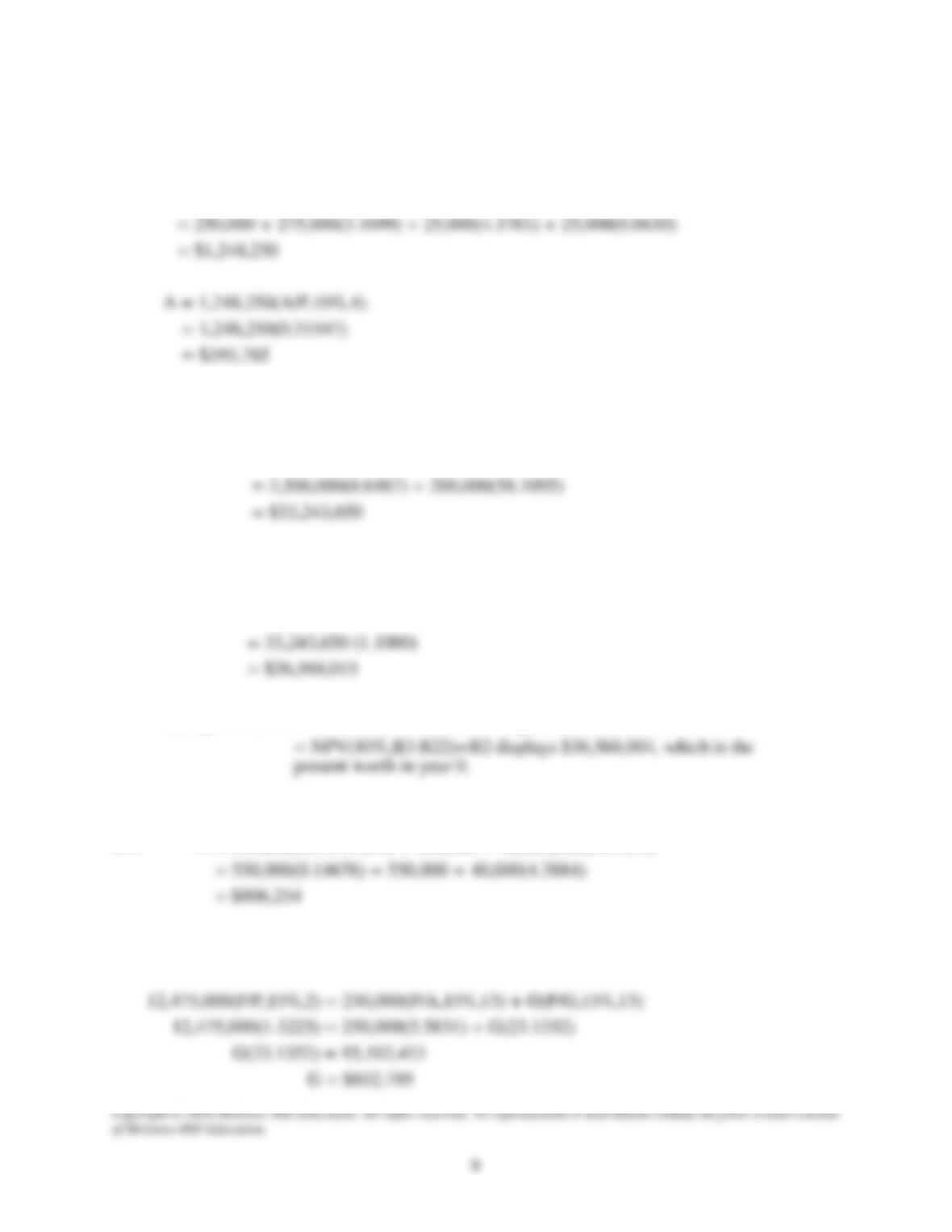
3.39 First find P in year 0, then find A over 4 years.
P = 250,000 + 275,000(P/A,10%,4) + 25,000(P/G,10%,4) + 25,000(P/F,10%,4)
3.40 (a) Factors: Find P in year –1 using gradient factor and then move forward 1 year
P-1 = 2,500,000(P/A,10%,21) + 200,000(P/G,10%,21)
F = P0 = 33,243,650(F/P,10%,1)
(b) Spreadsheet: If entries are in cells B2 through B22, the function
3.41 A = 550,000(A/P,10%,12) + 550,000 + 40,000(A/G,10%,12)
3.42 (a) Using tabulated factors
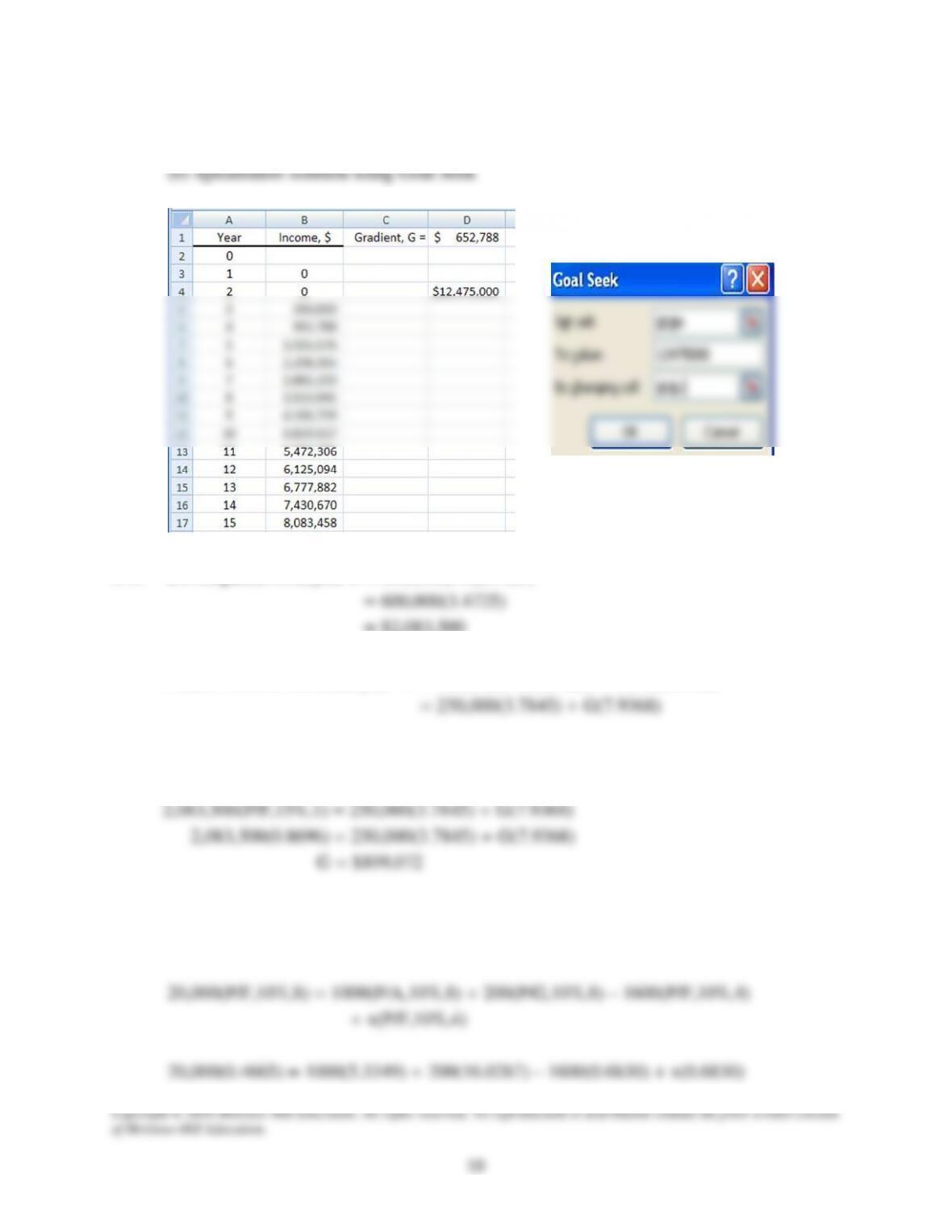
3.43 Development cost, year 0 = 600,000(F/A,15%,3)
= $2,083,500
Present worth of contract, year –1 = 250,000(P/A,15%,6) + G(P/G,15%,6)
Move development cost to year –1 and set equal to income
3.44 Move $20,000 to year 0, add and subtract $1600 in year 4 to use gradient, and
solve for x. Use + signs for cash flows for convenience.
9330 = 5334.90 + 3205.74 – 1092.80 + 0.683x
x = $2755.72
3.45 (a) Add and subtract $2400 and $2600 in periods 3 and 4, respectively, to use gradient
factors. Use + signs for cash flows for convenience.
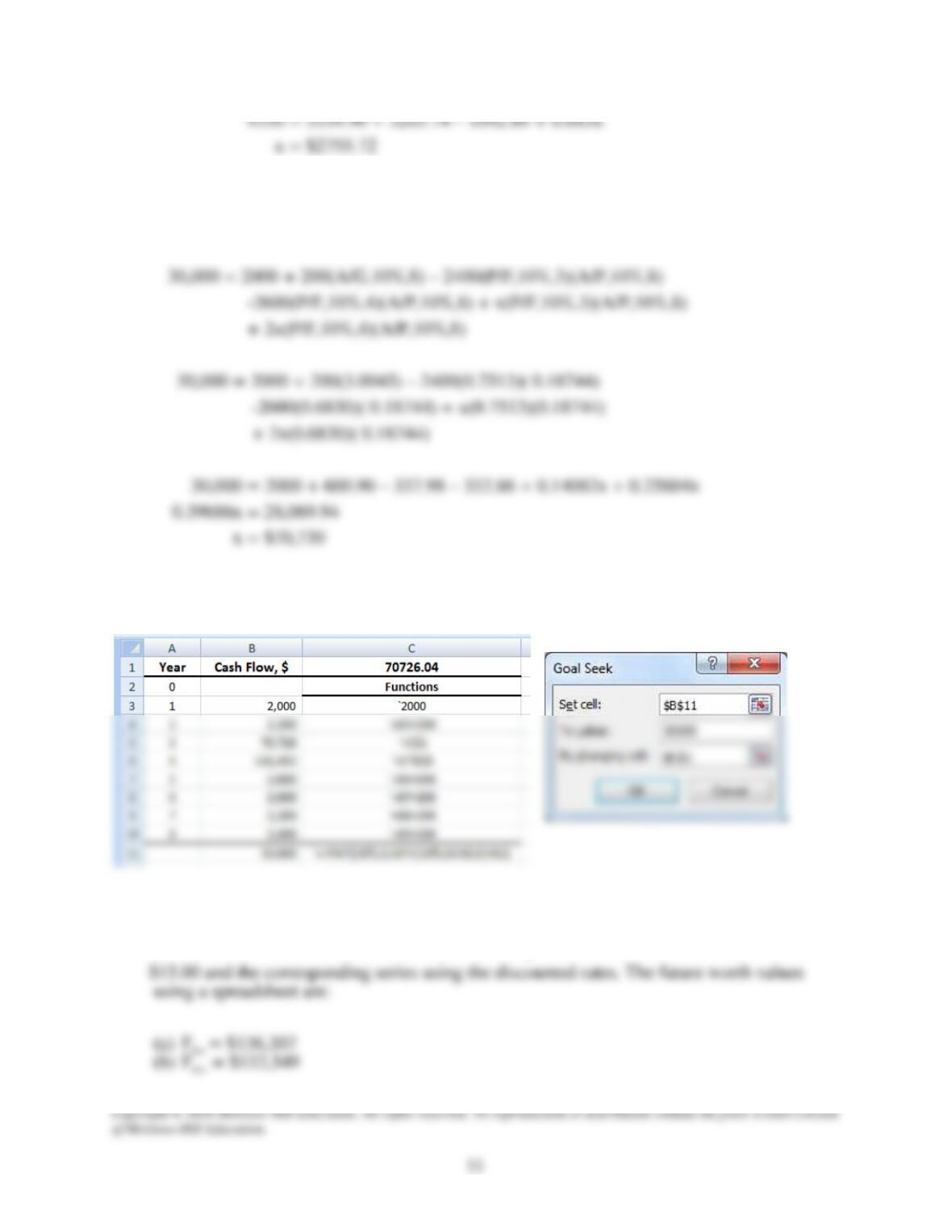
(b) Spreadsheet uses Goal Seek to find x = $70,726
3.46 First determine the discount cost schedule. Develop the annual cost series for the flat rate of