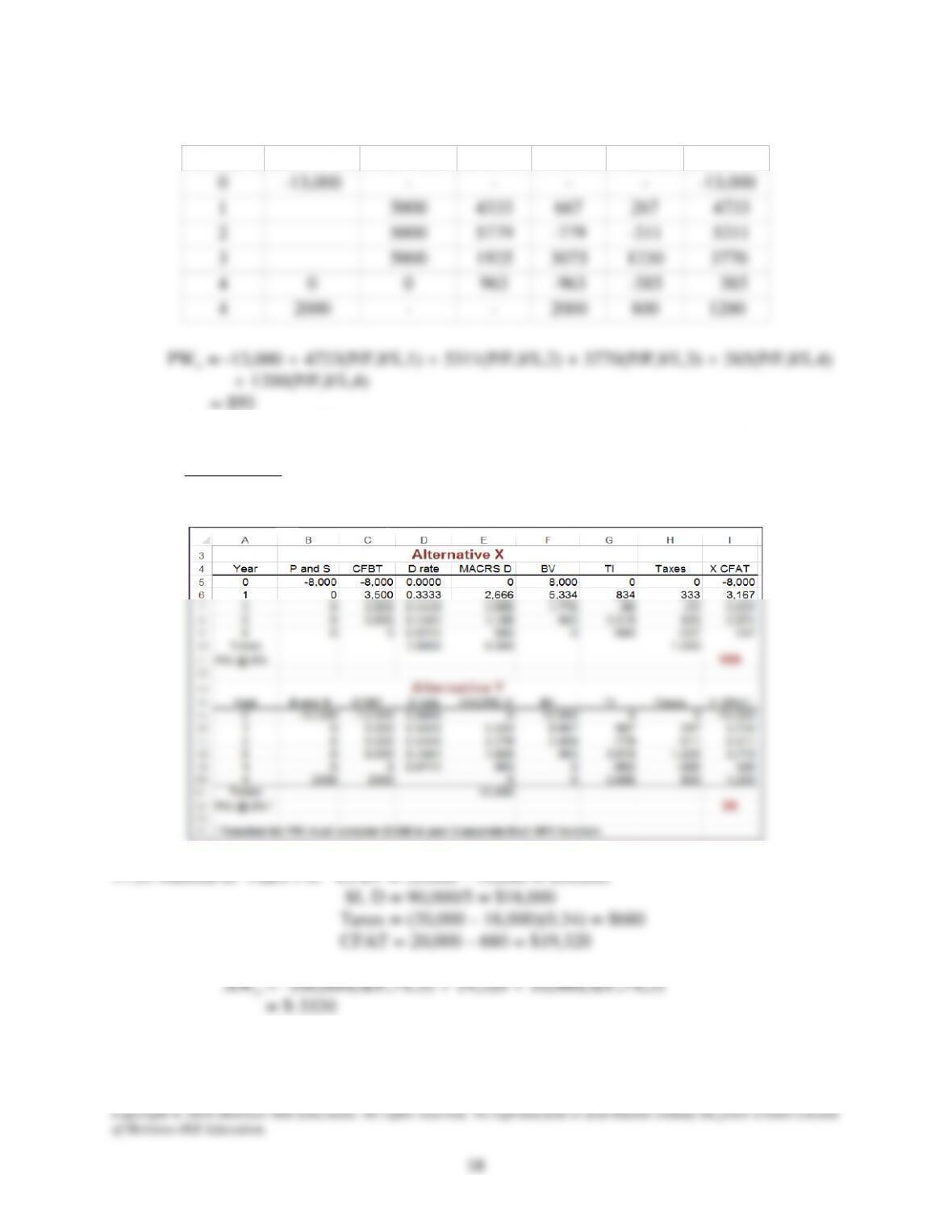
Alternative Y
-13,000
4733
1230
. Select alternative X
(b) Spreadsheet: Select X with the larger PW value. Note handling of $2000 salvage for Y
in year 4
Year
P and S
GI – OE
D
TI
Taxes
CFAT
Copyright © 2018 McGraw–Hill Education. All rights reserved. No reproduction or distribution without the prior written consent
of McGraw–Hill Education.
19
Method H: Years 1-5: CFBT = 45,000 – 6,000 = $39,000
SL D = 130,000/5 = $26,000
Taxes = (39,000 – 26,000)(0.34) = $4420
CFAT = 39,000 – 4420 = $34,580
AWH = -150,000(A/P,7%,5) + 34,580 + 20,000(A/F,7%,5)
= $1474
Method H is selected; the same as with MACRS.
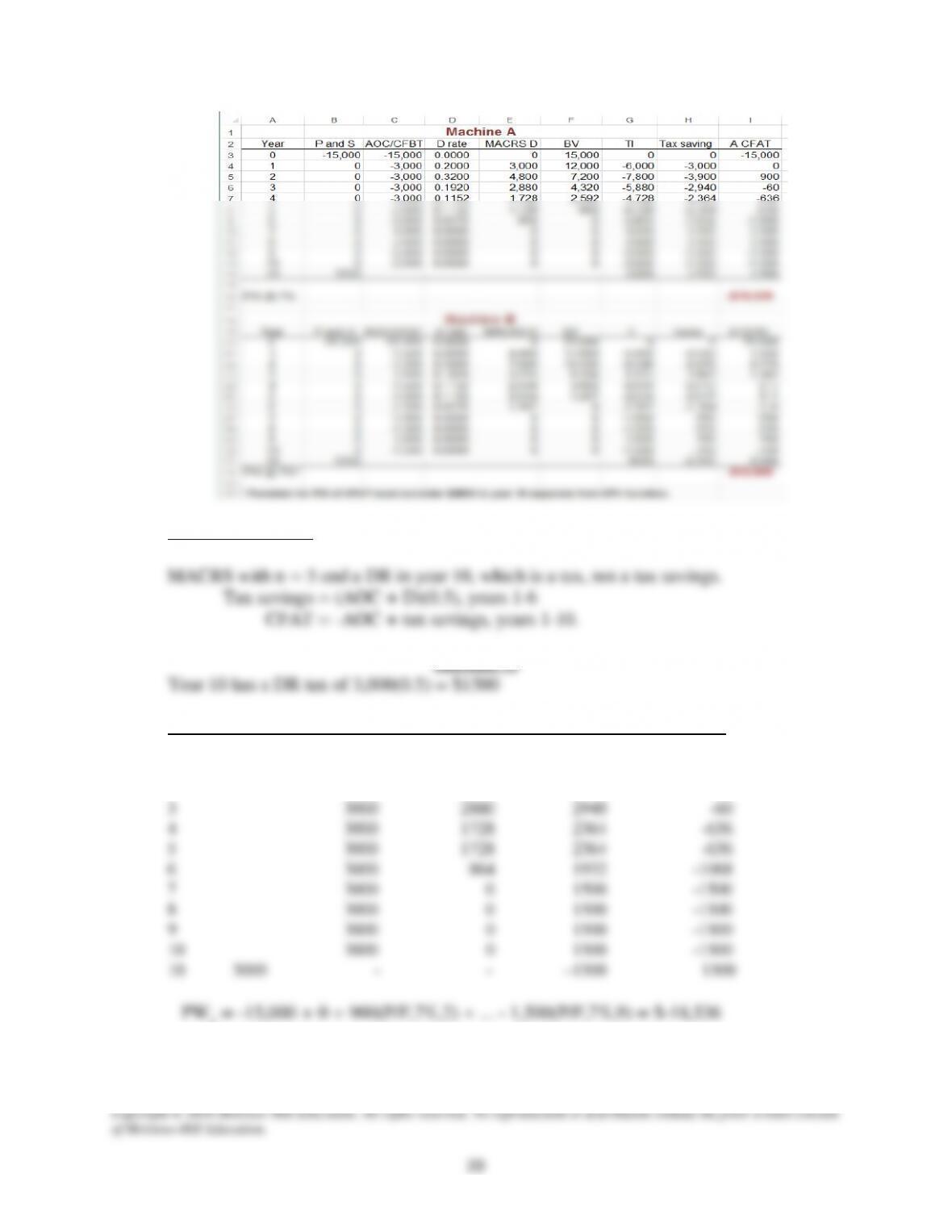
17.53 (a) Function for PWA: = -PV(14%,10,-3000,3000) – 15000 displays PWA = $-29,839
(b) All AOC estimates generate tax savings; GI estimates are equal.
Machine A
Machine B
(c) Again, select machine B. All methods give the same conclusion
Copyright © 2018 McGraw–Hill Education. All rights reserved. No reproduction or distribution without the prior written consent
of McGraw–Hill Education.
20
By hand, if needed:
Machine A
Year P or S AOC Depr. Tax savings CFAT
0 $-15,000 – – – $-15,000
1 $3000 $3000 $3000 0
2 3000 4800 3900 900
Copyright © 2018 McGraw–Hill Education. All rights reserved. No reproduction or distribution without the prior written consent
of McGraw–Hill Education.
21
Machine B
Year 10 has a DR tax of 5,000(0.5) = $2,500
Year P or S AOC Depr Tax savings CFAT
0 $–22,000 – – – $–22,000
1 $1500 $4400 $2950 1450
2 1500 7040 4270 2770
3 1500 4224 2862 1362
After–Tax Replacement
17.54 (a) For a capital loss, it is the difference between sales price and the asset’s book value.
(b) The AW of the challenger is affected in year 0 by the capital gains tax. If it is a capital
17.56 (a) Defender: CL = BV2 – sales price = [300,000 – 2(60,000)] – 100,000
This represents a tax savings for the challenger in year 0.
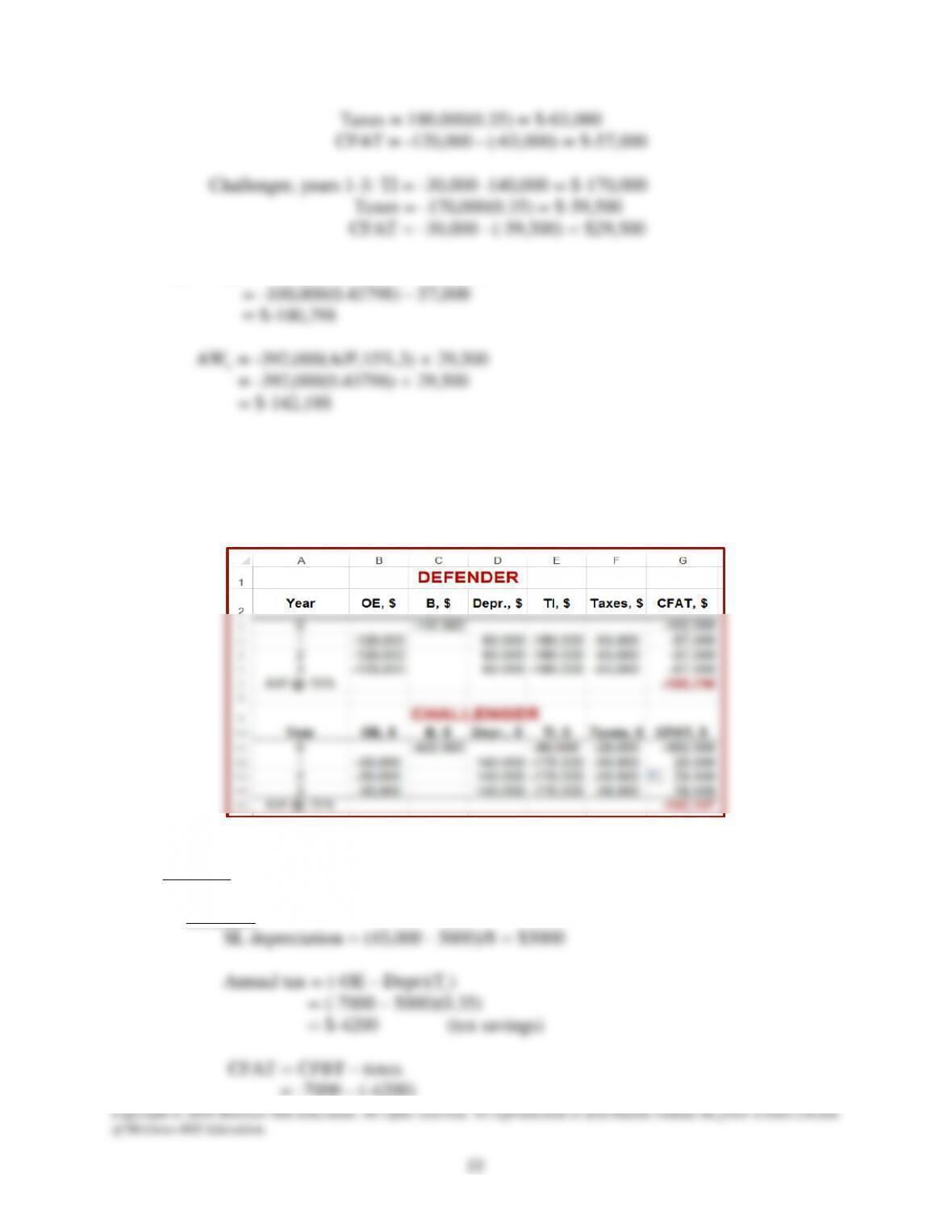
(b) Defender, years 1-3: TI = -120,000 – 60,000 = $-180,000
Copyright © 2018 McGraw–Hill Education. All rights reserved. No reproduction or distribution without the prior written consent
of McGraw–Hill Education.
22
Taxes = 180,000(0.35) = $-63,000
CFAT = -120,000 – (-63,000) = $-57,000
Challenger, years 1-3: TI = -30,000 –140,000 = $-170,000
Taxes = -170,000(0.35) = $-59,500
CFAT = -30,000 – (-59,500) = $29,500
(c) AWD = -100,000(A/P,15%,3) – 57,000
Conclusion: Keep the defender
(d) Spreadsheet shows CFAT and AW values; keep the defender.
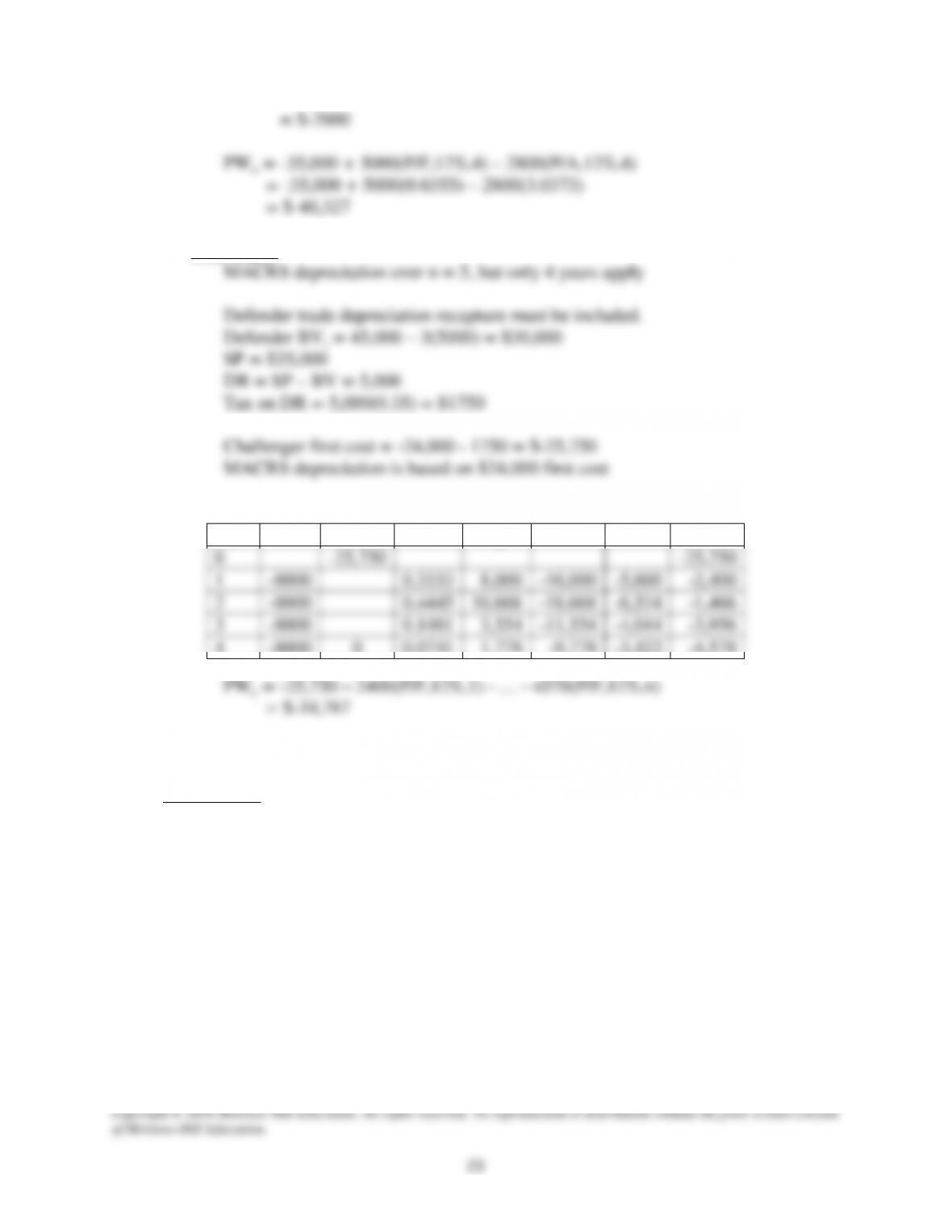
17.57 Find after-tax PW of costs over 4-year study period. DR is involved on the defender trade.
By hand:
Defender:
= -7000 – (-4200)
Copyright © 2018 McGraw–Hill Education. All rights reserved. No reproduction or distribution without the prior written consent
of McGraw–Hill Education.
23
= $-2800
PWD = -35,000 + 5000(P/F,12%,4) – 2800(P/A,12%,4)
= –35,000 + 5000(0.6355) – 2800(3.0373)
= $-40,327
Challenger:
0
-25,750
-25,750
1
-8000
0.3333
8,000
-16,000
-2,400
2
-8000
0.4445
-6,534
3
-8000
0.1481
3,554
-11,554
-4,044
-3,956
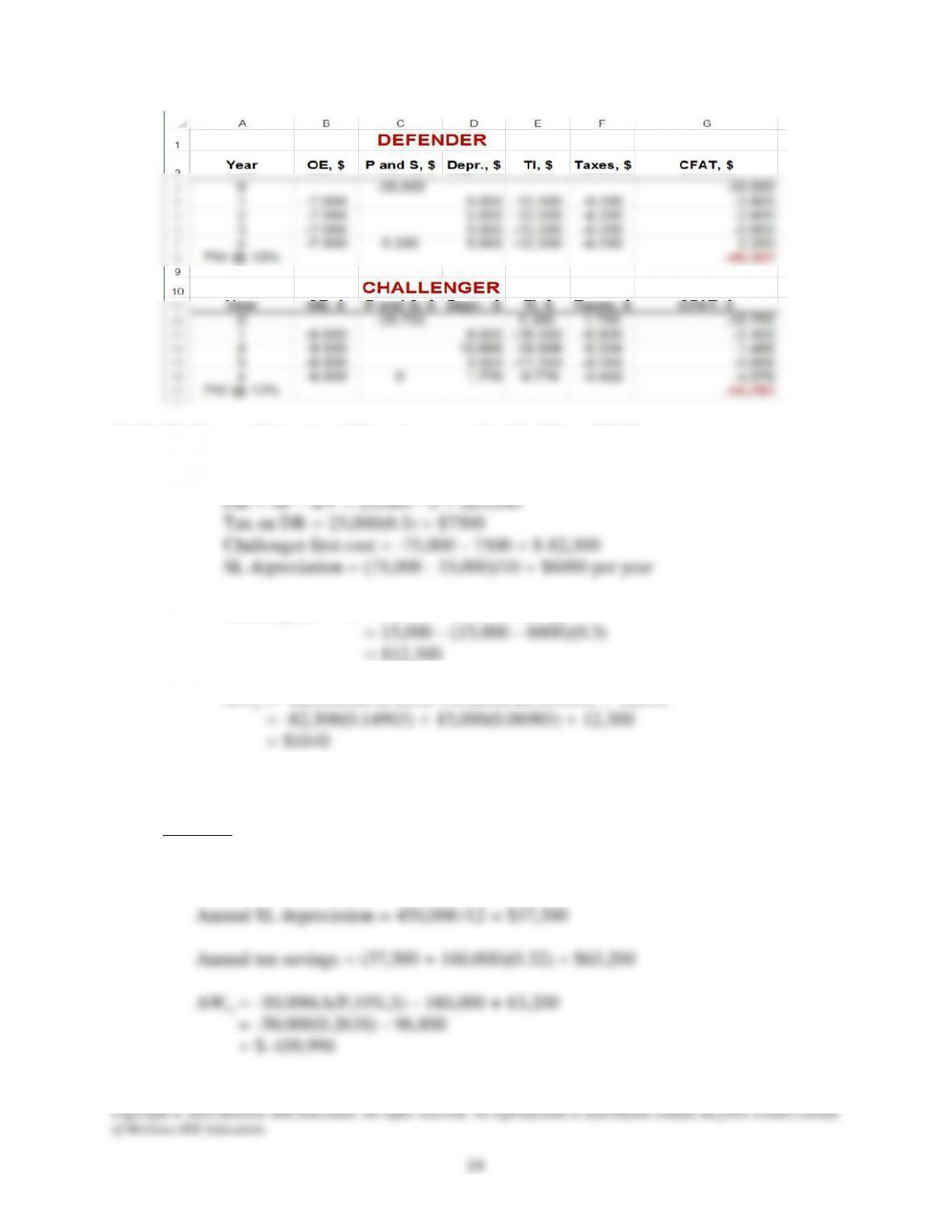
Conclusion: Select the challenger with a lower PW of cost
Spreadsheet: Same decision; select the challenger
Year
OE
P and S
Rate
Depr.
TI
Taxes
CFAT
4
-8000
0
0.0741
1,778
-9,778
-3,422
-4,578
Copyright © 2018 McGraw–Hill Education. All rights reserved. No reproduction or distribution without the prior written consent
of McGraw–Hill Education.
24
17.58 Challenger: Determine AWC and compare it with AWD = $2100.
Defender has DR on trade since BV = 0 now.
CFAT, years 1-10 = CFBT – (CFBT – D)( Te )
AWC = -82,500(A/P,8%,10) +15,000(A/F,8%,10) + 12,300
Retain the defender; it has a larger AW value.
17.59 Defender
Original life estimate was 12 years.
Challenger
CL from sale of D = BV7 – Market value
Tax savings from CL, year 0 = 137,500(0.32)
Challenger DR when sold in year 8 = $0
Select the defender. Decision was incorrect since D has a lower AW value of costs.
17.60 (a) By hand: Lives are set at 5 (remaining) for the defender and 8 years for the challenger.
Defender
Challenger
DR from sale of D = Market value – BV5
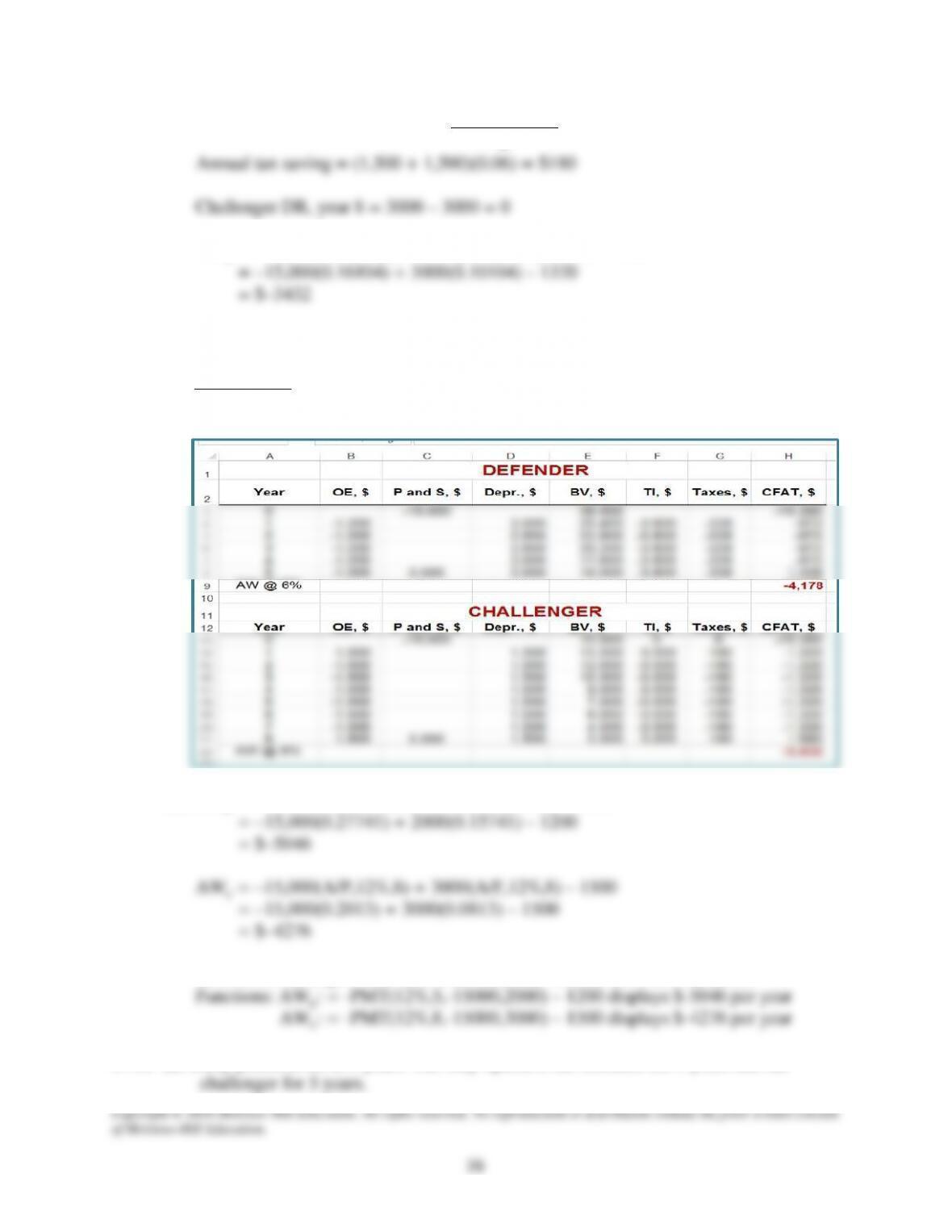
Challenger annual depreciation = 15,000 – 3000 = $1500
8
AWC = –15,000(A/P,6%,8) + 3000(A/F,6%,8) – 1500 + 180
Select the challenger
(b) Spreadsheet: With n = 5, AWD = $-4178; with n = 8, AWC = $-3432.
Select the challenger
(c) AWD = –15,000(A/P,12%,5) + 2000(A/F,12%,5) – 1200
Select the challenger. The before–tax and after-tax decisions are the same.
17.61 (a) Study period is set at 5 years. The only option is the defender for 5 years and the
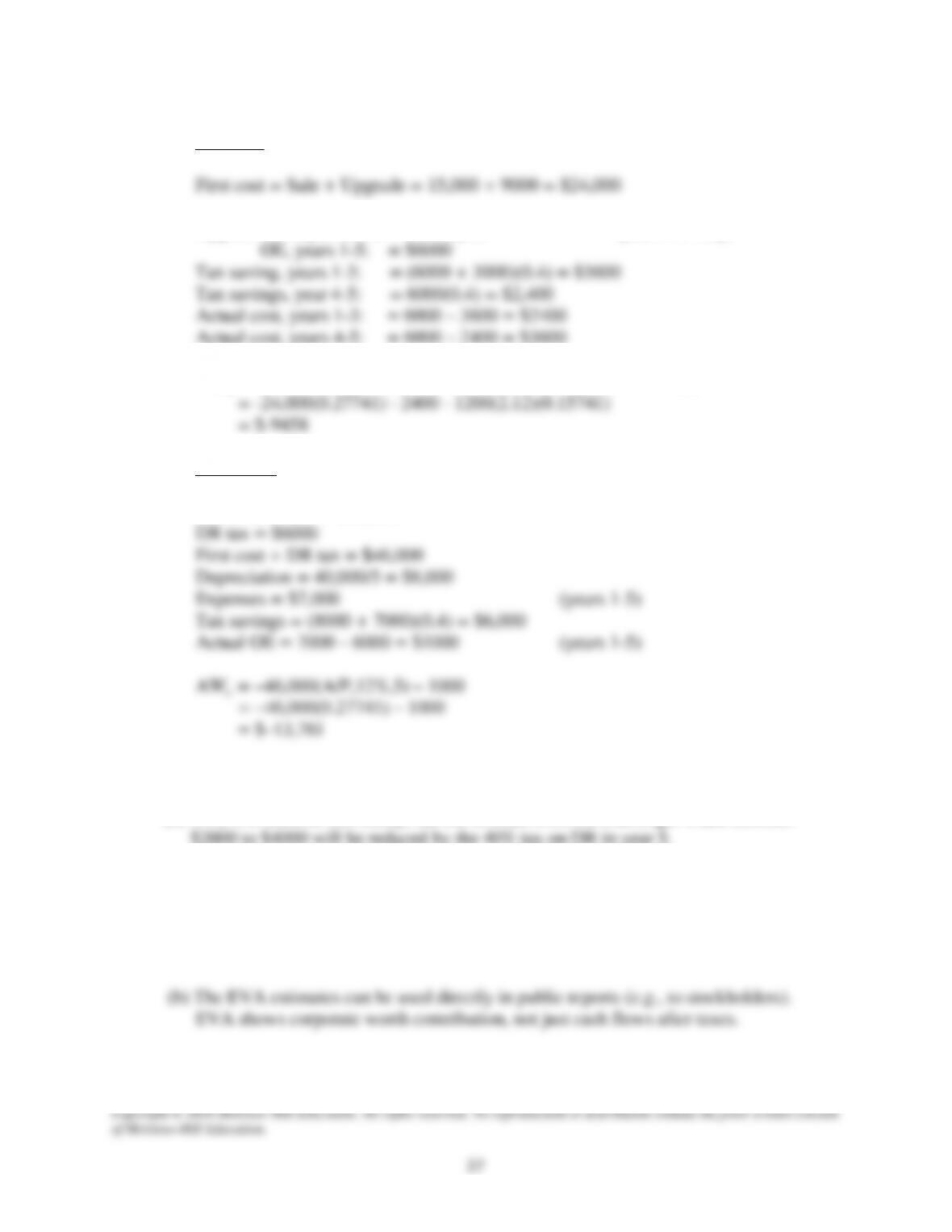
Defender
Upgrade SL depreciation = $3000 year (years 1–3 only)
Actual cost, years 4-5: = 6000 – 2400 = $3600
AWD = -24,000(A/P,12%,5) – 2400 – 1200(F/A,12%,2)(A/F,12%,5)
Challenger
DR on defender = $15,000
Retain the defender since the AW of cost is smaller.
(b) AWC will become less costly, but the revenue from the challenger’s sale between
$2000 to $4000 will be reduced by the 40% tax on DR in year 5.
Economic Value Added
17.62 (a) The EVA shows the monetary worth added to a corporation by an alternative.
17.63 BV1 = 300,000 – 300,000(0.20) = $240,000
Copyright © 2018 McGraw–Hill Education. All rights reserved. No reproduction or distribution without the prior written consent
of McGraw–Hill Education.
28
EVA = NOPAT – MARR(BV1)
= 70,000 – (0.15)(240,000)
= $34,000
17.64 Find BVt-1 and solve for NOPAT and TI, year 2, and solve for OE
Year 2 results:
EVA = 28,000 = NOPAT – (0.14)(366,685)
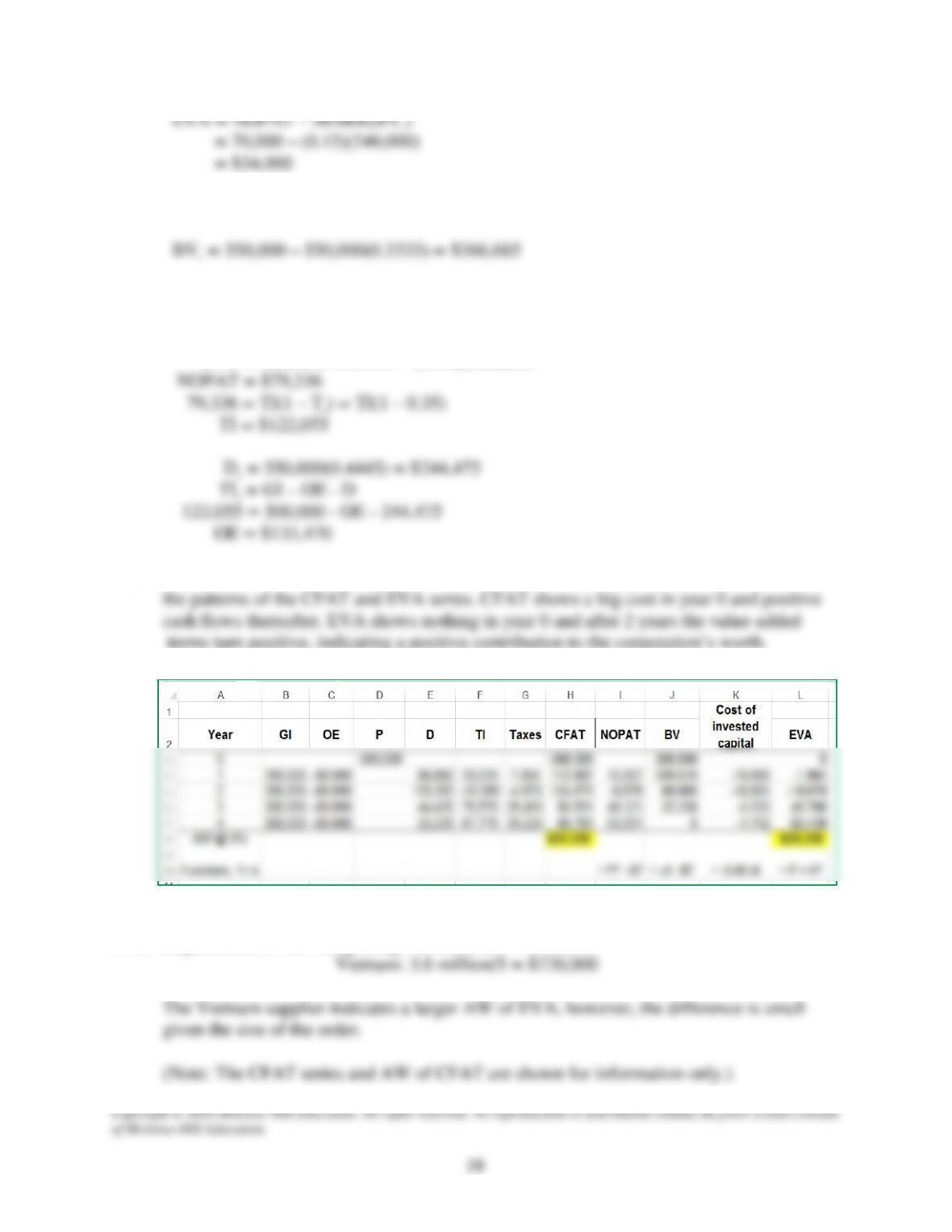
17.65 The spreadsheet verifies that the AW values are the same. Note the difference in
terms turn positive, indicating a positive contribution to the corporation’s worth.
17.66 Depreciation is SL: Hong Kong: 4.2 million/8 = $525,000
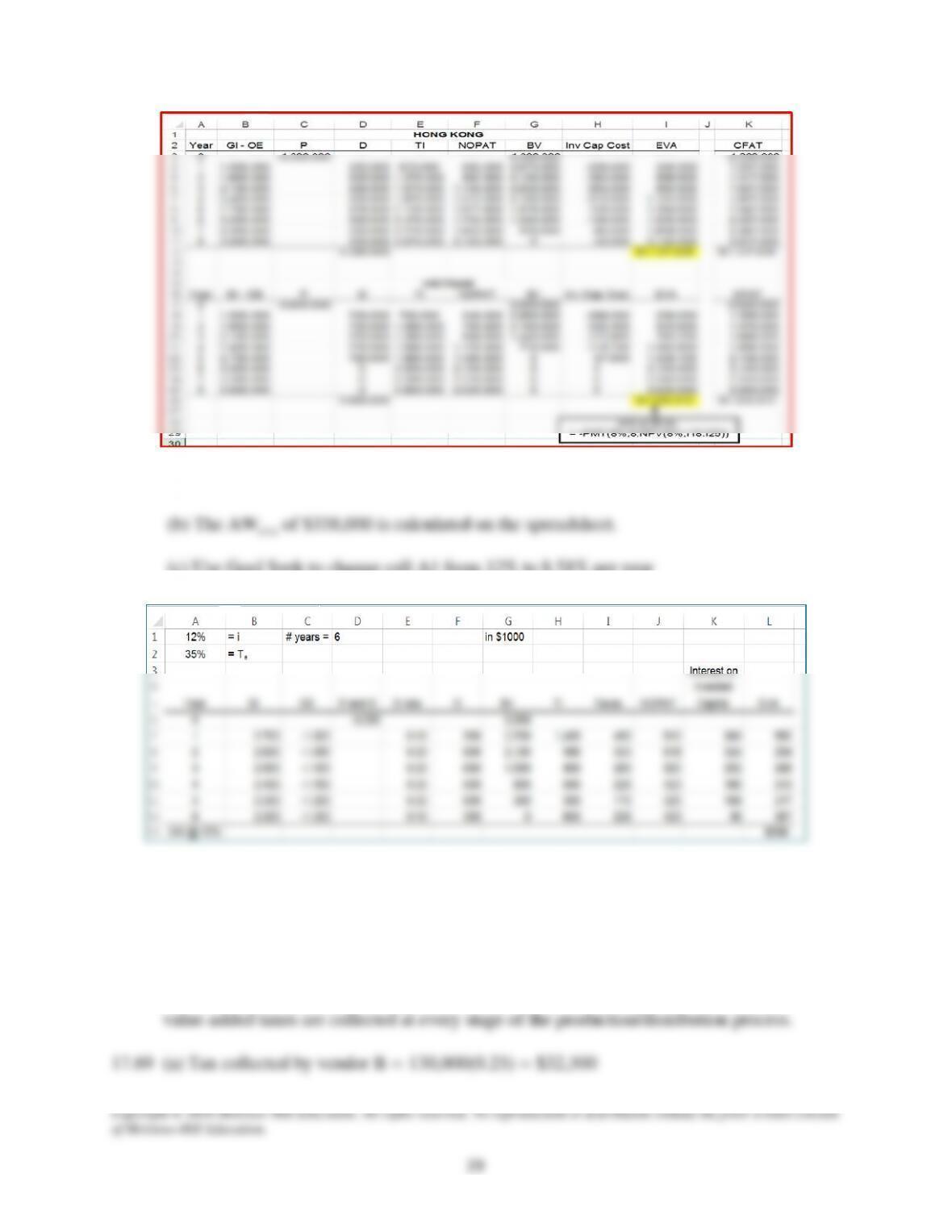
17.67 (a) Column L shows the EVA each year. Use Eq. [17.23} to calculate EVA.
(c) Use Goal Seek to change cell A1 from 12% to 8.51% per year
Value–Added Tax
17.68 A sales tax is collected when the goods or services are bought by the end–user, while
Copyright © 2018 McGraw–Hill Education. All rights reserved. No reproduction or distribution without the prior written consent
of McGraw–Hill Education.
30
(b) Tax sent by vendor B = amount collected – amount paid to vendor A
= 32,500 – 60,000(0.25) = $17,500
(c) Amount collected by Treasury = 250,000(0.25) = $62,500
17.70 VAT by supplier C = 620,000(0.125) = $77,500
17.74 Taxes sent = amount collected – amount paid
17.75 VAT collected = sent by suppliers + sent by Ajinkya
ADDITIONAL PROBLEMS AND FE EXAM PRACTICE PROBLEMS
17.76 Before–tax ROR = After–tax ROR/(1– Te)
17.77 Te = 0.07 + (1 – 0.07)(0.36) = 0.4048 (40.5%)
Copyright © 2018 McGraw–Hill Education. All rights reserved. No reproduction or distribution without the prior written consent
of McGraw–Hill Education.
31
17.81 Answer is (a)
17.82 Answer is (d)
17.83 Tax difference = (160,000,000 – 120,000,000)(0.50) = $20,000,000
17.85 The sale results in DR = $16,000, which is an increase in TI.
17.87 CFAT = GI – OE – TI(Te)
26,000 = 30,000 – TI(0.40)
17.88 BV5 = 100,000(0.0576) = $5760
Solution to Case Study, Chapter 17
There is not always a definitive answer to case study exercises. Here are example responses.
AFTER–TAX ANALYSIS FOR BUSINESS EXPANSION
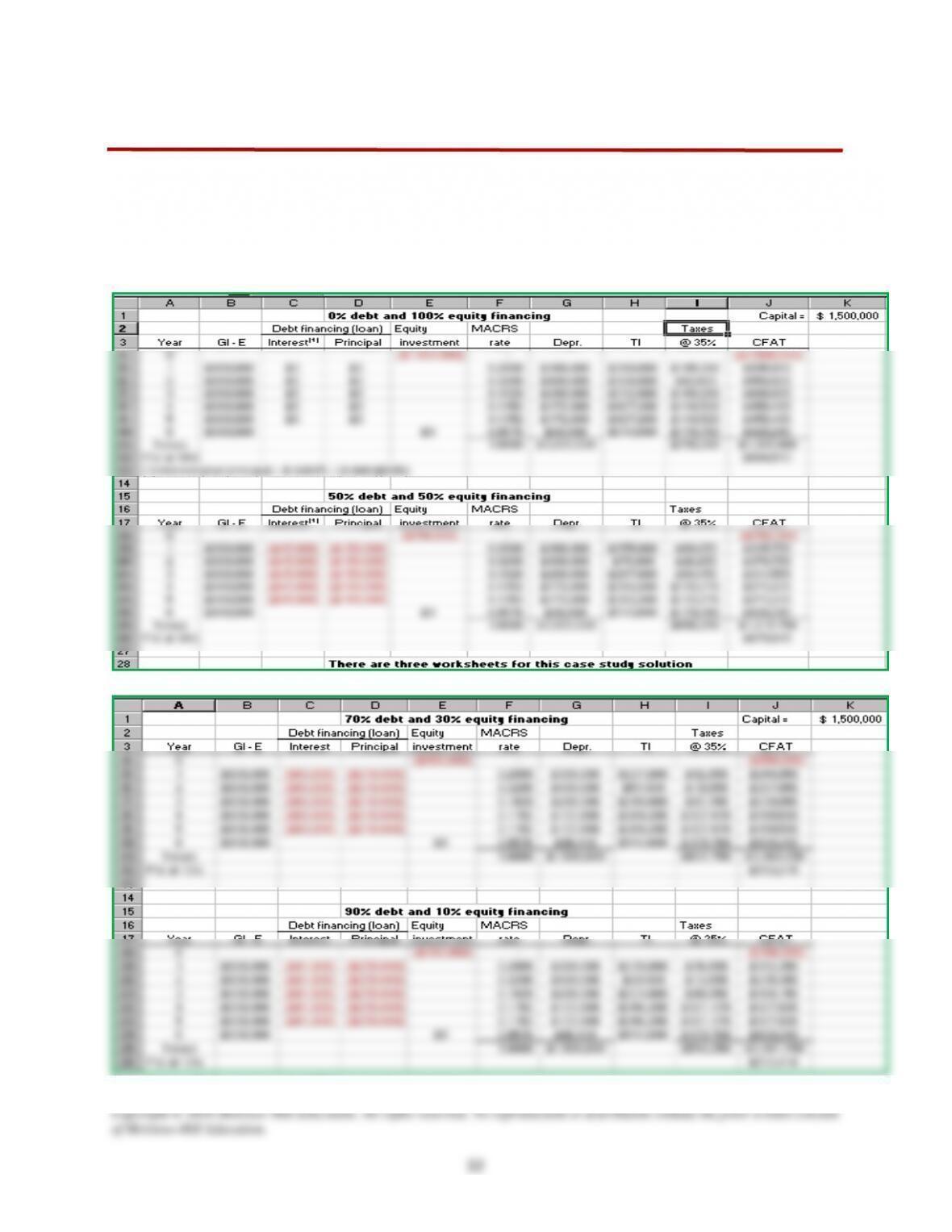
1. The next two spreadsheets perform an analysis of the four D-E mix scenarios
Note: Column B, E used instead of OE for operating expenses.
2. Subtract 2 different equity CFAT totals.
3. This happens because as less of Pro–Fence’s own (equity) funds are committed to the Victoria
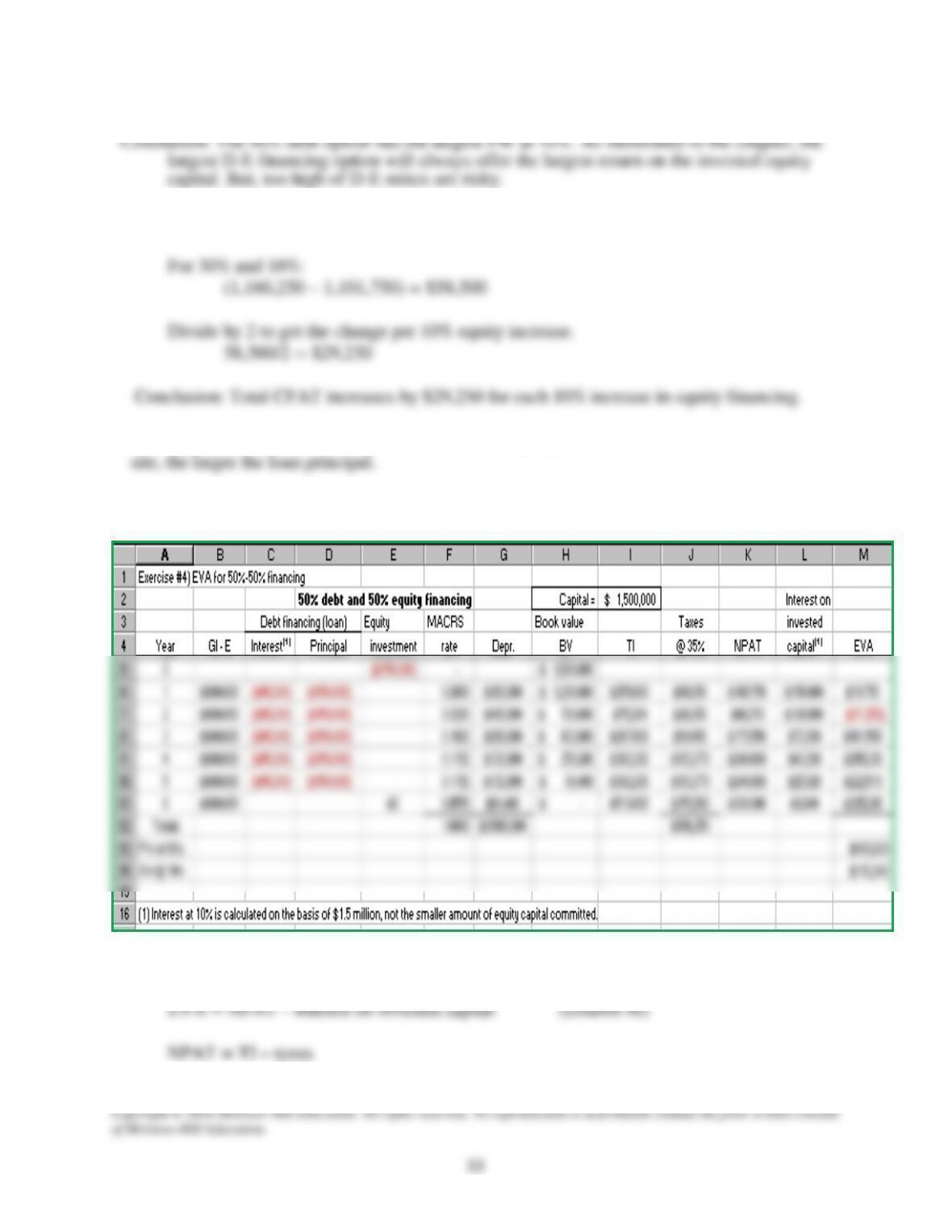
4. Use the EVA series as an estimate of contribution to Pro-Fence’s bottom line through time.
Equations used to determine the EVA use NOPAT (or NPAT) and interest on invested capital.
Copyright © 2018 McGraw–Hill Education. All rights reserved. No reproduction or distribution without the prior written consent
of McGraw–Hill Education.
34
(Interest on invested capital)t = i(BV in the previous year)
= 0.10(BVt–1)
Note: BV on the entire $1.5 million in depreciable assets is used to determine the interest on