Copyright © 2018 McGraw–Hill Education. All rights reserved. No reproduction or distribution without the prior
written consent of McGraw–Hill Education.
12
Linear Programming and Capital Budgeting
12.22 To develop the 0–1 ILP formulation, first calculate PWE, since it was not included
in Table 12-2. All amounts are in $1000 units.
The linear programming formulation is:
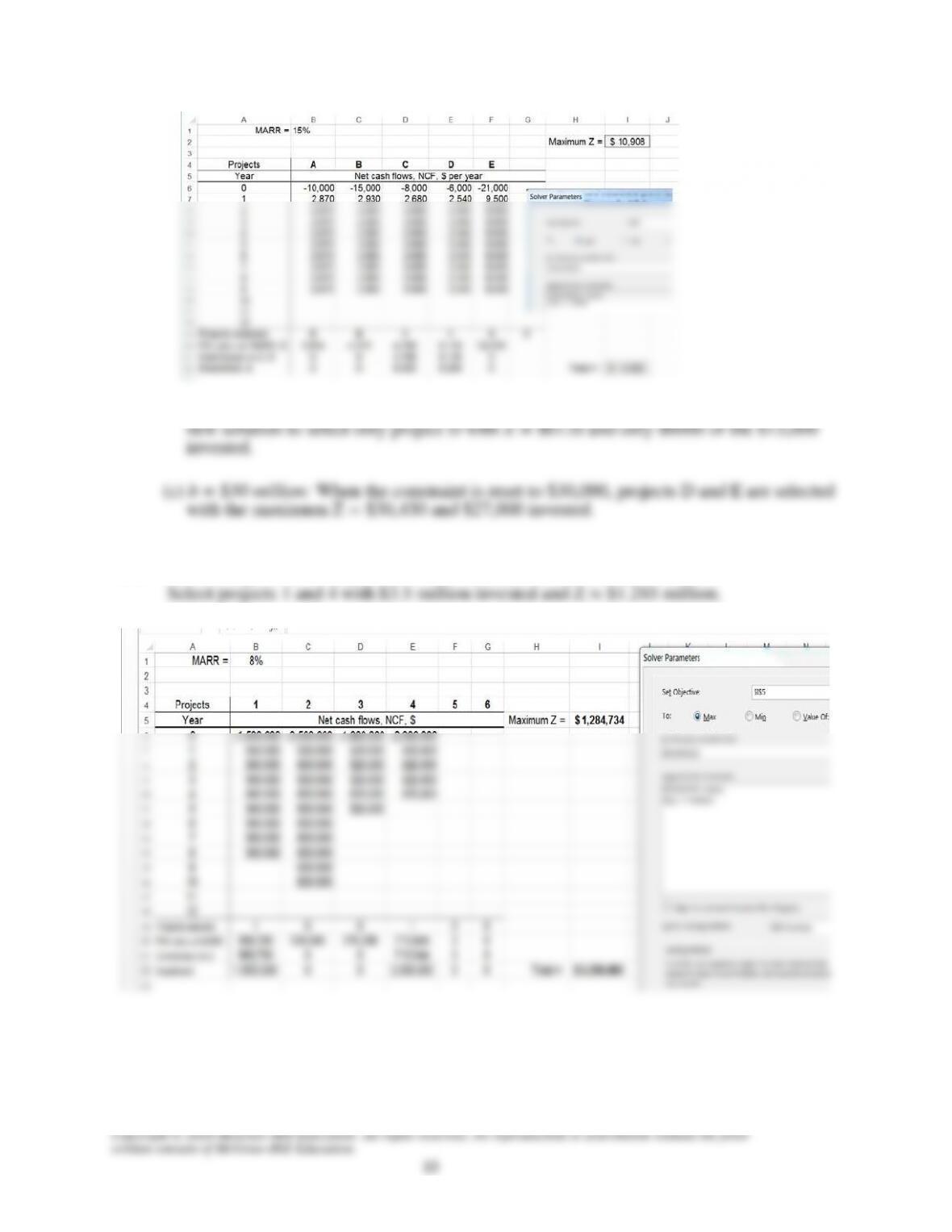
(a) For b = $20 million: The spreadsheet solution uses the template in Figure 12–5.
Copyright © 2018 McGraw–Hill Education. All rights reserved. No reproduction or distribution without the prior
written consent of McGraw–Hill Education.
13
(b) b = $13 million: Reset the budget constraint to b = $13,000 in Solver and obtain a
12.23 Use the Figure 12-5 template at 8% with an investment limit of $4 million.
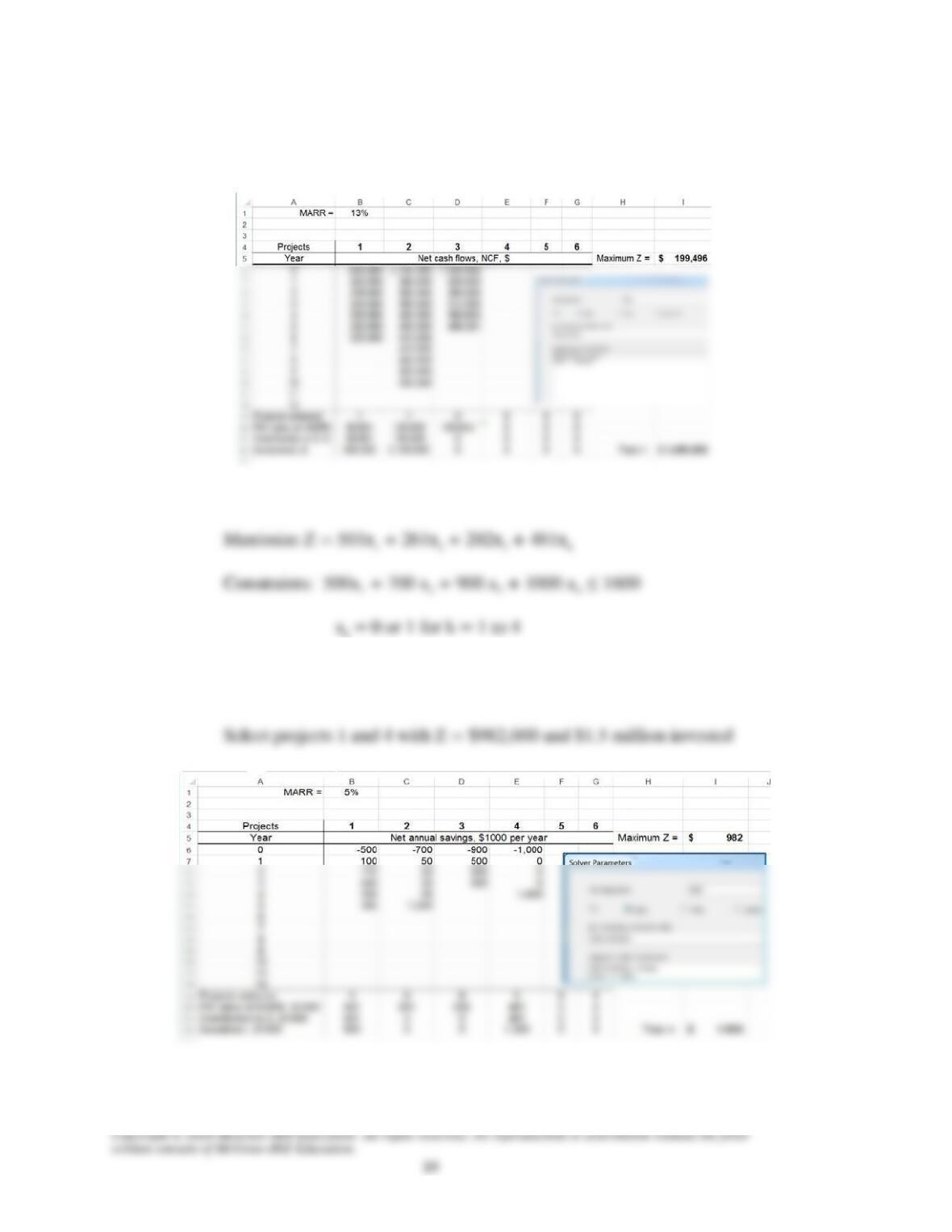
12.24 Enter the NCF values from Problem 12.21 into the capital budgeting template and a
constraint of b = $3,000,000 into Solver. Select projects 1 and 2 for Z = $199,496 with all
$3 million invested.
12.25 Linear programming model: In $1000 units,
Spreadsheet solution: Enter all estimates on a spreadsheet with a b = $1600 constraint
in Solver to obtain the answer:
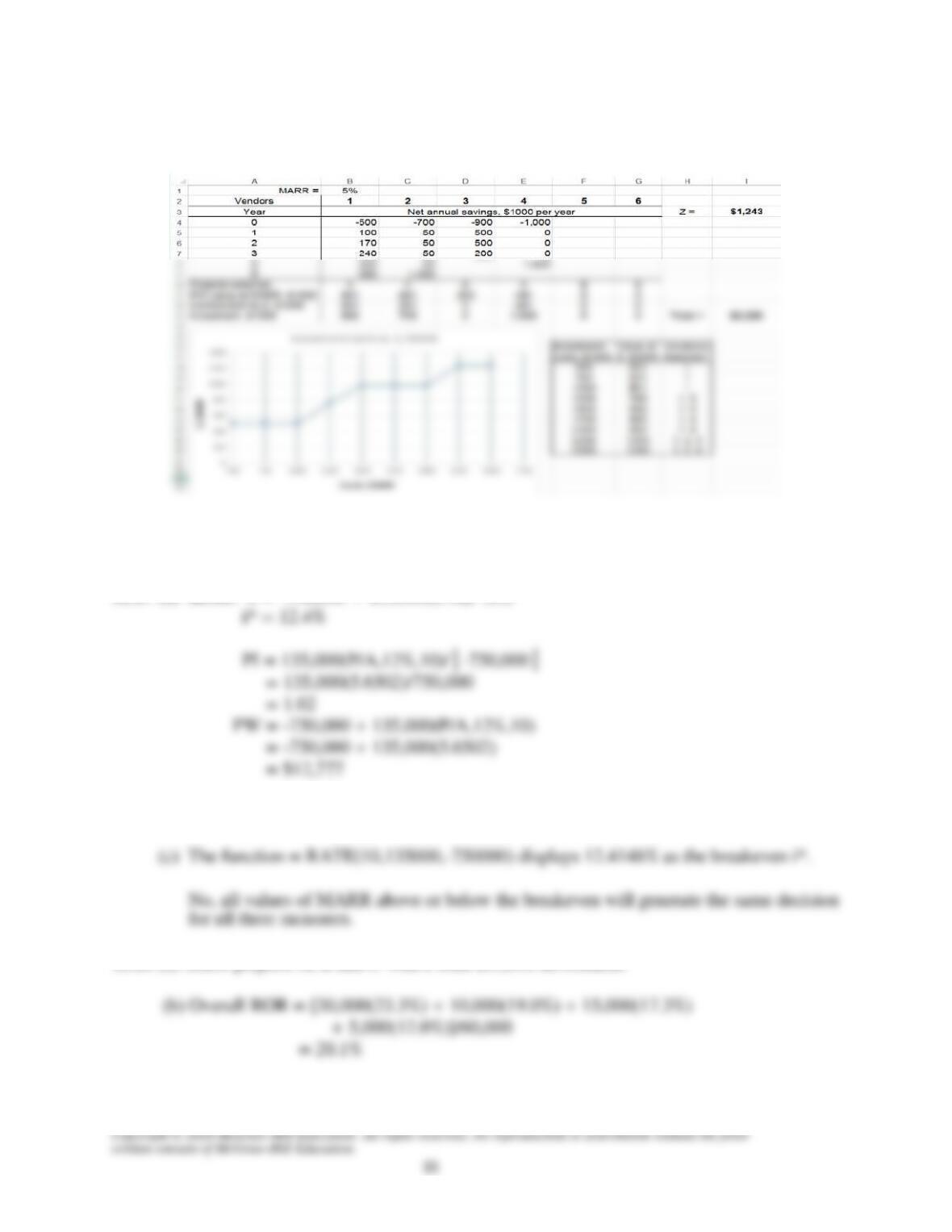
12.26 Build a spreadsheet and use Solver repeatedly at increasing values of b to find the
vendor combinations that maximize the value of Z; then develop a scatter graph.
Other Ranking Measures
12.27 (a) IROR: 0 = –750,000 + 135,000(P/A,i*,10)
(b) By all three measures, since IROR > 12%; PI > 1.0 and PW > 0 at MARR = 12%
12.28 (a) Select projects A, B and C with a total $55,000 investment.
Copyright © 2018 McGraw–Hill Education. All rights reserved. No reproduction or distribution without the prior
written consent of McGraw–Hill Education.
16
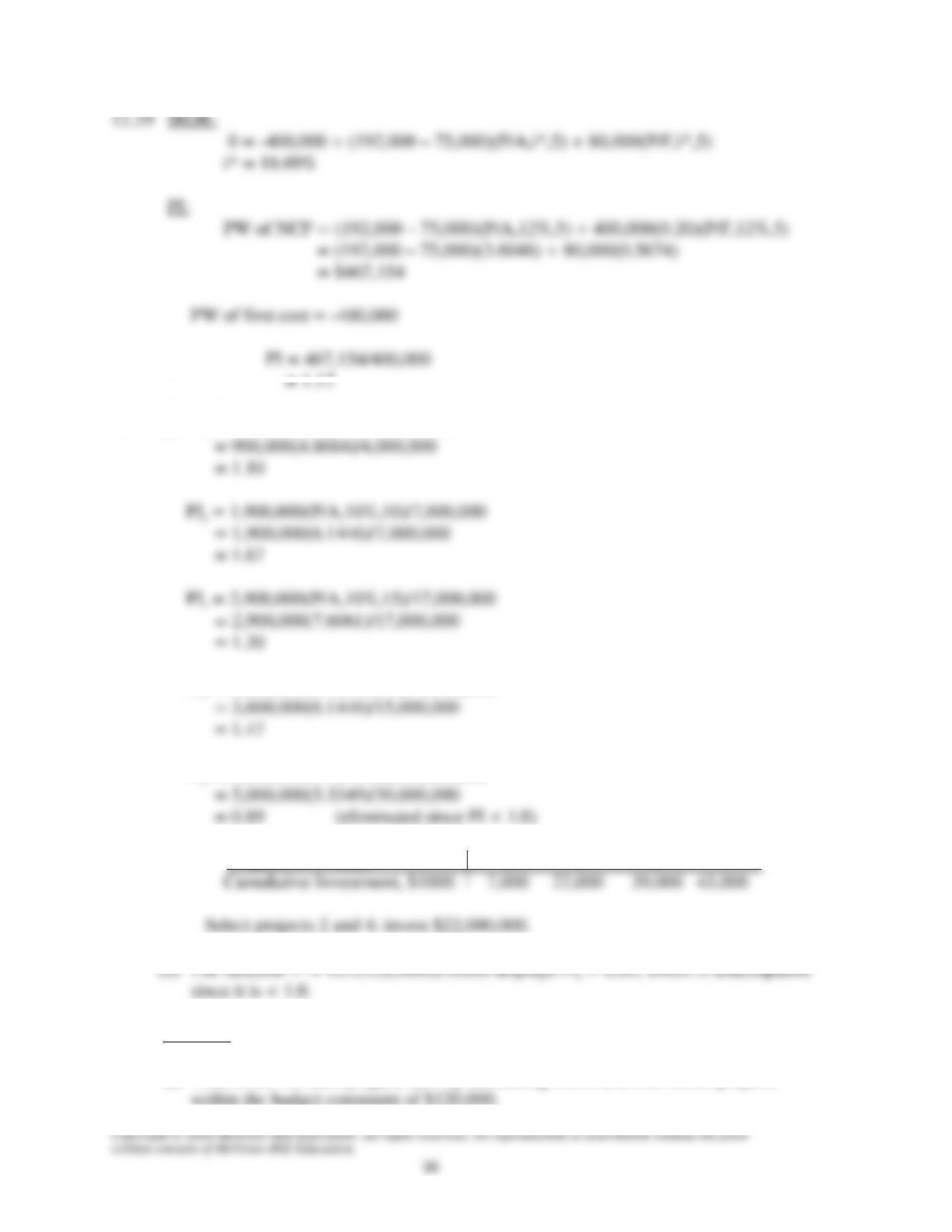
12.29 IROR:
0 = –400,000 + (192,000 – 75,000)(P/A,i*,5) + 80,000(P/F,i*,5)
i* = 18.09%
PI:
PW of NCF = (192,000 – 75,000)(P/A,12%,5) + 400,000(0.20)(P/F,12%,5)
= (192,000 – 75,000)(3.6048) + 80,000(0.5674)
= $467,154
PW of first cost = –400,000
PI = 467,154/400,000
= 1.17
12.30 (a) PI1 = 900,000(P/A,10%,7)/4,000,000
PI4 = 3,600,000(P/A,10%,10)/15,000,000
PI5 = 5,000,000(P/A,10%,8)/30,000,000
Projects in PI order 2 4 3 1
12.31 By hand:
(a) Find IROR for each project, rank by decreasing IROR and then select projects
within the budget constraint of $120,000.
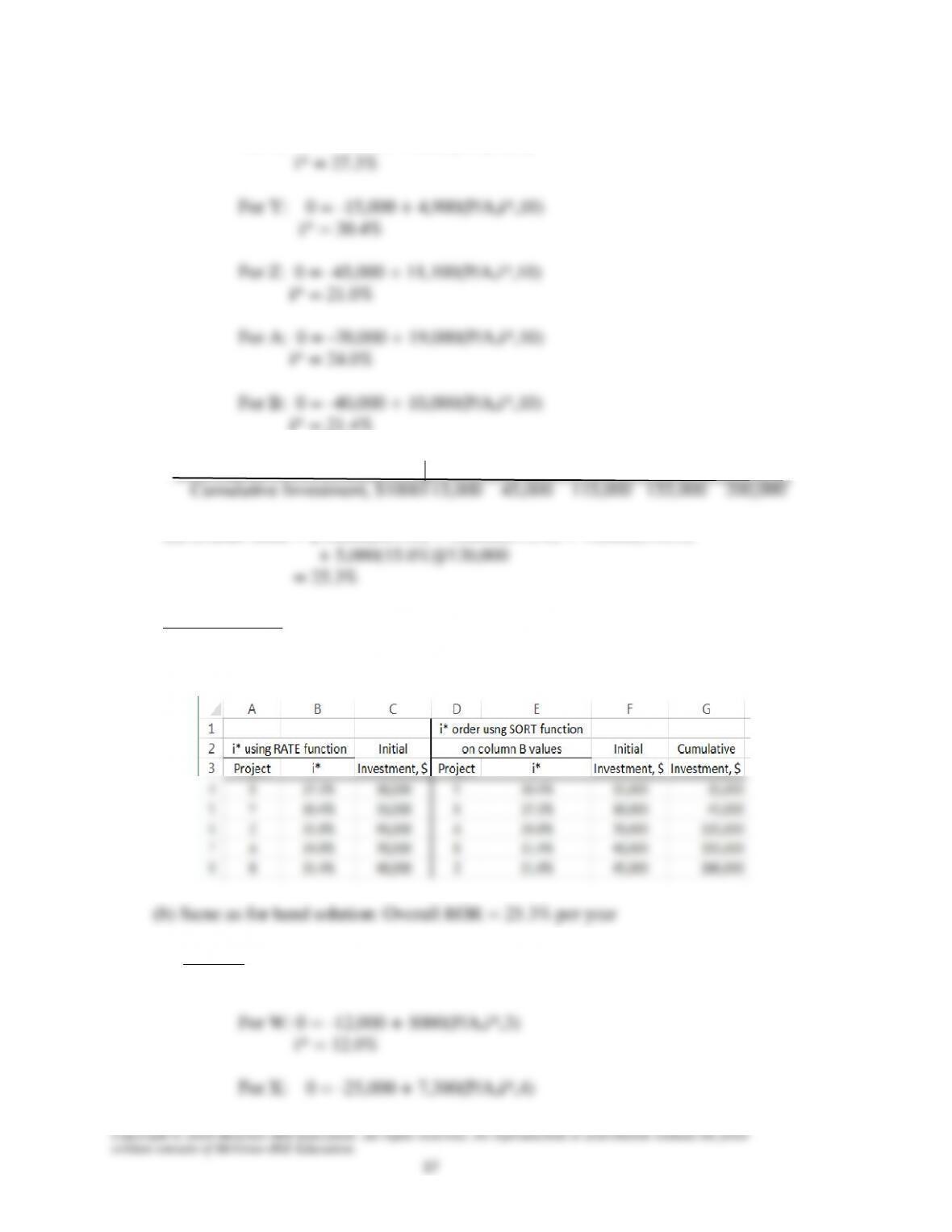
For X: 0 = -30,000 + 9000(P/A,i*,10)
i* = 21.4%
Projects in IROR order Y X A B Z
(b) Overall ROR = [15,000(30.4%) + 30,000(27.3%) + 70,000(24.0%)
By spreadsheet:
(a) Select projects Y, X, and A with a total investment of $115,000 (column G)
12.32 (a) By hand: Find IROR for each project; select highest ones within budget
constraint of $100 million.
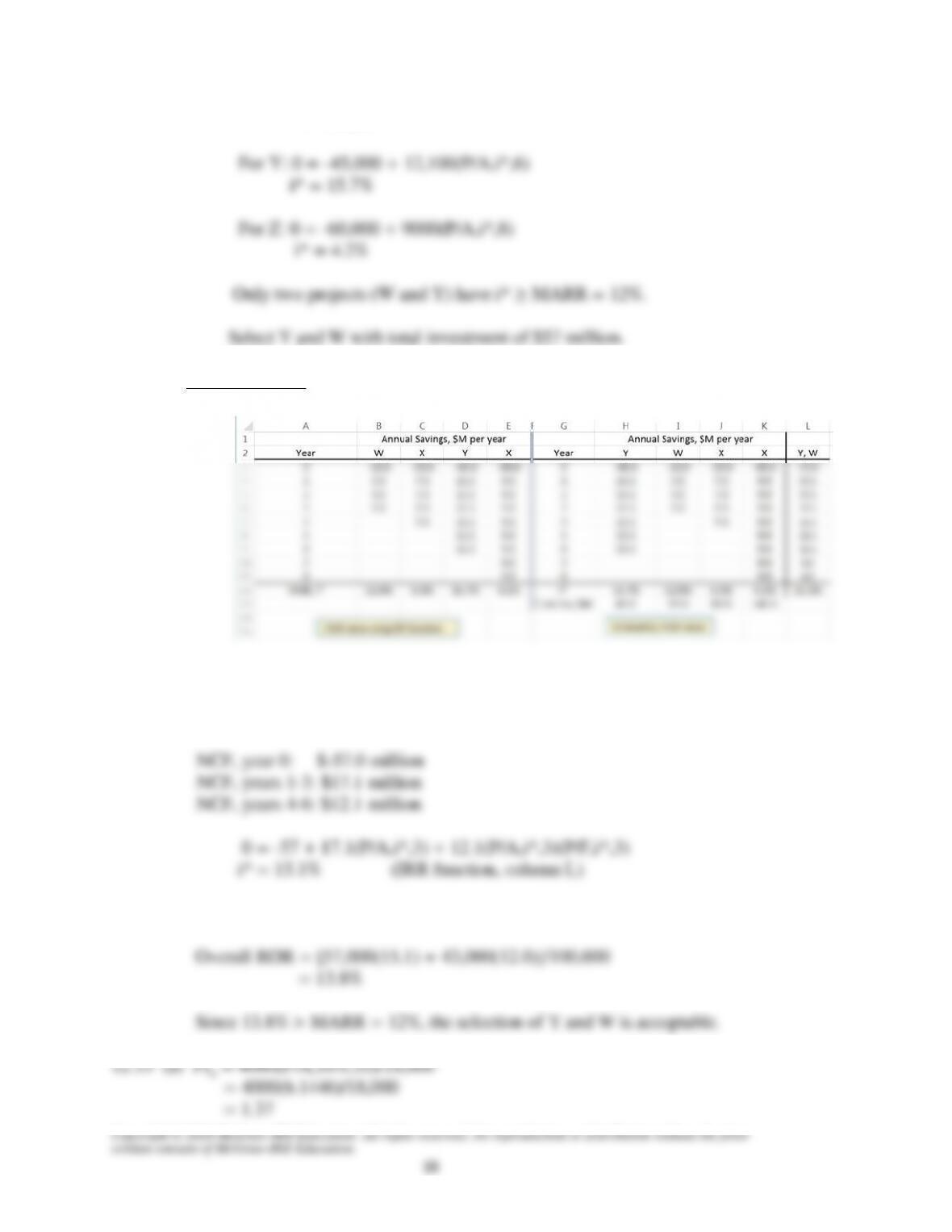
i* = 6.5%
By spreadsheet: Select Y and W after ranking (row 12); invest $57 million
(b) Find i* of Y and W
(c) The $43 million not committed makes MARR = 12% elsewhere.
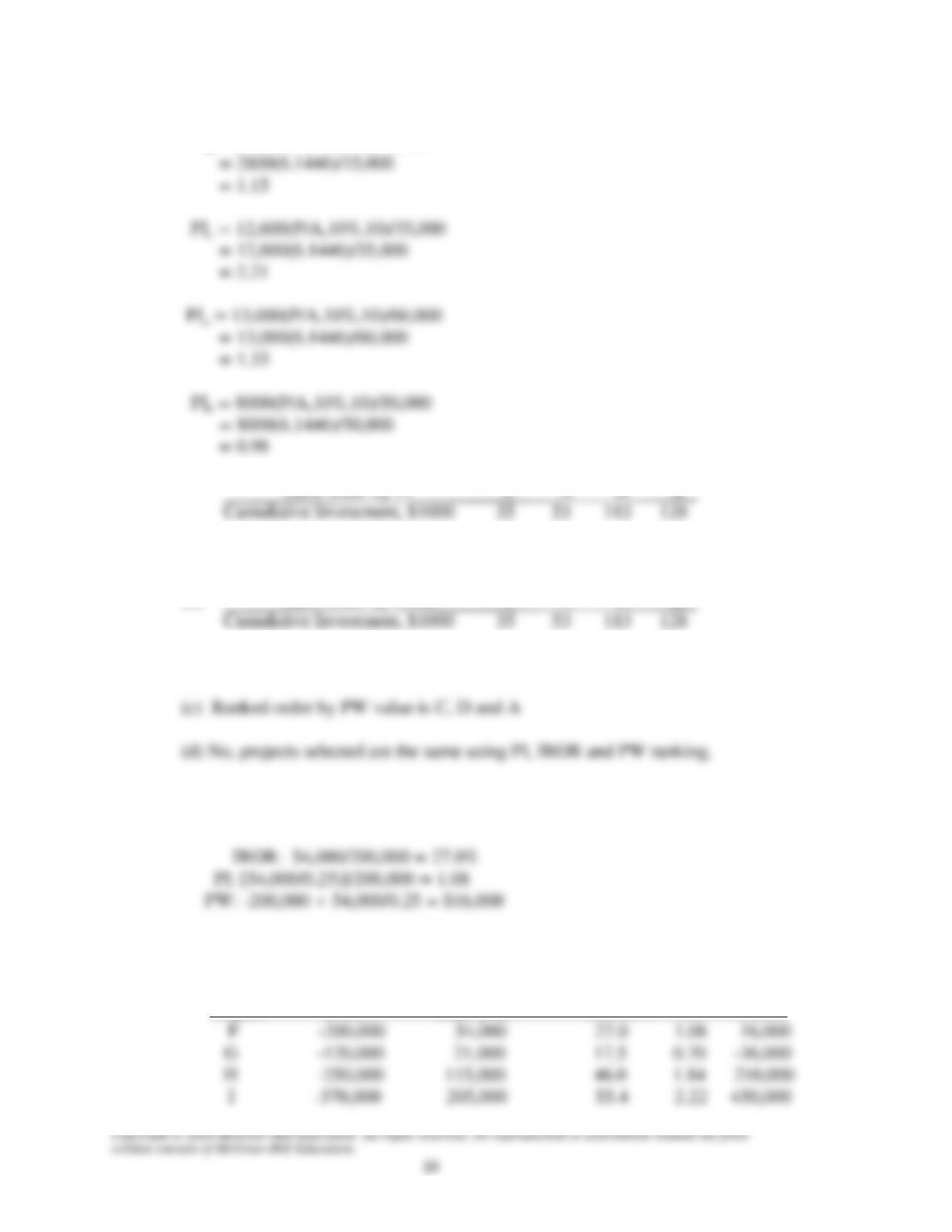
PIB = 2800(P/A,10%,10)/15,000
Rank order by PI C A D B
Select projects C, A, and D; invest $113,000. E is eliminated with PI < 1.0
(b) Rank order by IROR C A D B
Select C, A, and D; invest a total of $113,000. E is eliminated with IROR < 10%
12.34 The IROR, PI, and PW values are shown in the table below. Sample calculations for
project F are:
Projects G and K can be eliminated since their IROR, PI and PW are not acceptable.
First Annual Income,
Project Cost, $ $ per year IROR, % PI PW, $
Copyright © 2018 McGraw–Hill Education. All rights reserved. No reproduction or distribution without the prior
written consent of McGraw–Hill Education.
20
J -50,000 26,000 52.0 2.08 54,000
K -9000 2,100 23.3 0.93 –600
(a) b = $700,000
(1) IROR: Projects selected are I, J, and H with $670,000 invested
IROR rank I J H F
(2) PI: Projects selected are I, J, and H with $670,000 invested
PI rank I J H F
(3) PW: Projects selected are I, H and J with $670,000 invested
PW rank I H J F
(b) b = $600,000
(Note: The PW-based selection is different for the reduced budget of $600,000)
Additional Problems and FE Exam Review Problems
12.35 Answer is (c)
12.36 Answer is (d)
Answer is (b)
12.41 There are 24 = 16 possible bundles. Considering the selection restriction and the
$400,000 limitation, the viable bundles are:
12.42 Answer is (a)