Chapter 5: Production and Cost
CHOOSING THE MIX OF PEOPLE AND MACHINES IN A RETAIL SUPERCENTER
Discussion Question Answers
1. You should lease the additional 10 machines rather than continue to service your customers
with the same input mix. Your costs fall from to $72,000/week to $56,000 per week. Over this
range you are able to substitute people for machines at a rate of 3 to 1 (30/10) and keep output
Clerks Machines Total Cost
2. The following graph depicts this choice:
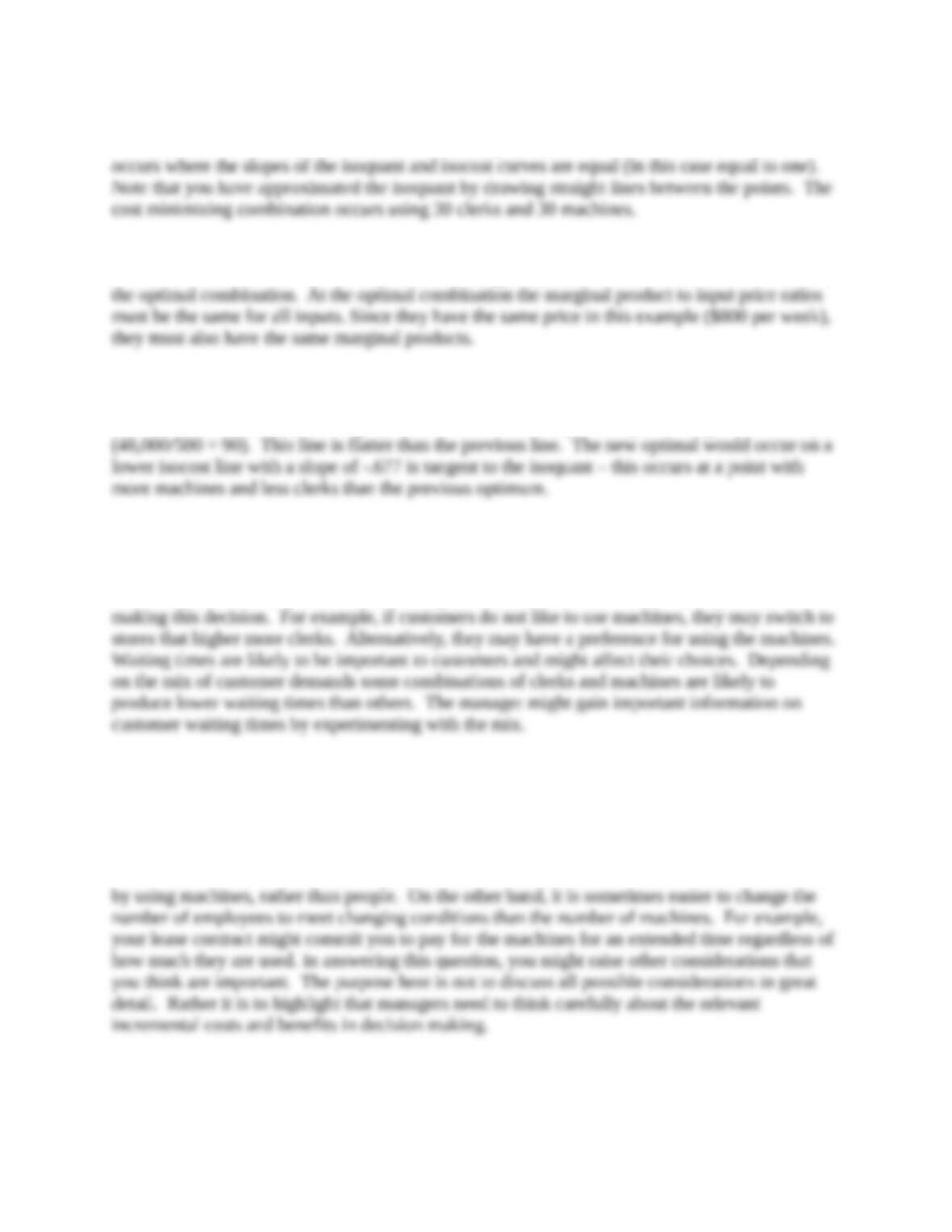
The isoquant pictured above the various combinations of inputs that serve 30,000
customers/week. The objective is to serve this many of customers at the lowest cost. This
3. It means that holding the number of machines constant, hiring one more clerk will increase
the number of customers serviced by 500. The marginal product of machines must also be 500 at
4. With the reduction in the price of machines, the lowest cost combination in would be to use a
mix of 15 clerks and 50 machines. The total cost for serving 30,000 customers falls to $37,000.
The isocost line for in the above graph would have the same y intercept but a higher X intercept
5. Our analysis has focused on input prices and technology in determining the low cost method
of serving 30,000 customers. This analysis is important and a good place to start. There,
however, are other potential incremental costs and benefits that might affect this type of decision.
For example, customer preferences for using machines versus clerks could be important in
Work force reductions can generate ill will both from labor unions and employees who continue
to work for the firm. This type of ill will can sometimes generate higher costs and lower
productivity. These costs might be mitigated by reducing the workforce through normal attrition
(not replacing workers who quit) rather than by large layoffs. Employees can quit jobs and new
people have to be hired and trained to take their places. Employees also can get sick and miss
work. The costs associated with employee turnover and absenteeism can sometimes be reduced
DEVELOPING ECONOMIES OF SCALE FOR MALAYSIA’S PROTON HOLDING
Discussion Question Answers
Economies of scale occur in industries in which average costs declines over a broad range of
output. Companies that fail to produce at sufficient scale will be at a cost disadvantage relative to
companies that produce higher volumes and thus will find it hard to compete. Automobile
Proton could try to expand its sales volume on its own to achieve increased economies of scale.
However, this might be difficult, if not impossible, since the company is not that well known
outside of Malaysia and would require significant investment by a company that is currently near
bankruptcy. The answer is likely to lie in a merger or strategic venture with a larger car company.
Consistent with this idea, Proton had strategic discussions with Volkswagen and General Motors,
RICH MANUFACTURING
Discussion Question Answers
1. Production costs change frequently due to changes in the price of labor, machines, fuel, etc.
3. Presumably Bhagat will be able to avoid part of the increase in labor costs by changing the
4. The flexibility to change the input mix is likely to be less in the short run than the long run.