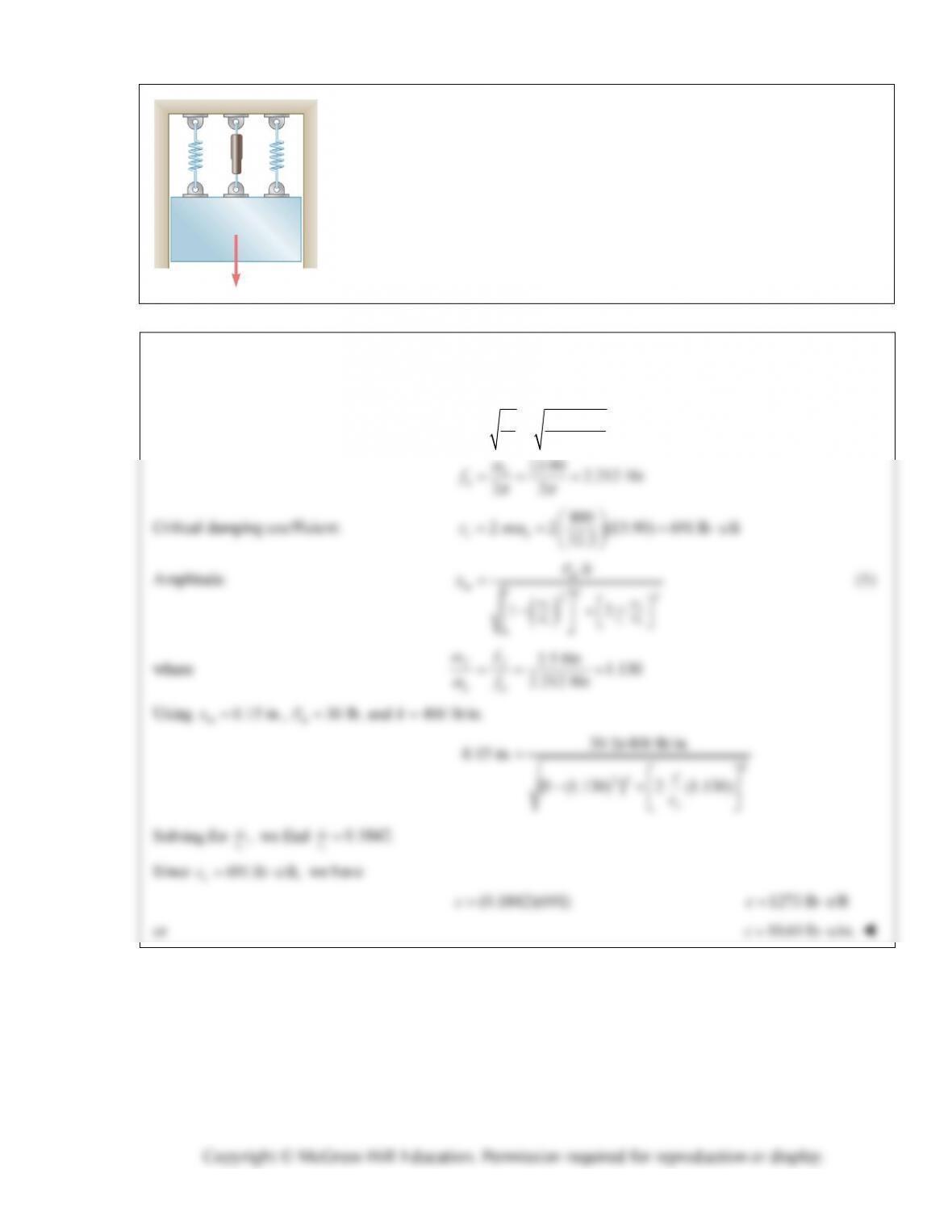
PROBLEM 19.140
In Problem 19.139, determine the required value of the coefficient of damping if
the amplitude of the steady-state vibration of the element is to be 0.15 in.
PROBLEM 19.139 A machine element weighing 800 lb is supported by two
springs, each having a constant of 200 lb/in. A periodic force of maximum value
30 lb is applied to the element with a frequency of 2.5 cycles per second.
Knowing that the coefficient of damping is 8 lb s/in.,⋅ determine the amplitude
of the steady-state vibration of the element.
SOLUTION
Equivalent spring: 2(200) 400 lb/in. 4800 lb/ftk
=
==
Undamped natural frequency: 4800 13.90 rad/s
800/32.2
n
k
m
ω
== =
⎛⎞
⎡
⎣
=
c
P
R
In
t
w
h
S
O
Fr
o
M
a
Fi
n
R
OBLEM 1
t
he case of t
h
h
ich the magn
i
O
LUTION
o
m Eq.
(19.53
a
gnification f
a
n
d value of
c
c
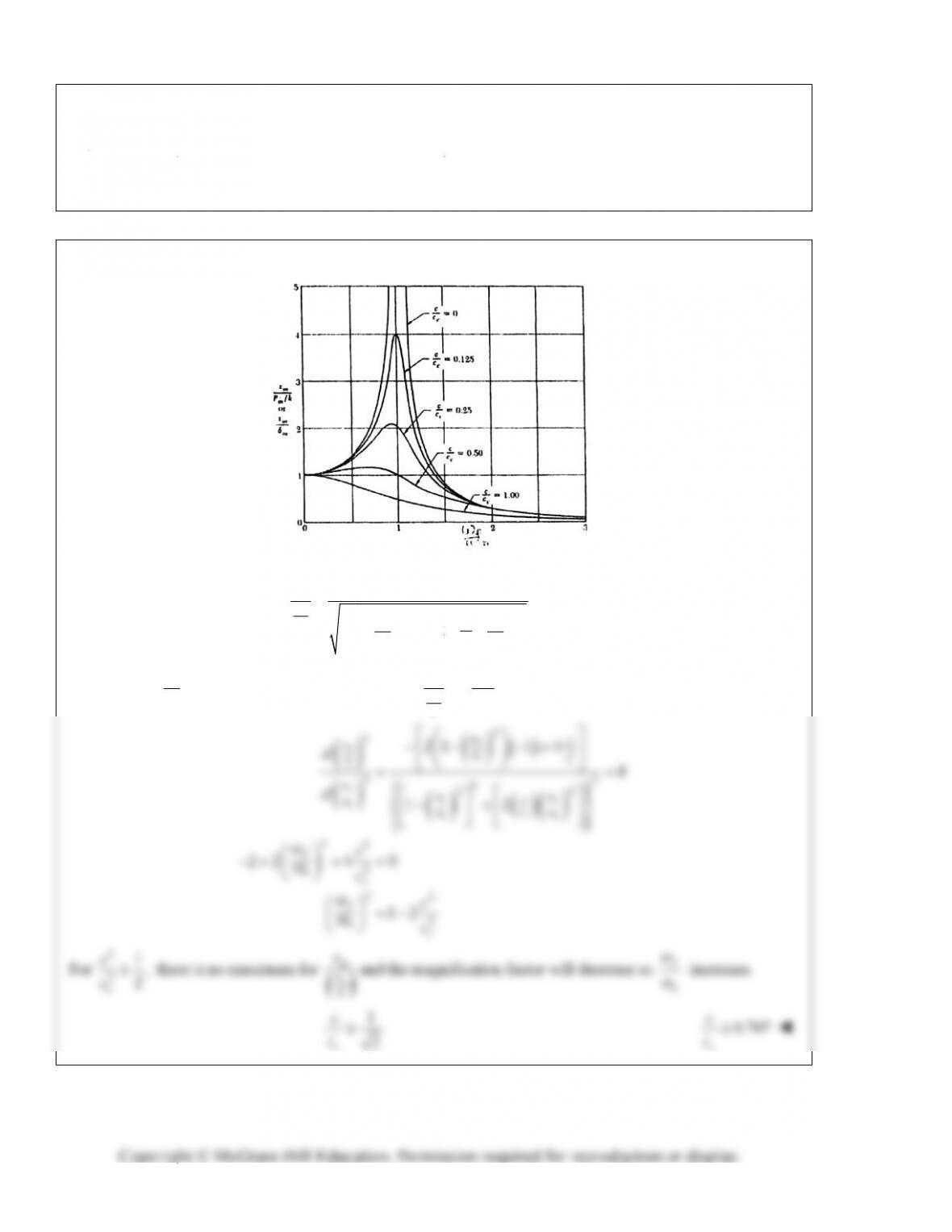
9.141
h
e forced vibr
a
i
fication facto
r
):
′
a
ctor:
for which t
h
a
tion of a sys
t
r
will always
d
1
m
m
P
k
x=
⎡
⎢
⎣
h
ere is no max
⎪
⎢
m
x
⎢
t
em, determi
n
d
ecrease as th
()
2
2
1
2
f
n
ω
ω
⎤
⎡
−+
⎥
⎢
⎣
⎦
imum for
m
m
P
x
2
2
1
⎡
⎛
−
n
e the range o
f
e frequency r
a
()
()
2
2
f
cn
c
c
ω
ω
⎤
⎥
⎦
as
f
ω
ω
incr
e
2
1
1
f
ω
⎞
−−
f
values of th
e
a
tio
/
fn
ωω
in
c
e
ases.
2
4
c
⎤
+⎥
e
damping fa
c
c
reases.
c
tor
/
c
cc
for
r
m
n
o
o
s
s
r
Copyright © McGraw-Hill Education. Permission required for reproduction or display.
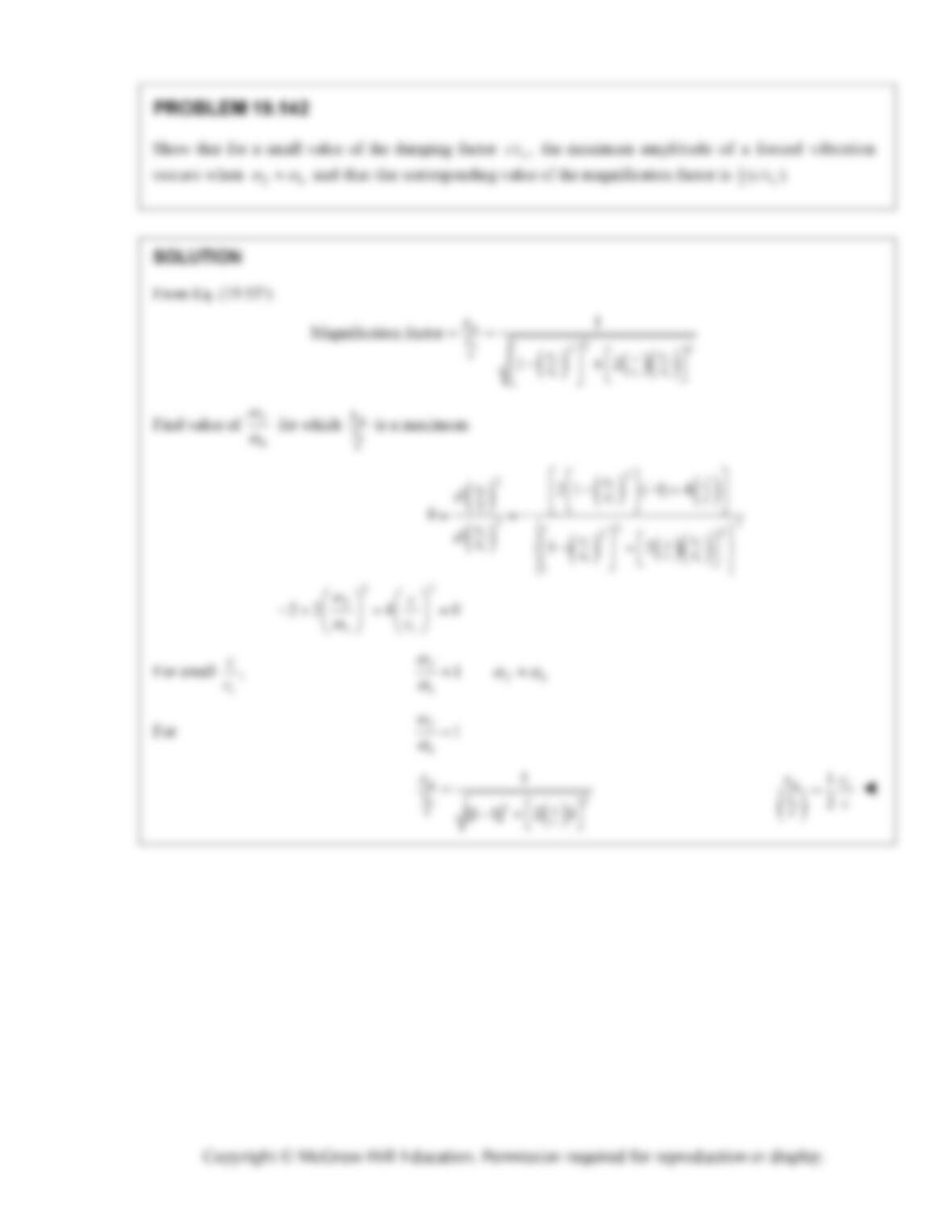
PROBLEM 19.142
Show that for a small value of the damping factor /,
c
cc the maximum amplitude of a forced vibration
occurs when
f
n
ω
ω
≈ and that the corresponding value of the magnification factor is 1
2(/ ).
c
cc
SOLUTION
From Eq. (19.53′):
()
()
()
22
2
1
Magnification factor
12
m
ff
c
nn
m
P
kc
c
x
ωω
ωω
==
⎡⎤
⎡
⎤
−+
⎢⎥
⎢
⎥
⎣
⎦
⎣⎦
Find value of
f
n
ω
ω
for which
m
m
P
k
x
is a maximum.
()
()
()
()
()
()
()
2
2
2
2
22
22
2
22
21 ( 1) 4
0
12
22 4 0
f
m
Pn
mc
k
f
ff
n
c
nn
c
x
c
c
c
f
nc
d
d
c
c
ω
ω
ωωω
ωωω
ω
ω
⎡
⎤
⎡⎤
−−+
⎢
⎥
⎢⎥
⎣⎦
⎣
⎦
==−
⎧
⎫
⎡⎤
⎪
⎪
⎡⎤
−+
⎨
⎬
⎢⎥
⎢⎥
⎣⎦
⎣⎦
⎪
⎪
⎩⎭
⎛⎞ ⎛⎞
−+ + =
⎜⎟ ⎜⎟
⎝⎠
⎝⎠
For small ,
c
c
c 1
f
f
n
n
ω
ω
ω
ω
≈
≈
For 1
f
n
ω
ω
=
()
2
2
1
[1 1] 2 1
m
c
m
P
c
kc
x=
⎡
⎤
−+
⎣
⎦
()
1
2
m
mc
P
k
x
c
c
=
S
O
Fo
r
U
n
Sh
a
n
a
O
LUTION
r
cing frequen
c
n
balance of on
a
king force:
PR
A c
o
des
c
on
a
det
e
rpm
axe
s
equ
i
is 0.
spri
n
c
y:
ω
e mass:
P
P
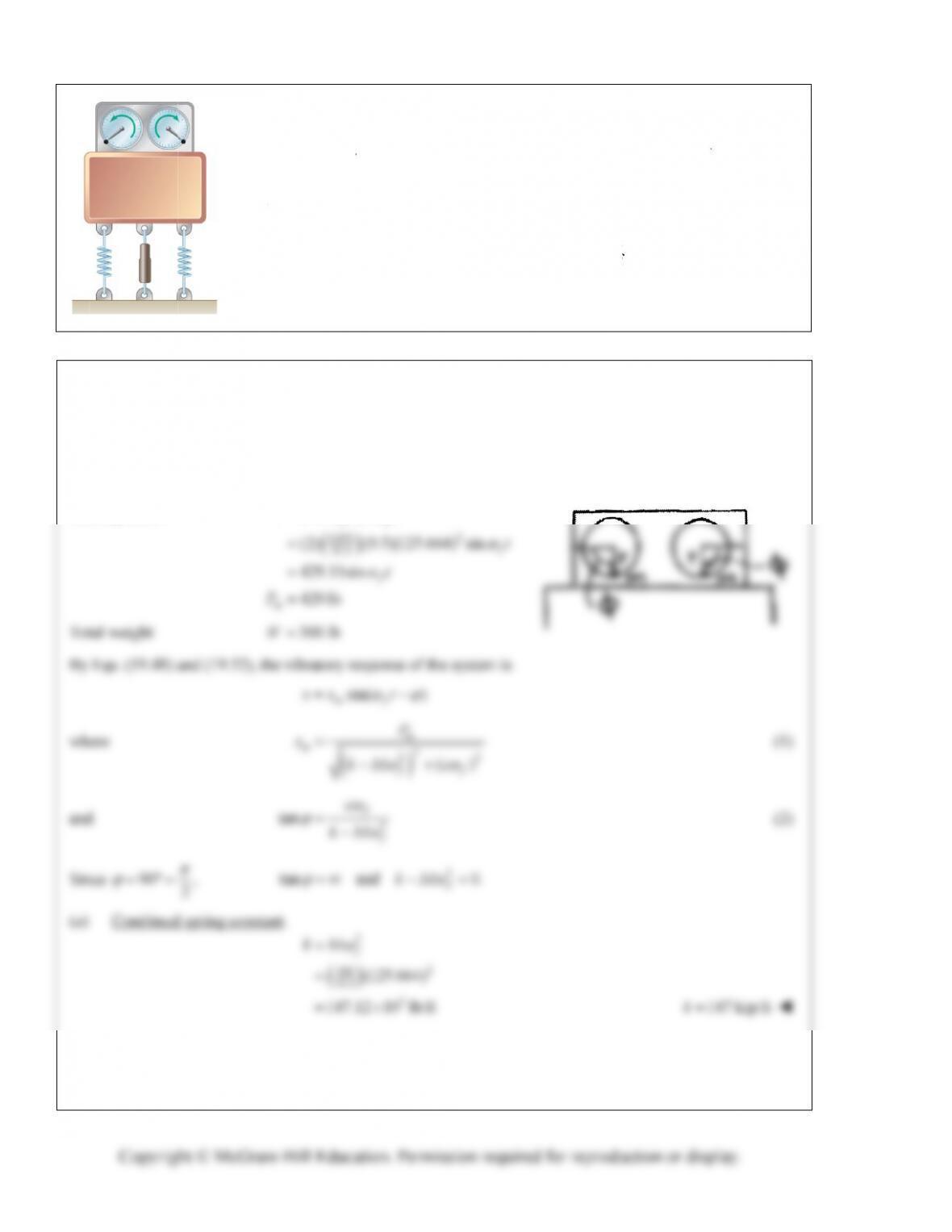
OBLEM 1
9
o
unte
r
-rotatin
g
c
ribing circles
a
machine el
e
e
rmine some
o
a stroboscop
s
of rotation
i
librium. Kno
w
6 in. and that
n
g constant
k
,
1200 rp
m
f
ω
=
14 oz
0
6 in. 0.
w
r
==
==
4
4
2
2
s
i
i
f
P
mr
ω
=
9
.143
g
eccentric
m
of 6-in. radi
u
e
ment to ind
u
o
f the dynami
e shows the
e
and the ele
m
w
ing that the
the total mas
s
(b) the damp
i
m
125.664 ra
d
=
0
.875 lb
5ft
s
in
f
t
ω
m
ass exciter c
o
u
s at the sam
e
u
ce a steady
–
c characterist
i
e
ccentric mas
s
m
ent to be
p
amplitude of
s
of the syste
m
i
ng factor
/
c
cc
d
/s
o
nsisting of t
w
e
speed but in
–
state vibrati
o
i
cs of the ele
m
s
es to be exa
c
p
assing thro
u
the motion o
f
m
is 300 lb, d
e
.
c
w
o rotating 1
4
opposite sen
s
o
n of the ele
m
m
ent. At a sp
c
tly under the
i
u
gh its positi
o
f
the element
a
e
termine (a) t
h
4
-oz masses
s
es is placed
m
ent and to
eed of 1200
i
r respective
o
n of static
a
t that speed
h
e combined
h
h
h
e
e
e
e
Copyright © McGraw-Hill Education. Permission required for reproduction or display.
PROBLEM 19.143 (Continued)
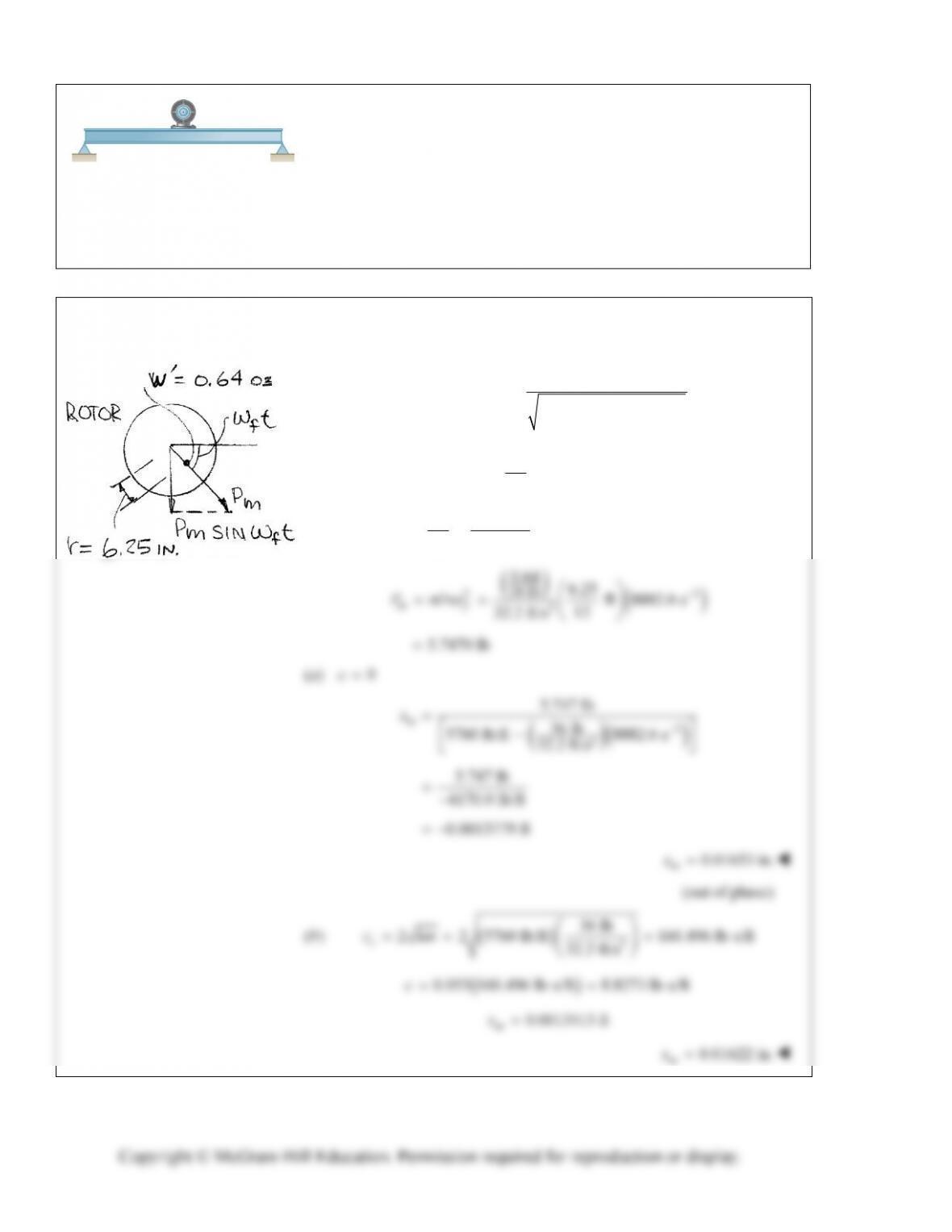
The observed amplitude is 0.6 in. 0.05 ft
m
x==
From Eq. (1):
2
2
1()
429.11
(125.664)(0.05)
68.296 lb s/ft
mm
f
f
mfm
P
P
ckM
x
x
ω
ωω
⎛⎞
=−−=
⎜⎟
⎝⎠
=
=⋅
Critical damping coefficient:
()
3300
32.2
3
2
2 (147.12 10 )
2.3416 10 lb s/ft
c
ckM=
=×
=×⋅
(b) Damping factor. 3
68.296
2.3416 10
c
c
c=× 0.0292
c
c
c=
PROBLEM 19.144
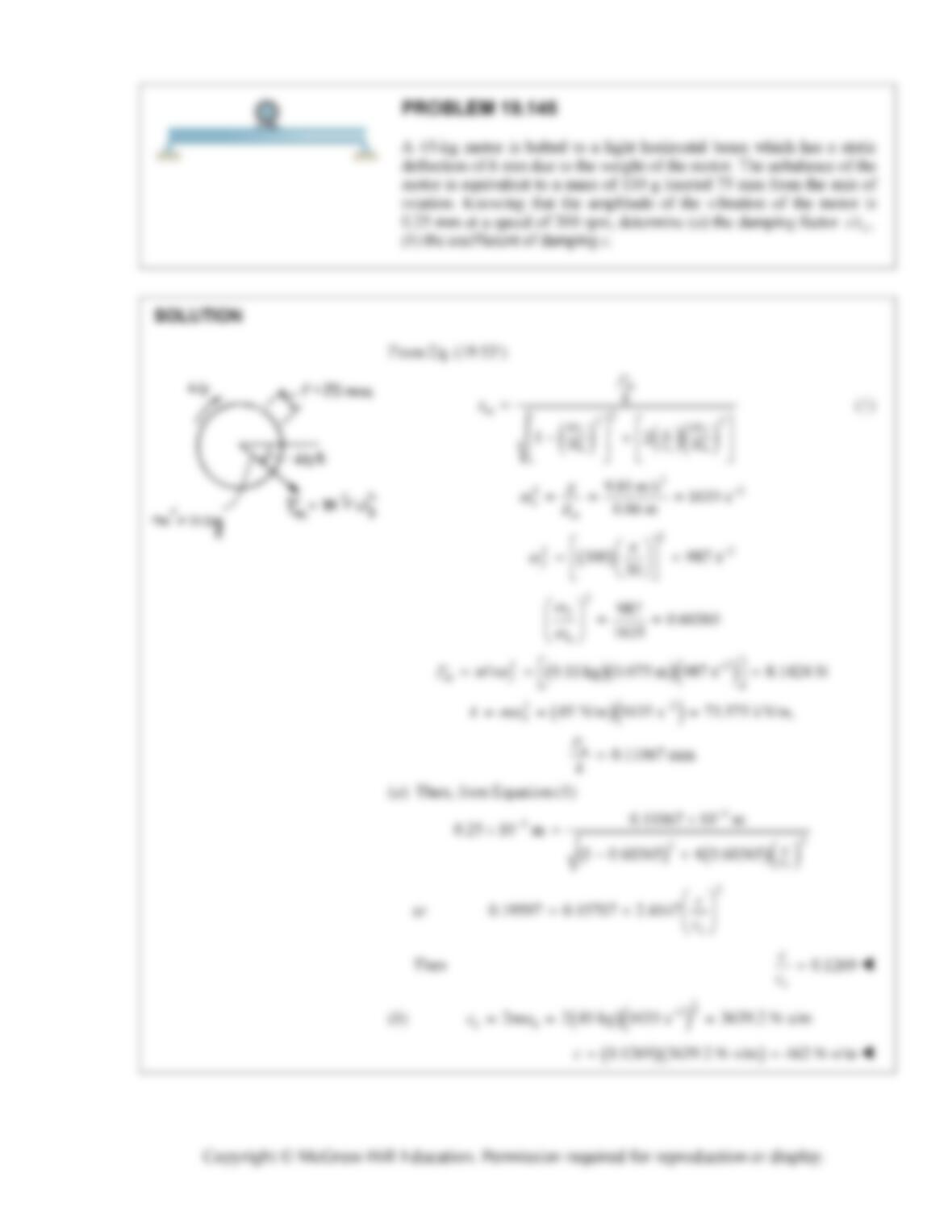
A 36-lb motor is bolted to a light horizontal beam which has a static
deflection of 0.075 in. due to the weight of the motor. Knowing that the
unbalance of the rotor is equivalent to a weight of 0.64 oz located 6.25
in. from the axis of rotation, determine the amplitude of the vibration of
the motor at a speed of 900 rpm, assuming (a) that no damping is
present, (b) that the damping factor /c
cc is equal to 0.055.
SOLUTION
From Eq. (19.52)
()
()
22
2
m
m
ff
P
x
km c
ωω
=
−+
2
22
2
900 rad/s 8882.6 s
60
f
π
ω
−
⎡⎤
⎛⎞
==
⎜⎟⎢⎥
⎝⎠
⎣⎦
36 lb 480 lb/in. 5760 lb/ft
0.075 in.
st
W
k
δ
== = =
(
)
()
22
2
0.64 6.25
16 lb ft 8882.6 s
12
32.2 ft/s
mf
Pmr
ω
−
⎛⎞
′
== ⎜⎟
⎝⎠
5.7470 lb
=
(a) 0c=
()
()
2
2
5.747 lb
36 lb
5760 lb/ft 8882.6 s
32.2 ft/s
m
x−
=
⎡
⎤
−
⎢
⎥
⎣
⎦
5.747 lb
4170.9 lb/ft
=−
0.0013779 ft
=
−
0.01653 in.
m
x=
(out of phase)
(b)
()
2
36 lb
2 2 5760 lb/ft 160.496 lb s/ft
32.2 ft/s
c
ckm ⎛⎞
=
==⋅
⎜⎟
⎝⎠
(
)
0.055 160.496 lb s/ft 8.8273 lb s/ftc
=
⋅= ⋅
0.0013513 ft
m
x=
0.01622 in.
m
x=
Copyright © McGraw-Hill Education. Permission required for reproduction or display.
PROBLEM 19.145
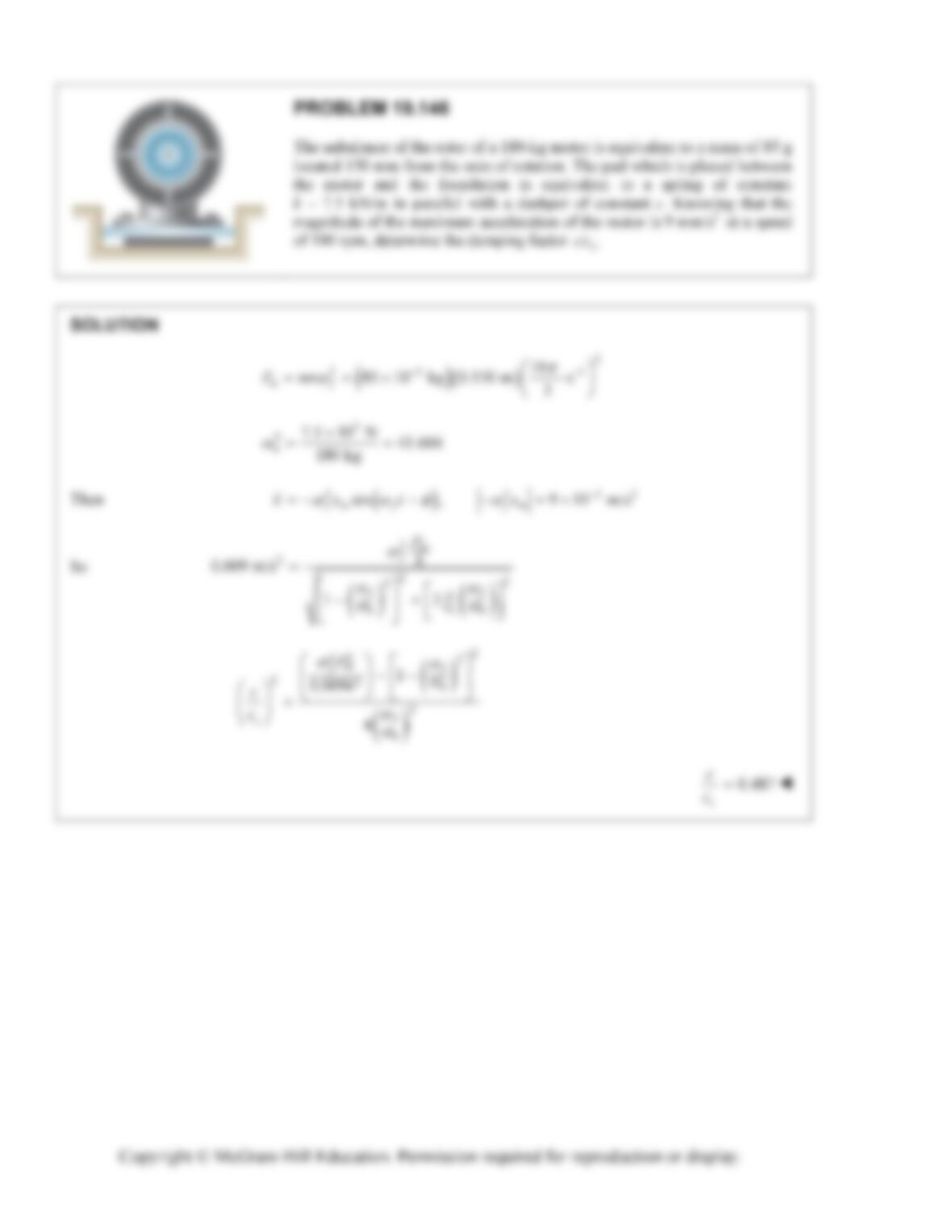
A 45-kg motor is bolted to a light horizontal beam which has a static
deflection of 6 mm due to the weight of the motor. The unbalance of the
motor is equivalent to a mass of 110 g located 75 mm from the axis of
rotation. Knowing that the amplitude of the vibration of the motor is
0.25 mm at a speed of 300 rpm, determine (a) the damping factor /,
c
cc
(b) the coefficient of damping c.
SOLUTION
From Eq. (19.53′)
()
()
()
2
22
12
m
ff
ncn
m
P
k
x
c
c
ωω
ωω
=
⎡
⎤⎡ ⎤
−+
⎢
⎥⎢ ⎥
⎣
⎦⎣ ⎦
(1)
2
22
9.81 m/s 1635 s
0.06 m
n
st
g
ωδ
−
== =
()
2
22
300 987 s
30
f
π
ω
−
⎡⎤
⎛⎞
==
⎜⎟⎢⎥
⎝⎠
⎣⎦
2987 0.60365
1635
f
n
ω
ω
⎛⎞
==
⎜⎟
⎝⎠
()( )
()
22
0.11 kg 0.075 m 987 s 8.1424 N
mf
Pmr
ω
−
⎡⎤
′
== =
⎣⎦
()
(
)
22
45 N/m 1635 s 73.575 kN/m,
n
km
ω
−
== =
0.11067 mm
m
P
k=
(a) Then, from Equation (1)
()()
()
3
3
2
2
0.11067 10 m
0.25 10 m
1 0.60365 4 0.60365 c
c
c
−
−×
×=
−+
or
2
0.19597 0.15707 2.4147
c
c
c
⎛⎞
=+
⎜⎟
⎝⎠
Then 0.1269
c
c
c=
(b)
()
()
1
2
2
2 2 45 kg 1635 s 3639.2 N s/m
cn
cm
ω
−
=
==⋅
(
)
(
)
0.1269 3639.2 N s/m 462 N s/mc
=
⋅= ⋅
Copyright © McGraw-Hill Education. Permission required for reproduction or display.
PROBLEM 19.146
The unbalance of the rotor of a 180-kg motor is equivalent to a mass of 85 g
located 150 mm from the axis of rotation. The pad which is placed between
the motor and the foundation is equivalent to a spring of constant
k = 7.5 kN/m in parallel with a dashpot of constant c. Knowing that the
magnitude of the maximum acceleration of the motor is 9 mm/s2 at a speed
of 100 rpm, determine the damping factor /.
c
cc
SOLUTION
()
()
2
23 1
10
85 10 kg 0.150 m s
3
mf
Pmr
π
ω
−−
⎛⎞
==× ⎜⎟
⎝⎠
3
27.5 10 N 41.666
180 kg
n
ω
×
==
Then
(
)
2232
sin , 9 10 m/s
fm f fm
xx t x
ωωφ ω
−
=− − − = ×
So
() ()
2
2
22
2
0.009 m/s
12
m
ff
ncn
f
P
k
c
c
ω
ωω
ωω
=
⎡⎤
⎡
⎤
−+
⎢⎥
⎢
⎥
⎣
⎦
⎣⎦
()
()
42
2
2
2
2
2
1
0.009
4
m
ff
n
f
n
c
P
k
c
c
ωω
ω
ω
ω
⎛⎞
⎡
⎤
−−
⎜⎟
⎢
⎥
⎜⎟
⎛⎞
⎣
⎦
⎝⎠
=
⎜⎟
⎝⎠
0.487=
c
c
c
Copyright © McGraw-Hill Education. Permission required for reproduction or display.
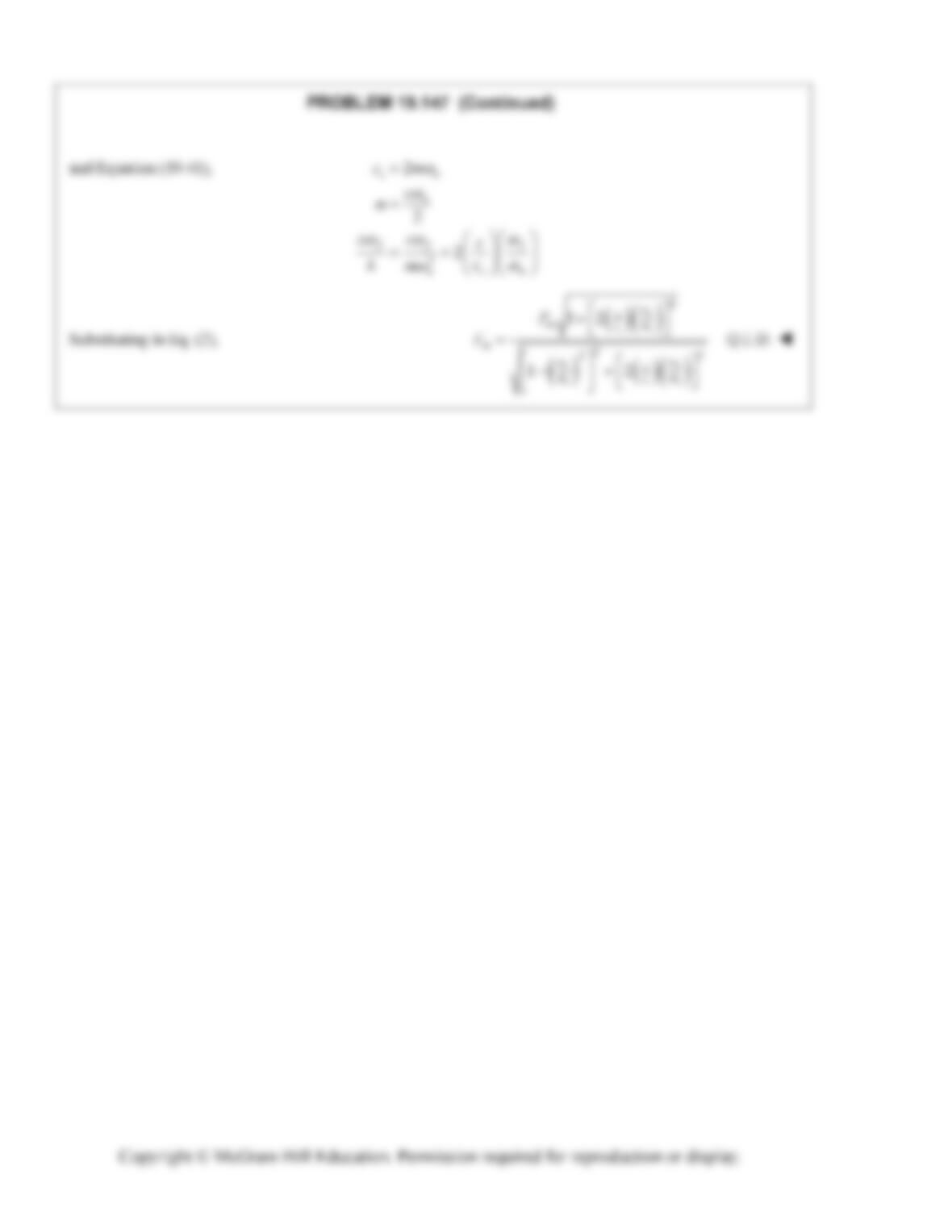
PROBLEM 19.147
A machine element is supported by springs and is connected to a dashpot as
shown. Show that if a periodic force of magnitude P = Pm sin
ω
ft is applied to
the element, the amplitude of the fluctuating force transmitted to the foundation is
()
()
()
()
()
2
22
22
12
12
f
cn
ff
ncn
c
c
mm
c
c
FP
ω
ω
ωω
ωω
⎡⎤
+⎢⎥
⎣⎦
=
⎡
⎤⎡ ⎤
−+
⎢
⎥⎢ ⎥
⎣
⎦⎣ ⎦
SOLUTION
From Equation (19.48), the motion of the machine is sin( )
mf
xx t
ω
φ
=
−
The force transmitted to the foundation is
Springs: sin( )
smf
Fkxkx t
ω
φ
=
=−
Dashpot: cos( )
[sin( ) cos( )]
dmff
tm f f f
Fcxcx t
Fxk t c t
ωωφ
ω
φω ωφ
== −
=−+−
or recalling the identity,
22
22
22
22
sin cos sin( )
sin
cos
sin( )
()
tf
mf
AyB y AB y
B
AB
A
AB
Ft
xk c
ψ
ψ
ψ
ω
φψ
ω
+=+ +
=+
=+
⎡⎤
=
−+
+
⎣⎦
Thus, the amplitude of t
F
is 22
()
mm f
Fxk c
ω
=+ (1)
From Equation (19.53):
()
()
22
2
12
m
ff
ncn
P
k
m
c
c
x
ωω
ωω
=
⎡⎤
⎡
⎤
−+
⎢⎥
⎢
⎥
⎣
⎦
⎣⎦
Substituting for m
x
in Equation (1),
()
()
()
()
2
2
2
2
2
1
12
f
ff
nc
n
c
mk
m
c
c
n
P
F
k
m
ω
ωω
ωω
ω
+
=
⎡⎤
⎡
⎤
−+
⎢⎥
⎢
⎥
⎣
⎦
⎣⎦
=
(2)
Copyright © McGraw-Hill Education. Permission required for reproduction or display.
PROBLEM 19.147 (Continued)
and Equation (19.41),
2
2
2
2
cn
n
f
ff
cn
n
cm
c
m
cc c
kc
m
ω
ω
ωω ω
ω
ω
=
=
⎛⎞
⎛⎞
== ⎜⎟
⎜⎟
⎝⎠
⎝⎠
Substituting in Eq. (2),
()
()
()
()
()
2
22
2
12
Q.E.D.
12
f
cn
ff
ncn
c
mc
m
c
c
P
F
ω
ω
ωω
ωω
⎡⎤
+⎢⎥
⎣⎦
=
⎡⎤
⎡⎤
−+
⎢⎥
⎢⎥
⎣⎦
⎣⎦